



Abstrak
Tin mining primarily relies on cassiterite (SnO₂), which accounts for most industrial tin production. While pemisahan gravitasi is the dominant beneficiation method due to cassiterite’s high density (6.4–7.1 g/cm³), its brittle nature leads to significant slime formation during crushing and grinding. Consequently, flotasi becomes essential for recovering fine-grained cassiterite from re-election tailings and slimes. This article explores cassiterite flotation techniques, including optimal collectors, pH control, and environmental considerations in modern practices.
The Necessity of Cassiterite Flotation
Challenges in Cassiterite Beneficiation
- Natural Brittleness – Cassiterite readily forms slimes (<0.04 mm) during mining and processing, rendering gravity separation inefficient for fine particles.
- Complex Ore Compositions – Tin ores often contain sulfide minerals (e.g., pyrrhotite, arsenopyrite) and silicate gangue, requiring selective separation.
- Economic & Environmental Drivers – Flotation recovers tin from low-grade tailings (0.3–1.5% Sn), reducing waste and improving resource utilization.
Key Flotation Parameters
1. Collectors
Various fatty acids and their soaps easily capture cassiterite. Therefore, collectors can use oleic acid, tar oil, oxidized white wax soap, nylon 1010 bottom, alkyl sulfate, alkyl sulfonate, sulfosuccinate, etc. Experimental studies have shown that cassiterite flotation with formazan, benzylic acid, and ethylene sometimes yields better results.
2. pH Optimization
- Asam oleat: nilai pH umumnya sekitar 9,0 ~ 9,5.
- A: The pH value of the rough selection is generally 5~6, and it can reduce the pH value of the selected one to 2.5~4.0.
- When adjusting the pH of pulp, chemicals such as sodium carbonate and sulfuric acid are often used.
- During cassiterite flotation, to suppress the associated silicate ore, calcium magnesium ore, and wolframite, water glass, sodium hexametaphosphate, carboxymethyl cellulose, and oxalic acid.
3. Feed Preparation
- Pre-remove ultrafines (<0.01 mm) to reduce reagent consumption. The flotation material is generally gravity tailings less than 0.04mm, and the sludge less than 0.01mm is removed first.
- Desulfurize sulfide-rich ores sebelum tin flotation to avoid concentrate contamination. If the flotation ore is vein tin ore, it is often accompanied by sulfide deposits of iron, arsenic, antimony, lead, copper, zinc, and other metals. At this moment, it should first use the sulfide deposit activator to separate the sulfide deposit. Then, flotation of cassiterite to avoid sulfide contamination of the cassiterite concentrate.
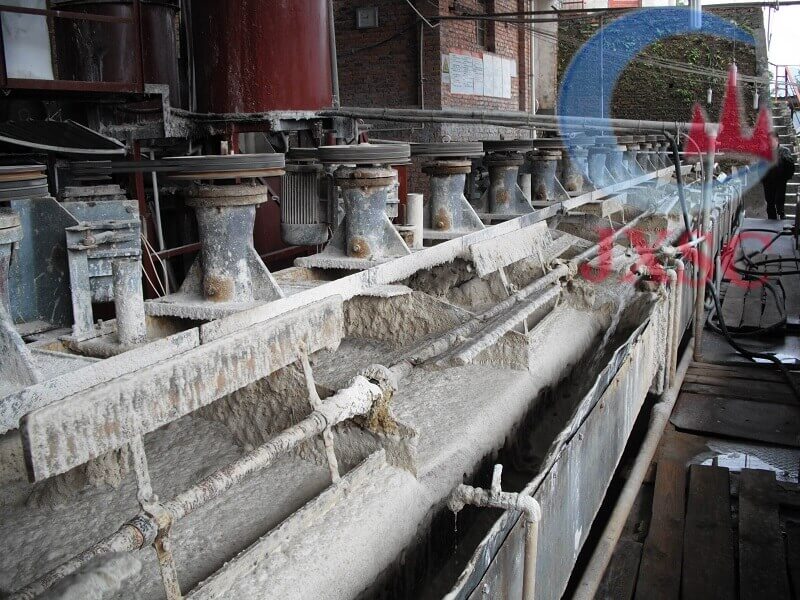
Pabrik Flotasi Kasiterit
The raw ore of tin ore is a high and medium-temperature hydrothermal cassiterite sulfide deposit. The composition of mineral deposits is messy. Metal deposits include pyrrhotite, magnetite, arsenopyrite, bismuthite, galena, sphalerite, chalcopyrite, etc. Non-metal deposits include carbonate, silicic acid, etc., salts, and halides. Cassiterite is yellowish-brown and black and is embedded in fine particles. Most of it is embedded in pyrrhotite in powder form, and a small part is scattered in magnetite and skarn deposits in granular form. The largest grain is 0.55mm, and the smallest is 0.002mm, generally between 0.15~0.02mm.
The feed of cassiterite flotation is the tailings after desulfurization, iron removal, and shaking table processing. The tailings of the meja goyang masukkan pengental untuk dehidrasi dan pergi ke mesin sentrifugal. Konsentrat centrifuge kemudian habis oleh pengental dan kemudian dimasukkan ke dalam tangki pencampuran untuk menambahkan obat dan pembuatan pulp. Menggunakan asam salisilat sebagai pengumpul, natrium karbonat untuk mengatur nilai pH pulp menjadi 7~8, getah murbei sebagai depresan, dan minyak No. 2 sebagai bahan pembusa. Pilih konsentrat timah melalui sapuan kasar pertama, sapuan kedua, sapuan halus ketiga, dan sapuan halus pertama. Bijih mentah mengandung timah 1.0% 6 ~ 1.3%, kadar konsentrat flotasi adalah 1.3% ~ 16%, dan tingkat pemulihannya adalah 72% ~ 72%.
The practice has shown that low-toxic salicylic enteric acid can completely replace the highly toxic swollen acid, significantly reducing the environmental pollution problems in the production and use of pharmaceuticals.
The flotation function for tin extraction from tin sludge and smelting slag: it has excellent collection and selectivity. It can replace the traditional medicament benzyl swollen acid for tin selection, overcoming the defects of benzylic swollen acid, such as preciousness and high toxicity.
Dosis yang diusulkan: Pengumpanan 400-800 g/ton
Metode pembuatannya adalah a 2-5% aqueous solution (weight ratio), dissolved with 40C warm water.
Lingkup aplikasi: Lumpur timah dan terak peleburan bermutu rendah, yang dapat menghasilkan 1,5% timah pada suhu kamar (suhu minimum 5°C) untuk memilih lebih dari 40% bubuk konsentrat timah, dengan tingkat pemulihan lebih dari 70%.
Fungsi perlindungan lingkungan: Agen ini memiliki tingkat toksisitas yang rendah, ramah terhadap manusia dan lingkungan, serta mudah terurai.
Fitur Produk
- Properti: Produk ini berupa padatan tepung berwarna merah muda hingga oranye-merah, sedikit larut dalam air, mudah larut dalam larutan alkali, dan stabil.
- New agent for selection efficiency.
- Standar farmasi sederhana, dan biayanya rendah;
- Ramah lingkungan.
Dalam kondisi tertentu, kolektor gabungan memiliki selektivitas yang baik. Produk ini dapat membentuk kelat yang stabil dengan timah, tungstentanah jarang, tembaga, besi, and other metals. And it forms unstable chelates with alkaline earth metals and alkali metals. Therefore, the combination drug used in the flotation operation of some metal deposits can get a good separation effect. A combination of medications with flotation weight can achieve a very excellent result. Generally, the total recovery can reach more than 85%.
Kesimpulan
Cassiterite flotation is indispensable for maximizing tin recovery from fine-grained or complex ores where gravity methods fail. Advances in collector chemistry (e.g., eco-friendly chelating agents) and process optimization have made flotation both economically viable and environmentally sustainable. Future developments may focus on AI-driven reagent dosing and hybrid gravity-flotation circuits to further enhance efficiency.
Key Takeaway: Flotation transforms marginal tin resources into profitable reserves while mitigating mining’s ecological footprint.
PRODUK TERBARU
-

SFM-8 Lab Grinder
【Max. Power Consumption】 150W 【Morta…
-
Cyclosizer
【Feeding Capacity】< 100g/time 【Feeding …
-
JKZ/2JKZ Mine Shaft Sinking Hoist
【Power Source】Electric Motor Drive 【Motor Spee…


 English
  French
  Spanish
  Portuguese
  Indonesian