



Gold prospecting is an exciting outdoor activity that combines adventure with potential treasure hunting. Whether you’re just starting or looking to refine your techniques, two essential tools—the kotak pintu air emas dan panci emas—will help you efficiently recover gold from riverbeds and streams.
1. Gold Sluice Box: High-Volume Gold Recovery
What is a Sluice Box?
A kotak pintu air is a long, narrow channel with built-in riffles that mimics a natural stream bed. It allows prospectors to process much larger volumes of sediment compared to panning alone.
The kotak pintu air emas is an efficient alternative to panning for gold. In spite of the fact that wide affordable varieties are available to purchase, they are even more affordable to build. With a little knowledge, skill, and creativity, a prospector can build a custom sluice box from almost any type of solid material available.
How Does It Work?
- Water & sediment flow over the sluice.
- Gold (dense & heavy) gets trapped in riffles while lighter material washes away.
- Works on the same principle as natural river gold deposits.
The sluice boxes impersonate a stream bed, enabling water and sediment to wash over it and store denser protests along the parts of the stream where the water moves all the more gradually.
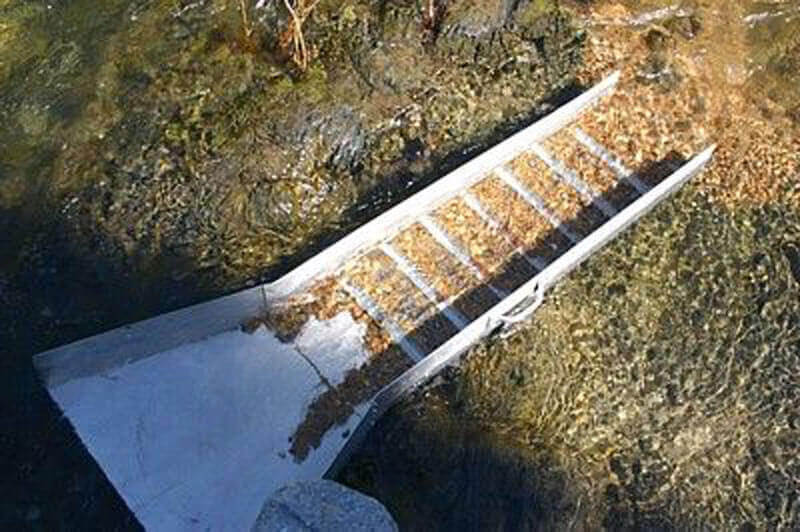
You can imagine a current and flow of water or air moving over a surface. The current slows down when it is compelled to move around or over a question, and this is the place the thick particles settle out of the current.
For instance, when sand or snow is taken away from the ground by wind, the air current slows down when it encounters a fence. The heavier particles are stored, leaving a trail on the contrary side of the fence, while the lighter ones stay in the current. Another illustration is the point at which a current is constrained through a winding way. It will back off when it hits each bend, and the heaviest particles will be kept there, though the lighter ones stay in the current. In view of this idea, one can imagine a variety of sluice box designs.
Types of Sluice Boxes
- Drop Riffle Sluice (best for fine gold trapping).
- Hungarian Riffle Sluice (good for fast water flow).
- Fluid Bed Sluice (excellent for fine flour gold).
How To Make a Sluice Box?
Materials Needed
- Lightweight but sturdy material (e.g., aluminum, wood, or plastic)
- Riffles (metal, rubber mats, or carpet for trapping gold)
- Mesh or expanded metal (optional, for classifying material)
- Posts or heavy rocks (to anchor the box)
- Water source (stream or river with a steady current)
Steps to Build a Sluice Box
- Choose the Right Size
- A sluice box 4–5 feet long is efficient and portable. Longer boxes don’t necessarily improve gold recovery.
- Build the Tray
- Construct a U-shaped or flat-bottomed channel to hold sediment and water flow.
- Aluminum or wood works well, but ensure it’s lightweight yet sturdy.
- Add Riffles or Traps
- Install riffle bars, rubber mats, or miner’s carpet to catch gold as material washes through.
- Place riffles at a slight downward angle (about 5–10 degrees) for optimal flow.
- Set Up a Dumping Area
- Create a feed area (either at the top or beside the box) where you shovel dirt/gravel into the sluice.
- Submerge in Water
- Place the sluice partially underwater in a stream or river to use the natural current.
- Adjust the angle so water flows smoothly through the riffles.
- Anchor Securely
- Gunakan wooden posts or heavy rocks to hold the sluice in place and prevent shifting.
- Test & Adjust
- Run a few test batches of material, checking the riffles for gold.
- Adjust the angle or water flow if needed for better efficiency.
Tips for Success
- Classify material (pre-sift with a mesh screen) to remove large rocks before feeding it into the sluice.
- Black ribbed matting or miner’s moss under riffles helps trap fine gold.
- Clean up regularly to recover gold before it washes out.
2. Gold Pan: The Essential Starter Tool
Panning is a gravity focus strategy that isolates material by contrast in density. Low-density materials spill out of the pan, while high-thickness materials sink to the base of the pan and get captured in the riffles.
Gold panning is the least complex and most seasoned strategy for gold mining, going back to the Roman Empire. Although panning isn’t utilized as an essential technique for gold mining in substantial business tasks, it is still utilized today by miners and even once in a while by metallurgists during preparatory metallurgical testing.
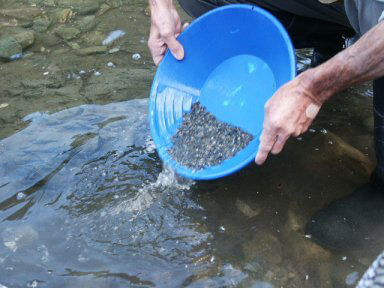
How to Pan for Gold (Step-by-Step)
- Fill your pan halfway with sediment from a gold-bearing area.
- Submerge in water and break up clumps with your fingers.
- Swirl & Shake the pan to let the heavier gold sink.
- Tilt slightly forward to wash away lighter material.
- Repeat until only black sands & gold remain.
- Use a snuffer bottle to extract fine gold flakes.
Pro Tip: Gunakan classifier screen (1/4″ or 1/8” mesh) to pre-filter large rocks before panning!
An essential panning kit regularly incorporates a pengklasifikasi, likewise called a screen or strainer, a pan(s), glass vials, and a suction bottle. It might likewise incorporate a magnifying glass and tweezers. Classifier screen sizes, for the most part, run from coarse (~2mm) to fine (~100um) in the measure. Gold mining pans can be either metal or plastic; however, plastic panners are generally best for learners as they are lighter in weight and their dark and non-intelligent shading makes it less demanding to spot gold pieces. Pan sizes can likewise differ in width. Littler panners are regularly simpler to deal with, while bigger panners can be harder to deal with, as they can hold a substantially bigger volume of material and turn out to be very overwhelming. Gold panners might contain riffles. In any case, riffles are prescribed as they make panning a great deal less demanding by providing a physical hindrance that makes it harder to lose gold while removing lighter materials from the panner.
Kesimpulan
Mastering both gold panning and sluicing will make you a more effective prospector. Start with a basic panning kit (~$20-50), then upgrade to a DIY or store-bought sluice as you gain experience.
PRODUK TERBARU
-

SFM-8 Lab Grinder
【Max. Power Consumption】 150W 【Morta…
-
Cyclosizer
【Feeding Capacity】< 100g/time 【Feeding …
-
JKZ/2JKZ Mine Shaft Sinking Hoist
【Power Source】Electric Motor Drive 【Motor Spee…


 English
  French
  Spanish
  Portuguese
  Indonesian