



Abstract: Grinding circuits play a pivotal role in mineral processing, influencing both cost efficiency and final product quality. This article compares one-stage and two-stage grinding circuits, highlighting their advantages, ideal applications, and configurations. Key factors such as ore characteristics, required fineness, and plant scale determine which grinding layout is optimal for a given operation.
Introduction to Grinding Circuits
After crushing, ore grinding prepares material for downstream separation. The grinding process uses mills (ball, rod, etc.) paired with classifiers to ensure proper particle sizing.
- Classifiers divide ground material into “qualified” (for beneficiation) and “unqualified” (returned for regrinding).
- Depending on process needs, the classification includes:
- Pre-classification (removing fines before grinding)
- Check-classification (controlling final particle size)
- Controlling classification (fine-tuning output)
Produk terkait: mesin penghancur dan penggiling, pabrik batang, pabrik bola, pengumpan & sabuk konveyor, pengklasifikasi partikel.
How to Determine The Grinding Circuit Layout?
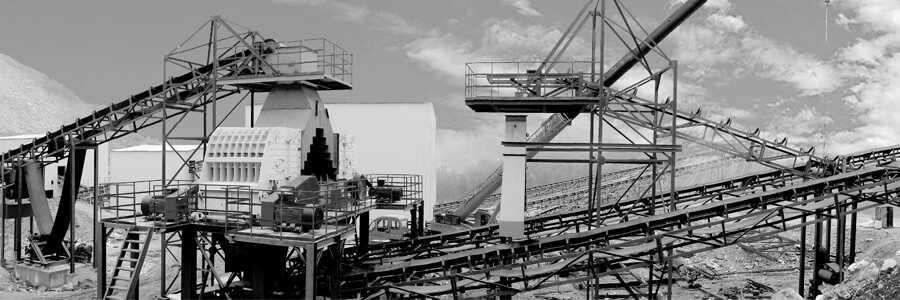
The main factors affecting the determination of the number of grinding sections are: ore grindability, mineral characteristics, feed size, required grinding size, production scale, etc.
The result shows that, for ore beneficiation processing, one or two stages of grinding can achieve the target particle size required for beneficiation; multi-stages are usually determined by the high precision requirement and multi-phase separation.
What is a One-stage & Two-stage Grinding Circuit?
1. One-stage Grinding Circuits
Compared with the two-stage grinding process, the main advantages of a one-stage grinding process are less equipment, low investment, simple operation, and short downtime. However, the one-stage grinding mill has a wider range of grain size, which makes it difficult to obtain a fine final product.
Kapan sebaiknya menggunakan penggerindaan satu tahap?
- The maximum particle size of the final product is 0.2 ~ 0.15mm ( -200 mesh 60% to 79%);
- Pabrik pemrosesan kecil, untuk menyederhanakan konfigurasi peralatan dan menghemat biaya, kehalusan yang diperlukan adalah -200mesh 80%.
Tata letak dan konfigurasi
Generally, a grinding machine working with the classifier, three common one-stage grinding process circuit as follows.
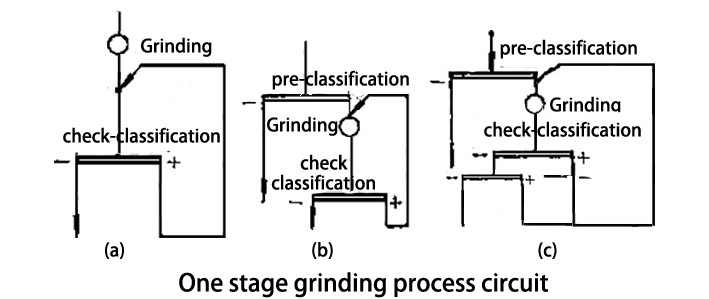
One-stage grading process with checking grading operation is the most widely used. The ore is directly fed into the grinding machine, and the optimum particle size for the ore is generally 6-20 mm. Particle checking classifier separates the ground material into qualified products and unqualified products; the unqualified materials are sent back to the grinding mill.
Jika bijih mengandung sejumlah besar bijih berkualitas halus, dan perlu untuk memisahkan terlebih dahulu garam-garam terlarut yang terkandung di dalam bijih mentah, maka proses penggilingan satu tahap dengan pra-penilaian dan pengecekan klasifikasi harus dilakukan.
The purpose of pre-separation is to remove the qualified fine-sized ore, thereby increasing the efficiency of the grinder, and also separating the ore slime for convenient subsequent processing.
Pre-grading is generally performed by mechanical means. To prevent serious mechanical wear, the grain size of the ore should not exceed 6 ~ 7 mm, and the qualified grain size should not be less than 14 ~ 15%.
One-stage grinding with controlling grade process can obtain the fine-size product. Compared with the two-stage grinding process, the main feature is that the one-stage process needs only one grinding machine, which is suited for pabrik pengolahan kecil.
2. Two-stage Grinding Circuits
The outstanding advantage of the two-stage grinding process is that coarse grinding and fine grinding can be carried out separately in different grinding sections. During coarse grinding, loading of larger steel balls and higher speed are beneficial to improve grinding efficiency; during fine grinding, loading of smaller steel balls and lower speed also improve the grinding efficiency.
Another great advantage of the two-stage grinding process is that it is suitable for stage sorting separation. When dealing with unevenly embedded ore and ore containing large specific gravity minerals, the sorting operation can be used in the grinding cycle to sort out the separated minerals in time to prevent over-grinding and improve the quality of the mineral; at the same time, it can reduce the accumulation of heavy metal minerals in the graded return sand, and can improve the classification efficiency of the classifier.
When to adopt two-stage grinding?
For medium and large-scale mineral processing plants, two stages grinding to be economical when the grinding fineness is less than 0.15mm.
Tata letak dan konfigurasi
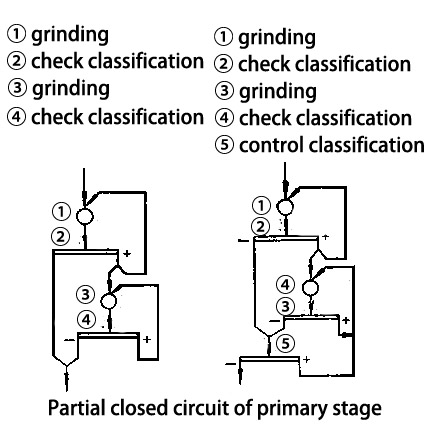
Generally, adopt a two-stage grinding process to obtain finer grinding products, and separate mineral particles more accurately. The primary classifier in the first stage selects the ore concentrate; the rest of the ground product, namely middling and tailings, then enter the secondary grinding mill.
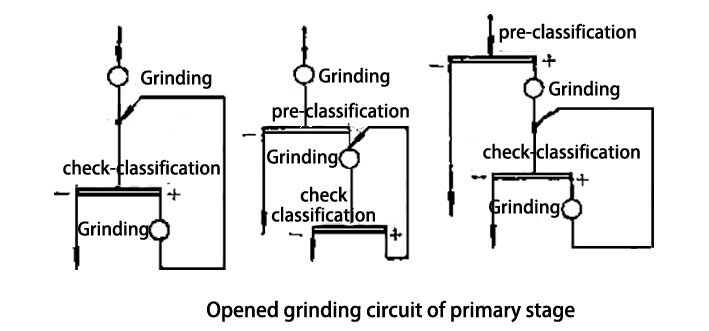
According to the different layout of the primary grinder and pengklasifikasi, yang two-stage grinding process can be divided into three modes: opened grinding circuit of the primary stage, closed-circuit of the primary stage, and partially closed circuit of the primary stage.
(1) Membuka sirkuit penggilingan tahap utama
There are three common designs of opened grinding circuits of the primary stage, usually used in large-scale mining plants.
(2) Sirkuit tertutup pada tahap utama
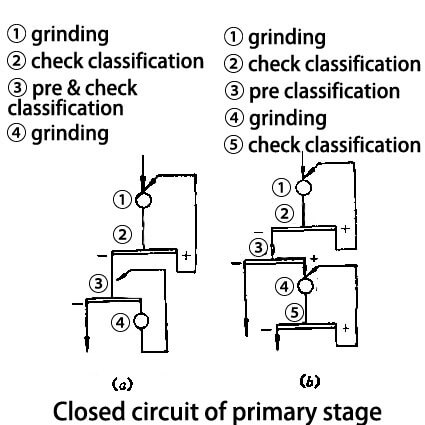
Usually used to process fine hard ore, especially suited for large-scale plants that require a grinding fineness of less than 0.15mm.
Properly arranging the loads of the first and second stages of the mill is important to maximize the processing efficiency. The reasonable distribution of the load between the two grinding sections can be achieved by controlling the overflow particle size of the first stage classifier.
(3) Sirkuit tertutup sebagian dari tahap primer
Keuntungan: no need for thinking about the load distribution of each grinding stage; avoid the gathering of precious metals in the grinding cycle.
Ringkasan
The grinding stage follows ore crushing and significantly impacts downstream beneficiation. The choice between single-stage and multi-stage grinding depends on:
- Ore properties (grindability, mineral liberation size, embedded texture)
- Target particle size (coarse or ultra-fine grinding)
- Plant capacity (small-scale vs. large-scale operations)
Here’s a clear comparison table for One-Stage vs. Two-Stage Grinding:
| Factor | One-Stage Grinding | Two-Stage Grinding |
|---|---|---|
| Kompleksitas Proses | Simple (single grinding circuit) | Complex (multiple grinding-classification loops) |
| Cost Efficiency | Lower capital & operating costs | Higher initial investment but potential energy savings |
| Particle Size Output | Coarser (typically ≥0.15–0.20 mm) | Finer (<0.15 mm; better for ultrafine liberation) |
| Ore Suitability | Uniform mineral distribution, soft-to-medium hardness | Uneven mineral texture, hard-to-grind ores |
| Classification Setup | Pre-classification (remove fines) or check-classification (control oversize) | Intermediate classification between stages |
| Over-Grinding Risk | Higher (limited particle size control) | Lower (staged separation reduces over-grinding) |
| Plant Scale | Ideal for small-to-medium capacity | Preferred for large-scale operations |
| Efisiensi Energi | Less efficient for fine grinding (higher energy/ton) | Optimized energy use per size fraction |
| Flexibility | Limited adjustment range | Adaptable to variable ore properties |
| Aplikasi | Small plants, coarse liberation (e.g., gold CIP) | Complex ores requiring fine liberation (e.g., copper porphyry) |
Key Takeaways
- Choose one-stage for simplicity, cost savings, and coarse grinding.
- Opt for two-stage for fine liberation, complex ores, and large-scale efficiency.
PRODUK TERBARU
-

Cyclosizer
【Feeding Capacity】< 100g/time 【Feeding …
-
JKZ/2JKZ Mine Shaft Sinking Hoist
【Power Source】Electric Motor Drive 【Motor Spee…
-
JK(B)/2JK(B) Mine Hoisting Winch
【Capacity】 6-17 Tons 【Drum Number】1-2 【…


 English
  French
  Spanish
  Portuguese
  Indonesian