



Pendahuluan
Ball mill parameter selection is crucial for achieving optimal grinding efficiency and production capacity in mineral processing operations. This comprehensive guide explores key calculations for determining mill capacity, power consumption, rotational speed, and steel ball loading—all essential factors that influence operational performance. By understanding these parameters and their interdependencies, engineers can optimize grinding processes to enhance productivity while minimizing energy costs. The following sections provide detailed methodologies and reference tables for practical implementation.
1. Calculation of Ball Mill Capacity
The production capacity of the ball mill is determined by the amount of material required to be ground, and it must have a certain margin when designing and selecting. There are many factors affecting the production capacity of the pabrik bola, in addition to the nature of the material (grain size, hardness, density, temperature and humidity), the degree of grinding (product size), the uniformity of the feeding material, the portion of loadeddan the mill structure (the mill barrel length, diameter ratio, the number of bins, the shape of the partition plate and the lining plate).
Secara teoritis sulit untuk menentukan produktivitas pabrik. Kapasitas produksi pabrik penggilingan umumnya dihitung berdasarkan bijih serbuk yang baru dihasilkan dengan ukuran kurang dari 0,074 mm (-200 mesh).
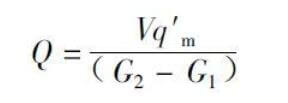
V - Volume efektif ball mill, m3;
G2 - Material yang kurang dari 0,074 mm dalam produk menyumbang persentase total material, %;
G1 - Material yang kurang dari 0,074 mm dalam pengumpanan bijih menyumbang 0,074 mm dalam persentase total material, %;
q'm - Unit produktivitas yang dihitung berdasarkan grade generasi baru (0,074mm), t/(m3.jam).
Nilai q'm ditentukan melalui eksperimen atau dikalibrasi dalam produksi dengan sifat fisik bijih yang serupa dan peralatan serta kondisi kerja yang sama. Jika tidak ada data uji dan nilai kalibrasi produksi, maka dapat dihitung dengan rumus (1-3).

Di1- Diameter gilingan standar, m;
K’4 — feed size and product size coefficient of the mill.

G3 G4 — The production capacity of existing or experimental mills with newly designed parameters (feed size or product size calculated according to the new generation 0.074mm level) is shown in Table 1-6.
The values of G1 and G2 above should be calculated according to actual data. If there is no actual data, they can be selected according to Tables 1-7 and 1-8.
Tabel 1-4 Koefisien Kesulitan Penggilingan Bijih (K'1)
| Kekerasan bijih | Kesulitan Penggilingan Bijih Koefisien (K'1) |
Kekerasan bijih | Kesulitan Penggilingan Bijih Koefisien (K'1) |
||
| Protodyakonov koefisien |
Tingkat kekerasan | Protodyakonov koefisien |
Tingkat kekerasan | ||
| <2 | sangat lembut | 1.4-2.0 | 8-10 | keras | 0.75-0.85 |
| 2-4 | lembut | 1.25-1.5 | >10 | sangat keras | 0.5-0.7 |
| 4-8 | sedang | 1.0 | |||
Tabel 1-5 Koefisien Koreksi Penggilingan (K'2)
| Jenis pabrik | Pabrik bola parut | Pabrik bola melimpah | Pabrik batang |
| K'2 | 1.0 | 0.9 | 0.85 |
Tabel 1-6 Kapasitas produksi relatif dari ukuran pakan dan ukuran produk (G3 atau G4)
| Ukuran pemberian makan /mm |
Product Size/mm | |||||
| 0.4 | 0.3 | 0.2 | 0.15 | 0.10 | 0.074 | |
| Isi -0,074mm (%) | ||||||
| 40 | 48 | 60 | 72 | 85 | 95 | |
| 40-0 | 0.77 | 0.81 | 0.83 | 0.81 | 0.80 | 0.78 |
| Ukuran pemberian makan /mm |
Product Size/mm | |||||
| 0.4 | 0.3 | 0.2 | 0.15 | 0.10 | 0.074 | |
| Isi -0,074mm (%) | ||||||
| 40 | 48 | 60 | 72 | 85 | 95 | |
| 0.77 | 0.81 | 0.83 | 0.81 | 0.80 | 0.78 | |
| 20-0 | 0.89 | 0.92 | 0.92 | 0.88 | 0.86 | 0.82 |
| 10-0 | 1.02 | 1.03 | 1.00 | 0.93 | 0.90 | 0.85 |
| 5-0 | 1.15 | 1.13 | 1.05 | 0.95 | 0.91 | 0.85 |
| 3-0 | 1.19 | 1.16 | 1.06 | 0.95 | 0.91 | 0.85 |
Tabel 1-7 Ukuran partikel produk yang dihancurkan dan nilai G1 dengan kadar kadar 0,074 mm
| Viskositas bijih yang dihancurkan | 40-0 | 20-0 | 10-0 | 5-0 | 3-0 | |
| Kelas 0.074mm konten G1 (%) |
Bijih tahan api | 2 | 5 | 8 | 10 | 15 |
| Bijih tahan api sedang | 3 | 6 | 10 | 15 | 23 | |
| bijih yang mudah dihancurkan | 5 | 8 | 15 | 20 | 25 | |
2. Perhitungan Daya, Kecepatan dan Media Pemuatan Ball Mill
2.1 Perhitungan daya

G' - jumlah media pemuatan dan material, T;
Dm - diameter bagian dalam efektif dari barel gilingan, m;
K’5 — grinding medium coefficient, check table 1-9.
Tabel 1-9 Koefisien Media Gerinda K' 5
| Tipe sedang | Laju pengisian | 0.1 | 0.2 | 0.3 | 0.4 | 0.5 |
| Batu silika | 13.3 | 12.25 | 11.0 | 9.5 | 7.8 |
| Bola baja besar | 11.9 | 11.0 | 9.9 | 8.5 | 7.0 |
| bola baja kecil | 11.5 | 10.6 | 9.5 | 8.2 | 6.8 |
When the filling rate of the grinding medium is less than 35% in a dry grinding operation, the power can be calculated by formula (1-7).

n - kecepatan gilingan, r/menit;
G" - Total media gerinda, T;
η - Efisiensi mekanis, bila penggerak tengah, η = 0,92-0,94; bila penggerak tepi, η = 0,86-0,90.
2.2 Perhitungan Kecepatan Rotasi Ball Mill
Kecepatan Kritis
Ketika silinder ball mill diputar, tidak ada selip relatif antara media penggilingan dan dinding silinder, dan itu hanya mulai berjalan dalam keadaan rotasi dengan silinder pabrik. Kecepatan sesaat dari gilingan ini adalah sebagai berikut:
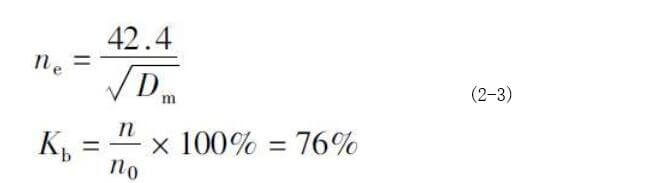
N0 - kecepatan kerja gilingan, r/menit;
K'b - rasio kecepatan, %.
There are many layers of grinding media in the mill barrel. It is assumed that the media will be concentrated in one layer, called the “polycondensation layer”, so that the grinding media of this layer will be at the maximum drop, i.e., the calculating speed of the mill when the total impact energy is the largest nj.
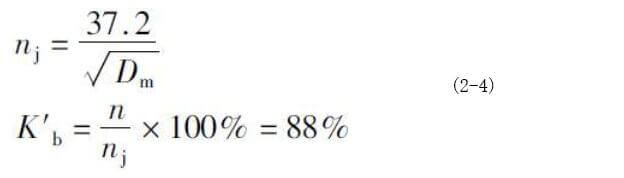
Oleh karena itu, secara teoretis disimpulkan bahwa kecepatan kerja yang wajar adalah

The working speeds of various mills are shown in Table 1-10.
Tabel 1-10 Kecepatan kerja dari berbagai pabrik
| Jenis pabrik | Pabrik bola | Pabrik batang | Pabrik tabung |
| Kecepatan kerja n0 | (0,76-0,88) nj | (0,65-0,70) nj | (0,68-0,76) nj |
In production practice, there are many factors affecting the motion state of grinding media. Therefore, the appropriate working speed should be selected according to the actual situation. In determining the actual working speed of the mill, the influences of the mill specifications, production methods, liner forms, grinding media types, filling rate, physical and chemical properties of the ground materials, particle size of the grinding materials, and grinding fineness of the products should be taken into account. The actual working speed of the mill should be determined by scientific experiments, which can reflect the influence of these factors more comprehensively.
2.3 Quantity of Loading Medium
Kapasitas pemuatan bola
The volume of the grinding medium is the percentage of the effective volume of the mill, which is called the filling rate of the grinding medium. The size of the filling directly affects the number of shocks, the area of grinding, and the load of the grinding medium in the grinding process. At the same time, it also affects the height of the grinding medium itself, the impact on the material, and the power consumption.
Kapasitas pemuatan bola dari gilingan dapat dihitung menurut rumus (1-14).

Gra - Jumlah Media Penggilingan, T.
Rho
s — loose density of grinding medium, t/m3.
Forged steel balls; P=s=4.5-4.8t/m3
cast steel balls P=4.3-4.6t/m3;
rolling steel balls P=6.0-6.8t/m3;
steel segments P=4.3-4.6t/m3
Filling Ratio of The Grinding Medium
When wet grinding: lattice ball mill pi = 40% – 45%; overflow ball mill phi = 40%; rod mill phi = 35%.
Dry grinding: When material is mixed between grinding media, the grinding medium expands, and when dry grinding is adopted, the material fluidity is relatively poor, and the material flow is hindered by the abrasive medium, so the filling rate is low, and the filling rate is between 28% and 35%. The pipe mill is 25%-35%. The void fraction of grinding medium_k=0.38-0.42 and the quality of crushed material accounts for about 14% of the quality of grinding medium.
Ukuran dan Proporsi Media Gerinda
In the ball mill, the size and proportion of steel balls have a great influence on the productivity and working efficiency of the mill. For coarse and hard materials, larger steel balls should be selected; for fine and brittle materials, with smaller diameter steel balls, the impact times of steel balls in the mill increase with the decrease of ball diameter, and the grinding between balls increases. The clearance is dense with a decrease in spherical diameter. Therefore, it is better to choose the ball with a larger mass and smaller diameter (lower density) as the grinding medium. The size of the ball mainly depends on the particle size of the material to be ground, and the diameter and speed of the mill can be considered appropriately. Formula (1-15) is an empirical formula for spherical diameter and feed size.

dmax — The maximum diameter of the steel ball, mm;
amax - ukuran maksimum perincian pengumpanan, mm.
After calculating the maximum steel ball diameter, the steel ball ratio in the mill can be calculated with reference to Fig. 2-1 (suitable for cement mill; other mills can refer to).
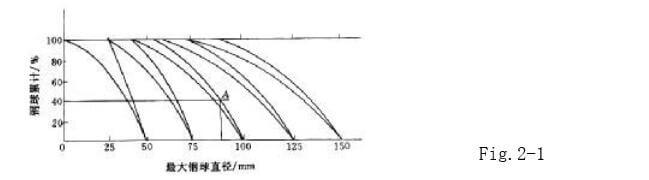
Setelah memilih diameter maksimum dan diameter minimum bola baja sesuai dengan persyaratan teknologi, sifat material, spesifikasi pabrik dan berbagai parameter, dan kemudian mencocokkan kelas, menggunakan kurva, persentase akumulatif massa dari setiap bola baja yang sesuai yang dimuat ke dalam gilingan dapat ditemukan, persentase massa yang sebenarnya dapat dihitung, dan kualitas pemuatan bola baja di semua tingkatan dapat diperoleh.
According to the production practice of production enterprises, the relationship between ball diameter and material size is shown in Table 1-11.
Steel balls are gradually worn out in the process of grinding materials. The wear of a drop steel ball is related to its impact force. The wear of grinding steel balls is related to the surface area of the steel balls. In general, the steel ball in the grinder has both impact and abrasion effects, so the wear is proportional to the n power of the diameter of the steel ball, and the value of n is between 2 and 3.
Tabel 1-11 Hubungan antara Diameter Bola Baja dan Ukuran Material
| Diameter bola baja db/mm |
120 | 100 | 90 | 80 | 70 | 60 | 50 | 40 |
| Ukuran pemberian makan /mm |
12-20 | 10-12 | 8-10 | 5-8 | 2.5-6 | 1.2-4 | 0.6-2 | 0.3-1 |
The quality and surface area of forged steel balls of various sizes are shown in Table 1-12.
Karena keausan bola baja dalam proses produksi gilingan, untuk menjaga kestabilan gilingan. Bola baja perlu ditambahkan secara teratur.
Diameter maksimum bola baja tambahan masih ditentukan oleh metode yang disebutkan di atas. Selain penambahan bola baja tambahan, beberapa bola baja berdiameter lebih kecil harus ditambahkan sesuai dengan pengalaman produksi.
Table 1-12: Quality and Surface Area of Steel Balls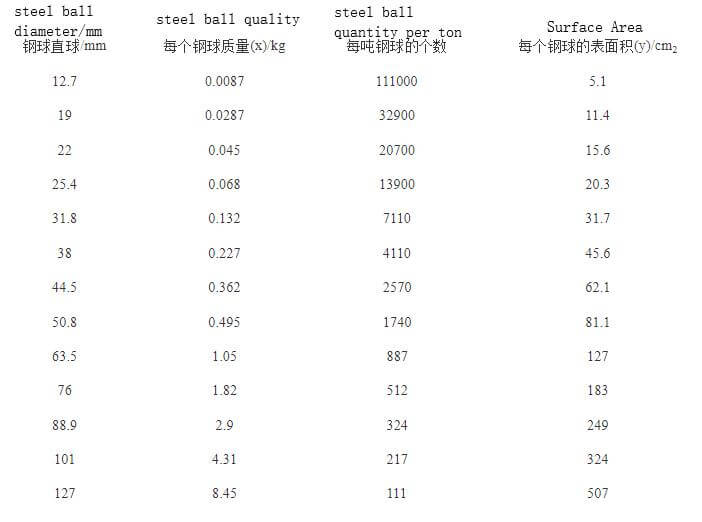
Kesimpulan
Proper selection of ball mill parameters requires balancing theoretical principles with practical adjustments based on material properties and operational conditions. Regular monitoring of steel ball wear, mill speed, and power draw ensures sustained efficiency. By leveraging the calculations and reference data provided in this guide, operators can tailor grinding processes to their specific needs, ultimately improving throughput and reducing operational costs. For further optimization, always validate theoretical models with real-world performance metrics and adjust parameters iteratively.
JXSC has supplied ball mill, rod mills for 40+ years. Contact us for a quotation.
Produk panasrahang crusher, impact crusher, cone crusher, ball mill, shaker table, pemisah sentrifugal, jig, pemisah magnetik, flotasi, trommel emas, trommel scrubber, pabrik pencucian emas, dan sebagainya.
PRODUK TERBARU
-

SFM-8 Lab Grinder
【Max. Power Consumption】 150W 【Morta…
-
Cyclosizer
【Feeding Capacity】< 100g/time 【Feeding …
-
JKZ/2JKZ Mine Shaft Sinking Hoist
【Power Source】Electric Motor Drive 【Motor Spee…


 English
  French
  Spanish
  Portuguese
  Indonesian