



Pendahuluan: Magnetic separation is an important separation technology in the field of mineral processing and is widely used for the sorting and recovery of various types of ores. Whether it involves ferrous ores such as iron and manganese ores or the extraction of non-ferrous metals such as tungsten and tantalum ores, magnetic separation technology plays a crucial role. This article systematically summarizes the most common questions regarding magnetic separation technology to help you gain a comprehensive understanding of its principles, applications, and equipment selection.
China is one of the earliest countries to understand the magnetic phenomenon. The ancient Chinese discovered that magnets can attract iron but not gold, silver, copper, or other metals. They also discovered the directivity of magnets and produced the earliest compass – Sinan.
Aurora juga terbentuk oleh aksi medan magnet.
1. What is Magnetic Separation?
A method of mineral separation in a non-uniform magnetic field based on the magnetic difference of various minerals.
2. What Are The Applications Of Magnetic Separation?
Pemisahan bijih logam besi (besi, mangan, kromium, dll.);
Non-Ferrous Metal (tungsten, tantalum, etc.) and rare metals separation;
Pemisahan bijih non-logam (asbes, berlian, kaolin, dll.);
Penghapusan komponen magnetik dari bahan padat dan limbah.
3. What Is The Magnetic Separation Working Principle?
Di bawah aksi pembilasan dari aliran air, partikel-partikel bijih akan terlepas.
In the magnetic field, the magnetic ore particles are aggregated to form a lump of magnetic material, which is attracted to the cylinder. As the cylinder rotates, the non-magnetic mineral, such as gangue, falls off, and the magnetic lump that is finally attracted to the cylinder surface is the concentrate ore. The concentrate goes to the edge of the cylinder, which has the weakest magnetic strength, and is discharged into the concentrate tank under the action of the flushing water. Non-magnetic or weakly magnetic minerals are left in the slurry and finally discharged, which are the tailings.
4. What’s The Precondition of Magnetic Beneficiation?
(1) There must be an uneven magnetic field of sufficient strength and gradient.
(2) There must be a certain magnetic difference between the minerals, that is, the specific susceptibility of the two minerals is different.
(3) For minerals with strong magnetic properties, the magnetic force they receive is greater than the sum of various mechanical forces.
Kondisi yang diperlukan untuk pemisahan partikel bijih magnetik adalah bahwa gaya magnetik partikel bijih magnetik harus lebih besar daripada gaya gabungan dari gaya mekanis yang berlawanan dengannya.
5. Why is Magnetic Separation Only In Non-uniform Magnetic Fields?
Dalam medan magnet yang seragam, bijih hanya mengalami torsi, sehingga arah sumbu panjangnya sejajar dengan arah medan magnet.
Dalam medan magnet yang tidak seragam, partikel bijih tidak hanya dipengaruhi oleh torsi tetapi juga oleh gaya magnet. Partikel bijih diputar dan digerakkan ke arah di mana gradien medan magnet meningkat, dan akhirnya diserap pada permukaan kutub magnet.
Dengan cara ini, partikel magnetik dengan sifat magnetik yang berbeda dipisahkan, sehingga pemisahan magnetik hanya dapat dicapai dalam medan magnetik yang tidak seragam.
6. What is The Classification of Magnetic Minerals?
Mineral magnetik yang kuat: It is easy to pick out in a weak magnetic separator with magnetic field strength H=900~1800Oe.
There are a few such minerals, mainly magnetite, pyrrhotite, titanomagnetite, zinc-iron spar, and the like.
Mineral magnetik yang lemah: In the magnetic field strength H = 6000 ~ 2000 Oersted, magnetic beneficiation is somewhat difficult, and some are easy.
Mainly iron-manganese ore, hematite, specularite, limonite, siderite, rhodochrosite, etc.; some titanium, chromium, tungsten-containing minerals; biotite, hornblende, epidote, chlorite, olivine, garnet, pyroxene, etc.;
Mineral non-magnetik: The magnetic separation method is not available currently.
Ada banyak mineral seperti itu, termasuk:
- Some metal minerals – chalcopyrite, galena, sphalerite, molybdenite, scheelite, cassiterite, gold, etc.
- Most non-metallic minerals – sulfur, coal, graphite, diamond, gypsum, kaolin, etc.
- Most of the rock-forming minerals – quartz, feldspar, calcite, and so on.
7. What is The Purpose of Magnetization Roasting For Weakly Magnetic Iron Ore?
The purpose of magnetization roasting:
- Turn the weak magnetic iron mineral into a ferromagnetic iron mineral;
- Remove gas and crystal water from ore
- Make the ore structure loose, reduce grinding cost
- Improve mineral processing efficiency.
8. How to Change The Surface Magnetism?
(1) Alkali leach magnetization
The NaOH solution leaches the siderite FeCO3, forming Fe(OH)2 on the surface of the ore; the leaching compound is reoxidized to γ-Fe2O3 and Fe3O4.
(2) Hydrophobic
Pelindian alkali memisahkan permukaan mineral, dan sabun asam lemak membentuk lapisan besi asam lemak hidrofobik dengan komponen besi dalam besi atau bubur yang tersisa di permukaan mineral, yang menutupi permukaan mineral untuk meningkatkan kerentanan magnetik.
(3) Magnetic seeds
Sesuaikan bubur, tambahkan biji magnetik (seperti bubuk magnetit yang ditumbuk halus) dan surfaktan untuk secara selektif menempelkan biji magnetik ke mineral target untuk meningkatkan sifat magnetik mineral target, dan kemudian pisahkan dan daur ulang dengan peralatan pemisah magnetik medan magnet yang lemah.
(4) Magnetization agent
The additional magnetic species is selectively attracted to the target mineral by the magnetizing agent to increase its magnetic properties.
9. What Are The Types of Magnetic Separators?
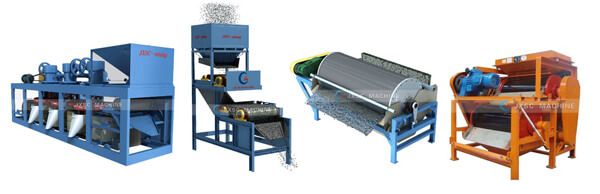
Since the 1980s, with the advent of bismuth-iron-boron high-magnetic rare-earth permanent magnet materials, the types of magnetic separators have become increasingly diverse. Classification of magnetic separation equipment:
- According to the strength of the magnetic field: weak, medium, and strong.
- According to the media, dry type, wet type separator.
- Menurut jenis medan magnet: konstan, berputar, bergantian, berdenyut.
- Menurut struktur pemisah magnetik: tipe silinder, tipe sabuk, tipe cakram, tipe cincin, dll.
Selecting the right magnetic separation equipment is crucial for improving mineral processing efficiency and economic benefits. JXSC Mining Equipment offers a wide range of pemisah magnetik, including wet, dry, high-intensity, and triple-disc models in various specifications to meet different mineral processing needs. If you require professional technical consultation, equipment quotes, or mineral processing plant design services, please feel free to hubungi kami for assistance.
Whether you want to learn about the principles of magnetic separation technology or need to select the right magnetic separation equipment, our professional technical team can provide comprehensive solutions to help you achieve optimal mineral separation results.
PRODUK TERBARU
-

SFM-8 Lab Grinder
【Max. Power Consumption】 150W 【Morta…
-
Cyclosizer
【Feeding Capacity】< 100g/time 【Feeding …
-
JKZ/2JKZ Mine Shaft Sinking Hoist
【Power Source】Electric Motor Drive 【Motor Spee…


 English
  French
  Spanish
  Portuguese
  Indonesian