



Introduction: The Power of Automated Mineral Separation
In today’s competitive mining industry, fully automatic mineral separation centrifuges represent a technological leap in mineral processing efficiency. These advanced systems combine high-speed centrifugal force with intelligent automation to achieve separation results that far surpass traditional gravity methods. With their ability to recover ultra-fine particles and operate with minimal supervision, automatic centrifuges have become indispensable in modern mineral processing plants for gold, rare earth elements, and other heavy minerals.
The effectiveness of these machines depends heavily on proper installation and operation. This guide provides comprehensive instructions to help engineers and plant operators correctly set up their equipment, establish optimal operating parameters, and maintain peak performance throughout the centrifuge’s service life. Whether you’re commissioning a new unit or optimizing an existing installation, these proven techniques will help you achieve maximum mineral recovery while minimizing operational costs.
What is a Fully Automatic Mineral Separation Centrifuge?
A fully automatic mineral separation centrifuge is a highly efficient and intelligent mineral processing device primarily used for separating minerals based on density differences (e.g., separating heavy minerals like gold, tungsten, and tin from waste rock). Its key feature is automated control, enabling continuous operation with minimal manual intervention while improving separation precision and recovery rates. Below is a detailed breakdown:
1. Working Principle
- Centrifugal Separation: A slurry feed enters a high-speed rotating drum, where dense minerals (e.g., gold particles) are forced against the drum wall under centrifugal force, while lighter minerals (e.g., quartz) remain closer to the inner layer and are discharged.
- Intelligent Control: Sensors monitor real-time parameters such as drum speed, feed concentration, and wash water volume, automatically adjusting operating conditions for optimal separation.
2. Keunggulan Inti
- High Recovery Rate: Capable of recovering ultra-fine particles (e.g., -0.037mm), which traditional gravity separation devices struggle with.
- High Automation: Fully automated from feeding to separation and discharge, minimizing human error.
- Energy-Saving & Eco-Friendly: Low water consumption (about 1/3 of spiral concentrators) and ease of tailings processing.
- Modular Design: Multiple units can operate in parallel for large-scale mining requirements.
3. Typical Structure
- Rotating Drum System: Cone or cylindrical-cone design with wear-resistant lining (e.g., rubber or polyurethane).
- Sistem Kontrol Otomatis: PLC programming with integrated pressure, flow, and speed sensors.
- Wash Water System: High-pressure water jets strip heavy minerals to enhance concentrate grade.
- Smart Discharge System: Automatically adjusts discharge intervals based on mineral enrichment levels.
4. Application Scenarios
- Gold Processing: Especially suitable for fine-grained disseminated gold ores, achieving recovery rates over 90%.
- Rare Earth & Precious Metals: Separates high-density minerals like monazite and wolframite.
- Tailings Reprocessing: Recovers valuable components from old tailings.
- Environmental Remediation: Heavy metal-contaminated soil treatment (e.g., lead or mercury separation).
5. Development Trends
- AI Integration: Combines machine vision for real-time analysis of mineral enrichment, dynamically optimizing parameters.
- Material Innovation: Uses lightweight carbon fiber drums to increase maximum rotation speed.
- Energy Recovery: Braking energy feedback systems reduce power consumption.
How to Install and Operate a Fully Automatic Centrifuge?
Fully automatic centrifuges are essential equipment in pengolahan mineral and various industrial applications. This comprehensive guide will walk you through the proper installation, electrical connections, and operational procedures to ensure optimal performance and mineral recovery rates.
Electrical Connection Procedures
Primary Power Connections
- Begin by connecting the three-phase power pasokan to the distribution cabinet
- Connect the lighting power circuit to complete the primary electrical setup
Distribution Cabinet Wiring (Minimum 3×4 cable required)
- Connect the marked terminal from the distribution cabinet to the centrifuge unit
- For solenoid valves:
Join the two solenoid valve wires together
Connect them to the designated terminal on the distribution cabinet - Connect the pneumatic butterfly valve wires to their specified terminal
Air Pump Configuration
- The air pump requires a 220V power supply
- Connect the air pump’s air line to the pneumatic butterfly valve
Relay Settings on Distribution Cabinet
- Working Time Control(First relay on the right):
- Setting options: S (seconds), M (minutes), H (hours)
- Recommended: 1H or 30M
- Ore Discharge Timing(Second relay on the right):
- Set to 2M or 1M based on processing requirements
- Solenoid Valve Opening Duration(Third relay on the right):
- Typically set between 3-5 seconds for optimal operation
Operational Sequence
- Power Up:
- Close the main power switch
- Set the working switch to “automatic ore discharge” mode
- Speed Selection:
- Use the frequency conversion switch to select the optimal speed:
Speed 1: 50 Hz (450 rpm)
Speed 2: 45 Hz (400 rpm)
Speed 3: 40 Hz (360 rpm) - Select the speed that provides the best recovery rate for your specific heavy minerals
- Feeding Cycle:
- When reaching 30 Hz, the pneumatic butterfly valve automatically opens for material feeding
- Below 30 Hz, the valve closes to stop feeding
- Discharge Process:
- At 5 Hz, automatic ore discharge activates (duration 1-2 minutes)
- Solenoid valve operation:
Normally closed during processing
During discharge, one valve releases water for pressure reduction; Another sprays water upward to assist cake discharge.
System Diagram Overview
Section 1: Electrical Distribution
- Three-phase power connection
- Neutral wire terminal
- Backwash pump circuit
- Centrifuge power
- Water solenoid valve wiring
- Pneumatic butterfly valve control
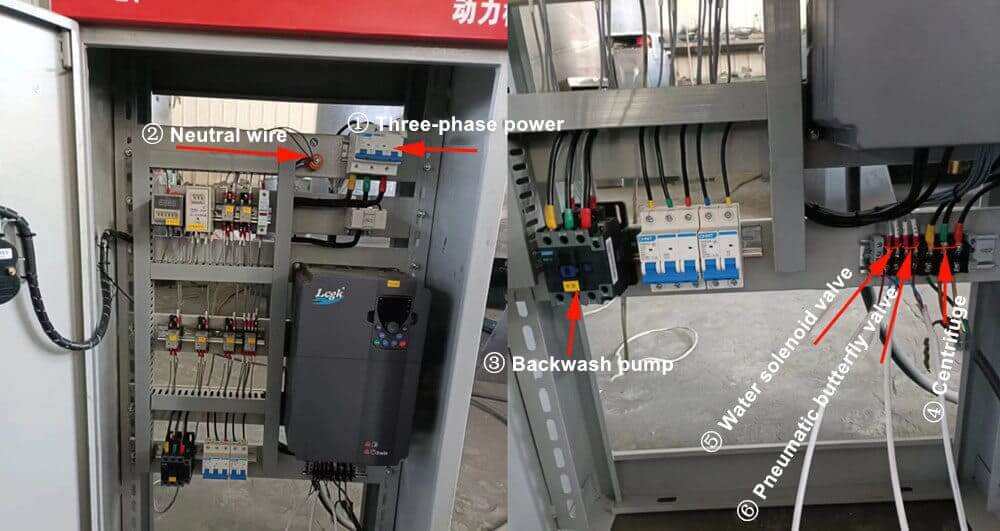
Section 2: Hydraulic Circuit
- Connection to a large water tank
- Pressure adjustment switch setup
- Pressure gauge pipe fittings
- Water solenoid valve configuration
- Concentrate the discharge water pipe
- Heavy mineral discharge bypass
- Main water connection pipe
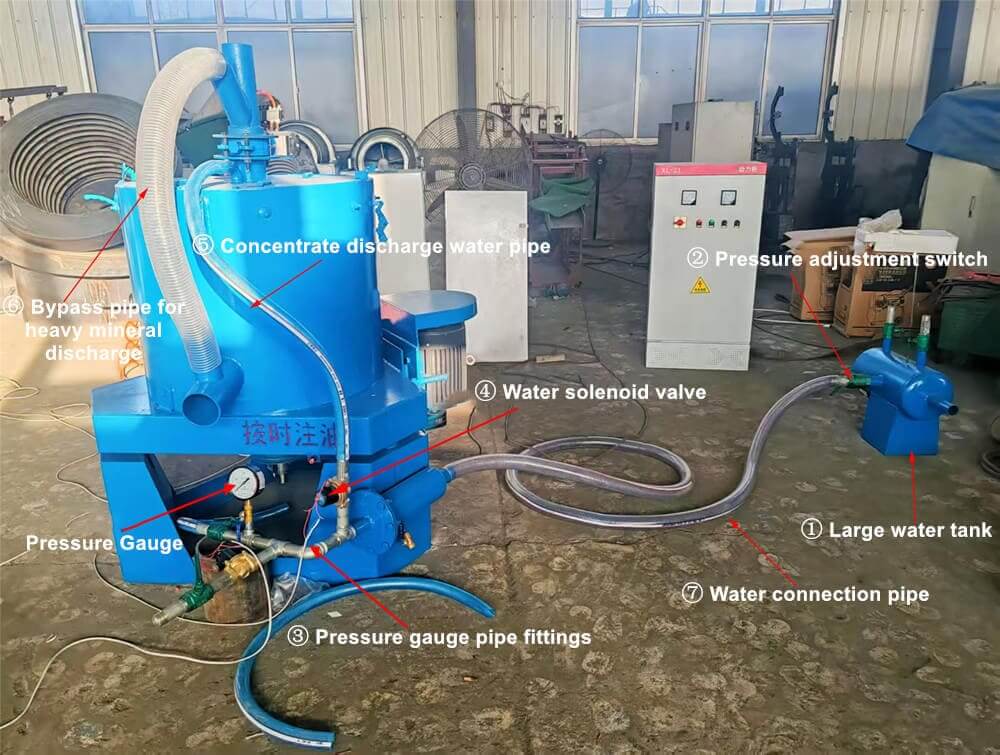
Section 3: Feed Mechanism
- Feed tee junction
- Pneumatic butterfly valve installation
- Air pump connection point
- Air pump power and positioning
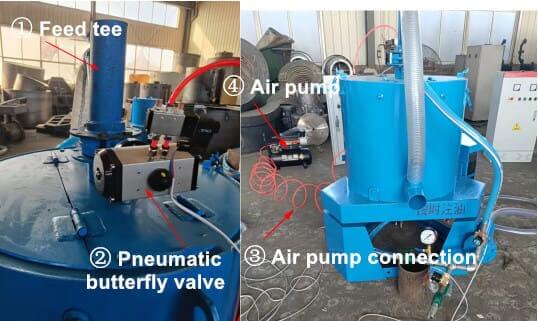
Section 4: Discharge System
- Heavy mineral discharge port
- Tailings output port
- Feed inlet port
- Small filter water tank
- Wastewater discharge outlet
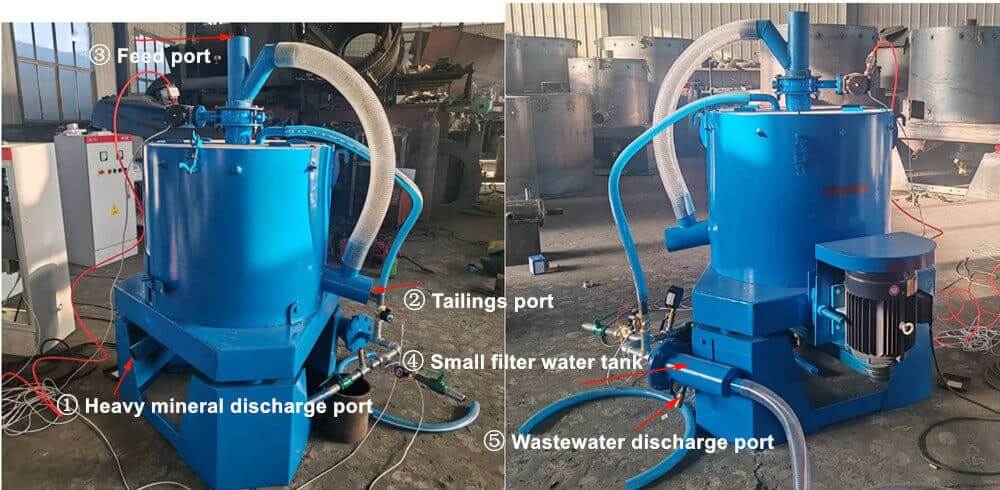
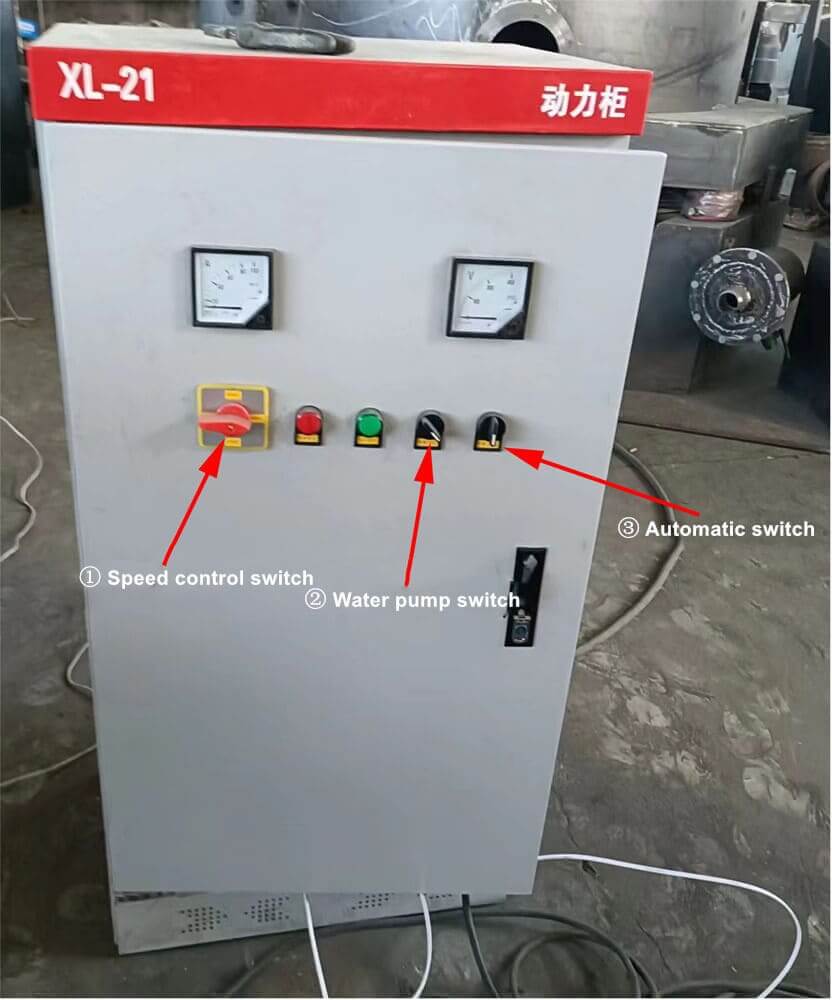
Section 5: Control Panel
- Speed control selector switch
- Water pump activation switch
- Automatic/manual mode selector
Best Practices for Operation
- Always verify all electrical connections are secure before energizing the system
- Perform a dry run test without material to confirm proper mechanical operation
- Monitor the first few cycles to ensure proper feed and discharge timing
- Regularly check water pressure and spray patterns during discharge
- Maintain a log of speed settings and corresponding recovery rates to identify optimal operating parameters
By following these installation and operation guidelines, you can ensure your fully automatic centrifuge operates efficiently with maximum mineral recovery rates. Regular maintenance and parameter optimization will further enhance performance and equipment longevity.
Conclusion: Mastering Centrifuge Technology
Proper installation and operation of fully automatic centrifuges can dramatically transform mineral processing outcomes. By following these methodical setup procedures, maintaining vigilance during initial operation, and implementing ongoing optimization practices, operators can consistently achieve 90%+ recovery rates for even ultra-fine heavy minerals. The automated nature of these systems doesn’t eliminate the need for skilled operation—rather, it shifts the focus from manual control to intelligent supervision and parameter optimization.
As centrifugal separation technology continues evolving with AI integration and advanced materials, the fundamentals of proper installation and operation remain the foundation for success. Facilities that master these procedures today will be best positioned to adopt tomorrow’s advancements in automated mineral processing. Remember to maintain detailed operating logs, schedule regular maintenance, and continually benchmark your recovery rates against industry standards to ensure your centrifugal separation system delivers maximum value throughout its operational life.
PRODUK TERBARU
-

Inclined Vibrating Screen
The inclined vibrating screen is a simple and eff…
-
High Temperature & Pressure Gold Desorption Electrolysis System
High-Temperature & Pressure Gold Desorption Elect…
-
Normal Temperature & Pressure Gold Desorption Electrolysis System
The normal temperature & pressure gold desorption…


BERITA TERBARU
- Modern Cyanide Residue Treatment Technologies for Gold Processing
- Traditional De-cyanidation Technologies for Gold Cyanide Residues
- Shaking Table, 3-Disc Dry Magnetic & Electrostatic Separator for W-Sn-Ta-Nb
- Mineral Analysis: The Foundation for Successful Mineral Processing Projects
- What Is Over-Grinding and How Can It Be Prevented?
 English
  French
  Spanish
  Portuguese
  Indonesian