



Fluorite, a vital industrial mineral, is categorized into four ore types based on gangue mineral composition. Each type requires tailored beneficiation methods to maximize fluorite recovery and purity.
Fluorite Ore Type
Mineral gangue yang berbeda dapat membagi bijih fluorit menjadi empat jenis:
- Bijih fluorit tipe kuarsa
- Bijih fluorit tipe karbonat
- Bijih fluorit tipe barit
- Bijih fluorit sulfida
(1) Bijih fluorit jenis kuarsa: Mineral utamanya adalah fluorit dan kuarsadan kandungan fluoritnya bisa mencapai 80% hingga 90%. Ini mengandung sejumlah kecil kalsit, barit, dan sulfida.
(2) Carbonate-type fluorite ore: The main minerals are fluorite and calcite. The content of calcite can reach more than 30%, and there is a small amount of quartz, sometimes composed of quartz, calcite, and fluorite-type ore.
(3) Bijih fluorit tipe barit: The main minerals are barite and fluorite, and the barite content reaches 10% to 40%. It often accompanies this type of ore with pyrite, galena, sphalerite, and other sulfides, and sometimes the range of quartz increases, forming a quartz-barite-fluorite type ore.
(4) Bijih fluorit tipe sulfida: Komposisi mineralnya sama dengan kuarsa-fluorit, tetapi mengandung lebih banyak sulfida logam, dan terkadang kandungan timbal dan seng dapat mencapai kadar industri.
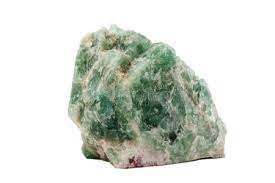
Bagaimana Cara Memanfaatkan Bijih Fluorit?
Saat ini, ia terutama menggunakan sistem metode flotasi untuk manfaat dan pemurnian fluorit di dalam dan luar negeri.
1. Kuarsa-Fluorit
Quartz-type fluorite ore is mainly composed of fluorite (about 85%) dan quartz, with only a small amount of calcite, barite, and sulfide.
Kunci pemilihannya terutama untuk mengurangi silikon dalam konsentrat.
To separate quartz from fluorite, it is necessary to dissociate the quartz and fluorite monomers through grinding, so grinding is an essential factor affecting the flotation of quartz-type fluorite. If the grinding particle size is too coarse, the conjoined body of quartz and fluorite exists in the product, making the rough concentrate after flotation too high. If the grinding particle size is too fine, although it dissociates the quartz and fluorite individually, it will lead to excessive fluorite crushing in the grinding product and reduce the recovery rate of fluorite.
The most reasonable method is to use a stage grinding process, which can reduce the silicon content in the fluorite concentrate after flotation and increase the fluorite concentrate’s recovery rate.
This type of fluorite ore can be divided into two kinds, coarse-grained and fine-grained, according to the inlaid characteristics of valuable minerals.
- Fluorit tertanam berbutir kasar mudah dipilih. Kolektor jenis asam lemak digunakan, pengatur bubur adalah natrium karbonat, dan penghambat kuarsa adalah gelas air. Ini dapat memperoleh konsentrat fluorit berkualitas tinggi melalui proses kasar dan multi-halus.
- The flotation reagents of the fine-grained embedded quartz-type fluorite ore are the same as those of the coarse-grained embedded quartz-type fluorite ore. Still, due to the small embedded particle size of the target minerals, it is necessary to strengthen the grinding and use a stage grinding stage for the separation process flow.
Quartz-type Fluorite Beneficiation
Quartz-type low-grade fluorite ore: the main recoverable mineral is fluorite with a grade of 30%, and the main gangue mineral is quartz, followed by calcite, feldspar, mica, etc.
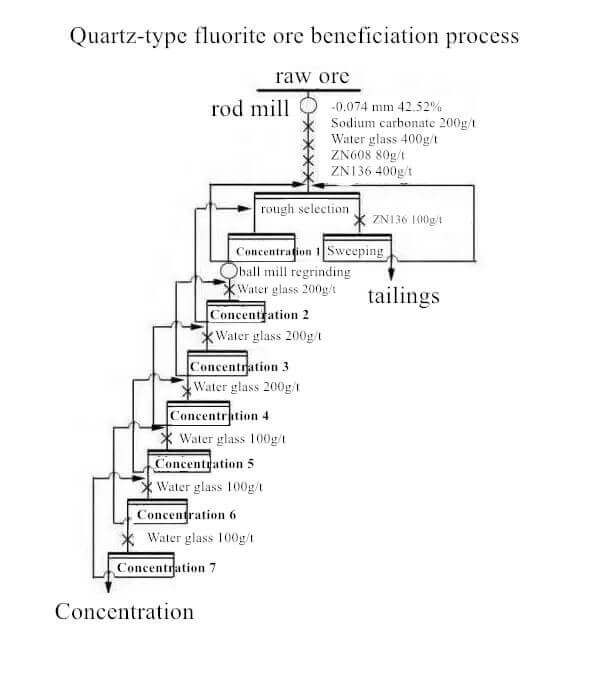
Parameter proses: rough dressing and grinding fineness is -200 mesh(accounting for 42.52%). It uses water glass + ZN608 as an inhibitor and fluorite low-temperature collector ZN136 as a collector. It uses one coarse, one sweep, and seven fine. One-stage concentrate regrinding and middling return to a closed-circuit process that can obtain fluorite concentrate with a CaF2 grade of 97.45% and a recovery rate of 92.71%.
Fine-grained Embedded Quartz-type Fluorite Ore Beneficiation
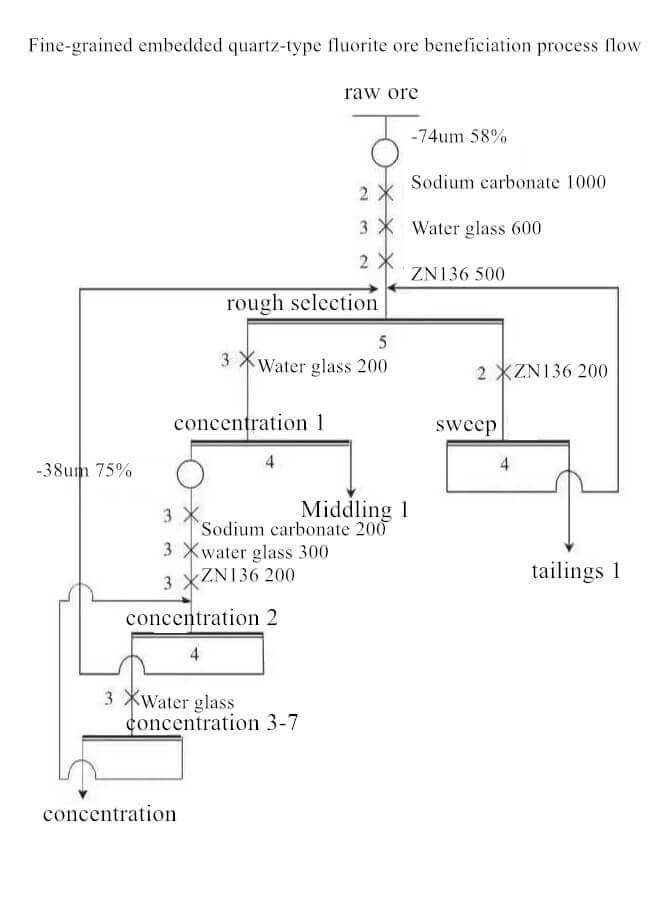
Bijih fluorit tipe kuarsa bertatahkan berbutir halus memiliki kandungan fluorit sebesar 32,75%. Hubungan hias antara fluorit dan kuarsa dalam bijih sangat kompleks, dan perincian hiasnya kecil. Diperlukan penggilingan halus untuk memisahkan monomer fluorit dan kuarsa.
Parameter proses
Penelitian eksperimental ini mengadopsi proses satu kali pengasaran, satu kali penyapuan, dan tujuh kali manfaat.
One-stage middling cast tails directly; flotation concentrate of one-stage concentrate regrind and refloat. It uses the self-developed ZN136 as the fluorite low-temperature flotation collector. Under the condition that the slurry temperature is 5~10℃, the beneficiation index obtained by the laboratory is the fluorite feed CaF2 32.52%, the concentrate CaF2 97.55%, and SiO2 1.36%; the fluorite recovery rate is 76.67%. Under the slurry temperature of 5℃, the industrial production index is fluorite feeding CaF2 30.14%, concentrate CaF2 97.37%, SiO2 0.81%, fluorite recovery rate 89.67 %.
2. Kalsit-fluorit
Calcite-type fluorite ore is mainly composed of fluorite and calcite (content up to 30% or more), with a small amount of quartz, which can form quartz-calcite-fluorite-type ore.
Alasan utama mengapa bijih fluorit jenis kalsit sulit dipisahkan adalah karena kalsit dan fluorit merupakan mineral yang mengandung kalsium dengan sifat fisik dan kimiawi permukaan yang serupa.
Both fluorite and calcite are calcium-containing minerals, and their solubility is similar. Therefore, the flotation separation of such ores is difficult. The selection of suitable collectors and inhibitors is the key to achieving the separation of fluorite from calcite. At the same time, proper process flow and process conditions are also essential factors in improving the flotation index. Combined and new agents are widely used in sorting this type of fluorite ore.
To achieve the separation of calcite and fluorite, the pH value of the slurry and use a collector to achieve a good separation effect. Water glass, salted water glass, acidified water glass, sodium hexametaphosphate, lignosulfonate, dextrin, tannin, and calcium carbonate special inhibitor ZN608 can be used. They can use them alone or in combination to inhibit calcite for separation purposes.
3. Barit-fluorit
The main minerals of barite-type fluorite ore are barite and fluorite, and the barite content is 10% to 40%. It often accompanies this ore with pyrite, galena, sphalerite, and other sulfide minerals.
The difficulty in beneficiation of barite-type fluorite ore is that the floatability of barite and fluorite is similar, which makes it difficult to separate the two.
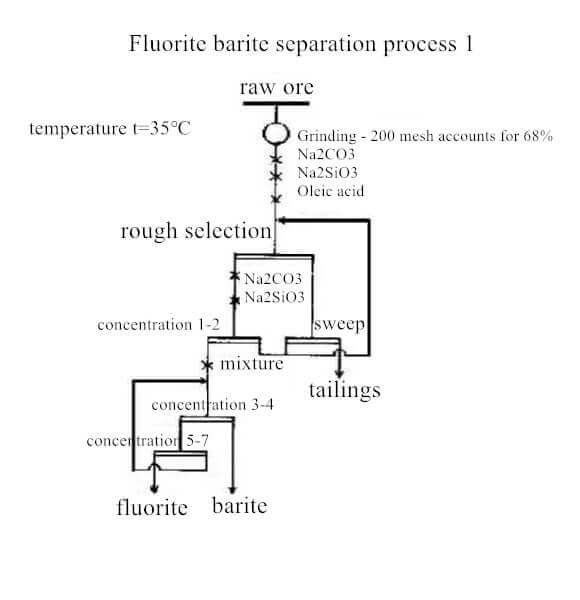
Mixing flotation and Na2CO3 adjusts the slurry’s pH value in the flotation of barite-type fluorite ore. It uses oleic acid and water glass as collectors and inhibitors to obtain fluorite and barite. The concentrate is mixed and uses flotation to separate barite and fluorite.
The flotation separation process of barite-type fluorite ore is divided into two types: inhibiting barite from floating out of fluorite and inhibiting fluorite from floating out of barite. The key to flotation separation of barite and fluorite lies in the choice of inhibitor.
Penggunaan Inhibitor Kombinasi 1
Dengan menggunakan asam oleat sebagai kolektor, dekstrin + besi klorida sebagai penghambat gabungan barit, melalui proses flotasi 1 kasar satu sapuan tujuh halus, dapat diperoleh konsentrat fluorit dengan kadar CaF2 97,87% dan tingkat pemulihan 79,26%, konsentrat barit dengan kadar BaSO4 94,62% dan tingkat pemulihan 72,53%.
Penggunaan Inhibitor Kombinasi 2
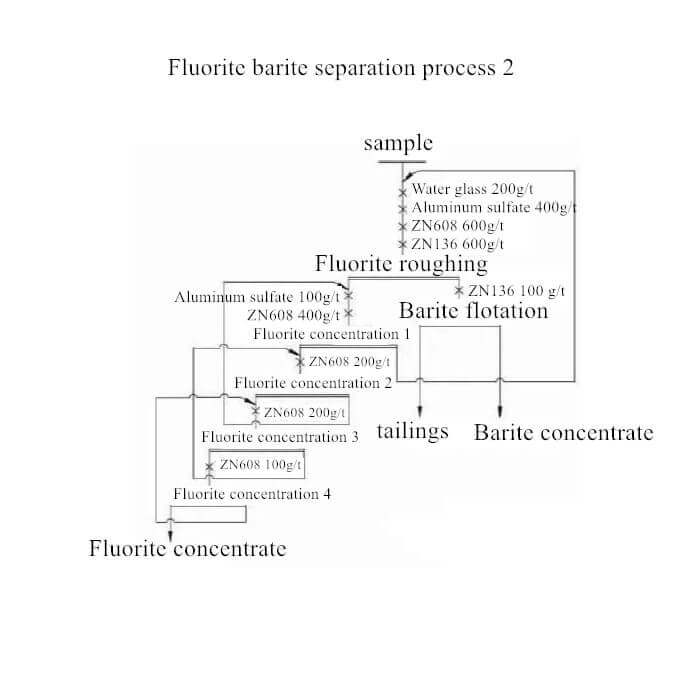
ZN608 secara selektif dapat menghambat barit, dan gelas air secara selektif dapat menghambat kuarsa dan meningkatkan dispersitas pulp. Aluminium sulfat tidak hanya dapat membantu menghambat barit tetapi juga melemahkan efek penghambatan gelas air pada fluorit. Untuk mencapai tujuan menghambat barit dan kuarsa pada saat yang bersamaan.
Parameter proses: The mixed concentrate was treated with one coarse, four refined, one sweep, and selected medium ore returning to the process. It can obtain the fluorite concentrate with a CaF2 grade of 97.21%, a recovery rate of 85.44%, and a BaSO4 grade of 94.36%, and the barite concentrate with a rate of 86.75% and a density of 4.25 g/cm3 has achieved high-efficiency separation of fluorite and barite.
4. Pemurnian Bijih Fluorit Sulfida
Komposisi bijih fluorit jenis bijih sulfida mirip dengan komposisi mineral fluorit jenis kuarsa. Namun, kandungan logam sulfida lebih tinggi, dan terkadang kandungan memimpin dan seng dapat mencapai kelas industri. Oleh karena itu, ketika mengembangkan dan memanfaatkan fluorit, kita juga harus mempertimbangkan pemulihan bijih logam.
Tambang fluorit jenis bijih sulfida umumnya menggunakan pengumpul bijih sulfida untuk memilih mineral logam sulfida secara istimewa dan kemudian menggunakan pengumpul asam lemak untuk mengambil kembali fluorit dari tailing pengapungan. Selain itu, juga dapat menggunakan proses seperti pemanggangan dan pencucian untuk mengekstraksi logam berharga dan menguraikan fluorit. Alur prosesnya relatif sederhana, dan produk fluorit berkualitas tinggi dapat dibuat sambil mendaur ulang logam berharga secara komprehensif.
Ringkasan
Fluorite ore is classified into four types based on gangue mineral composition: quartz-type, carbonate-type, barite-type, and sulfide-type, each requiring tailored beneficiation approaches. Quartz-type fluorite focuses on silicon reduction through staged grinding and selective inhibitors, while carbonate-type demands precise pH control and specialized reagents to separate calcite. Barite-type fluorite relies on combined inhibitors like dextrin-ferric chloride or ZN608 for efficient separation from barite. Sulfide-type fluorite prioritizes sequential flotation to recover metals before fluorite extraction. Across all types, optimizing grinding, reagent selection, and process flow ensures high-purity fluorite concentrates with maximal recovery, highlighting the importance of ore-specific strategies in industrial mineral processing.
PRODUK TERBARU
-

Inclined Vibrating Screen
The inclined vibrating screen is a simple and eff…
-
High Temperature & Pressure Gold Desorption Electrolysis System
High-Temperature & Pressure Gold Desorption Elect…
-
Normal Temperature & Pressure Gold Desorption Electrolysis System
The normal temperature & pressure gold desorption…


BERITA TERBARU
- Modern Cyanide Residue Treatment Technologies for Gold Processing
- Traditional De-cyanidation Technologies for Gold Cyanide Residues
- Shaking Table, 3-Disc Dry Magnetic & Electrostatic Separator for W-Sn-Ta-Nb
- Mineral Analysis: The Foundation for Successful Mineral Processing Projects
- What Is Over-Grinding and How Can It Be Prevented?
 English
  French
  Spanish
  Portuguese
  Indonesian