



Perak exhibits diverse mineralogical forms in nature, with economically significant varieties including native silver, argentite (Ag₂S), horn silver (AgCl), pyrargyrite (Ag₃SbS₃), and gold-silver alloys. These minerals frequently occur in association with lead-zinc ores, copper deposits, gold-bearing quartz veins, and iron oxides like limonite, necessitating integrated recovery strategies.
The fine-grained dissemination (typically 5–10 μm) and complex mineralogical associations of silver present unique beneficiation challenges. Effective processing requires optimized grinding to expose silver particles while avoiding overgrinding, followed by tailored separation techniques such as flotation, cyanidation, or hybrid methods. This article examines silver ore preparation and separation approaches, with emphasis on liberation dynamics and metallurgical optimization.
Proses Pemanfaatan Bijih Perak
Preparation Stage: Liberation Optimization
In the preparation stage, grinding significantly influences the recovery of silver ore. The number of grinding stages and fineness need to be determined based on the silver ore’s distribution characteristics and occurrence state. The crystallization size of silver minerals is mostly between 5-10μm. During this period, the primary carrier particle size is much thicker than the silver mineral itself, so it is not necessary to dissociate all the monomers of the silver mineral during the grinding stage as long as the carrier is fully dissociated.
Namun, situasi ini relatif ideal, kecuali untuk beberapa mineral perak dengan tembaga, memimpin, sengdan mineral lain sebagai pembawa. Beberapa mineral perak tersebar dalam bentuk yang tidak beraturan atau mineral perak berbutir halus yang tersebar dalam mineral gangue. Kain yang tertanam, sedangkan kandungan mineral sulfida lainnya rendah. Pemisahan mineral perak berbutir halus dapat dicapai dengan meningkatkan tahap penggilingan halus untuk memulihkan kedua jenis mineral perak ini.
Tahap Pemisahan
1. Proses flotasi bijih perak
Dalam proses pemurnian bijih perak, flotasi biasanya digunakan untuk mengambil kembali perak dan logam-logam yang menyertainya. Proses flotasi yang dapat dipilih sesuai dengan karakteristiknya antara lain flotasi preferensial, flotasi preferensial parsial, flotasi campuran parsial, flotasi asinkron, flotasi terdistribusi, flotasi ekuipotensial, flotasi aliran cabang, dan lain-lain. Dalam proses pemulihan flotasi bijih perak, faktor-faktor yang perlu diperhatikan antara lain nilai pH pulp dan kombinasi reagen.
(1) Penyesuaian nilai pH bubur kertas
Dalam pemulihan flotasi bijih perak, perlu untuk menghindari penggunaan beberapa regulator, seperti kapur dan sianida, yang dapat menghambat mineral perak. Ketika menggunakan regulator seperti natrium sulfit, natrium sulfat, dan pati, perhatian harus diberikan pada dosisnya. Melebihi jumlah tertentu juga tidak kondusif untuk pengapungan mineral perak. Nilai pH bubur yang lebih sesuai untuk flotasi mineral perak adalah antara 6 dan 8. Mempertimbangkan kondisi pemulihan yang komprehensif, maka harus disesuaikan dengan pemulihan mineral lainnya.
(2) Kombinasi obat yang tepat
In addition to the grinding fineness and the pH value of the pulp, the appropriate chemical system is the key factor affecting the beneficiation index. The primary collectors of silver and its carrier metal sulfide minerals include butyl ammonium black drug, aniline black drug, ethyl xanthate, Butyl xanthate, ethion, thiocarbamate, etc. Using a mixed collector based on a single collector can strengthen the flotation effect, and the commonly used collector combination includes butyl ammonium black drug and xanthate, aniline black drug and xanthate, etc.
2. Proses sianidasi bijih perak
The cyanidation method is suitable for the symbiotic type of gold and silver minerals and silver mines with reduced sulfide content, fine-grained silver minerals, and quartz as the main gangue mineral. The leached silver minerals include silver oxide, elemental silver, and silver sulfide. The principle is to use a cyanide solution to dissolve silver minerals in a precious solution and then use the zinc replacement method to extract it from silver. In this stage, factors that can affect silver recovery include the amount of sodium cyanide, oxygen, or leaching aids, leaching time, and so on.
3. Proses penyortiran gabungan bijih perak
Proses gabungan pemisahan gravitasi-flotasi cocok untuk bijih dengan kadar tinggi tetapi ukuran partikelnya tidak merata dan mudah dipisahkan, yang dapat meningkatkan tingkat pemulihan mineral perak dan mengurangi biaya benefisiasi tertentu. Proses gabungan flotasi-sianidasi cocok untuk memulihkan mineral perak yang tertanam dalam mineral gangue, yang dapat meningkatkan tingkat pemulihan bijih perak.
Di atas adalah beberapa konten tentang proses benefisiasi bijih perak. Dalam produksi aktual, perlu juga diingat bahwa ketika merumuskan proses pengolahan mineral, perlu dilakukan uji pengolahan mineral, menentukan proses teknologi secara ilmiah dan masuk akal, dan mendapatkan indikator pengolahan mineral yang ideal.
Pengolahan Flotasi Bijih Perak
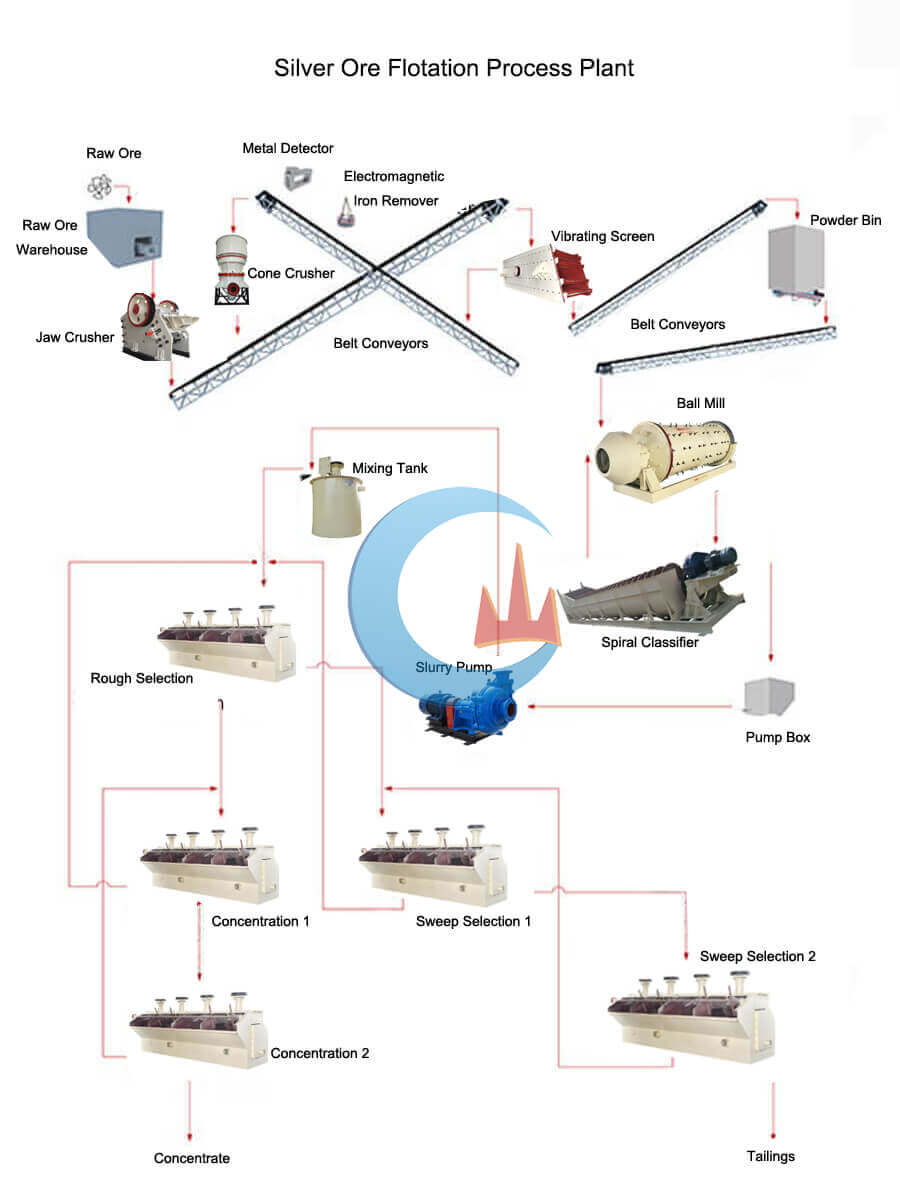
Kapasitas: 500T / D
Kapasitas Produksi Aktual: 750T / D
Jenis Bijih: The main metal minerals in the ore are pirit, chalcopyrite, silver-gold ore, and natural ore.
Aiming at the problems in the original production, we performed a technical transformation of the silver ore beneficiation process in combination with the actual show.
The proses pemanfaatan perak adopts the flotation-cyanide combined process. Silver concentrates are obtained by flotation, and after regrinding, the concentrates are subjected to cyanide leaching, countercurrent washing, and electrolytic separation to obtain silver ingots. Make the process smooth and easy to operate. In addition, the number of specific silver ore beneficiation equipment and the flotation reagent system has been improved.
Kesimpulan
Successful silver beneficiation hinges on:
- Ore-specific grinding: Balancing liberation against slimes generation.
- Adaptive separation: Hybrid flowsheets (e.g., flotation + cyanidation) maximize recovery from complex ores.
- Sustainability: Emerging non-cyanide lixiviants (e.g., thiosulfate) and AI-driven process control enhance efficiency.
Customized testwork remains imperative to address variability in silver mineralization, ensuring economically viable and environmentally compliant operations.
Key Takeaways
- Flotation dominates for sulfide ores; cyanidation suits oxidized/free-milling silver.
- Ultra-fine grinding (<20 μm) may be justified for disseminated silver but requires cost-benefit analysis.
- Integrated processes (e.g., gravity pre-concentration + flotation) boost recovery rates by 5–15%.
PRODUK TERBARU
-

Inclined Vibrating Screen
The inclined vibrating screen is a simple and eff…
-
High Temperature & Pressure Gold Desorption Electrolysis System
High-Temperature & Pressure Gold Desorption Elect…
-
Normal Temperature & Pressure Gold Desorption Electrolysis System
The normal temperature & pressure gold desorption…


BERITA TERBARU
- Traditional De-cyanidation Technologies for Gold Cyanide Residues
- Shaking Table, 3-Disc Dry Magnetic & Electrostatic Separator for W-Sn-Ta-Nb
- Mineral Analysis: The Foundation for Successful Mineral Processing Projects
- What Is Over-Grinding and How Can It Be Prevented?
- Fluorspar vs Graphite vs Quartz: Non-Metal Minerals Beneficiation Differences
 English
  French
  Spanish
  Portuguese
  Indonesian