



The feed concentration of a magnetic separator is a critical operational parameter that directly impacts separation efficiency, equipment performance, and overall mineral recovery. Striking the right balance between pulp density and flow dynamics is essential for optimizing concentrate grade, minimizing losses, and ensuring stable production. This article delves into the technical rationale behind feed concentration, explores its influence on magnetic separation processes, and provides actionable insights for fine-tuning this parameter in industrial applications. Whether you’re operating drum separators for magnetite or high-gradient units for weakly magnetic minerals, understanding these principles will help maximize your plant’s productivity.
Technical Rationale Behind The Feed Concentration of a Magnetic Separator
Separation Process of Magnetic Separators
Pemisah magnetik separate magnetic minerals from non-magnetic minerals through magnetic force. The detailed process is as follows:
1. Feed Preparation
- Ore is crushed and ground to a suitable particle size (typically 0.1–2mm).
- The slurry is uniformly mixed in an agitation tank to ensure particle dispersion.
2. Magnetic Field Effect
- Magnetic Particles: Adsorbed onto the magnetic poles or drum surface under magnetic force.
- Non-Magnetic Particles: Discharged directly under gravity/centrifugal force, and fluid drag.
3. Separation & Collection
- Magnetic Product: Moves with the magnetic pole to a non-magnetic zone (e.g., demagnetizing brush) and falls off.
- Non-Magnetic Product: Discharged from the tailings port.
Feed Concentration Determines 3 Key Factors
- Slurry viscosity: As concentration increases, the slurry viscosity index rises. When the concentration exceeds 35%, viscosity increases sharply, the resistance to sedimentation of non-magnetic particles increases, and they are easily “entrained” by magnetic particles into the concentrate, thereby reducing the concentrate grade.
- Dispersibility of magnetic particles: At an appropriate concentration, magnetic particles disperse well, are fully exposed to the magnetic field, and are effectively adsorbed by the magnetic separator. If the concentration is too high, particles stick together, causing severe magnetic agglomeration and entraining gangue; if the concentration is too low, particles are too sparse, reducing the probability of magnetic capture.
- Kapasitas pemrosesan: Feed concentration is directly proportional to processing capacity. If the concentration is too low, the amount of solids passing through per unit time is insufficient, resulting in wasted equipment capacity; if the concentration is too high, the magnetic separator is overloaded, the concentrate is not thoroughly washed, and the tailings grade increases.
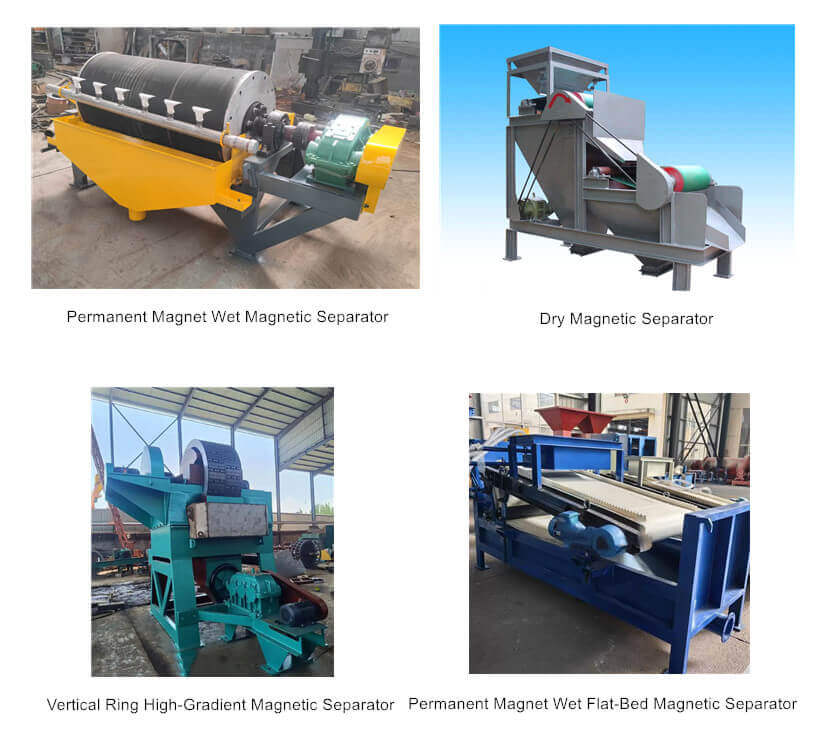
The optimal concentration of a magnetic separator is typically 25%–35%. The specific value depends on the mineral’s magnetic properties, particle size, magnetic separator type (drum, ring, high-gradient, etc.), and the processing stage (roughing, concentrating, or scavenging).
Theoretical optimal ranges (25–35%) provide a guideline, but real-world adjustments must account for mineralogy and equipment specifics. Below, we compare concentration thresholds across separator types—revealing why “one-size-fits-all” doesn’t apply.
Optimal Feed Concentration Ranges for Different Types of Magnetic Separation
| Magnetic Separator Type | Optimal Feed Concentration (%) | Catatan |
| Permanent Magnet Drum Magnetic Separator (Roughing) | 25%-35% | Processing coarse-grained, strongly magnetic minerals (magnetite) |
| Permanent Magnet Drum Magnetic Separator (Cleaning) | 20%-30% | Requires high purity; low concentration is recommended |
| Permanent Magnet Drum Magnetic Separator (Sweeping) | 30%-40% | Recovering residual magnetic minerals from tailings may allow for slightly higher concentrations |
| High-Gradient Magnetic Separator (Weakly Magnetic Minerals) | 15%-25% | Slurry viscosity has a significant impact; low concentration is required |
| Pemisah Magnetik Kering | 5%–10% (by weight) | Since the material is actually dry, concentration is not applicable |
Particle size adjustment: Coarse-grained ore (>0.15 mm) can be processed at a higher concentration (30%–40%), while fine-grained ore (<0.074 mm) requires a lower concentration (20%–30%) to prevent agglomeration and entrainment of fine particles.
Consequences of Excessively High or Low Feed Concentration
Beyond the Goldilocks zone of feed density, consequences cascade from clogged machinery to misplaced particles. Empirical data underscores how even minor deviations erode profitability.
Consequences of Excessive Feed Density
- Decreased Concentrate Grade
When the density is excessively high, the viscosity of the pulp increases. Non-magnetic particles (gangue) settle more slowly and become “encapsulated” or “entrained” within the magnetic chains formed by magnetic particles, thereby entering the concentrate. Empirical Data: In a specific magnetite roughing operation, increasing the feed density from 30% to 40% resulted in a drop in concentrate grade from 65% to 62%, and a decline in Fe recovery rate from 92% to 88%. - Magnetic Separator Clogging
In high-density pulp, coarse and heavy particles tend to settle at the bottom of the tank or accumulate in the crevices of the magnetic separator. This causes clogging, which can lead to equipment overload or a complete shutdown. - Ineffective Concentrate Washing
At high densities, the concentrate layer becomes thick and dense, making it difficult for wash water to penetrate. Consequently, gangue particles trapped between the magnetic particles cannot be effectively removed, further compromising the concentrate grade. - Increased Loss of Magnetic Material in Tailings
Some magnetic particles are “pushed” through the magnetic separation zone by the pulp flow; failing to be captured in time, they pass directly into the tailings. Additionally, if magnetic flocculation becomes too tight, the magnetic field force may be insufficient to capture individual particles effectively.
Consequences of Insufficient Feed Density
- Reduced Processing Capacity
When the density is too low, the mass of solids processed per unit of time decreases. For example, if the density drops from 30% to 20%, the processing throughput declines by 33%; consequently, achieving the same production output requires either installing additional equipment or extending production time. - Loss of Fine Magnetic Minerals
If the pulp is too dilute, the flow velocity increases. Fine magnetic minerals (<30 μm)—due to their low mass—experience fluid drag forces that exceed the magnetic forces acting upon them; they are easily swept into the tailings, resulting in a decline in recovery rate. - Wasted Energy Consumption
Equipment such as pulp pumps and agitation tanks must handle a larger volume of pulp to process the same mass of solids, leading to increased electricity consumption. - Increased Water Consumption
Diluting the pulp to such low densities requires the addition of large quantities of makeup water, which subsequently drives up the costs associated with water recovery and treatment.
Technical Causes and Impacts of Feed Concentration Fluctuations
Unstable concentration isn’t just an operational nuisance; it’s a silent revenue leak. We dissect common sources of fluctuation and their quantifiable impacts on metallurgical performance.
Sources of Fluctuations
- Grinding and Classification System: Unstable mill discharge concentration; variations in hydrocyclone classification efficiency.
- Thickening or Dewatering Operations: Fluctuations in thickener underflow concentration; uneven filter feed.
- Make-up Water Control: Arbitrary manual valve adjustments; automatic control system malfunctions.
Impact of Fluctuations
When feed concentration fluctuates by ±5%, concentrate grade may vary by ±1–2 percentage points, and recovery rate by ±2–4 percentage points. At a certain iron ore mine, due to severe fluctuations in feed concentration between 25% and 40%, the concentrate grade dropped from 64% to 60%, and the recovery rate fell from 90% to 85%; these indicators returned to normal after the concentration was stabilized.
How to Assess and Adjust Feed Concentration on Site?
- Measure concentration: Use a concentration flask or the drying method to take 2–4 measurements per shift and record the data. The normal range should be within ±3% of the target value.
- Observe the concentrate and tailings
- Low concentrate grade and black tailings (high magnetic content) → Concentration may be too high.
- Low concentrate yield and dark-colored tailings → Concentration may be too low.
- Visible gangue in the concentrate even after washing → Concentration is too high or insufficient wash water.
- Adjustment measures
- Concentration too high: Increase dilution water (added to the magnetic separator feed hopper or upstream piping), or reduce feed rate (adjust the feed valve).
- Concentration too low: Reduce dilution water, or increase feed rate (increase mill capacity).
- Significant fluctuations: Inspect upstream thickeners dan hidrosiklon to stabilize feed concentration. Install an online concentration meter and interlock it with the feed pump or valve for automatic adjustment.
Kesimpulan
Mastering feed concentration is less about rigid formulas and more about adaptive precision. By aligning pulp density with mineral characteristics, separator design, and process goals, operators can transform this variable from a troubleshooting headache into a strategic advantage. Continuous monitoring, coupled with rapid response protocols, ensures that concentration catalyzes efficiency—not a bottleneck. As magnetic separation technology evolves, the principles outlined here will remain foundational to achieving both economic and metallurgical excellence.
PRODUK TERBARU
-

Inclined Vibrating Screen
The inclined vibrating screen is a simple and eff…
-
High Temperature & Pressure Gold Desorption Electrolysis System
High-Temperature & Pressure Gold Desorption Elect…
-
Normal Temperature & Pressure Gold Desorption Electrolysis System
The normal temperature & pressure gold desorption…


BERITA TERBARU
- Modern Cyanide Residue Treatment Technologies for Gold Processing
- Traditional De-cyanidation Technologies for Gold Cyanide Residues
- Shaking Table, 3-Disc Dry Magnetic & Electrostatic Separator for W-Sn-Ta-Nb
- Mineral Analysis: The Foundation for Successful Mineral Processing Projects
- What Is Over-Grinding and How Can It Be Prevented?
 English
  French
  Spanish
  Portuguese
  Indonesian