



Introduction to Ore Characteristics
The composition and properties of ore significantly influence mineral flotation efficiency. Key factors include:
- Komposisi mineral: Type, content, and distribution of valuable minerals and gangue.
- Ore genesis: Primary (e.g., sulfide/oxide minerals) vs. secondary mineralization.
- Impurities and isomorphic substitution: Presence of soluble salts or trace elements (e.g., iron in sphalerite affecting floatability).
- Oksidasi permukaan: Variations during mining, storage, or transportation.
Different deposits of the same mineral may exhibit distinct flotation behaviors due to formation conditions, structural variations, and impurity content. For example, the floatability of galena or sphalerite collected from different producing areas is very different, especially the different colors of sphalerite (related to the amount of impurities such as iron and cadmium) are more prominent. The floatability of apatite, calcite, or barite produced in the production area is also very different. The reason for this phenomenon is mainly related to the conditions for the production of minerals and the entry of impurities into the minerals in the same way. In addition, during the mining, transportation, and storage of ore, the floatability of the mineral may also change due to the oxidation of the mineral surface and the contamination of impurities.
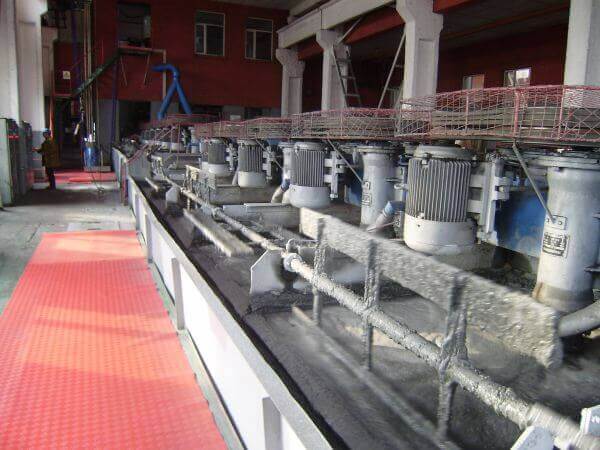
Impact of Mineral Formation on Floatability
Kondisi pembentukan mineral yang berguna mempengaruhi struktur mineral dan memiliki pengaruh yang kuat terhadap daya apung mineral. Mineral sulfida yang dihasilkan di bawah tekanan tinggi dan kondisi suhu tinggi, seperti yang dipisahkan dari magma cair atau diendapkan dari cairan hidrotermal, biasanya memiliki struktur yang relatif kompak tanpa pori-pori di antaranya, dan ukuran geometris kristal mineral relatif besar.
Urutan pembentukan mineral dapat berdampak penting pada flotasi. When there are cracks in the minerals formed earlier, they are often filled with minerals formed later to become vein-like or net-like structures. In the process of crushing and grinding, new fracture surfaces often appear along the fine mesh veins of the ore, and the secondary minerals are more prone to slumping.
Selama proses mineralisasi, pengayaan sekunder sometimes occurs; that is, after some primary sulfide minerals interact with other metal salt solutions, they precipitate to form a rich ore zone at the contact between the oxide ore and the primary sulfide ore. Due to secondary enrichment, films with different compositions are often formed on the surface of primary sulfide minerals. A typical example is that the surface of pyrite is covered with chalcocite or a copper blue film; it is also common that the surface of chalcopyrite is covered with copper blue, and the surface of sphalerite is covered by a silverite film. Obviously, during crushing and grinding, it is very difficult to completely separate the covering film on the mineral surface from the mineral, resulting in the mineral having floatability similar to that of the covering film.
Perlu ditunjukkan bahwa dua perubahan berikut ini memiliki dampak yang sangat besar pada sifat flotasi mineral: pertama adalah silikifikasiYang lainnya adalah kaolinization, chloriteization, and sericitization. In the first case, the minerals are glued by silica; in the second case, many very different microcrystalline minerals are formed, which will produce a large amount of fine mud during the grinding process.
Jenis mineral simbiotik yang berbeda, tingkat kesulitan pemisahan flotasi juga sangat berbeda, karena dalam pemisahan flotasi, tidak hanya satu atau beberapa mineral yang mudah mengapung ke dalam produk busa, tetapi juga mineral lain yang seharusnya tidak mengapung. Kemudahan kontrol. Sebagai contoh, tidak ada kesulitan dalam menggunakan pengumpul asam lemak untuk mengapungkan scheelite dari kuarsa, tetapi jika gangue adalah kalsit, fluorit atau dolomit, pemisahan flotasi sangat rumit; senyawa belerang digunakan dari mineral non-sulfida. Hal ini juga relatif mudah bagi pengumpul untuk memunculkan mineral sulfida ke permukaan, tetapi jauh lebih sulit untuk memisahkan mineral sulfida pekat atau mineral sulfida yang teroksidasi sebagian satu sama lain.
Ore Blending Strategies for Stable Flotation Performance: From Mining to Processing
Sifat bijih merupakan faktor obyektif yang sulit untuk diubah, so corresponding technological measures must be taken in the practice of flotation production to adapt to the nature of the ore and its changing law. In order to establish a relatively stable process operation system and obtain a relatively stable flotation index, the ore entering the concentrator should be relatively stable in nature to facilitate management. This often requires the cooperation of mining and beneficiation workers. Can be achieved. For example, before blasting, some mines first sample and analyze the ore in each pit and face each face, to roughly find out the grade and composition of the ore blasted from each face, and then, according to each face, Proper ore blending is performed in proportion to the amount of ore produced. Some mines are equipped with special ore blending sites to maintain the relatively stable nature of the ore beneficiation process; some concentrators also perform ore blending by feeding and unloading during the crushing process; In other dressing plants, the grinding products are mixed through a public pengental to mix the grinding products of the whole field, and remove excess water or fine mud, so that the feed concentration of the flotation operation is also relatively stable.
How Do You Select a Flotation Process?
Pemilihan proses flotasi tergantung pada ukuran partikel dan karakteristik lumpur dari mineral-mineral yang berguna di dalam bijih.
There are five types of inlay granularity: coarse-grained inlay, fine-grained uniform inlay, uneven in thickness, complex uneven inlay, and aggregate inlay.
- For coarse-grained embedded ore, because the particle size of the embedded cloth is coarse, it is easy to separate useful minerals from the gangue. It is advisable to use the two-stage flotation principle process of regrinding the medium ore;
- Coarse grains and fine grains. In one stage, part of the coarse-grained qualified concentrate can be obtained, and the fine-grained contiguous body is reground and re-selected. It is advisable to use the two-stage flotation principle process or the three-stage flotation principle process of the tailings regrind;
- Evenly embedded ore, because the particle size of the embedded ore is extremely uneven, and the dissociation range is very wide, it is appropriate to use the three-stage flotation principle process;
- In aggregate ore, because the useful minerals are contained in a larger aggregate, during rough grinding it is easy to separate the aggregate from the gangue. It is advisable to use the two-stage flotation principle process of regrinding the two ends of the coarse concentrate (ie aggregate) or the two-stage flotation principle of regrinding the middle ore.
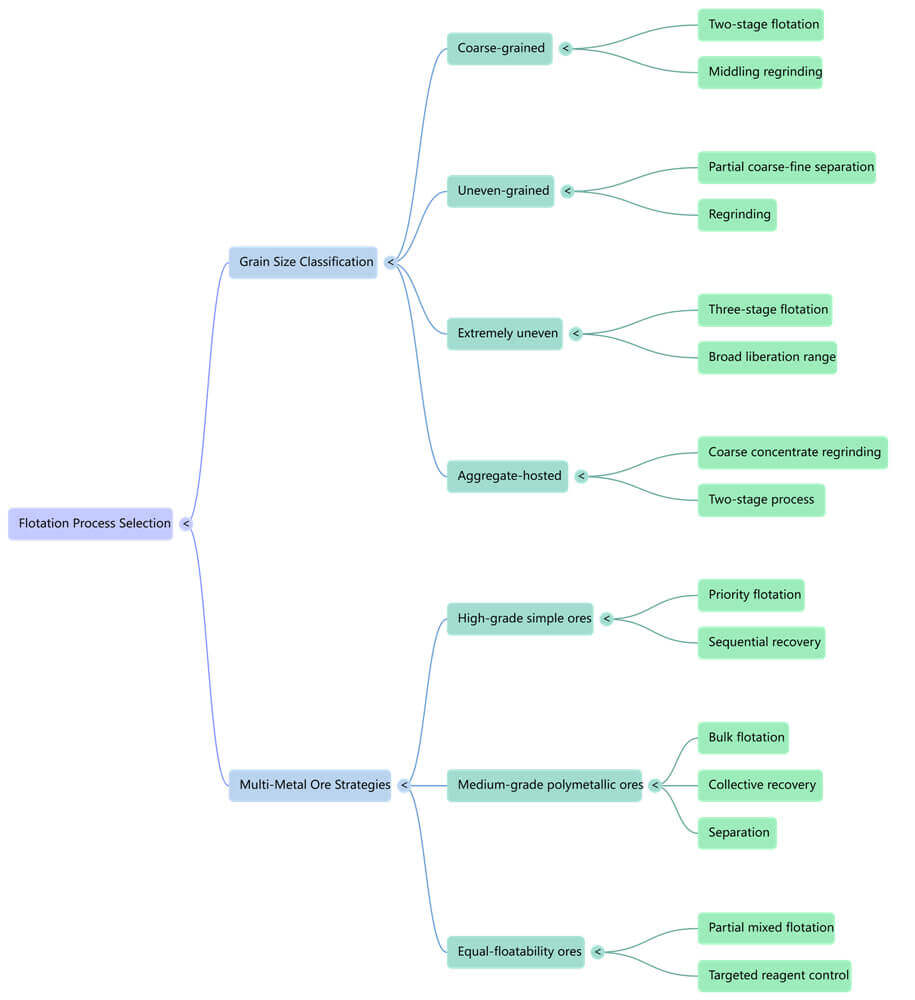
Saat memilih proses flotasi multi-logam, selain mempertimbangkan pengaruh karakteristik ukuran partikel dari kain yang disematkan pada proses, perhatian juga harus diberikan pada pengaruh daya apung berbagai mineral dan faktor lain pada pemilihan proses.
- For three types of ores, such as high-grade raw ore, low gangue content, coarse-grained distribution, or simple ore properties, large difference in the floatability of useful minerals, easy separation, or containing a large amount of dense polymetallic sulfide ore, direct priority should be given to the principle flow of flotation;
- For the ore with medium grade of raw ore, or poor and coarse aggregates, or ore containing a small amount of polymetallic sulfide ore, it is advisable to use the principle flow of full mixed flotation;
- For the complex polymetallic ore with “equal floatability”, it is advisable to use part of the part-mixed flotation principle process.
Kesimpulan
Ore properties dictate flotation design. Process selection must align with mineralogy, texture, and liberation characteristics, supported by blending and staged grinding where needed. Continuous ore characterization ensures adaptive and efficient separation. Stable feed properties and process flexibility are critical for optimizing metallurgical performance.
PRODUK TERBARU
-

Inclined Vibrating Screen
The inclined vibrating screen is a simple and eff…
-
High Temperature & Pressure Gold Desorption Electrolysis System
High-Temperature & Pressure Gold Desorption Elect…
-
Normal Temperature & Pressure Gold Desorption Electrolysis System
The normal temperature & pressure gold desorption…


BERITA TERBARU
- Modern Cyanide Residue Treatment Technologies for Gold Processing
- Traditional De-cyanidation Technologies for Gold Cyanide Residues
- Shaking Table, 3-Disc Dry Magnetic & Electrostatic Separator for W-Sn-Ta-Nb
- Mineral Analysis: The Foundation for Successful Mineral Processing Projects
- What Is Over-Grinding and How Can It Be Prevented?
 English
  French
  Spanish
  Portuguese
  Indonesian