



Tembaga, as a vital non-ferrous metal, plays an indispensable role in modern industries, including electrical engineering, machinery manufacturing, construction, and defense. However, oxidized copper ores present unique challenges in beneficiation due to their complex mineralogy and variable surface properties. This article explores various proven methods to process oxidized copper ores effectively, balancing economic viability with environmental sustainability.
Main Separation Methods for Various Copper Oxide Minerals
Sulfidization-Xanthate Flotation
The sulfidization-xanthate flotation method involves sulfurizing oxidized minerals with sodium sulfide or other sulfurizing agents (such as sodium hydrosulfide), and then flotation with a high-grade xanthate as a collector.
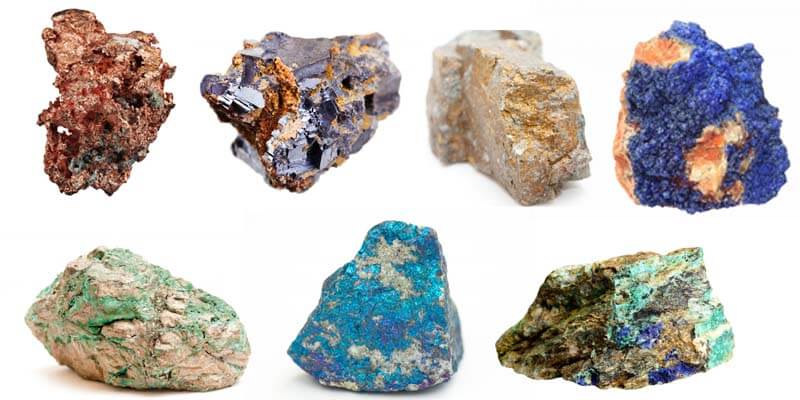
Copper oxide minerals that can be treated by vulcanization, mainly copper carbonates such as malachite and azurite, can also be used for hematite flotation.
If silicomachite is not specially treated in advance, its vulcanization effect is very poor or cannot even be vulcanized.
Fatty Acid Flotation (Direct Flotation)
When fatty acids and their soaps are used as collectors for flotation, gangue inhibitors, water glass, phosphate, and pulp regulator sodium carbonate are usually added.
This method is only applicable to oxidized copper ore whose gangue is not carbonate. When gangue contains a lot of besi dan mangan minerals, its indicators will deteriorate.
Leach-Precipitation-Flotation (LPF)
There are many kinds of copper oxide minerals, some have good floatability, some have poor floatability, and some copper oxide minerals are easy to be dissolved by some acids and alkalis, some copper oxide minerals that are difficult to select and easy to dissolve are first leached by acid (usually sulfuric acid); Then replace with iron powder, precipitate and precipitate metal copper, and then float the precipitated copper by flotation method.
This leach-precipitation-flotation method is suitable for treating refractory minerals such as malachite or refractory oxidized copper ore with a very low separation index and high mud content.
Separation Flotation
The separation flotation method can also achieve good results for refractory oxidized copper ore. It is to crush the mineral to a certain particle size, mix 0.1% ~ 1.0% salt and 0.5% ~ 2.0% pulverized coal, and heat it to about 900 ℃ in oxygen isolation. The copper in the ore will precipitate on the carbon particle surface in metal state. After oxygen isolation and cooling, the calcine will be ground and floated to obtain the copper concentrate.
This method is used to treat copper oxide minerals with more mud, which are difficult to separate, and ores with combined copper oxide accounting for more than 30% of copper.
Test Scheme for Copper Oxide Ores
The main beneficiation processes for copper oxide ores are summarized as follows
- Metode flotasi: direct flotation, sulfide flotation, etc.
- Hydrometallurgy: ammonia leaching and acid leaching.
- Leaching-precipitation-flotation method: The first step is leaching with sulfuric acid, then replacing copper with iron filings, and then floating out the precipitated copper by flotation. The second is leaching with NH3 and CO2, precipitating copper sulfide from sulfur (sulfur, pyrite, etc.), and then flotation.
- Metode flotasi pemisahan
- Bacterial leaching
At present, all the factories and mines that have been put into operation in China are pre-sulfurized with sodium sulfide, and then separated by the single flotation method. However, it is difficult to recover refractory oxidized copper ore by single flotation. In order to solve the utilization of this part of the resources, many schemes have been studied. The general trend is to adopt a beneficiation metallurgy combined process or metallurgical method.
The same is true in foreign countries. The flotation method is mainly used to deal with easily separable oxidized copper ores, and the combined process is mostly used for refractory oxidized copper ores.
Pemilihan Skema Pengujian
The main separation objects of this ore are oxidized copper ore and pyrite.
First, a single flotation process has been tried, including preferential flotation dan mixed flotation processes.
Practice has proved that a single flotation scheme can not be used, and satisfactory indices can not be obtained. The understanding of ore properties cannot be completed before the test. To truly understand the characteristics of the studied ore, we must finally rely on our own practice.
Through practice, understanding, re-practice, and re-understanding, it is found that under the condition of coarse-grained, most of the oxidized copper ore can be dissolved in water or dilute acid, but it is insoluble after grinding. The reason is that the mine contains a lot of limestone and other alkaline gangues. After grinding, these gangues are not only unfavorable to hydrometallurgy but also lead to the reprecipitation of dissolved copper, which makes it difficult to carry out hydrometallurgy and flotation. This special law of ore is mainly because the oxidized copper ore is located in the oxidation zone of the sulfide deposit, and most of the ore and vein are weathered in powder loose form and are seriously weathered. To master this Law of ore, we should make our thoughts conform to this objective external law, change the original scheme, and re-formulate the following schemes:
(1) Flotasi pelindian asam (flotasi residu pelindian)
(2) Flotasi pelindian air (flotasi residu pelindian)
The combined hydrometallurgy flotation process can not only improve the index of copper, but also improve the flotation of leaching residue. However, due to the high content of pyrite in the raw ore, it is difficult to separate copper and sulfur if it is directly precipitated and floated in the leaching pulp, so the slag solution should be treated separately. Since the raw ore contains a large amount of limestone, the leaching particle size cannot be the flotation particle size, but coarse-grained leaching should be adopted by taking advantage of its weathering nature. The hydrometallurgical process can be leached with water or 0.3% – 1.0% dilute acid solution. Although the leaching rates of the two are quite different, the final indices are very close.
Innovations & Future Trends
In recent years, the separation of oxidized copper ores has gradually developed towards refractory oxidized copper ores with low grade, high mud content, and high oxidation rate.
1. Hybrid Flotation-Reagents
For the separation of oxidized copper ore, the preferred method is flotasi, and the core of flotation is various flotation reagents, but the application of flotation methods for some minerals, such as azurite, chlorite, and malachite, can not achieve ideal results. Therefore, the research on flotation reagents for these refractory oxidized copper ores is a development direction in the future.
For minerals that cannot be separated by single flotation for the time being, the combination of chemistry and flotation is mainly used to separate them. However, this method has great environmental pollution and high energy consumption, so its development is limited to a certain extent.
2. Bioflotation
Biological beneficiation started late. This method has a wide range of ore treatment and low cost. More importantly, this method has almost no pollution to the environment and belongs to the ranks of green beneficiation. However, some technologies of this method are not mature, such as the long cycle of bacterial oxide and the difficulty of rapid cultivation of a large number of bacteria. However, from a long-term development point of view, this method is another development trend of refractory oxidized copper ore dressing in the future, which is worth studying.
3. Dry Processing
Microwave-assisted roasting to reduce energy use by 30%.
Sustainability Focus: Regulatory pressures are driving the adoption of closed-loop water systems and bio-based reagents.
Kesimpulan
Beneficiation of oxidized copper ores demands a tailored approach. While flotation dominates for simpler ores, integrated hydrometallurgy-flotation circuits are rising for refractory types. Future advancements will hinge on biotech and clean chemistry to align with global decarbonization goals.
PRODUK TERBARU
-

SFM-8 Lab Grinder
【Max. Power Consumption】 150W 【Morta…
-
Cyclosizer
【Feeding Capacity】< 100g/time 【Feeding …
-
JKZ/2JKZ Mine Shaft Sinking Hoist
【Power Source】Electric Motor Drive 【Motor Spee…


 English
  French
  Spanish
  Portuguese
  Indonesian