



The Konsentrator Knelson, often paired with a gold shaker, represents an efficient and environmentally friendly gravity beneficiation solution in gold and precious metal processing. By leveraging centrifugal force, it enhances the separation of fine gold particles while reducing reliance on harmful chemicals such as sodium cyanide. This article explores the working principles, structure, and real-world applications of Knelson concentrators in mineral processing.
1. Introduction to the Knelson Concentrator
The core challenge in fine particle separation is increasing the sedimentation speed difference. In normal gravity fields, fine particles exhibit minimal velocity disparity, reducing separation efficiency. However, centrifugal force amplifies this difference, enabling effective classification.
2. Structure and Working Principle of the Nelson Concentrator
2.1 Struktur
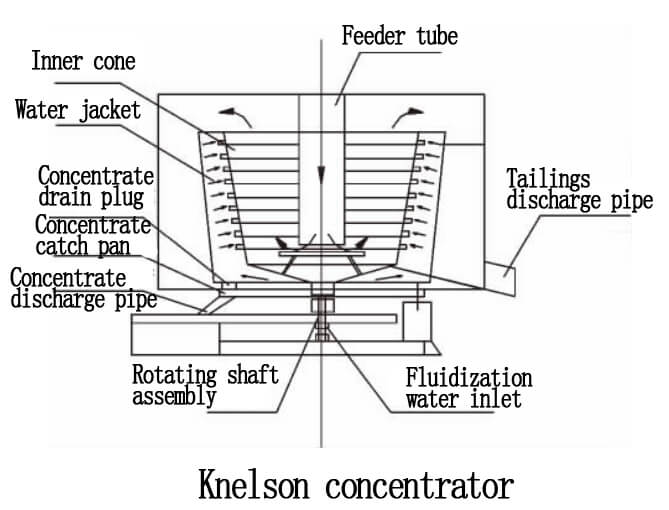
The separation part of the Nelson gold concentrator is a double-wall cone with flushing holes on the inner wall, and a sealed water chamber is formed between the outer cone and the inner cone. The inner wall of the inner cone, also called the concentration cone, has several circles of grooves and water inlet holes.
2.2 Working Principle
Knelson concentrator is a gravity concentrator based on centrifugation. In the high-intensity gravity field, the gravity difference between the mineral of high density and of low density will be amplified greatly; this gravity difference makes the separating task in the high-intensity gravity field easier than that of the normal gravity field. Under the interaction of fluidized water and hindered settlement, the mineral layer can keep losing condition continuously. Then the heavy mineral particles are settled, and the light minerals are discharged as tailings.
When the machine is at work, the ore pulp feeds into the bottom of the enrichment cone, the pulp is thrown to the inner wall because of the centrifugal force, and moves up along the inner wall. At the same time, the water enters the chamber through the inlet holes continuously, and makes the mineral layer keep the state of flow.
Under the interaction of the centrifugal force and the bounce-back force of water, the heavy mineral can bear the radial resistance, centrifugal settle in the concentrated layer. However, the gangue mineral cannot bear the bounce-back force of water discharged at the end.
3. Primary Applications in Gold & Precious Metal Processing
- Fine Gold Recovery: Efficiently captures fine gold particles (down to 50 mesh/0.3 mm) that conventional sluices or jigs might miss.
- Alluvial & Hard Rock Mining: Works on placer deposits (riverbeds, eluvial/weathered ores) as well as milled hard rock concentrates.
- Sulfide & Free Milling Ores: Can recover free gold from gravity circuits before cyanidation or flotation processes.
- Tailings Reprocessing: Recovers residual gold from old mine tailings, reducing economic losses.
Key Advantages
- High Recovery Rates (90%+ in optimal conditions): Outperforms traditional methods like shaking tables or spiral concentrators for fine gold.
- Compact & Low Installation Cost: Requires minimal space compared to sluice boxes or jig plants.
- Continuous Operation: Unlike batch-processing Knelson concentrators, some Nelson models allow continuous discharge.
- Low Water & Power Consumption: More efficient than sluices or flotation methods.
Keterbatasan
- Not Ideal for Ultra-Fines (<10 microns): Requires additional methods like cyanidation.
- Maintenance of Moving Parts: Rotating components need periodic checks.
4. Case Study: African Gold Mine Application
Description of the gold mine
A mining area in Africa has a rich gold reserve. The primary ore is sulfide gold ore; the oxidized ore is quartz vein type. Main metal minerals are iron pyrite, limonite, native gold, and small amounts of galena and sphalerite. The gangue minerals are mainly quartz, sericite, and pelite. The useful components are single and mainly natural gold; the content of harmful components is low, and the gold grade of the original ore is AU 5. 3G / T.
The Processing is as follows:
- Comminution: Three-stage crushing + closed-circuit grinding (60% -200 mesh).
- Klasifikasi: FX-350 hidrosiklon (2 sets).
- Pemisahan Gravitasi: Two KC-CD20MS Knelson Concentrators + one 6S Shaker.
- Pengolahan Tailing: Flotation for residual recovery.
Results: 94% gold recovery, demonstrating high efficiency.
Knelson concentrator is an efficient centrifugal gravity separation equipment, suitable for recovering precious metals such as gold, silver, platinum group, and other heavy metal minerals, and has become one of the most used gravity separation machines.
Advantages of the Nelson concentrator
- Rasio manfaat yang tinggi.
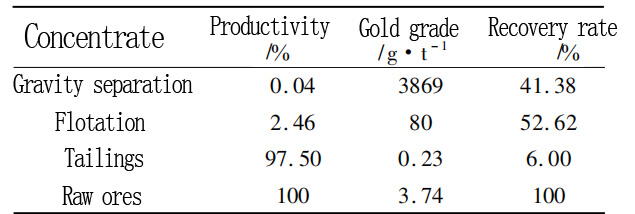
- High grade of gold concentrate, the recovery rate of coarse gold( up to 41.38%) is greatly higher than that of the method of the pintu air emas.
- Pengoperasian otomatis, stabil, tahan aus.
- Tidak ada bahan kimia berbahaya seperti merkuri atau natrium sianida.
Mineral index
For Knelson Concentrator pricing, consult JXSC Mining Equipment (China-based manufacturer).
Kesimpulan
The Knelson Concentrator is a proven, high-efficiency gravity separation solution for recovering gold and heavy minerals. By combining centrifugal force and hydraulic fluidization, it outperforms traditional methods such as sluice boxes while reducing chemical dependence. Its application in an African gold mine (94% recovery rate) highlights its industrial viability for sustainable mineral processing.
For optimal gold recovery without harmful chemicals, Knelson remains an industry-leading choice.
Related Post
Apa pengganti terbaik untuk Knelson Concentrator?
PRODUK TERBARU
-

Inclined Vibrating Screen
The inclined vibrating screen is a simple and eff…
-
High Temperature & Pressure Gold Desorption Electrolysis System
High-Temperature & Pressure Gold Desorption Elect…
-
Normal Temperature & Pressure Gold Desorption Electrolysis System
The normal temperature & pressure gold desorption…


BERITA TERBARU
- Modern Cyanide Residue Treatment Technologies for Gold Processing
- Traditional De-cyanidation Technologies for Gold Cyanide Residues
- Shaking Table, 3-Disc Dry Magnetic & Electrostatic Separator for W-Sn-Ta-Nb
- Mineral Analysis: The Foundation for Successful Mineral Processing Projects
- What Is Over-Grinding and How Can It Be Prevented?
 English
  French
  Spanish
  Portuguese
  Indonesian