



Quartz sand is an important industrial mineral. According to different product qualities, it can be divided into ordinary, refined, high-purity, and fused quartz sand. High-purity quartz sand is currently the product with the highest demand in the quartz sand market. With its superior performance, it has become a key raw material in photovoltaics, semiconductors, and other fields. It is mainly used to produce quartz crucibles and quartz boats.
At present, there are three main production methods for quartz sand, which are deeply purified from quartz minerals (purification method), processed from natural crystals as raw materials (natural crystal processing method), dan produced from silicon-containing compounds as raw materials (synthetic method). Among them, the purification method is currently the mainstream production method of quartz sand in China. To produce high-purity quartz sand through this method, high-purity quartz sand raw ore is required as raw material. The synthesis method is an emerging method for preparing high-purity quartz sand in China. It refers to the quartz sand products produced from silicon-containing compounds such as sodium silicate and aluminum silicate as raw materials through mixing, heating, crystallization, crushing, washing, drying, etc, collectively called pasir kuarsa sintetis atau pasir kuarsa buatan. Synthetic quartz sand has the keuntungan of high strength, high purity, strong corrosion resistance, and good chemical stability, and it can be used in industry, electronics, optics, semiconductors, machinery, aviation, and other fields.
This guide explores how artificial quartz sand is made, its unique properties, and where it’s used in industries from construction to semiconductors.
Artificial Synthetic Quartz Sand Overview
Pasir kuarsa sintetis buatan adalah bahan buatan. Ini adalah bahan non-logam anorganik yang terbuat dari pasir kuarsa, kaolin, bubuk aluminium, dan bahan mentah lainnya melalui proses penghancuran, penyaringan, pencampuran, pencetakan, pengeringan, sintering, dan proses lainnya.
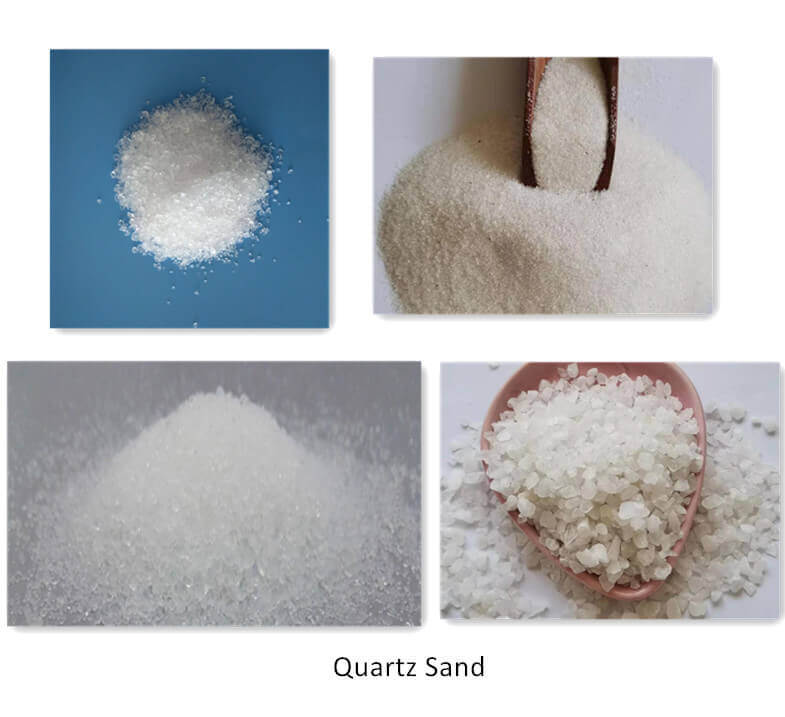
Sifat Fisik Pasir Kuarsa Sintetis Buatan
Sifat fisik pasir kuarsa sintetis buatan mirip dengan pasir kuarsa alami, dan memiliki keuntungan ketahanan suhu tinggi yang baik, ketahanan aus, ketahanan korosi, kekuatan tekan yang tinggi, dan sifat insulasi yang baik. Namun, karena kekerasannya yang tinggi, kesulitan dalam pemrosesan, dan kerapuhan yang mudah, rentang aplikasi pasir kuarsa sintetis buatan relatif sempit.
Key Differences from Natural Quartz:
| Fitur | Natural Quartz Sand | Artificial Quartz Sand |
|---|---|---|
| Purity | 90-99% SiO₂ | 99-99.99% SiO₂ |
| Impurities | Contains iron, alumina, etc. | Chemically refined for minimal contamination |
| Grain Shape | Irregular, angular | Controlled (spherical, uniform) |
| Warna | Often yellowish due to iron | Pure white or custom-tinted |
Artificial Synthetic Quartz Sand Application
Area aplikasi utama pasir kuarsa sintetis buatan adalah bahan tahan aus, bahan peralatan bersuhu tinggi, industri kimia, metalurgi dan manufaktur peralatan industri lainnya, bahan berkekuatan tinggi, bahan isolasi, etc,
- Dari segi bahan tahan aus, pasir kuarsa sintetis buatan dapat digunakan untuk membuat roda gerinda, bahan abrasif, amplas, dll.
- Dalam hal bahan peralatan suhu tinggi, pasir kuarsa sintetis buatan dapat digunakan untuk membuat termokopel, tabung termokopel, selongsong termokopel, dll.
- In terms of manufacturing equipment in the chemical industry, metallurgy, and other industries, artificial synthetic quartz sand can be used to make acid- and alkali-resistant pipes, acid and alkali-resistant containers, acid and alkali-resistant pumps, etc.
- Dalam hal bahan berkekuatan tinggi, pasir kuarsa sintetis buatan dapat digunakan untuk membuat beton berkekuatan tinggi, kaca berkekuatan tinggi, keramik berkekuatan tinggi, dll.
- Dalam hal bahan insulasi, pasir kuarsa sintetis buatan dapat digunakan untuk membuat keramik insulasi, pelat insulasi, tabung insulasi, dll.
Artificial Synthetic Quartz Sand Manufacturing Process
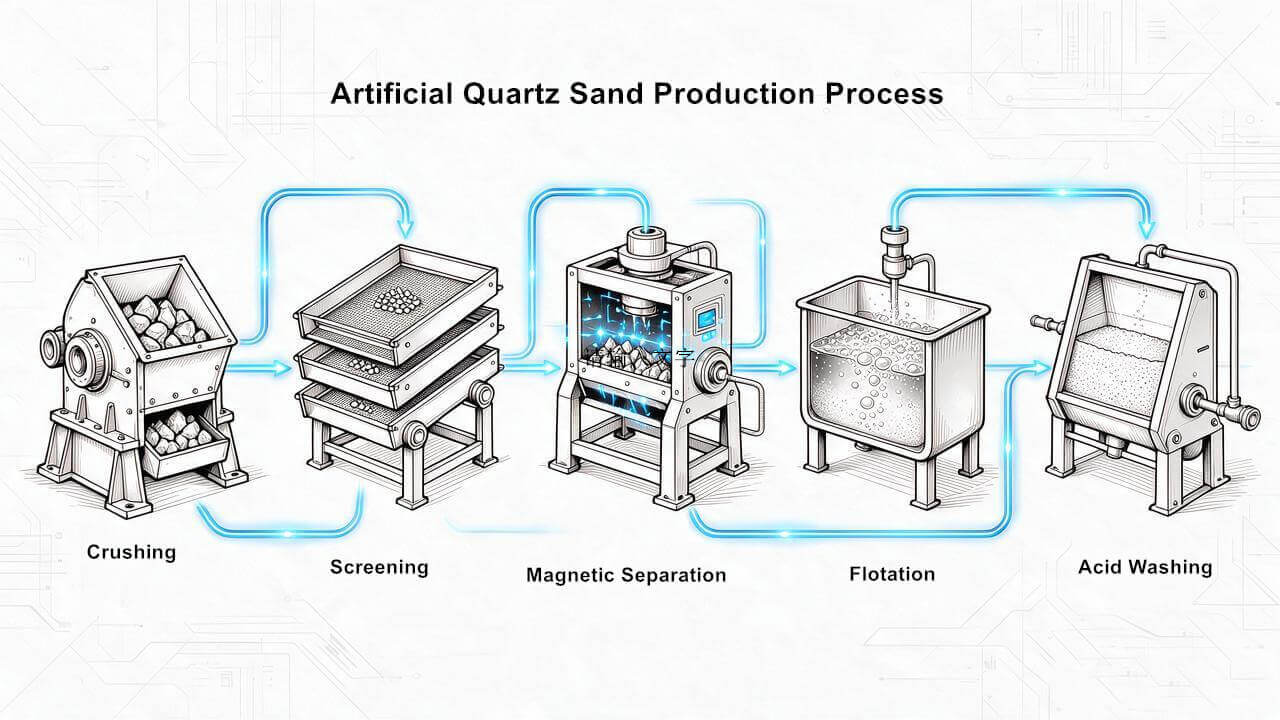
Proses pembuatan pasir kuarsa sintetis buatan terutama meliputi menghancurkan, menyaring, mencampur, mencetak, mengeringkan, sinteringdan lainnya proses.
- Menghancurkan: Pertama, bijih kuarsa alami atau pasir kuarsa dihancurkan menjadi ukuran partikel yang sesuai untuk diproses lebih lanjut.
- Penyaringan: Partikel kuarsa yang dihancurkan disaring untuk menghilangkan kotoran dan partikel yang tidak memenuhi spesifikasi, untuk memastikan kualitas produk.
- Pencampuran: Partikel kuarsa yang disaring dicampur dengan resin, pigmen, dan bahan tambahan lainnya. Proses pencampuran memerlukan kontrol yang ketat terhadap proporsi bahan untuk memastikan kinerja dan penampilan produk akhir.
- Cetakan: Bahan-bahan campuran diisi ke dalam cetakan, kemudian dipadatkan untuk mengisi cetakan dan mencapai bentuk dan ukuran yang diinginkan melalui metode seperti getaran atau kompresi.
- Pengeringan: Cetakan yang telah diisi biasanya menjalani proses pengeringan untuk menghilangkan kelembapan dan mempercepat proses pengawetan bahan. Pengeringan dapat dilakukan melalui pengeringan udara alami atau menggunakan peralatan pengeringan.
- Sintering: Cetakan yang telah diisi dan dikeringkan menjalani proses sintering, di mana cetakan tersebut terkena suhu tinggi untuk menyembuhkan resin, mengikat partikel kuarsa dengan erat, dan membentuk pasir kuarsa sintetis buatan yang padat
Artificial Synthetic Quartz Sand: Current Challenges & Future Potential
Artificial synthetic quartz sand presents a promising alternative to natural quartz sand, boasting superior properties such as high-temperature resistance, wear resistance, corrosion resistance, high compressive strength, and excellent insulation performance. While its physical properties closely resemble natural quartz sand, synthetic quartz offers greater purity and consistency, making it a preferred choice for high-tech industries like semiconductors and advanced materials.
However, despite its advantages, widespread adoption remains in the pilot stage, with key challenges impeding full-scale industry integration.
Key Challenges in Artificial Quartz Sand Adoption
Limited Industrial Maturity
- Synthetic quartz sand is still in the early phases of testing and application, with uncertainties around its performance in downstream processes (e.g., crucible inner layers).
- Ini brittleness and processing difficulties must be improved to broaden usability.
Balancing Purity & Performance
- While synthetic sand offers higher purity, excessive purity can reduce temperature resistance, creating trade-offs in industrial applications.
- Not all industries require ultra-high purity, meaning natural sand remains preferable for cost-sensitive uses.
High Production Costs
- Current synthetic sand costs are several times higher than natural quartz, making it economically viable only in high-value applications like semiconductor crucibles.
- Expanding production efficiency is crucial to making it viable for broader industries like photovoltaics.
Future Outlook & Industry Evolution
Despite current limitations, synthetic quartz sand is on an inevitable path toward replacing natural sand in critical sectors, driven by:
- Sustainability & Resource Security – Reducing reliance on finite natural quartz deposits.
- Technological Advancements – Enhancing processing methods to improve hardness and reduce brittleness.
- Cost Optimization – Scaling production to make synthetic sand competitive across more industries.
As R & D progresses, synthetic quartz is expected to unlock new applications in quantum computing, advanced electronics, and high-performance construction materials. However, achieving full-scale commercialization will require overcoming technical and economic barriers.
Conclusion: A Gradual but Inevitable Shift
While synthetic quartz sand cannot yet fully replace natural sand, its superior properties and long-term potential position it as the future standard for high-precision industries. The technology must evolve to enhance durability, reduce costs, and improve manufacturability before achieving widespread adoption.
Looking for tailored synthetic quartz solutions? Contact our experts for advanced material specifications.
PRODUK TERBARU
-

Inclined Vibrating Screen
The inclined vibrating screen is a simple and eff…
-
High Temperature & Pressure Gold Desorption Electrolysis System
High-Temperature & Pressure Gold Desorption Elect…
-
Normal Temperature & Pressure Gold Desorption Electrolysis System
The normal temperature & pressure gold desorption…


BERITA TERBARU
- Modern Cyanide Residue Treatment Technologies for Gold Processing
- Traditional De-cyanidation Technologies for Gold Cyanide Residues
- Shaking Table, 3-Disc Dry Magnetic & Electrostatic Separator for W-Sn-Ta-Nb
- Mineral Analysis: The Foundation for Successful Mineral Processing Projects
- What Is Over-Grinding and How Can It Be Prevented?
 English
  French
  Spanish
  Portuguese
  Indonesian