



Overview of Chemical Beneficiation
Manfaat kimiawi is a mineral processing method based on differences in the chemical properties of minerals and their components. It uses chemical reactions, dissolution, precipitation, ion exchange, solvent extraction, and other chemical techniques to alter the composition or chemical form of minerals, thereby separating and enriching valuable components.
For example, malachite-bearing copper ore can be leached with dilute sulfuric acid. During leaching, malachite is converted into a copper sulfate solution. Copper metal can then be recovered from the solution by cementation, in which iron filings replace copper ions to produce metallic copper, commonly known as sponge copper.
Chemical beneficiation is particularly effective for processing low-grade, fine-grained, complex, and refractory mineral resources that are difficult to treat using conventional physical beneficiation methods. It can improve resource utilization, recover valuable components from previously uneconomic materials, and contribute to the treatment and utilization of waste streams such as wastewater and waste residues.
A typical chemical beneficiation process consists of six major operations:
- Preparatory work
- Memanggang
- Leaching
- Pemisahan padat-cair
- Purification
- Recovery of chemical concentrates
The specific process configuration depends on the mineral composition, the properties of the valuable components, and the required product quality.
Proses Pemanfaatan Bahan Kimia
Benefisiasi kimia memiliki operasi yang berbeda sesuai dengan proses teknologi yang berbeda. Proses benefisiasi kimiawi yang khas umumnya mencakup enam operasi utama berikut ini.
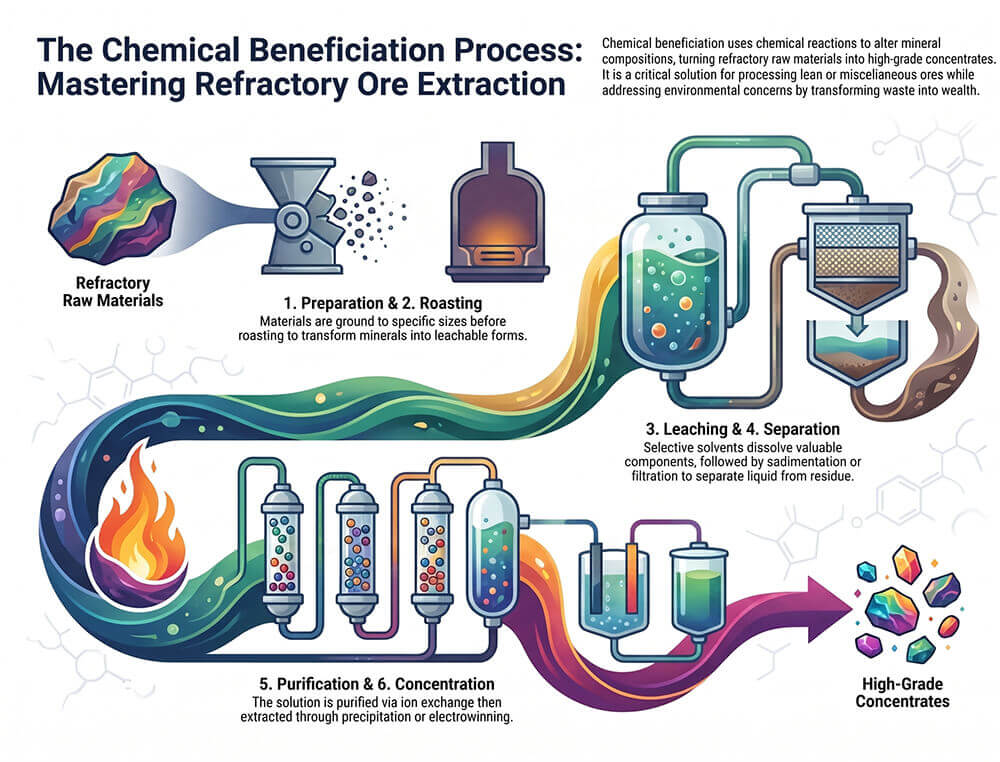
1. Preparatory Work
Operasi ini sama dengan metode penerima manfaat fisik, termasuk menghancurkan dan menyaring bahan, menggiling dan menilai, mencampur bahan, dan proses pemrosesan mekanis lainnya. The purpose is to grind the material to a specific particle size, prepare suitable fineness and concentration for the next operation, and sometimes use physical beneficiation to remove some harmful impurities or enrich the target minerals in advance so that the mineral raw materials and chemical reagents are mixed well. If the fire method is used, sometimes the material must be dried or sintered to create favorable conditions for the next operation.
2. Roasting Operation
The purpose of roasting is to change the chemical composition of the ore or remove harmful impurities so that we can transform the target mineral (component) into a form that is easy to leach or beneficial to physical beneficiation and prepare conditions for the next operation. The roasted products include calcined sand, dry dust, wet dust collection liquid, and mud, from which corresponding methods can recover functional components according to their composition and properties.
3. Leaching Operation
Operasi ini untuk melarutkan komponen fungsional atau komponen pengotor secara selektif dalam pelarut pelindian sesuai dengan sifat-sifat bahan baku dan persyaratan proses sehingga komponen berharga dipisahkan dari komponen pengotor, atau komponen fungsional dipisahkan, yang merupakan langkah selanjutnya. Menciptakan kondisi untuk mendapatkan kembali komponen yang berguna dari larutan pelindian atau residu pelindian.
4. Solid-liquid Separation Operation
This is the same as the dehydration operation of physical beneficiation products, but the solid-liquid separation of chemical beneficiation leached pulp is more complicated. Generally, sedimentation, filtration, and classification are used to process leached ore pulp to obtain a clarified solution or contain a small number of fine mineral particles.
5. Purification Work
To obtain high-grade chemical concentrates, the leaching solution is often purified and separated by chemical precipitation, ion exchange, or solvent extraction to remove impurities and obtain a purified solution with a high content of valuable components.
6. Production of Chemical Concentrates
Chemical concentrates are obtained by extracting valuable metals (components) from the leaching solution. Generally, chemical precipitation, metal replacement, electrowinning, carbon adsorption, ion exchange, or solvent extraction can be used; in some cases, physical beneficiation can also be used. The principal process of typical chemical beneficiation is as follows.
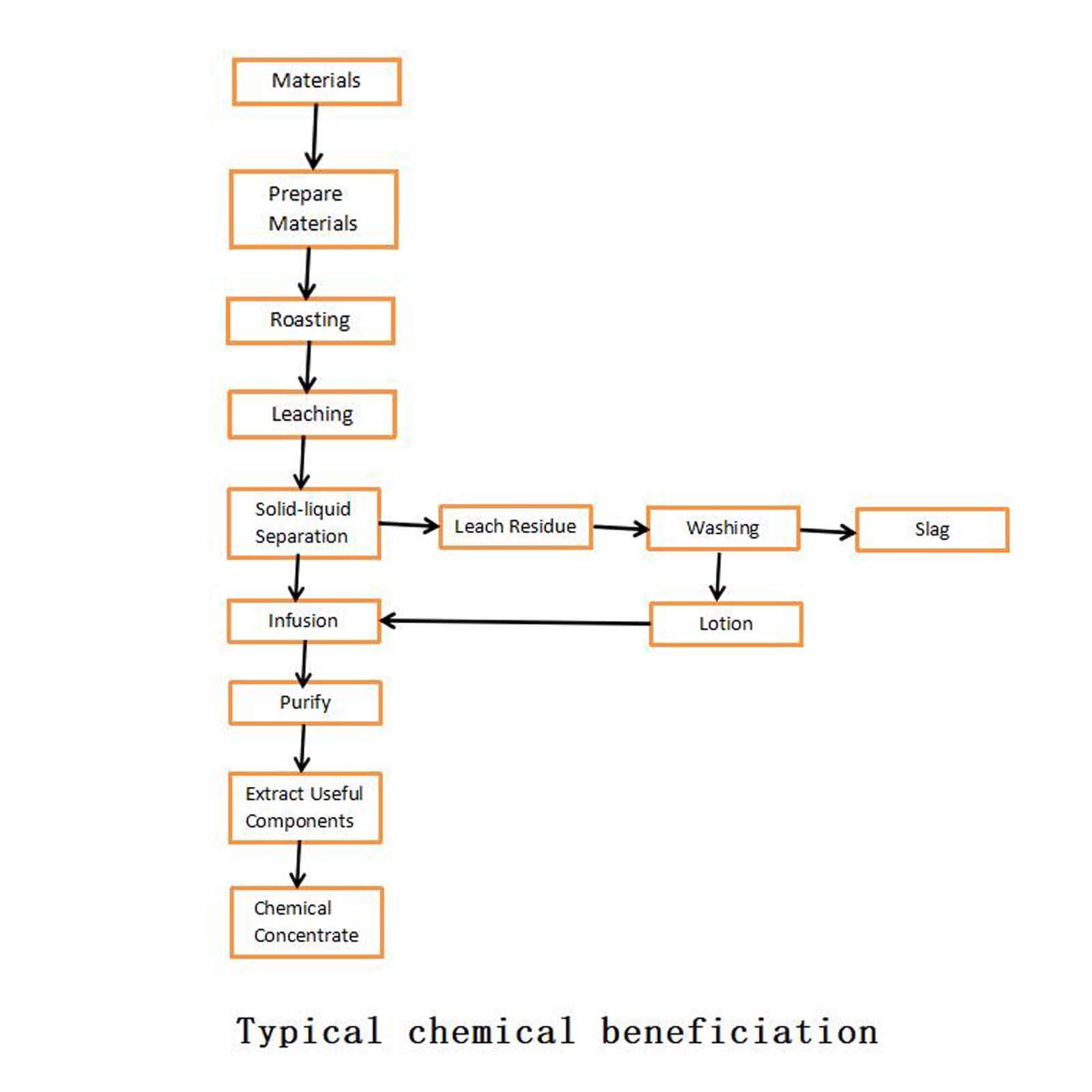
Perusahaan ini telah berhasil menggunakan benefisiasi kimia untuk memproses banyak mineral logam dan bahan baku mineral non-logam seperti besi, mangan, memimpin, tembaga, seng, tungstenaluminium, timah, emas, peraktantalum, niobium, kobalt, nikeluranium, thorium, tanah jarang, aluminium, fosfor, grafit, berlian, kaolin, dan bahan baku mineral padat lainnya. Alat ini juga dapat mengekstrak komponen berharga dari air tambang, air limbah, dan air laut.
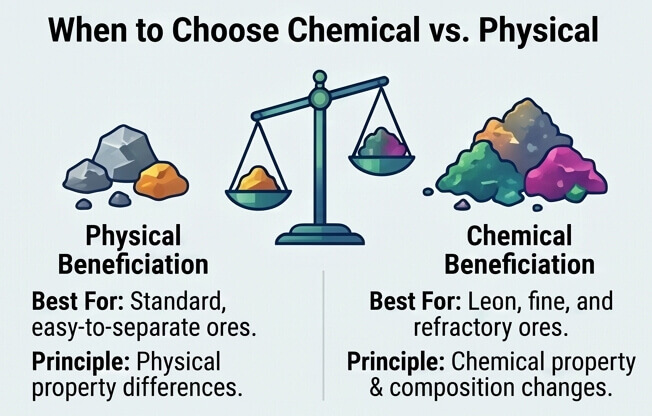
The processing object of characteristic chemical beneficiation is the same as that of physical beneficiation. Still, the adaptability of the chemical beneficiation method is stronger than that of the physical beneficiation method, and its separation principle and product form are different from physical beneficiation. The separation principle of chemical beneficiation is similar to the traditional metallurgical process. Chemical beneficiation and the metallurgical process both use the basic principles of inorganic chemistry, organic chemistry, physical chemistry, and chemical processes to solve their respective process problems. Mineral dressing is widely used in developing various refractory ferrous metals, non-ferrous metals, precious metals, and non-metallic mineral resources.
Menerapkan benefisiasi kimia adalah metode yang efektif untuk menangani bahan baku mineral yang buruk, halus, lain-lain, dan bahan baku mineral tahan api lainnya serta mendaur ulang sumber daya mineral yang tidak terpakai. Efisiensi pemisahannya lebih tinggi dibandingkan dengan benefisiasi fisik. Namun, proses benefisiasi kimiawi mengkonsumsi banyak bahan kimia, dan persyaratan untuk bahan peralatan dan pemisahan padat-cair lebih tinggi daripada proses benefisiasi fisik. Oleh karena itu, dalam kondisi normal, harus menggunakan metode manfaat fisik yang ada untuk memproses bahan baku mineral sebanyak mungkin.
Kapan harus mempertimbangkan penggunaan proses benefisiasi kimia?
- Ini tidak dapat diproses hanya dengan manfaat fisik saja.
- Ketika metode pemberian manfaat fisik gagal mendapatkan indikator teknis dan ekonomi yang masuk akal
When Should Chemical Beneficiation Be Considered?
Chemical beneficiation should generally be considered under the following conditions:
1. Physical Beneficiation Alone Is Ineffective
When valuable minerals are extremely fine-grained, closely associated with gangue, disseminated, or chemically similar to the surrounding minerals, conventional physical beneficiation may not achieve satisfactory separation.
2. Physical Beneficiation Cannot Achieve Reasonable Technical and Economic Indicators
If physical beneficiation cannot provide acceptable recovery, concentrate grade, or economic performance, chemical treatment may provide an alternative or supplementary solution.
3. Valuable Components Occur in Complex or Refractory Forms
Chemical beneficiation is particularly suitable when valuable components occur in forms that are difficult to recover through conventional gravity, magnetic, flotation, or other physical methods.
Precautions When Using The Chemical Beneficiation Process
- Gunakan proses loop tertutup sebanyak mungkin. Regenerasi obat sepenuhnya dan mendaur ulang air untuk mengurangi konsumsi obat dan pencemaran lingkungan.
- Proses gabungan antara pemurnian fisik dan pemurnian kimiawi harus diadopsi sebanyak mungkin. Berbagai metode pemurnian digunakan untuk memproses bahan baku mineral agar pemanfaatan sumber daya mineral dapat dilakukan secara ekonomis dan komprehensif.
Kesimpulan
Chemical beneficiation is an important mineral processing technology for treating low-grade, fine-grained, complex, and refractory mineral resources. By utilizing differences in chemical properties and employing operations such as roasting, leaching, solid-liquid separation, purification, and valuable-component recovery, it can achieve separations that are difficult or impossible to accomplish through physical beneficiation alone.
However, chemical beneficiation generally requires greater consumption of chemical reagents and places higher demands on equipment, materials, solid-liquid separation, and environmental management. Therefore, it should not automatically replace physical beneficiation.
In practice, physical beneficiation should be used whenever it can provide satisfactory technical and economic results, while chemical beneficiation should be introduced where necessary and, whenever possible, integrated with physical beneficiation. The optimal process should maximize valuable-component recovery, minimize reagent and water consumption, promote closed-loop operation, reduce environmental impact, and achieve comprehensive and economical utilization of mineral resources.
PRODUK TERBARU
-

Inclined Vibrating Screen
The inclined vibrating screen is a simple and eff…
-
High Temperature & Pressure Gold Desorption Electrolysis System
High-Temperature & Pressure Gold Desorption Elect…
-
Normal Temperature & Pressure Gold Desorption Electrolysis System
The normal temperature & pressure gold desorption…


BERITA TERBARU
- Modern Cyanide Residue Treatment Technologies for Gold Processing
- Traditional De-cyanidation Technologies for Gold Cyanide Residues
- Shaking Table, 3-Disc Dry Magnetic & Electrostatic Separator for W-Sn-Ta-Nb
- Mineral Analysis: The Foundation for Successful Mineral Processing Projects
- What Is Over-Grinding and How Can It Be Prevented?
 English
  French
  Spanish
  Portuguese
  Indonesian