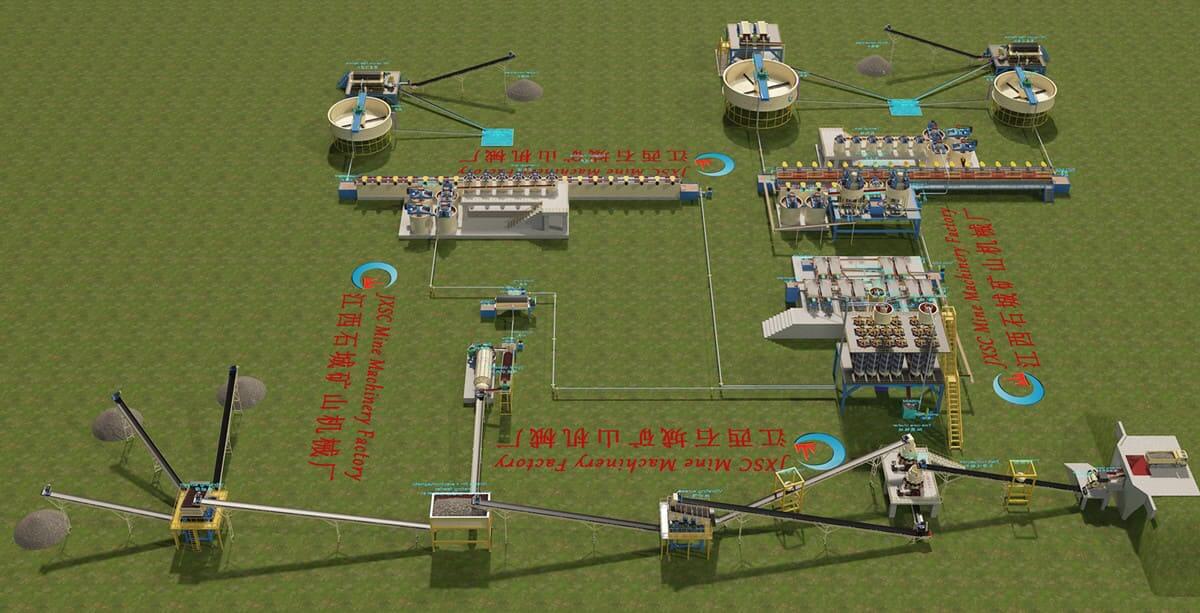
1) Crushing Part: Capacity 100TPH
Send 0-500 mm rocks to the hopper at first. The pengumpan getaran will feed the rocks into the first cone crusher. After crushing, the smaller rocks will be sent to a vibration screen with a 20 mm and 40 mm screen by belt conveyor.
The larger than 20 mm rocks will be sent back to another cone crusher to be crushed again. The material less than 20 mm will be transferred to an underground transfer bin before the ball mill.
- If the feeding materials of the plant are kuarsa, the under-hopper feeder will send the crushed materials to the next vibration screen with two layers of screens, 13 mm and 6mm. Then can get 3 kinds of crushed final output.
- If the feeding materials of the plant are copper, gold, or lithium ore, another feeder will send the crushed materials to the grinding system.
2)Grinding Process Part: Capacity 42 TPH
The -20mm materials will be transferred by an electromagnetic vibration feeder beneath the hopper to the ball mill evenly. The ball mill will grind the -20 mm rocks to be 0-1 mm (70%-80% 200 mesh, around 0.074 mm). The ball mill will match with a pengklasifikasi spiral. The classifier will send the materials larger than 0.074 mm back to the ball mill to grind again. The particles less than 0.074mm will go to a pemisah magnetik drum to remove iron at first.
3)Sulfide copper and gold ore flotation Process System
If the raw ore is sulfide copper and gold, one pompa lumpur will send the ground slurry to the flotation system to extract the concentrate copper and gold. There are 3 stages for the flotation process: roughing, scavenging, and cleaning. The concentrate will be extracted from the cleaning stage and then will be sent to the thickener to do sedimentation. Then, underflow from the pengental will go to the vacuum filter to dewater and get the final concentrate.
The tailings from the flotation system will go to the shaking table to do gravity separation to collect concentrate in the tailings as much as possible.
4)Lithium Ore with Tantalum Process System
If the raw ore is lithium ore that contains tantalum, another slurry pump will send the ground slurry to a gravity separation system to collect the tantalum first. Generally, use two-stage saluran spiral to do first-stage gravity separation. Then the concentrate from the spirals will go to shaking tables to do the second stage gravity separation and get the concentrate of tantalum.
All the tailings from the two stages of gravity separators will go to a flotation system to extract the Li2O. Before the flotation process, generally, two stages of the hydrocyclone group are used to decline the mud to ensure the flotation efficiency.
The slurry from the hydrocyclone groups will go to several sets of mixing tanks to mix with chemicals. After that, the pulp will go to the flotation machines and start the Li2O beneficiation. If there’s a lot of mica in the lithium ore, it also needs to undergo a pre-process by several flotation cells to remove as much mica as possible. Then the concentrate from the pre-process cells will go to the next stage, the concentrate extraction flotation cells. Generally, there are 3 stages for flotation: roughing, scavenging, and cleaning. The concentrate will be extracted from the cleaning stage and then will be sent to the thickener to do sedimentation. Then, underflow from the thickener will go to the vacuum filter for dewatering, and the final concentrate will be sent away by belt conveyor.
The tailings will go to another thickener, and the underflow from the thickener will go to the plate filter to do dewatering.








 English
  French
  Spanish
  Portuguese
  Indonesian