



Tambang Ruby are deposits rich in ruby, a precious gemstone in the corundum family of minerals; its main component is aluminium oksida (Al₂O₃). Warna merah pada batu rubi berasal dari jejak kromiumdan semakin gelap warnanya, semakin tinggi nilainya. Bijih Ruby termasuk dalam sistem kristal tripartit dan memiliki kekerasan tinggi 9 pada skala Mohskedua setelah berlian. Ruby memiliki ketahanan abrasi dan kimia yang sangat baik serta memiliki kilau seperti kaca, transparan hingga tembus cahaya. Rubi biasanya terbentuk dalam batuan metamorf (misalnya marmer, gneiss) dan batuan beku, dan umumnya bersimbiosis dengan mineral seperti kalsit, tremolit, dan mika. Its color varies from pink to deep red, where the iron and titanium content affects its hue and transparency.
Because ruby is relatively rare and commonly occurs with other minerals, ruby mining and processing require careful geological exploration, selective extraction, ore washing, sorting, and gemstone-quality evaluation. The most important factors determining a finished ruby’s value include color, clarity, origin, size, cut, and whether the stone has been treated.
This guide explains the mineralogy of ruby, common ruby-associated minerals, the main methods used in ruby mining and processing, and the production process from exploration to the finished gemstone.
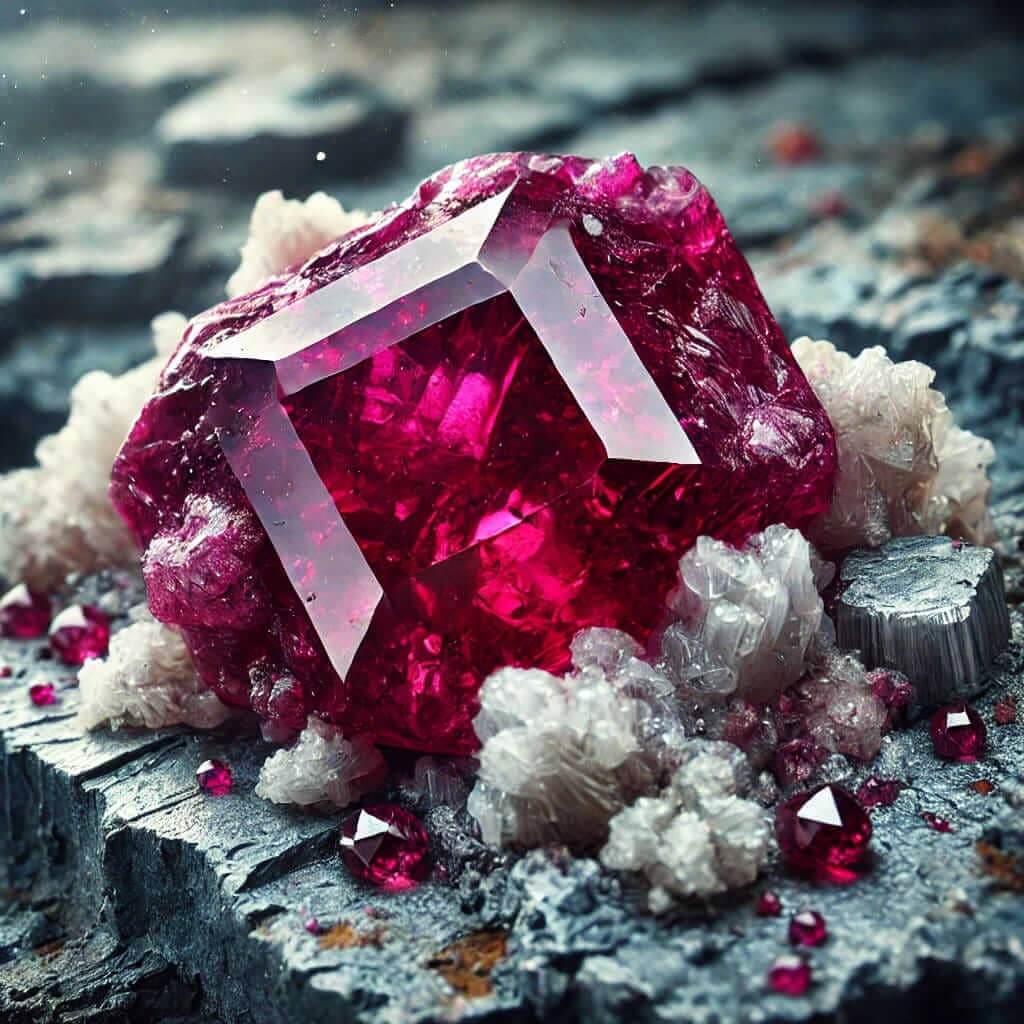
Where Are Ruby Deposits Found?
Ruby deposits form under specific geological conditions in which aluminum-rich rocks interact with chromium-bearing fluids or rocks. Commercial ruby deposits can be broadly associated with metamorphic, metasomatic, and basalt-related geological environments.
In many metamorphic deposits, ruby occurs in marble or calc-silicate rocks together with minerals such as calcite, amphiboles, mica, spinel, garnet, and diopside. The mineral assemblage provides important clues during geological exploration because it helps geologists identify the formation environment of the deposit.
The distribution and quality of ruby within an orebody can be highly irregular. Some deposits contain relatively abundant gem-quality material, while others produce only small quantities of rough ruby mixed with a large amount of host rock and associated minerals.
Mineral Simbiosis Ruby
Bijih ruby sering kali bersimbiosis dengan mineral lain, membentuk kombinasi mineral yang kompleks. Jenis-jenis mineral simbiotik ini berkaitan erat dengan asal-usul geologi bijih ruby dan jenis deposit. Berikut ini adalah beberapa mineral simbiosis bijih ruby yang umum:
- Korundum (Safir)
Ruby dan safir keduanya korundum minerals with the same chemical composition, aluminum oxide (Al₂O₃), but with different colors due to different coloring elements. In some deposits, ruby and sapphire can form at the same time; ruby is red because of chromium, while sapphire is blue because of trace elements such as iron and titanium. - Tremolit (Ca₂Mg₅Si₈O₂₂(OH)₂)
Tremolite is a chain silicate mineral often associated with metamorphosed marble and serpentinite. It is a member of the amphibole group, often found in calc-silicate metamorphic rocks where rubies form. - Spinel (MgAl₂O₄)
Spinel adalah magnesium-aluminium oksida yang sering muncul dalam berbagai warna, termasuk merah, biru, dan ungu. Spinel merah mungkin menyerupai ruby. Baik spinel maupun ruby terbentuk di lingkungan geologi bersuhu dan bertekanan tinggi, terutama di endapan metamorfisme ultramafik dan dasit, di mana keduanya sering hidup berdampingan. - Mika
Mika adalah sekelompok mineral silikat berlapis yang tersebar luas dalam sekis kristal dan kyanit dengan metamorfisme rendah dan menengah, serta pada gneis muskovit dan biotit, urat kuarsa, sedimen berbutir halus, dan batuan pembawa amfibol biru. Ini terbentuk dengan urat ruby dan sangat umum di batuan metamorf seperti gneis dan sekis. - Kalsit (CaCO₃)
Mineral kalsium karbonat (CaCO₃), biasanya berwarna putih atau berwarna terang, tetapi varietas transparan juga tersedia. Mineral ini umum ditemukan pada marmer dan menjadi tuan rumah bagi banyak deposit rubi metamorf. Kalsit adalah mineral dengan kekerasan rendah, sangat kontras dengan kekerasan ruby. - Garnet
Garnet is a common class of silicate minerals that comes in a variety of colors, with common variants including red, green, and yellow. Garnets and rubies form under high-temperature and high-pressure environments, especially in metamorphic and ultramafic environments, where they often coexist. - Diopsida (CaMgSi₂O₆)
Mineral kalsium magnesium silikat (CaMgSi₂O₆), sering ditemukan dalam marmer metamorf dan gabro. Dalam dasit, tremolit dan ruby sering terbentuk bersama, mencerminkan kumpulan mineral dalam metamorfisme suhu tinggi. - Rutil (TiO₂)
Rutil adalah mineral titanium dioksida yang biasanya tampak berwarna merah atau cokelat. Sebagai mineral titanium yang umum, mineral ini sering menyertai pembentukan batu rubi, terutama pada endapan metamorf. Sebagai inklusi yang khas pada batu rubi, rutil ditemukan pada batu rubi dari Burma, Mozambik, dan Sri Lanka. - Talk (Mg₃Si₄O₁₀(OH)₂)
Bedak adalah mineral silikat yang sangat lunak dengan tekstur licin dan kekerasan pada skala Mohs hanya 1. Talc dan ruby terkadang bersimbiosis selama metamorfisme pada massa batuan ultramafik, terutama pada zona metamorf yang mengandung magnesium. - Turbidit (Ca₂Mg₅Si₈O₂₂ (OH)₂)
Turbidit adalah mineral silikat berantai yang sering dikaitkan dengan marmer metamorf dan serpentinit. Pada beberapa endapan rubi, khususnya di zona metamorf marmer, tremolit dan rubi dapat terjadi bersamaan.
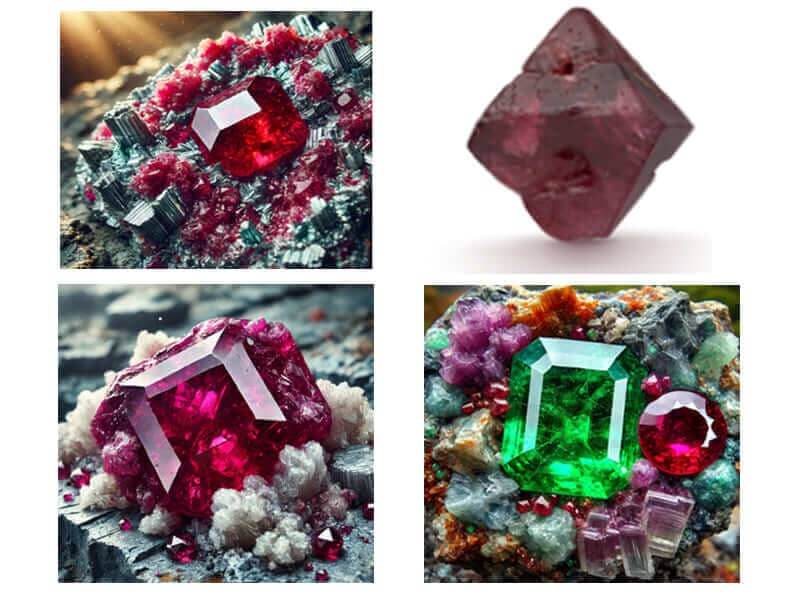
Penambangan & Produksi Ruby
Proses penambangan dan produksi batu delima melibatkan beberapa tahap, mulai dari eksplorasi deposit hingga penambangan dan pengolahan bijih. Berikut ini adalah langkah-langkah utama dalam penambangan dan produksi ruby:
1. Deposit Exploration
Survei geologi: Identifikasi potensi deposit ruby melalui survei geologi dan pengambilan sampel. Pencarian utama adalah untuk area-area aluminium, silikon, dan pengayaan kromium yang terkait dengan pembentukan ruby.
Analisis geofisika dan geokimia: Berbagai teknik geofisika (misalnya, elektromagnetik, refleksi seismik, dan lain-lain) dan analisis geokimia digunakan untuk menilai ukuran dan kualitas deposit.
2. Pertambangan
(1) Open-pit mining: Open-pit mining is usually used when ruby deposits are close to the surface. This method involves stripping the topsoil and overburden to access the ruby ore.
The typical operations include:
- Removing soil and weathered overburden.
- Excavating ruby-bearing rock.
- Selectively extracting mineralized zones.
- Washing and screening the extracted material.
- Recovering and sorting ruby-bearing fragments.
Because gem-quality ruby can be easily damaged by excessive
blasting or crushing, selective mining and controlled excavation are particularly important.
(2) Underground Mining: When the deposit is deep, miners use underground techniques, including shafts and adits, to extract the ore safely and efficiently.
Depending on the deposit, underground operations may involve:
- Shafts or declines.
- Horizontal adits or tunnels.
- Selective extraction of mineralized zones.
- Manual or mechanized ore removal.
- Ground support and mine ventilation.
Small-scale underground mining is also common in some traditional ruby-producing regions.
(3) Washing: Bijih yang ditambang dicuci atau disaring untuk menghilangkan kotoran dan memisahkan bijih yang mengandung ruby.
3. Pengolahan
Ruby ore processing is different from conventional metal-ore processing because the objective is to recover intact gemstones rather than liberate a fine mineral concentrate.
A typical ruby processing flow may include:
Mining → Washing → Screening → Desliming → Gravity concentration → Hand sorting → Gemological evaluation → Cutting and polishing
Washing and Desliming: Freshly mined ruby-bearing material may contain clay, soil, sand, and weathered rock. Washing removes loose material and helps expose ruby-bearing fragments.
Crushing and Size Reduction: Crushing may be required when ruby is locked within hard host rock. However, excessive crushing can fracture valuable crystals and reduce gemstone recovery. For this reason, controlled and selective size reduction is generally preferable to aggressive grinding.
Penyaringan dan Klasifikasi: Pisahkan bijih yang mengandung ruby dari bijih lainnya dengan metode seperti penyaringan dan pemisahan gravitasi. Rubi yang lebih besar dan lebih baik biasanya dipilih secara individual.
Pemisahan Gravitasi: Because ruby has a relatively high specific gravity compared with many common gangue minerals, gravity-based methods can assist in concentrating ruby-bearing material.
Hand Sorting and Gemstone Recovery: High-value rough ruby is often recovered through careful manual sorting. Workers or gemologists examine individual stones for color, transparency, crystal form, fractures, inclusions, and potential cutting value. This stage is particularly important because a small rough crystal can be worth significantly more as an intact gemstone than as crushed material.
Selesai: Bijih ruby yang dipilih selanjutnya dipoles dan dipotong untuk mendapatkan bentuk yang tepat untuk batu tersebut. Proses ini biasanya dilakukan di pabrik pengolahan perhiasan khusus dan melibatkan pemotongan dan pemolesan presisi tinggi.
4. Quality Control
Evaluasi dan penilaian: Rubi dinilai berdasarkan warna, transparansi, kualitas potongan, dan ukurannya untuk menentukan nilai pasarnya.
Pengujian: Analisis spektral, pemeriksaan mikroskopis, dan cara teknis lainnya digunakan untuk memastikan keaslian dan kualitas batu rubi.
5. Pemasaran
Grosir dan eceran: Rubi diproses dan dijual melalui toko perhiasan, rumah lelang, atau pasar online.
Pencitraan merek dan sertifikasi: Sertifikasi oleh merek dan organisasi terkenal (misalnya GIA, dll.) dapat meningkatkan nilai pasar batu rubi.
6. Sustainability and Environmental Protection
Sustainable Ruby Mining: Modern ruby mining increasingly considers environmental protection, resource efficiency, worker safety, and local community development.
Responsible ruby mining may include:
- Minimizing unnecessary excavation.
- Managing mine waste and wastewater.
- Controlling erosion and sediment discharge.
- Rehabilitating disturbed land.
- Improving worker health and safety.
- Supporting local communities.
- Maintaining transparent supply chains.
- Complying with applicable mining and environmental regulations.
Sustainability is particularly important for gemstone operations because the social and environmental conditions under which a gemstone is produced can affect its long-term market acceptance.
Kesimpulan
The evolution of ruby processing has been significantly shaped by technological advancements, including solutions from JXSC Machine—a leader in mineral processing equipment. Modern techniques like automated ore sorting, sensor-based gravity separation, and eco-friendly washing systems improve yield and gemstone preservation while reducing environmental impact. JXSC’s crushers and screening equipment enable precise, low-waste extraction, ensuring high recovery rates for even fragile rubies.
The ruby mining process is a blend of geological artistry and cutting-edge engineering. By marrying traditional knowledge with modern tech—like JXSC’s machinery—the industry can meet global standards for quality, sustainability, and traceability, securing rubies’ legacy as one of Earth’s most treasured gems.
PRODUK TERBARU
-

Inclined Vibrating Screen
The inclined vibrating screen is a simple and eff…
-
High Temperature & Pressure Gold Desorption Electrolysis System
High-Temperature & Pressure Gold Desorption Elect…
-
Normal Temperature & Pressure Gold Desorption Electrolysis System
The normal temperature & pressure gold desorption…


BERITA TERBARU
- Modern Cyanide Residue Treatment Technologies for Gold Processing
- Traditional De-cyanidation Technologies for Gold Cyanide Residues
- Shaking Table, 3-Disc Dry Magnetic & Electrostatic Separator for W-Sn-Ta-Nb
- Mineral Analysis: The Foundation for Successful Mineral Processing Projects
- What Is Over-Grinding and How Can It Be Prevented?
 English
  French
  Spanish
  Portuguese
  Indonesian