



For a new planta de tratamiento de minerales, plant expansion, or mining project, selecting the right equipment is not the first step. The first step is to understand the ore.
What minerals are present in the ore? Where are the valuable elements hosted? What are the grain sizes of the valuable minerals? How are the minerals intergrown, associated, or locked together? At what grinding size can sufficient mineral liberation be achieved? Which impurities may affect concentrate quality?
These questions can only be answered through systematic mineral analysis, process mineralogy studies, and mineral testing.
Mineral analysis is therefore much more than a routine chemical assay. It is a fundamental part of the pre-project ore characterization process. It provides essential information for designing beneficiation tests, selecting the appropriate processing route, and developing a reliable mineral processing flowsheet.
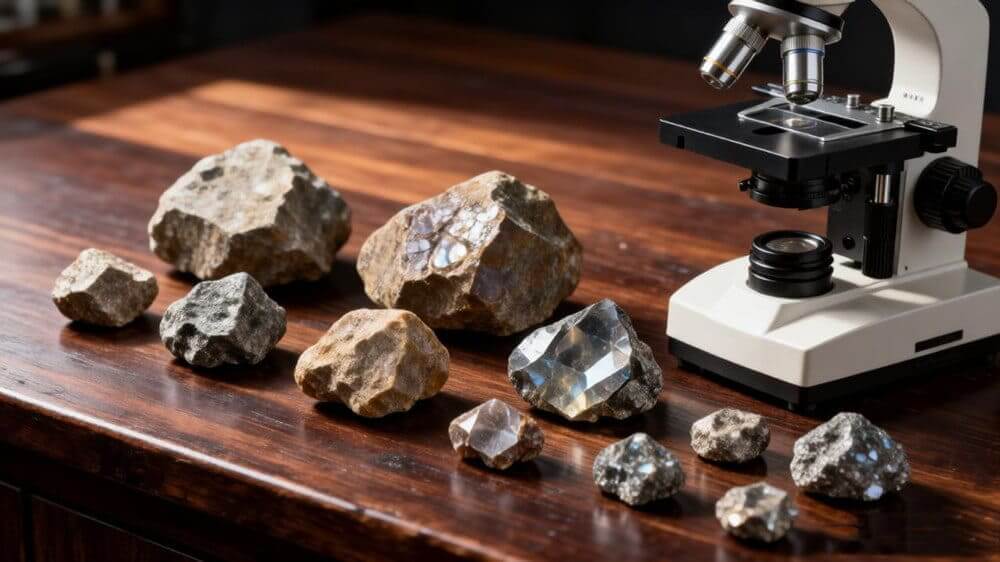
What Does Mineral Analysis Tell Us?
Routine chemical analysis primarily tells us what elements are present and how much of each element is contained in the ore.
For example, an ore may contain valuable elements such as cobre, lead, zinc, iron, molibdeno, gold, or silver, as well as potentially harmful elements such as arsenic and sulfur.
However, elemental analysis alone is not enough for mineral processing.
Consider a silver-bearing ore. Silver may occur as independent silver minerals or as microscopic inclusions within pyrite or other sulfide minerals. Although two ores may have similar silver grades, their processing characteristics can be completely different.
This is why:
Chemical analysis tells us how much value is contained in the ore, while mineral analysis tells us how that value occurs and whether it can be effectively recovered.
Understanding the mineralogical characteristics of an ore is therefore critical to selecting an appropriate beneficiation method.
Key Components of Mineral Analysis
1. Multi-Element Chemical Analysis
The first stage of ore characterization is usually comprehensive chemical analysis.
The main objectives are to determine:
- The types and grades of valuable elements;
- Associated elements with potential economic value;
- Harmful impurities and their concentrations;
- Variations in ore composition between different mining zones;
- Element distribution across different particle-size fractions.
These results provide the foundation for subsequent mineralogical investigations.
2. Process Mineralogy: Understanding Where Valuable Elements Occur
Process mineralogy goes beyond elemental composition to determine which minerals host the valuable elements.
Depending on project requirements, techniques such as optical microscopy, reflected-light microscopy, electron microscopy, automated mineral analysis, and other analytical methods can be used to investigate:
- Major ore and gangue minerals;
- Valuable mineral species;
- Host minerals of valuable elements;
- Mineral grain size and distribution;
- Mineral associations and intergrowths;
- Mineral inclusions and locking characteristics;
- The occurrence of deleterious elements.
This information provides a direct basis for evaluating whether gravity separation, magnetic separation, flotation, or other beneficiation methods may be suitable.
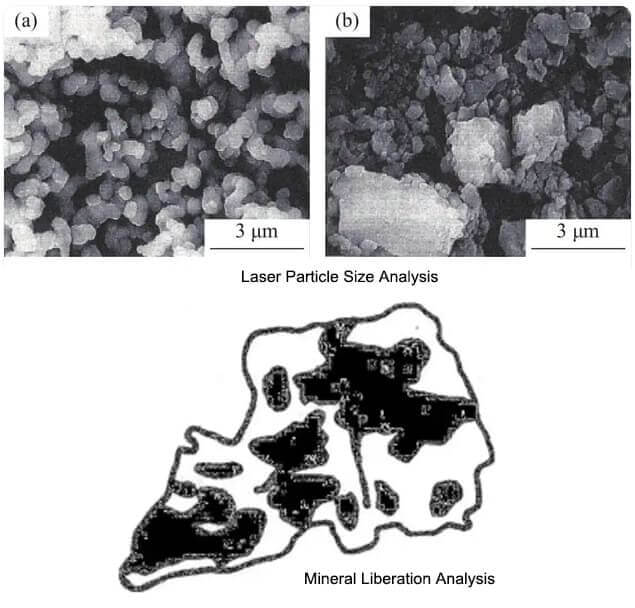
3. Particle Size and Mineral Liberation Analysis
Grinding is not simply a matter of making the ore as fine as possible.
Insufficient grinding may leave valuable minerals locked with gangue or other minerals, resulting in poor separation. Excessive grinding, on the other hand, can generate excessive slimes, increase energy and reagent consumption, and negatively affect downstream separation.
Particle-size analysis and mineral liberation studies can therefore be used to evaluate the degree of mineral liberation at different grinding sizes.
The objective is to determine:
What grinding size provides sufficient mineral liberation without unnecessary overgrinding?
This information is particularly important for designing the grinding and classification circuit.
Mineral Characteristics Determine the Processing Route
Different mineralogical characteristics can lead to completely different beneficiation strategies.
If valuable minerals occur as relatively coarse grains and have significant density differences from gangue minerals, separación gravimétrica may be an important processing option.
If valuable minerals occur as fine disseminated particles or have complex associations with sulfide minerals, flotación may become the primary beneficiation method.
If the ore contains significant magnetic minerals, separación magnética can be evaluated based on differences in magnetic susceptibility.
If the ore contains large amounts of clay minerals or slimes, scrubbing, washing, and desliming may need to be incorporated into the flowsheet.
If deleterious elements occur as extremely fine inclusions within other minerals, simply increasing the grinding fineness may not solve the problem. Additional pretreatment or specialized separation methods may need to be investigated.
Therefore, mineral analysis helps define the technical boundaries of a mineral processing flowsheet.
Mineral Analysis and Beneficiation Tests Work Together
Mineral analysis does not, by itself, constitute a final plant design.
It answers questions such as:
What is the ore made of?
How do valuable minerals occur?
What processing methods may theoretically be suitable?
Beneficiation testing then determines whether those theoretical possibilities can be achieved under practical operating conditions.
A typical technical workflow can be summarized as:
Representative Sampling → Chemical Analysis → Process Mineralogy → Particle-Size & Liberation Analysis → Process Concept Development → Beneficiation Testing → Process Optimization → Flowsheet Development → Equipment Selection
For example, if mineralogical analysis indicates that a valuable mineral reaches a high degree of liberation at a particular grinding size, beneficiation tests can be designed around that condition.
If the actual test results differ from the mineralogical prediction, further investigation may be required to understand the effects of mineral association, surface properties, slimes, reagent interactions, or other factors.
Mineral analysis and beneficiation testing should therefore be viewed as complementary and mutually validating stages of the same technical process.
Representative Sampling Is the First Step to Reliable Results
The reliability of mineral analysis depends heavily on the representativeness of the samples.
Testing only a few high-grade samples may produce attractive laboratory results, but those results may not represent the ore that will actually be processed during commercial production.
A representative sampling program should consider:
- Different mining levels and zones;
- Different ore types;
- Variations in geological and mineralogical characteristics;
- Expected future mining and blending conditions.
For deposits with significant ore variability, multiple samples and composite samples may be required to obtain a more realistic understanding of the material that will enter the processing plant.
Reliable mineral analysis starts with representative samples.
Why Should You Avoid Simply Copying Another Mine’s Flowsheet?
A common approach in mineral processing projects is to adopt the flowsheet used by a nearby mine processing a similar ore.
Existing plants can certainly provide useful technical references. However, their flowsheets should not simply be copied without characterizing the ore of the new project.
Even within the same mining district or deposit, different ore zones can have significant differences in:
- Mineral composition;
- Mineral grain size;
- Mineral associations;
- Degree of liberation;
- Slime generation;
- Surface properties;
- Metallurgical response.
As a result, two apparently similar ores may require completely different grinding sizes, reagent schemes, flotation conditions, or flowsheet configurations.
A proven flowsheet can be a reference—but it cannot replace project-specific mineral analysis and beneficiation testing.
JXSC Mineral Analysis and Testing Services
JXSC provides mineral analysis and mineral testing services to support ore characterization, beneficiation testing, and mineral processing flowsheet development.
Depending on the ore type and project requirements, JXSC’s mineral analysis services can help investigate:
- Major and minor elements and their concentrations;
- The occurrence and distribution of valuable elements;
- Host minerals of valuable elements;
- Ore and gangue mineral composition;
- Mineral grain size and dissemination characteristics;
- Mineral associations, intergrowths, and inclusions;
- Mineral distribution in different size fractions;
- Mineral liberation characteristics;
- The occurrence of deleterious elements;
- Key mineralogical parameters required for subsequent beneficiation testing.
Chemical analysis, mineral identification, particle-size analysis, liberation studies, and other analytical techniques can be combined according to the specific requirements of each project.
For new mineral processing plants, plant expansion projects, difficult-to-process ores, and comprehensive mineral utilization projects, these analytical results can provide important baseline data for developing and optimizing beneficiation test programs.
From Mineral Analysis to Plant Design
The ultimate value of mineral analysis lies in how its results are applied to engineering decisions.
For example:
Mineral liberation characteristics → Determine the appropriate grinding target;
Mineral size distribution → Guide grinding and classification design;
Density differences → Evaluate the potential of gravity separation;
Magnetic properties → Support magnetic separation process selection;
Mineral surface properties and associations → Guide flotation reagent schemes and process optimization;
Clay and slime characteristics → Determine the need for washing or desliming;
Occurrence of deleterious elements → Support concentrate quality control and impurity removal strategies;
Occurrence of associated valuable elements → Provide a basis for comprehensive recovery.
This creates a complete technical chain:
Mineral Analysis → Beneficiation Testing → Process Optimization → Flowsheet Design → Equipment Selection → Plant Operation
Conclusion: Understand the Ore Before Designing the Process
Mineral processing is fundamentally about exploiting differences in the physical and chemical properties of minerals to separate valuable minerals from gangue and unwanted components.
That is why a reliable mineral processing project should not begin with the question:
“Which equipment should we buy?”
It should begin with:
“What is the ore actually like?”
Mineral analysis determines what the ore is.
Beneficiation testing determines how effectively it can be processed.
Engineering design determines how the selected process can be implemented at industrial scale.
For new processing plants, expansion projects, and complex or refractory ores, systematic mineral analysis and testing can provide a reliable technical foundation for subsequent beneficiation studies and flowsheet development.
JXSC provides mineral analysis and testing services focused on ore composition, mineral occurrence, mineral associations, grain size, and liberation characteristics, helping mining companies and mineral processing projects build a stronger technical foundation for beneficiation testing and process development.
Understand the ore first. Design the process second.
ÚLTIMOS PRODUCTOS
-

Handheld Rock Drills
【Drilling Hole Diameter】30-45 mm 【Dill Hole De…
-
Hydraulic Rock Drills
【Drive Method】 Driven by high-pressure hyd…
-
Gasoline Rock Drills
【Engine Type】 Gasoline engine …


ÚLTIMAS NOTICIAS
- Flotation Collectors and Froth Regulation for Low-Grade Phosphate Ore
- Low-Grade Phosphate Ore Flotation
- Kanyika Niobium-Tantalum Project in Malawi: Processing Priorities
- Modern Cyanide Residue Treatment Technologies for Gold Processing
- Traditional De-cyanidation Technologies for Gold Cyanide Residues
 English
  French
  Spanish
  Portuguese
  Indonesian