


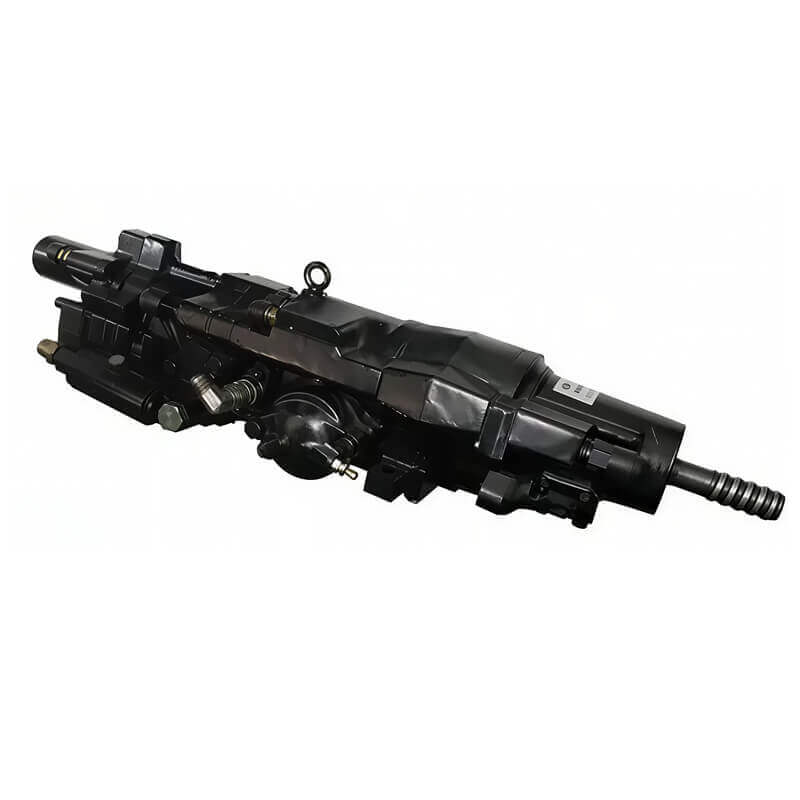
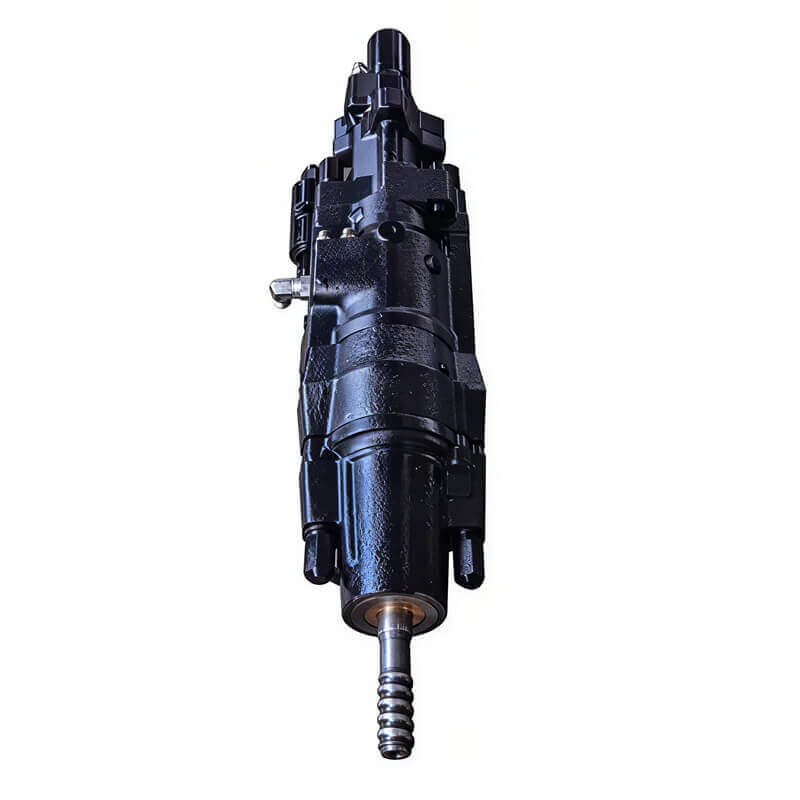
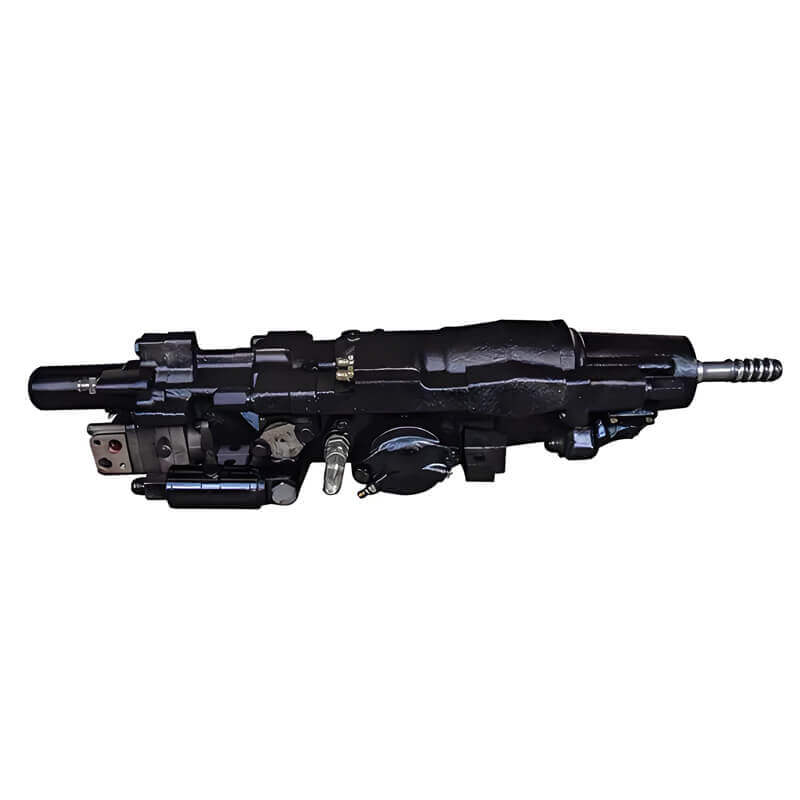
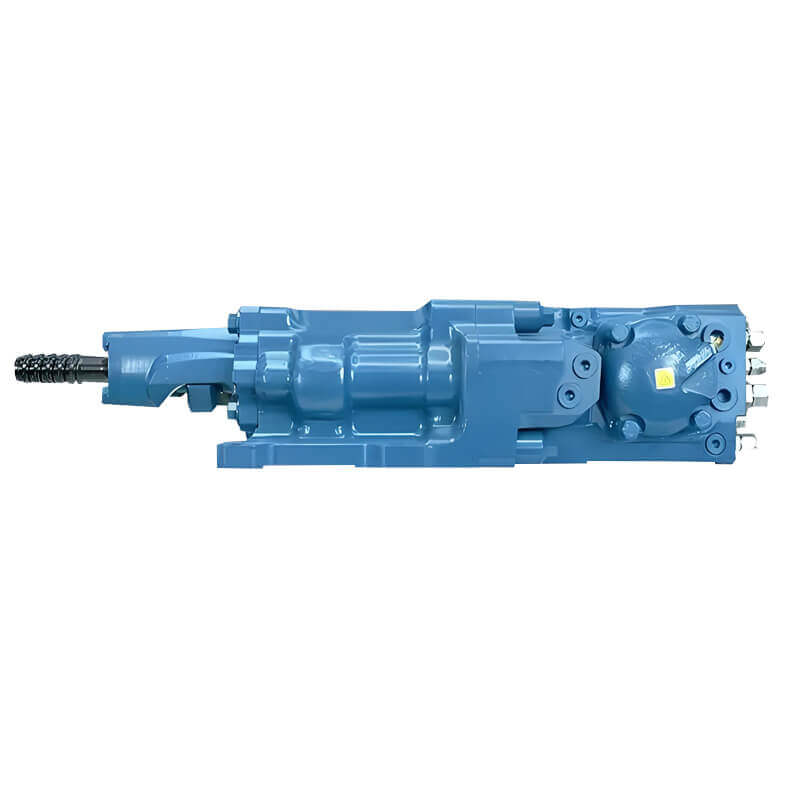


Hydraulic Rock Drills
【Drive Method】 Driven by high-pressure hydraulic oil
【Drilling Hole Diameter】33-76 mm
【Max.Impact Power】25 kW
【Max.Impact Pressure】250 Bar
【Water Pressure】20-25 Bar
【Impact Engine】269/3000 J
【Aplicación】 Mining, quarrying, tunneling, construction, and rock excavation
【Drilling Material】Rock, stone, concrete
 Chatear en línea por WhatsApp
Ventajas
En hydraulic rock drill (often called a top hammer or rotation-percussive drill) is a high-performance drilling machine that uses hydraulic power to generate strong rotational and impact forces to drill hard rock, concrete, and stone. Operating pressures typically exceed 10 megapascals, making it a core rock-breaking piece of equipment in modern mining and tunnel construction projects.
Unlike pneumatic drills (which use compressed air), hydraulic drills deliver greater energy efficiency, faster drilling speeds, and better precision. Hydraulic rock drills are widely used in mining, quarrying, tunneling, construction, and large-scale rock excavation projects.
【Main Types of Hydraulic Rock Drills】
- Top-Hammer Drills: Hammer strikes from above (best for shallow holes).
- Down-the-Hole (DTH) Drills: Hammer sits behind the bit (for deep, large holes).
- Rotary-Percussive Drills: Combine hammering + high-torque rotation.
- Hand-Held Hydraulic Drills: Portable units for demolition/anchoring.
【Key Features of Hydraulic Rock Drills】
- High Drilling Power: Delivers exceptional impact force for efficient drilling in hard rock and tough geological conditions.
- Precision Control: Allows accurate adjustment of drilling parameters (impact rate, rotation speed, and feed force) for optimal performance.
- Exceptional Durability: Can handle abrasive rock and high-intensity underground mining.
- High Adaptability: Compatible with various drill rigs, booms, and carriers to suit different mining and construction applications.
- Adaptive Hydraulic System: Smoothly adjusts to changing ground conditions, enhancing stability and productivity.
- Mechanized Operation: Designed for automated, continuous drilling in modern mining operations to increase output.
【Applications of Hydraulic Rock Drills in Mining】
Hydraulic rock drills are powerful and versatile tools widely used in the mining industry for various critical applications, including:
- Blast Hole Drilling: Used to create precision blast holes for explosives placement, facilitating efficient rock fragmentation and mineral extraction.
- Exploration Drilling: Essential for core sampling and geological surveys, helping mining companies assess mineral deposits before extraction.
- Production Drilling: Designed for continuous operation in active mining sites, drilling holes for ore extraction, ventilation, and ground support systems.
- Anchor Bolt Installation: Enables safe reinforcement of underground tunnels, walls, and roofs by drilling holes for bolt placement, improving structural stability.
- Dewatering Well Drilling: Helps manage water levels in mines by drilling dewatering wells, preventing flooding and maintaining safe working conditions.
- Tunneling & Mine Development: Used in the construction of shafts, tunnels, and underground passages to ensure smooth access, ventilation, and transport routes.
With high power, precision, and durability, hydraulic rock drills enhance efficiency and safety in modern mining operations.


Estructura del producto
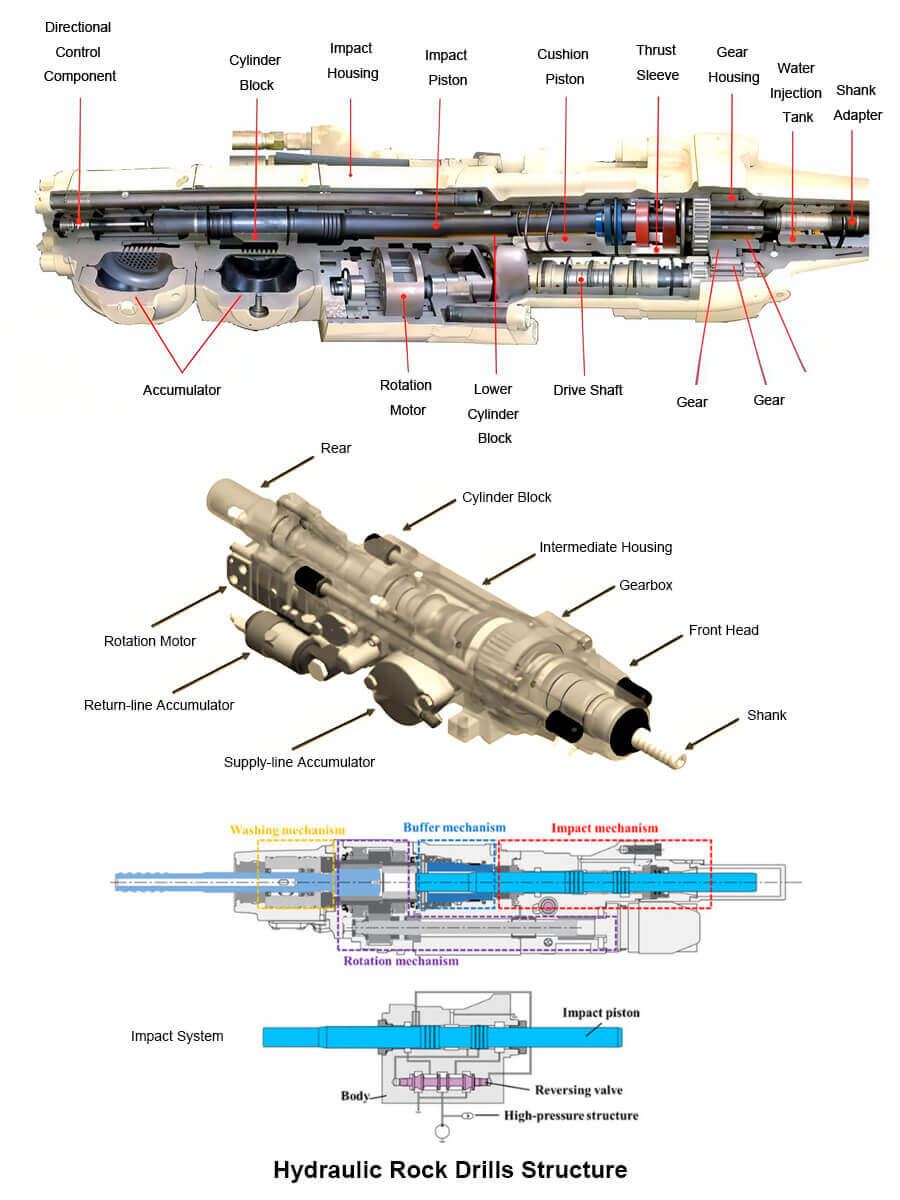
【Hydraulic Rock Drills Structure】
Hydraulic rock drills operate through the coordinated action of core components—specifically the percussion and rotation systems—alongside the front head, main body, and auxiliary systems, to achieve efficient rock drilling.
- Hydraulic Power Unit: Hydraulic pump (driven by diesel/electric motor), high-pressure hoses (flexible oil transfer lines), hydraulic oil tank & filters (clean oil circulation), control valves (regulate oil flow for hammering & rotation).
- Hammering (Percussion) System: Percussion piston (strikes the drill steel), pressure accumulator (stores hydraulic energy for impact), impact chuck or striker (transmits force to the drill bit), damping mechanism (reduces vibration and recoil).
- Rotation (Feed) System: Hydraulic motor (provides rotary motion), gearbox & splined shaft (controls rotation speed), auto-feed mechanism (pushes drill steel forward), chuck assembly (holds and guides the drill steel).
- Drill Steel & Bit Assembly: Hollow drill rods (transmit hydraulic flush), tungsten carbide bits (button bits, cross bits), flushing system (water/air to remove cuttings).
- Frame & Support Structure: Drill rig mount (for large hydraulic rock drills), guide bars & feed beam (stabilizes drilling direction), damping pads (reduce shock transmission).
【Hydraulic Rock Drills Working Principle】
A hydraulic rock drill operates through an integrated system of power and motion components. The hydraulic pump supplies high-pressure oil flow that is precisely regulated by control valves to adjust power output. In the percussive mechanism, pressurized oil drives a piston's reciprocating motion - during the forward stroke, the piston impacts the shank adapter to deliver tremendous compressive force to the drill bit (typically at thousands of blows per minute) for effective rock fracturing. Simultaneously, a hydraulic motor provides rotational torque to the drill bit between impacts, ensuring even bit wear and true hole formation while preventing destructive chatter. The system incorporates compressed air or water flushing through the drill steel to efficiently remove rock cuttings and prevent jamming, with intelligent oil pressure routing managing the piston's return stroke. Modern designs utilize accumulators to maintain consistent system pressure, creating a continuous cycle of impact, rotation, and debris removal for optimal drilling performance.
Parámetros técnicos
| Modelo | GL18T | S25D/L | A22L/D |
| Size(mm) L*W*H | 1215*255*223 | 1010*333.1*224 | 1008*292*233 |
| Peso (Kg) | 184 | 225 | 175 |
| Center Height(mm) | 88 | 94 | 88 |
| Shank | T38/R38/R32 | T35/T38/T45 | R32/R38/R38 |
| Drilling Hole Diameter(mm) | 33~76 | 43~64 | 33~76 |
| Max.Impact Power(Kw) | 18 | 25 | 22 |
| Max.Impact Pressure(Bar) | 230 | 235 | 250 |
| Impact Frequency(Hz) | 45~60 | 93 | 73 |
| Flow Rate(L/min) | 75~95 | 125 | 95 |
| Impact Energy (J) | 300 | 269 | 300 |
| Displacement(Standard) (CC) | 160 | 80/125/160 | 80/100/120/160 |
| Max.Torque(N.m) | 800 | 720 | 1000 |
| Flow Rate(L/min) | 75 | 65-75 | 80/75 |
| Max.Intake Pressure(Bar) | 210 | 175 | 210 |
| Rotation Speed(r/m) | 0~340 | 0~390 | 460/340/275/210 |
| Lubricating Air Flow Rate(L/S) | 5 | 5 | 5 |
| Lubricating Air Pressure(Bar) | 2 | 4-7 | 3 |
| Water Pressure(Bar) | 25 | 20 | 20-25 |
| Water Flow Rate(L/min) | 40~120 | 80~120 | 60~150 |
Casos de éxito


Póngase en contacto con nosotros
Si tiene alguna pregunta sobre nuestros productos, rellene el siguiente formulario y nos pondremos en contacto con usted en un plazo de 24 horas. Tenga la seguridad de que no revelaremos su información a nadie.
 English
  French
  Spanish
  Portuguese
  Indonesian