Processing sulfide copper ore involves several key steps to effectively extract copper from the ore while minimizing environmental impact. Here’s an overview of the main stages involved in the processing of sulfide copper ore:
1. Mining
Extraction Methods: Sulfide copper ores are typically mined using open-pit or underground mining methods. The choice of method depends on the depth and location of the ore body.
2. Crushing and Grinding
Menghancurkan: The mined ore is crushed using crushers to reduce it to a manageable size for further processing.
Grinding: The crushed ore is then ground into a fine powder in mills (such as pabrik bola) to liberate the copper sulfide minerals from the gangue (waste material).
3. Konsentrasi
Flotasi: This is the most commonly used method for concentrating sulfide copper ores. The ground ore is mixed with water to create a slurry, and chemicals (collectors, frothers, and modifiers) are added to enhance the hydrophobicity of the copper sulfide minerals.
Hydrophobicity: Copper sulfide minerals attach to air bubbles in the slurry and rise to the surface, forming a froth layer.
Pemisahan: The froth is skimmed off, while the remaining gangue settles to the bottom.
Concentrate: The resulting copper concentrate typically contains between 20% to 30% copper, along with other metals.
4. Smelting
Roasting: The copper concentrate may first undergo roasting in a tungku to convert some of the sulfides to oxides and remove impurities (e.g., arsenic).
Peleburan: The concentrated copper sulfide is then smelted in a furnace at high temperatures (around 1200°C). During smelting:
Fluxes: Materials like silica and limestone are added to combine with gangue minerals to form a slag.
Reduction: The copper sulfide is reduced to produce molten copper and sulfur dioxide gas. The reaction typically forms blister copper along with by-products like slag.
5. Converting
Converting: Blister copper is further processed to remove impurities. This is done in a converter furnace, where air or oxygen-enriched air is blown through the molten copper to oxidize remaining sulfides and remove impurities, such as iron and nickel.
Final Product: The result is anode copper, which is about 98-99% pure.
6. Refining
Electrolytic Refining: Anode copper is then refined through an electrolytic process:
The anodes are placed in an electrolytic cell, where they are immersed in an electrolyte solution (usually copper sulfate and sulfuric acid).
A direct current is applied, causing copper ions to migrate from the anode to the cathode, resulting in high-purity copper (99.99%).
By-products: This process also results in precious metals (like gold and silver) and other valuable metals (like selenium and tellurium) that can be collected from the anode slime.
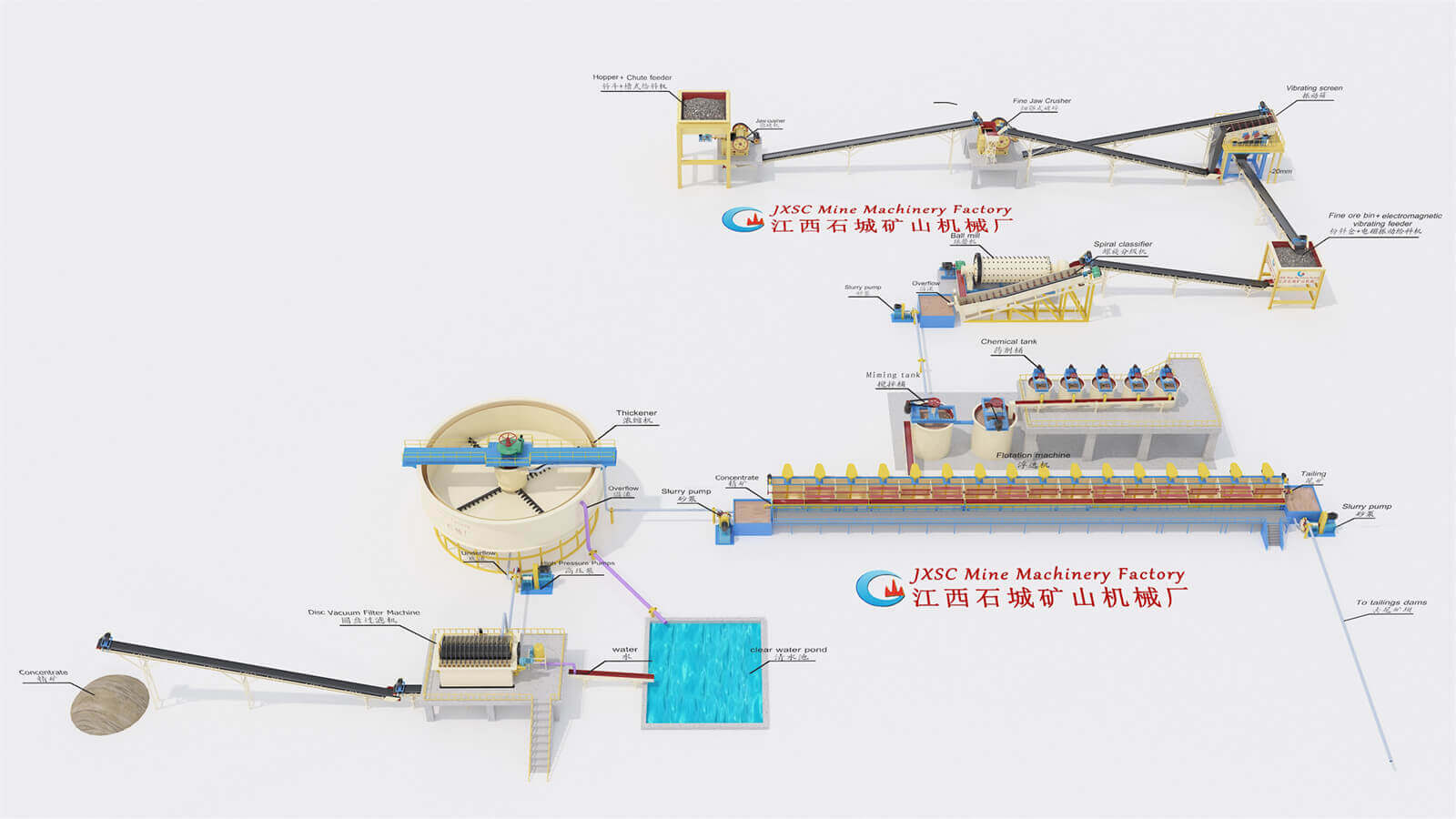
This flowchart design utilizes the flotation method to extract the copper concentrate. Flotation plant is suitable for recovery of both oxide and sulphide copper, has the best recovery ratio, and can get the best concentrate grade.
This setup is a complete copper ore processing plant. It includes Menghancurkan System, Grinding & Classification System, Flotation System, and Concentrate Filtering & Dewatering System.
1. Sistem Penghancuran
The crushing system consists of two two-stage penghancur rahang, one vibrating screen, and belt conveyors. The function of the crushing system is to reduce a maximum of 300mm big size to 25mm small size. The raw materials are unloaded to the hopper by excavator or loader, then through chute feeder machine evenly feed to primary jaw crusher for crushing -300mm lumps down to 40mm; the output 0-40mm are sent to secondary fine jaw crusher for further crushing to 25mm by belt conveyor; the output 0-25mm are sent to layar bergetar for sieving out 0-25mm fine ore and above 25mm big ore. Above 25mm big ore will be back to the fine jaw crusher for re-crushing. 0-25mm fine ore will be sent to the transfer hopper by belt conveyor. This is a closed crushing circuit, which has the feature of a high crushing rate and is suitable for any hardness rocks.
2. Grinding & Classification System
The grinding & classification system consists of a ball mill and a pengklasifikasi spiral. The function of the grinding & classification system is to make 25mm fine ore to 200mesh. The fine ore 0-25mm is smoothly sent to the ball mill by electromagnetic feeder + belt conveyor. The output of the ball mill goes to the spiral classifier for classification of 200 mesh and coarse particles. The underflow of the spiral classifier is coarse particles, which will be back to the ball mill for regrinding. The overflow of the spiral classifier is 200 mesh, which will be pumped to the tangki pencampuran. This is a closed grinding circuit; it can get as much as 200 mesh output for the flotation process.
3. Sistem Flotasi
The flotation system consists of a mixing tank and mesin flotasi. The function of the flotation system is to extract high-grade copper concentrate. The 200mesh slurry from the spiral classifier is pumped to the mixing tank for mixing slurry with chemicals. Then the slurry mixed with chemicals goes to the flotation process.
The flotation process is divided into roughing flotation, scavenging flotation, and cleaning flotation. The regular configuration for flotation copper sulphide ore is one stage roughing flotation, two stages scavenging flotation, and two stages cleaning flotation. Here, the flotation capacity is 240 tons per day, so the quantities of flotation cells are as follows:
SF2.8 flotation machine for 240TPD Copper Flotation Process:
One time roughing flotation: 4 cells
1st scavenging flotation: 4 cells
2nd scavenging flotation: 4 cells
1st cleaning flotation: 2 cells
2nd cleaning flotation: 2 cells
Total 16 flotation cells for the complete flotation system.
4. Concentrate filtering&dewatering system
The concentrate filtering system consists of a pengental dan filter vakum cakram. The function of the filtering system is to remove most of the water from concentrate to get dry concentrate. The concentrate gained from the flotation system is pumped to the thickener for adjusting slurry density around 40-45%. The overflow of the thickener is clear water, which goes to the clear water pool. This water can be reused in the plant. The underflow of thickener goes to the disc vacuum filter machine for dewatering concentrate.
About the tailing from the flotation process, if customers don’t have special requirements to treat the tailing, the tailing will be sent to the tailing dam by pump.
The chemicals used for copper flotation are not harmful; you can add a little lime to the tailing and then pump it to the tailing dam. The function of the lime is to allow the suspended solids and chemicals in the tailing to sedimentation. This way, the tailings have no harmfulness to the environment.






 English
  French
  Spanish
  Portuguese
  Indonesian