



Manufactured sand (M-Sand) is artificial sand processed through specialized machinery(sand making machine and other ancillary equipment) to create precisely sized and shaped particles for construction applications. This guide examines 5 proven sand manufacturing processes with detailed flowcharts for optimal production.
What Is a Manufactured Sand Machine?
Manufactured sand machines are industrial equipment that transform raw materials into high-quality artificial sand through crushing, grinding, and shaping processes. These systems range from simple hammer crushers to advanced multi-stage vertical shaft impactors.
How to Design a Sand Manufacturing Process?
The ideal sand production process depends on:
- Raw material characteristics
- Required production capacity
- Finished product specifications
- Environmental considerations
- Budget constraints
Below, we compare 5 established manufacturing methods with their advantages and limitations.
Visión general
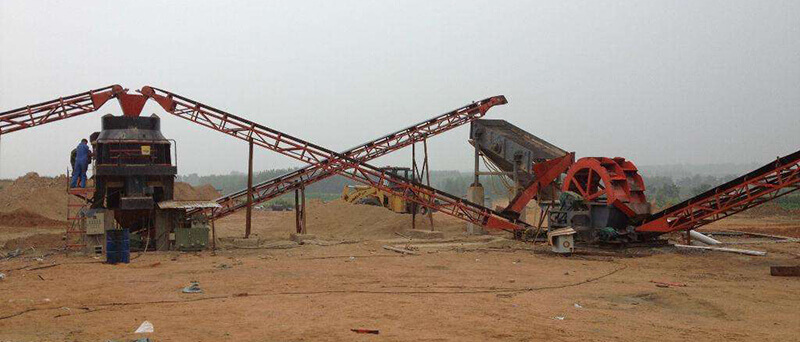
The artificial sand-making process has developed from the single-crushing sand-making process (such as hammer crushing, rod grinding, vertical shaft impact crusher sand making) to the combined crushing process (vertical shaft crusher & rod grinder, two-stage vertical shaft crusher). The dry, wet, and semi-dry processes have also been put into production.
Haz clic para saber qué trituradoras de roca suministramos.
1. Hammer Crusher Sand Manufacturing
Flujo del proceso ( foto de abajo )
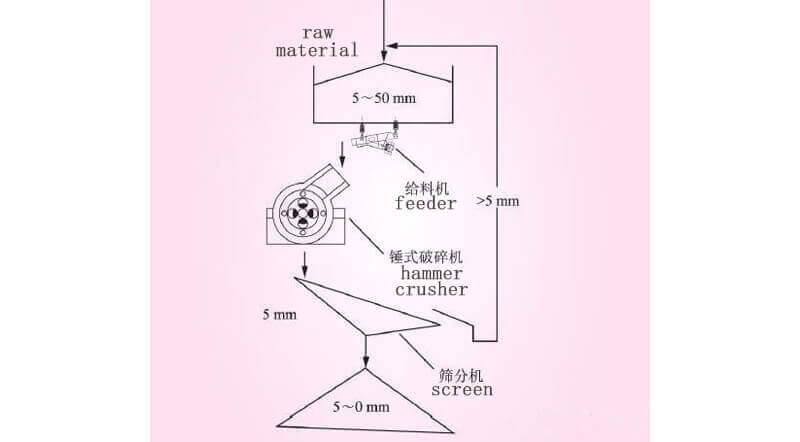
Using a feeder and a belt conveyor to transfer the stone material from the bin to the trituradora de martillos. All the crushed stones are screened by a sieve screen, in which those larger than 5mm are returned to the crusher, and those smaller than 5mm enter the finished sand bin.
Key Features
- Production Method: Dry process
- Scale: Small production systems
- Ventajas: Low initial investment; Quick setup; Immediate results
- Limitations: High wear rate; Significant dust generation; Limited to small-scale operations
2. Rod Mill Sand Manufacturing
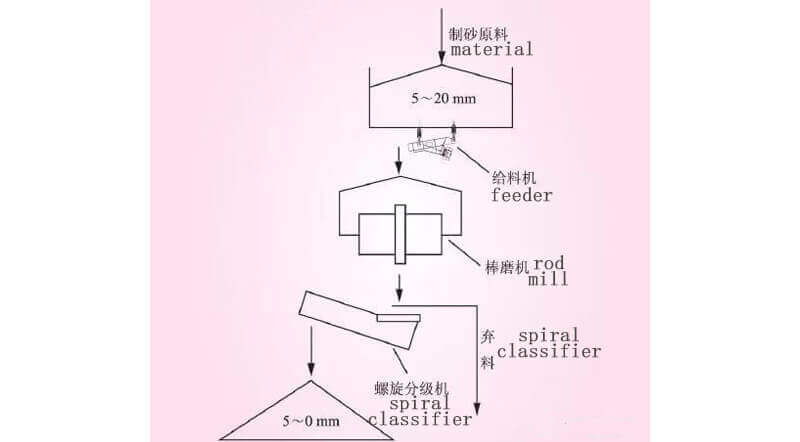
Rod mill sand manufacturing generally adopts a wet making method, suitable for some difficult-to-crush rocks. It has the ventajas of simple structure, convenient operation, reliable equipment, good grain shape, uniform particle size distribution, adjustable fineness modulus, and stable quality.
Limitaciones
High energy and steel rods consumption, noise, difficult to dewater, a small feed particle size (≤25mm), high operating cost, etc., are not used as the main sand making equipment; more commonly used in combination with a vertical shaft impact crusher.
Besides, the wet sand making process has a long sand dewatering cycle, requires a large sand silo, and will affect the output of finished sand. The wet process brings environmental pollution caused by production wastewater. High water consumption, but low recycling rate. The moisture content of the finished sand is not easy to control below 6%.
3. VSI Crusher Sand Manufacturing
Vertical shaft impact crusher sand manufacturing process operational details:
Ideal For: Limestone processing
Ventajas: Low unit energy consumption; Excellent particle shaping; Low wearing costs
Shortages:
- The stone of 5~2.5mm is repeatedly squeezed and broken, has a poor crushing effect, and higher power consumption.
- The finished sand has a large range of particle diameters and more in fine diameter, and the intermediate particle diameter (2.5 to 1.25 mm, 1.25 to 0.63 mm particle diameter) has a small content.
- The control of the particle size modulus of the finished sand is difficult (controlled by humans).
- Low finished sand rate. The semi-dry production process generally refers to the pre-wet and post-dry production process. That is, the pre-screening adopts the wet process to produce and control the moisture content of the discharge, and some of the particles of 5 to 40 mm are dehydrated and used as the sand-making raw material, and the sand-crushing machine discharges the material. The water content is controlled between 2% and 5%, and the screening is no longer sprayed with water.
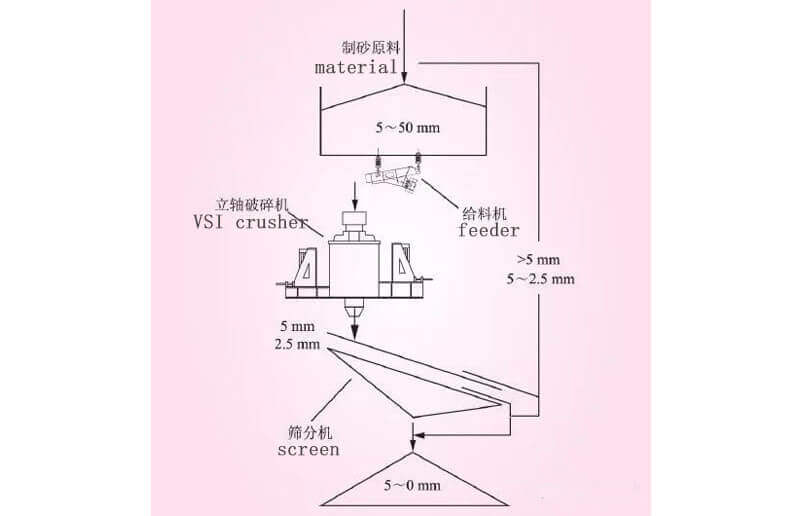
The VSI crusher sand manufacturing is mainly suitable for sites where the mud content of the raw material is not too high, and the sand requires a high powder content. However, the disadvantage is that the sand-making raw materials are washed by water, and must be reliably dehydrated before entering the vertical shaft to ensure that the moisture content of the raw materials broken into the vertical shaft is not more than 3%, otherwise the sand-making effect of the vertical shaft breaking and the screening efficiency of the screening are seriously affected.
4. Vertical Shaft Impact Crusher + Rod Mill Combination
The stone material is sent to the vertical shaft and rod mill by the feeding bin and the belt conveyor, respectively. After being crushed, it is sent to the screening machine for classification. All the stones larger than 5mm are returned to the converting bin for the next crushing circuit. Ground material enters the lavadora de arena y el criba de deshidratación.
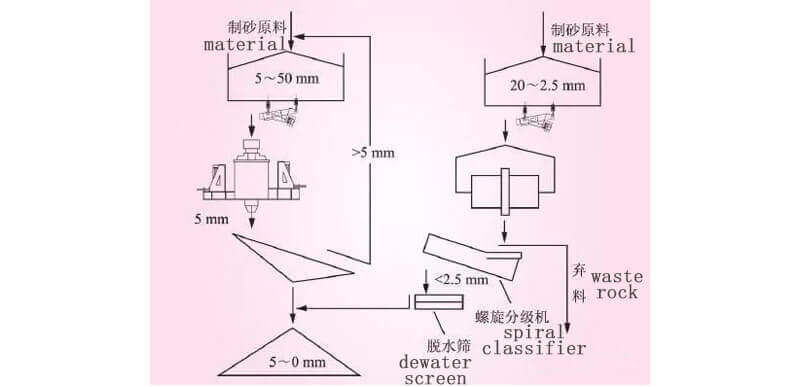
- This combination process possesses the advantages of a vertical shaft breaker and a rod grinder, and overcomes their respective shortcomings, such as the problem of medium diameter content and excessive loss of stone powder, which improves the sanding rate.
- “vertical shaft impact crusher + rod mill”, which can flexibly adjust the fineness and stone powder content of the finished product according to the change of raw materials, ensure the quality of finished sand, and effectively control the cost of sand making.
- More complicated and need higher equipment costs.
5. Two-stage VSI Crushers
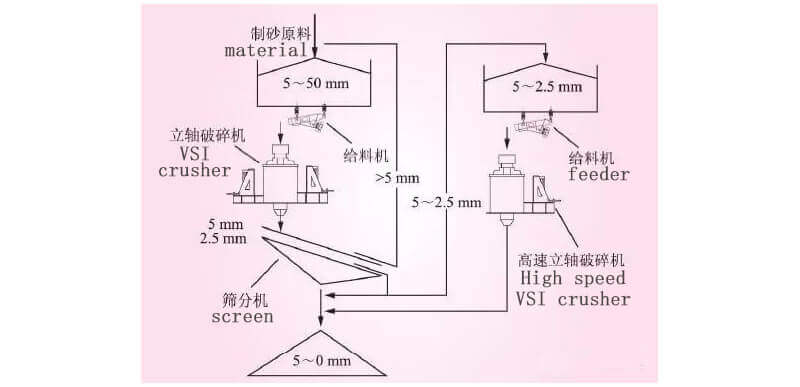
A combination of high-speed and normal-speed vertical shaft impact crushers.
El material pétreo se introduce en la trituradora de eje vertical a velocidad normal (baja) (v=50~70m/s) mediante el depósito alimentador y la cinta transportadora. Tras la trituración, entra en la criba. El material pétreo con más de 5mm se devuelve al silo de transferencia. 5- 2,5mm de arena entra en el silo de arena acabada, y otra parte de la piedra se envía al eje vertical de alta velocidad (v>75m/s). La piedra reventada se mezcla con la piedra de menos de 2,5mm y luego entra en el silo de arena acabada.
(1) Adecuado para la producción en seco y semiseco, se necesita más investigación para la producción húmeda completa.
(2) Las trituradoras de impacto de eje vertical de dos velocidades pueden aumentar aún más el contenido de polvo de piedra y reducir el módulo de finura de la arena acabada.
El excelente proceso de producción de arena de mecanismos y la razonable selección de equipos son la garantía de la calidad de la arena de mecanismos. Al seleccionar el proceso de arena de mecanismo, debe combinarse con los materiales específicos y los requisitos de producción, y la producción debe garantizarse de acuerdo con las condiciones locales.
Process Selection Guide
| Proceso | Best For | Capacidad | Humedad | Coste |
|---|---|---|---|---|
| Trituradora de martillos | Small ops | Bajo | Dry | + |
| Molino de barras | Tough materials | Medio | Wet | ++ |
| VSI Crusher | Piedra caliza | Alto | Semi-dry | +++ |
| VSI+Rod Mill | Quality sand | Alto | Ajustable | ++++ |
| Two-Stage VSI | Premium sand | Very High | Dry/Semi-dry | +++++ |
Pro Tip: Always conduct material testing and pilot trials before full-scale implementation.
ÚLTIMOS PRODUCTOS
-

Inclined Vibrating Screen
The inclined vibrating screen is a simple and eff…
-
High Temperature & Pressure Gold Desorption Electrolysis System
High-Temperature & Pressure Gold Desorption Elect…
-
Normal Temperature & Pressure Gold Desorption Electrolysis System
The normal temperature & pressure gold desorption…


ÚLTIMAS NOTICIAS
- Shaking Table, 3-Disc Dry Magnetic & Electrostatic Separator for W-Sn-Ta-Nb
- Mineral Analysis: The Foundation for Successful Mineral Processing Projects
- What Is Over-Grinding and How Can It Be Prevented?
- Fluorspar vs Graphite vs Quartz: Non-Metal Minerals Beneficiation Differences
- Tailings Dam Safety: 5 Critical Parameters to Monitor
 English
  French
  Spanish
  Portuguese
  Indonesian