



Imagine losing half your gold or tin because your jig can’t keep up. Old jigs waste time and money. The hydraulic radial jig fixes these problems with smarter design and better efficiency.
A hydraulic radial jig is a gravity-based roughing separator for minerals like alluvial gold, tin, and diamonds. Unlike old jigs, it uses a mechanical-hydraulic drive to pulse the cone, improving recovery rates. Modular and power-efficient, it works in mines, beaches, and even waste recycling plants. It handles more feed while cutting energy costs.
You might think all jigs do the same job. But hydraulic radial jigs are different. Let me explain why—and how they can transform your operation.
What is The Working Principle of a Hydraulic Radial Jig?
Jigs fail when pulses are uneven. Your ore settles incorrectly, and valuable minerals escape. The hydraulic radial jig solves this with precision.
The hydraulic radial jig separates minerals by density using pulsed water flow. A hydraulic cylinder drives the cone upward, creating suction. Heavy particles (like gold) sink, while lighter waste rises. Adjustable stroke and frequency let operators fine-tune for different ores, maximizing recovery.
Key Steps in the Process
- Pulsation: The hydraulic cylinder lifts the cone, forcing water through the bed.
- Suction Phase: Heavy minerals settle as water drains downward.
- Descarga: Light waste overflows the screen.
Settings to Optimize
| Parameter | Effect | Adjustment |
| Stroke Length | Deeper pulses trap denser particles | Increase for coarse ore |
| Pulse Speed | Faster cycles suit finer materials | 45-60 RPM for gold |
| Water Flow | Low flow gives sharper separation | Reduce for high-grade feed |
Unlike piston jigs, hydraulic drives eliminate dead zones. This means fewer losses—especially critical for high-value minerals.
What Are The Structural Components of a Hydraulic Radial Jig?
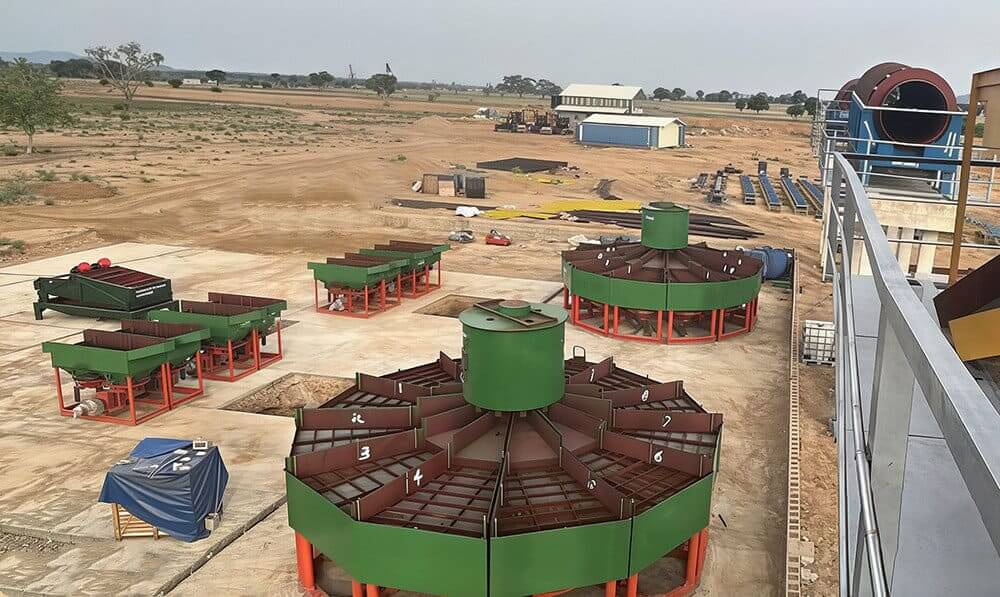
The core structure of a hydraulic radial jig is primarily divided into two main components: the mechanical-hydraulic drive system y the trough separation system. It is also equipped with a complete set of hydraulic control and auxiliary components, with all parts working together to achieve pulsating mineral separation.
Mechanical-Hydraulic Drive System
This is the power core of the equipment, responsible for converting electrical energy into controllable pulsating mechanical energy:
- Power and Speed Control Unit: Utilizes an electromagnetic speed-regulated asynchronous motor, paired with a speed-changing mechanism and a reducer, to achieve stepless adjustment of the pulsation frequency from 0 to 90 cycles per minute.
- Cam Drive Assembly: The output shaft of the reducer drives the cam to rotate; the cam’s contour curve drives the piston of the drive cylinder to perform periodic reciprocating motion, thereby converting mechanical energy into hydraulic energy.
- Hydraulic Actuation Unit: This includes a drive cylinder and a driven cylinder. The pressurized oil output from the drive cylinder drives the movement of the driven cylinder, reconverting hydraulic energy into mechanical energy to directly drive the up-and-down pulsation of the sorting cone.
Trough Sorting System
This is the core operational space for mineral sorting and features a modular design:
- Modular Jigging Units: Each basic unit consists of three trapezoidal jigging chambers, with a single chamber area of up to 3.3 m². These units can be flexibly combined into circular or sector-shaped structures based on processing capacity requirements.
- Sector-Shaped Sorting Trough: The trough features a radial sector-shaped layout, enabling concentrated feed and minimizing space requirements. It is particularly well-suited for compact operating environments such as mining vessels, while also facilitating the recovery of fine-grained minerals.
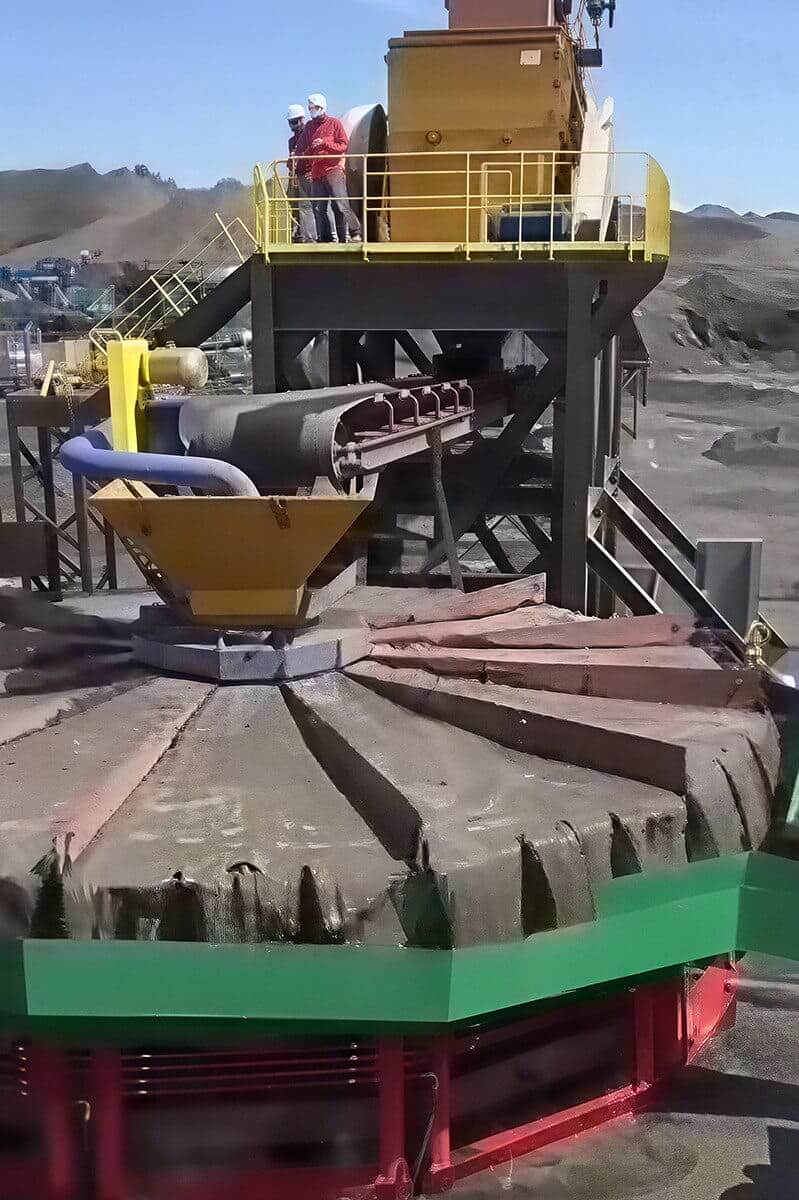
- Pulsating Cone Hopper Assembly: Directly connected to the driven hydraulic cylinder, it generates upward and downward pulsations as the cylinder moves, creating an asymmetric jigging curve resembling a sawtooth pattern, which significantly reduces the amount of make-up water required for the undersize fraction.
Supporting Hydraulic and Auxiliary Systems
Control and power supply components that ensure stable equipment operation:
- Hydraulic Power Unit: Primarily responsible for replenishing oil in the system and maintaining stable pressure in the hydraulic circuit; equipped with a motor rated at only 0.55 kW, resulting in extremely low energy consumption.
- Hydraulic Piping and Control Valve Assemblies: Connect various hydraulic components and precisely regulate oil flow direction, pressure, and flow rate through valves to enable flexible adjustment of the pulsating stroke (15–30 mm).
- Support and Auxiliary Components: Include the equipment frame, feed distribution device, screen plate, and light/heavy mineral discharge mechanisms, which collectively complete the entire process of material feeding, bed support, and discharge of sorted products.
What Are The Advantages of a Hydraulic Radial Jig?
1. High-efficiency sorting: Enables materials of different densities to stratify effectively in a pulsating water flow, achieving precise sorting and improving concentrate quality and recovery rates.
2. High processing capacity: Capable of handling large particles and large volumes of material, making it suitable for mineral processing plants o coal preparation plants of all sizes.
3. High Adaptability: It adapts well to materials of varying properties and particle sizes, capable of processing a wide range of ores and coals.
4. High Degree of Automation: Utilizing hydraulic drive and advanced control systems, it enables automated operation, reduces manual intervention, and improves production efficiency and stability.
5. Excellent Energy Efficiency: Compared to some traditional sorting equipment, the hydraulic jig consumes less energy, helping to lower production costs.
6. Stable and Reliable Operation: With a well-designed structure and a stable hydraulic system, the equipment has a low failure rate and low maintenance costs.
7. Excellent Environmental Performance: It generates relatively little noise and dust during the sorting process, resulting in minimal environmental pollution.
8. Compact Footprint: The equipment’s compact design effectively saves factory floor space, making it particularly suitable for enterprises with limited space.
What is The Scope of Application for a Hydraulic Radial Jig?
Hydraulic radial jigs are versatile and efficient gravity separation devices widely employed in mineral processing, particularly for recovering valuable heavy minerals from alluvial deposits. Their key applications span:
1. Alluvial and Marine Mining
Integral to dredging operations, these jigs are installed on mining vessels to process large volumes of sediment directly at the source. They serve as primary roughing concentrators for materials extracted from riverbeds, coastal zones, or offshore deposits.
2. Target Mineral Recovery
Specialized in sorting dense minerals, hydraulic radial jigs efficiently capture:
- Precious metals (e.g., oro aluvial)
- Industrial ores (e.g., tin, tungsten, manganese, hematite)
- Gemstones (e.g., diamonds)
3. Fine Particle Processing
Advanced models (e.g., DYTA-7750 series) enhance recovery rates for fine-sized minerals, reducing material loss during initial concentration—a critical advantage for optimizing yield.
4. Gravity Separation in Plants
Beyond mobile dredgers, these jigs are deployed in stationary processing plants to upgrade raw ore feeds through efficient density-based separation.
Industries Served
- Mineral sand mining
- Placer gold/diamond operations
- Heavy metal ore beneficiation
Hydraulic radial jigs bridge mobility and precision, making them indispensable for high-volume, coarse-to-fine mineral recovery in diverse mining environments.
How Should a Hydraulic Radial Jig be Maintained on a Daily Basis?
To ensure the stable operation of a hydraulic jig, three wear-prone components must be inspected regularly: the degree of wear on the screen plate, the integrity of the diaphragm seals, and the cleanliness of the hydraulic oil. Clogged screen plate pores should be cleared weekly, and the head of the jig’s water pump should be checked monthly to ensure it meets specifications.
Pay special attention to the hydraulic oil temperature—exceeding 65°C accelerates seal aging, at which point the jig motor load or cooling system should be inspected.
Among common malfunctions, a decline in sorting efficiency is often caused by perforations in the screen plate or unstable hydraulic pressure; abnormal vibration may result from a ruptured diaphragm or loose foundation bolts. Addressing the former requires shutting down the machine to replace the screen plate and calibrate the pressure valve, while the latter requires checking the coaxiality of the transmission components.
Conclusion: The Future of Mineral Processing
In summary, hydraulic radial jigs represent a technological leap in gravity separation, combining efficiency, sustainability, and versatility. Their hydraulic-driven pulsation ensures superior mineral recovery with minimal energy consumption, while their modular design y low-maintenance operation make them ideal for diverse applications—from alluvial mining to e-waste recycling.
By delivering stable performance, adjustable pulsationy eco-friendly processing, these jigs outperform traditional mechanical models, offering mines a cost-effective, high-yield, and environmentally responsible solution. As the mining industry prioritizes scalability and green practices, hydraulic radial jigs stand out as the next-generation choice for maximizing productivity while minimizing operational and environmental costs.
In short: Where precision, durability, and sustainability matter, hydraulic radial jigs lead the way.
ÚLTIMOS PRODUCTOS
-

Handheld Rock Drills
【Drilling Hole Diameter】30-45 mm 【Dill Hole De…
-
Hydraulic Rock Drills
【Drive Method】 Driven by high-pressure hyd…
-
Gasoline Rock Drills
【Engine Type】 Gasoline engine …


 English
 French
 Spanish
 Portuguese
 Indonesian