



Choosing the right alluvial gold washing plant can make or break your mining operation. Many miners lose money by choosing the wrong equipment or overlooking critical factors. The right plant maximizes gold recovery while minimizing costs. Here’s how to avoid common mistakes and select the best solution for your needs.
To choose the right alluvial gold washing plant, evaluate the deposit characteristics, required production capacity, equipment types, site conditions, and budget. The gold particle size, clay content, and ore size distribution affect equipment selection. Small-scale operations (1–10 TPH) need compact plants, while large-scale projects (10–200+ TPH) require heavy-duty systems. Key equipment includes trommel screens, vibrating screens, sluices, jigs, centrifugal concentrators, and shaking tables. Always test the ore first to optimize recovery.
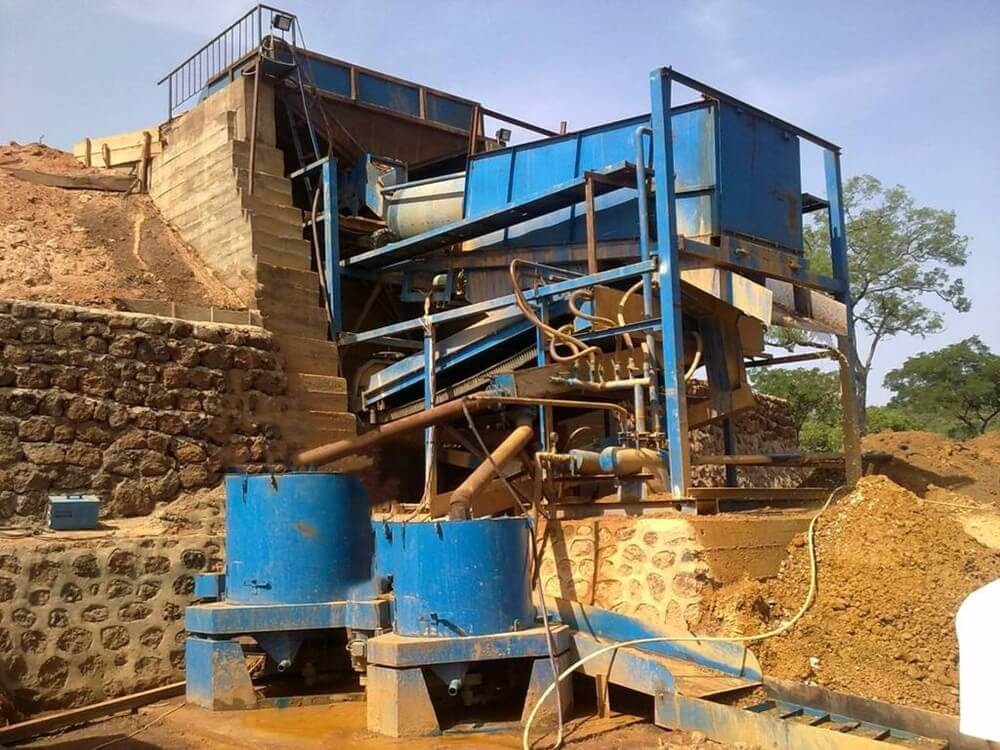
Now let’s break down each factor in detail. This will help you avoid costly errors and select the best plant for maximum profitability.
1. Understand the Deposit Characteristics – What’s in Your Ore?
Not all alluvial gold deposits are the same. Some have thick clay, while others contain coarse nuggets. Choosing the wrong plant for your ore type means low recovery and wasted effort.
The deposit characteristics determine which equipment works best. Three key factors are:
- Clay content– High clay needs scrubbing or trommel washing to break it down.
- Gold particle size– Fine gold requires concentradores centrífugos, while nuggets may only need sluices.
- Ore size distribution– Gravel-heavy deposits need better classification to separate gold efficiently.
If the deposit has sticky clay, a trommel with water jets is necessary. For sandy ore, a simple sluice might work. Always test a sample first to confirm gold size and distribution.
How Does Clay Content Affect Washing?
Clay binds gold particles, making them harder to recover. Without proper clay removal, gold gets lost in slimes or tails.
If your ore has over 20% clay, you need
- A lavador trómel to break down clay.
- High-pressure water jets to wash gold free.
- Longer retention time in the washing process.
If the clay content is low, a trommel screen may provide sufficient washing and screening performance at a lower equipment cost.
Does Gold Size Dictate Equipment Choice?
Yes. Gold particle size has a direct influence on gravity separation performance, and different machines capture different gold sizes.
Fine gold may require centrifugal concentrators, while larger and relatively coarse gold particles can often be recovered effectively using properly designed sluice boxes.
Representative ore samples should be tested to determine the most appropriate recovery combination.
Particle Size Distribution of the Raw Ore
The size distribution of the feed material determines the screening specifications and downstream equipment requirements.
For example, the 0–6 mm, 6–20 mm, and 20–100 mm classification used in this 400TPH plant is one possible configuration. Actual screen openings should be selected according to the characteristics of the deposit.
2. Determine Production Capacity – How Much Gold Can You Process?
A plant too small slows production. One too large wastes money. Matching capacity to your operation is critical.
Assess your expected tons per hour (TPH) before selecting a plant:
- Small-scale (1–10 TPH): Ideal for artisanal miners. Use mobile or trailer-mounted plants.
- Medium (10–50 TPH): Suits small mining companies. Adds more sluices or jigs.
- Large-scale (50–200+ TPH): For industrial operations. Requires multiple washing lines.
A 10 TPH plant processes 80 tons in an 8-hour shift. Estimate realistically—overestimating leads to unused capacity.
How to Avoid Under- or Over-Capacity?
- Test run a small batch first to measure actual TPH.
- Future expansion? Buy modular equipment for easy scaling.
- Energy cost– Larger plants need more water and power.
A 20 TPH plant might cost less upfront, but a 50 TPH unit could be cheaper per ton long-term.
3. Choose the Right Equipment – What Machines Work Best?
The wrong machines mean lost gold and frustration. Here’s how to match equipment to your deposit.
Key gold washing equipment incluye
| Equipamiento | Best For | Pros | Cons |
| Criba Trommel | Clay-rich ore | Handles sticky material well | Less efficient for fine gold |
| Criba vibratoria | Sand/gravel | Fast processing | Less effective for high-clay ore |
| Sluicing System | Coarse gold recovery | Low maintenance | Needs steady water flow |
| Jig Machine | Medium-to-coarse gold | High recovery rates | Requires calibration |
| Knelson/Falcon Concentrator | Fine gold | Alta eficacia | Higher operating costs |
| Mesa vibratoria | Final concentration | Excellent separation | Lower throughput |
| Separador magnético | Removing iron impurities | Increases purity | Not a primary gold recovery tool |
Tip: Combine multiple unit operations (e.g., trommel → jig → centrifugal concentrator) for optimized recovery.
4. Site Conditions and Water Supply – What Are Your Physical Constraints?
A perfect gold washing plant design means nothing if it won’t work at your site. Overlooking terrain, water access, or power can stall your operation before it starts.
Site Conditions
Site conditions determine whether you need:
- Fixed Plant: Best for long-term mining sites.
- Mobile/Trailer-Mounted Plant: Great for remote or frequently changing locations.
- Floating Plant (Dredge): Suitable for riverbed mining operations.
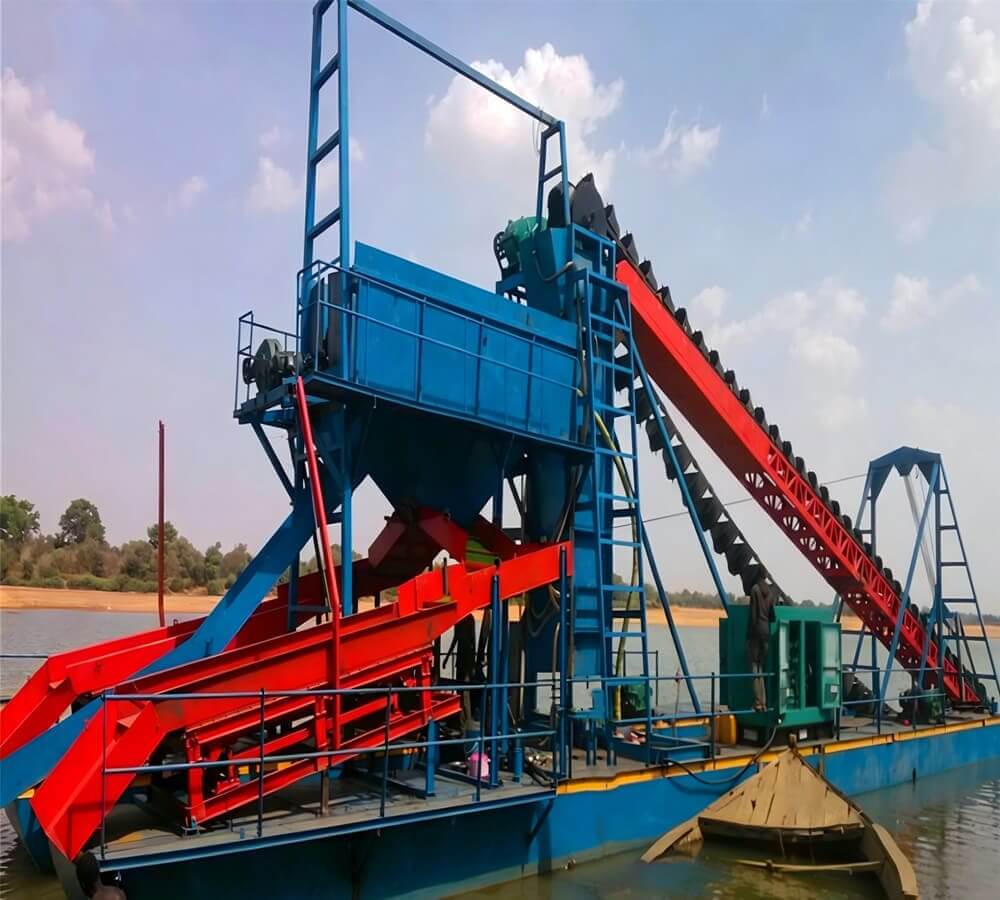
Water & Power Requirements
Water recycling systems reduce fresh water needs.
Diesel generators vs. grid power—choose based on accessibility.
5. Environmental & Regulatory Compliance – What Rules Apply?
Governments increasingly penalize miners who ignore environmental laws. A compliant plant avoids fines and keeps its license.
Key regulations often cover
- Water discharge (no mercury/cyanide, pH levels)
- Land rehabilitation (backfilling pits)
- Chemical use (restrictions on mercury)
- Noise/dust control (for near communities)
Solución: Use mercury-free equipment (like centrifuges) and settling ponds for water reuse.
How to Minimize Environmental Impact?
- Water recycling: Reduces discharge volume by 70-90%.
- Dry stack tailings: Eliminates toxic ponds.
- Biodegradable detergents: For clay washing.
- Capture mercury vapors (if used) with retorts.
Check local laws—some countries ban certain equipment outright.
6. Budget & ROI Analysis – What’s the Real Cost?
A $50,000 plant that recovers 95% of gold beats a $20,000 plant that loses half your gold. But how do you calculate true costs?
Compare
- Upfront cost(equipment purchase)
- Operating cost(fuel, water, labor)
- Gold recovery rate(a 10% higher recovery pays for upgrades fast)
Example: A $80,000 Knelson concentrator may pay for itself in months if it catches 30% more fine gold than a sluice.
Hidden Costs to Consider
- Maintenance: Trommels need weekly bearing checks.
- Labor: Automated plants cost more but need fewer workers.
- Fuel: Diesel-powered plants in remote areas add expense.
Always calculate cost per ounce recovered, not just equipment price.
7. Test & Optimize – Why Guess When You Can Know?
I’ve seen miners waste $100,000 on plants that don’t suit their ore. Testing is cheap compared to failure.
Steps
- Sample testing(panning, lab assays) to confirm gold size/distribution.
- Pilot plant trials(rent small equipment first).
- Adjust settings(water flow, angle, screen sizes). A $1,000 test can prevent $50,000 in mistakes.
Common Optimization Fixes
| Problem | Solución |
| Gold loss in tailings | Add a secondary concentrator |
| Clay clogging | Increase scrubber time |
| Water shortages | Install recycling system |
| Low fine gold recovery | Switch from sluice to centrifuge |
Track recovery rates weekly—small tweaks boost profits.
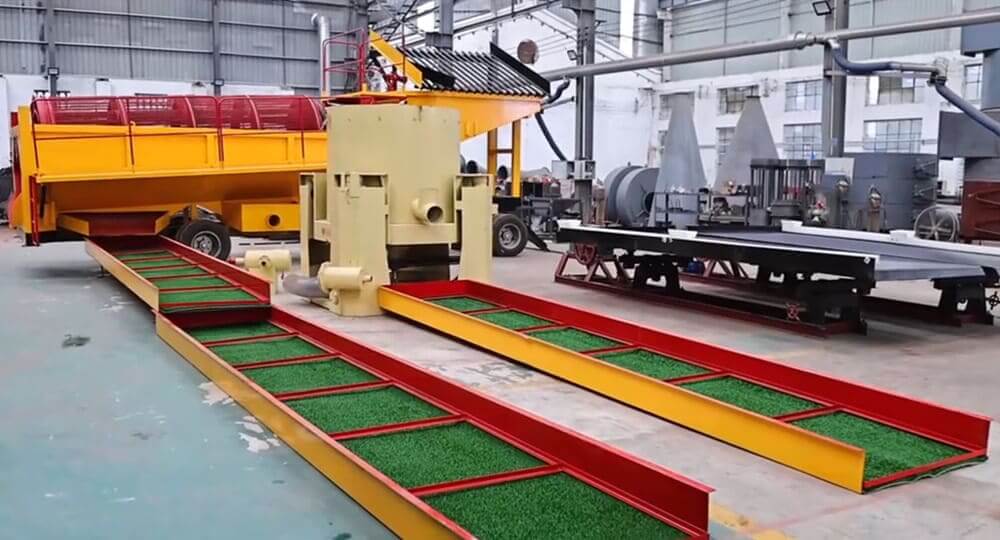
Customized Alluvial Gold Washing Plant Solutions
Every alluvial gold deposit has different geological and mineral processing characteristics. Therefore, a standard equipment configuration may not be suitable for every mining project.
We provide customized alluvial gold washing plant solutions based on:
- Raw ore composition and clay content.
- Gold particle size and distribution.
- Feed material particle size distribution.
- Required processing capacity.
- Site layout and installation conditions.
- Water availability and recycling requirements.
- Expected gold recovery and concentrate grade.
Before selecting the final equipment configuration, we recommend conducting representative ore sampling and mineral processing tests.
Based on the test results, we can optimize the screening mesh sizes, number of centrifugal concentrators, sluice boxes, and mesas vibratorias to achieve a more suitable processing arrangement.
Conclusión
Choosing the right alluvial gold washing plant requires more than comparing equipment prices and processing capacities. It means understanding your deposit characteristics, selecting suitable washing and equipo de separación por gravedad, evaluating site conditions, and balancing gold recovery with operating costs. Most importantly, conducting representative ore sampling and processing tests before purchasing equipment can help you avoid costly mistakes and improve overall recovery efficiency.
There is no one-size-fits-all solution for alluvial gold mining. A well-designed plant should be tailored to your ore characteristics, production targets, water supply, and site requirements. With the right equipment configuration and an efficient processing flow, you can maximize gold recovery, reduce operating costs, and achieve better long-term profitability.
If you are planning an alluvial gold mining project, contact our team with your ore samples, target capacity, and site information. We can help you evaluate your processing requirements and design a customized alluvial gold washing plant solution that fits your project.
ÚLTIMOS PRODUCTOS
-

Handheld Rock Drills
【Drilling Hole Diameter】30-45 mm 【Dill Hole De…
-
Hydraulic Rock Drills
【Drive Method】 Driven by high-pressure hyd…
-
Gasoline Rock Drills
【Engine Type】 Gasoline engine …


 English
 French
 Spanish
 Portuguese
 Indonesian