



This in-depth guide explores the complete process of hard rock (lode) gold mining – from geological formation and global deposits to extraction methods and processing technologies. We cover the characteristics of rock gold deposits, modern exploration techniques, and the three primary processing methods: gravity separation, flotation, and cyanide leaching. The article also examines essential mining equipment and real-world case studies from major gold-producing regions. Whether you’re a mining professional, investor, or geology enthusiast, this comprehensive overview provides valuable insights into the fascinating world of hard rock gold production.
Publicado el tiempo:25 octubre 2018
Hard Rock Gold
Oro de roca dura is also called mineral gold, which is produced in mines. Gold deposits, mostly deposited by hot springs gushing out of the ground through cracks in the rocks, are often associated with quartz in cracks in the rocks. Most of the gold deposits are associated with other metals, including silver, platinum, zinc, and other metals besides gold, which was called composite gold before other metals were put forward. Ore gold occurs in different mines and contains different components of other metals, so the fineness varies from 50% to 90%.
According to the structural state and gold content of gold in minerals, the minerals of gold deposits can be divided into three categories: gold ore, gold-bearing minerals, and gold-carrying minerals. The so-called independent mineral of gold refers to the gold produced in the form of gold minerals and gold-bearing minerals. It is the most important form of occurrence of gold in nature and the main object of industrial development and utilization. So far, 98 kinds of gold minerals and gold-bearing minerals have been found in the world, but only 47 kinds are common, while only 10 kinds of minerals are directly used by industry.
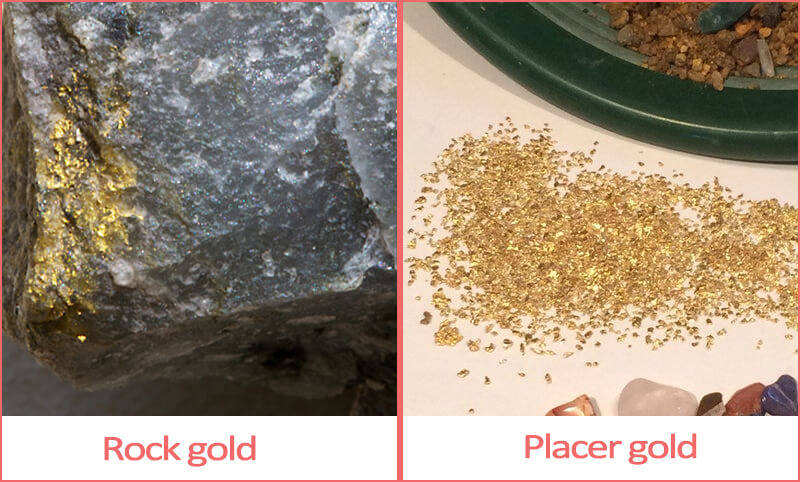
How to Find The Rock Gold Ore Deposit?
The easiest way to find rock gold on land or underground is with a rock gold detector. This machine is operated manually; it is very popular among small rock gold miners. They try to find rock gold or other metals underground, dig up the rock gold ore, then separate out rock gold using a small sluice box and washing machine.
For a large-scale rock gold mining plant, a big rock gold detection machine is used to find the exact rock gold mine position and blast the rock gold stone out. Then send it to the next rock gold processing plant.
Rock Gold Ore Worldwide Distribution
El mineral de oro de roca es muy rico en África, Sudamérica, como Malí, Sudán, Tanzania, Mozambique, Surinam, Ghana, Congo, Zimbabue, Zambia, Etiopía, Perú, Chile, Bolivia, Australia, América, etc.
Proceso de separación por gravedad del mineral de oro
Gravity Separation for Hard Rock Gold Mining
Dónde ir buy an ore crusher machine?
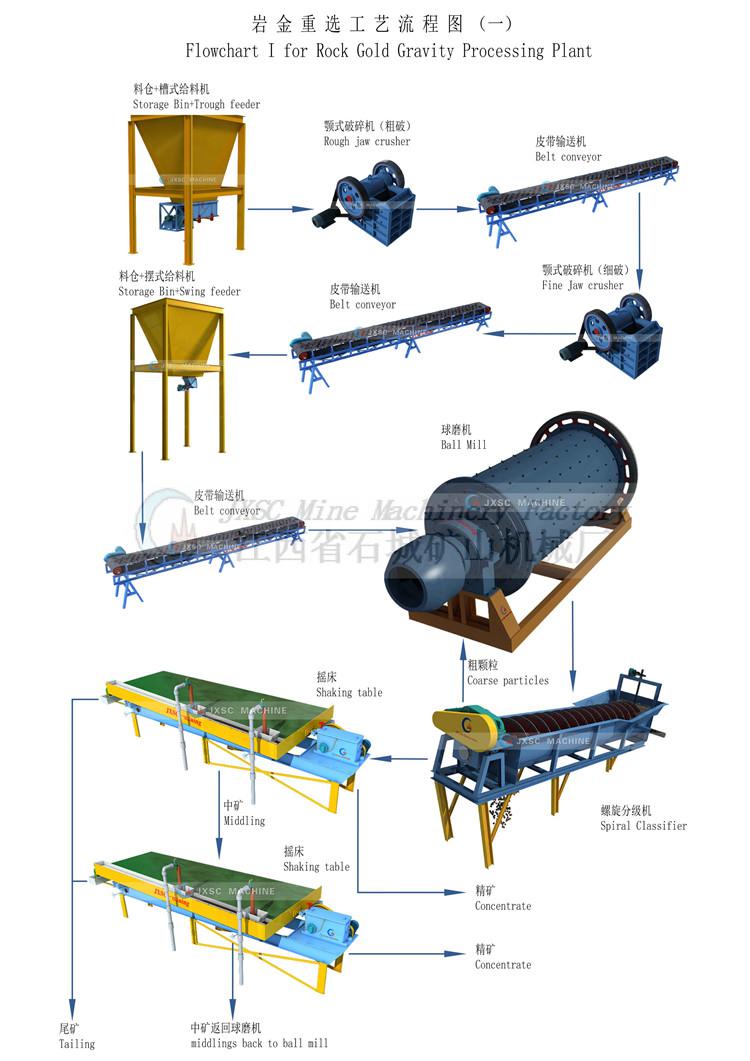
- Fase de trituración y molienda
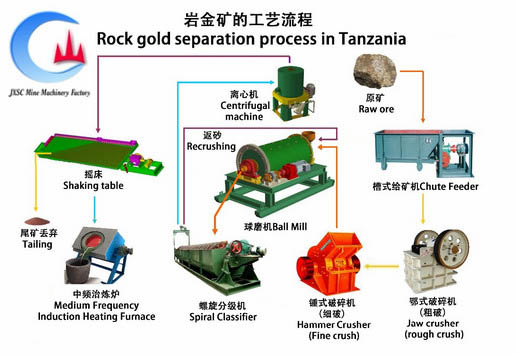
The extracted ore should be crushed by a jaw crusher initially and then by the fine crusher. When it gets the reasonable fineness, it is transported into a ball mill by an elevating conveyor and feeder and is milled by the molino de bolas. - Etapa de clasificación
The finely milled ore goes to the next procedure: classification. There is a theory that if the weights of solid particles are different, the sedimentation will be different, and the mixed ore can be classified by a spiral classifier/screw classifier. - Fase de beneficio
The superfine particles from the ball mill will feed into a shaking table through the hydraulic classifiers, which can ensure different size distribution ore/slurry feed into different riffles on the shaking table, in order to reach a higher recovery ratio.
JXSC Shaking Table is one of our flagship mining equipment with more than 30 years of experience. It has a very high recovery rate, up to 95%, high recovery rate which widely used to concentrate free gold. - Etapa de refinado del oro
Mercury Distiller/Gold Amalgamator is a traditional gold refining machine, widely used to mix mercury and gold concentrate in order to get pure gold; then we can use a gold melting furnace to produce a gold bar.
Proceso de flotación del oro
Proceso de flotación para la extracción de oro de roca dura
Dónde ir buy a gold flotation machine?
- Fase de trituración y molienda
- En classifying stage is the same as the gravity process.
- Fase de mezcla y flotación
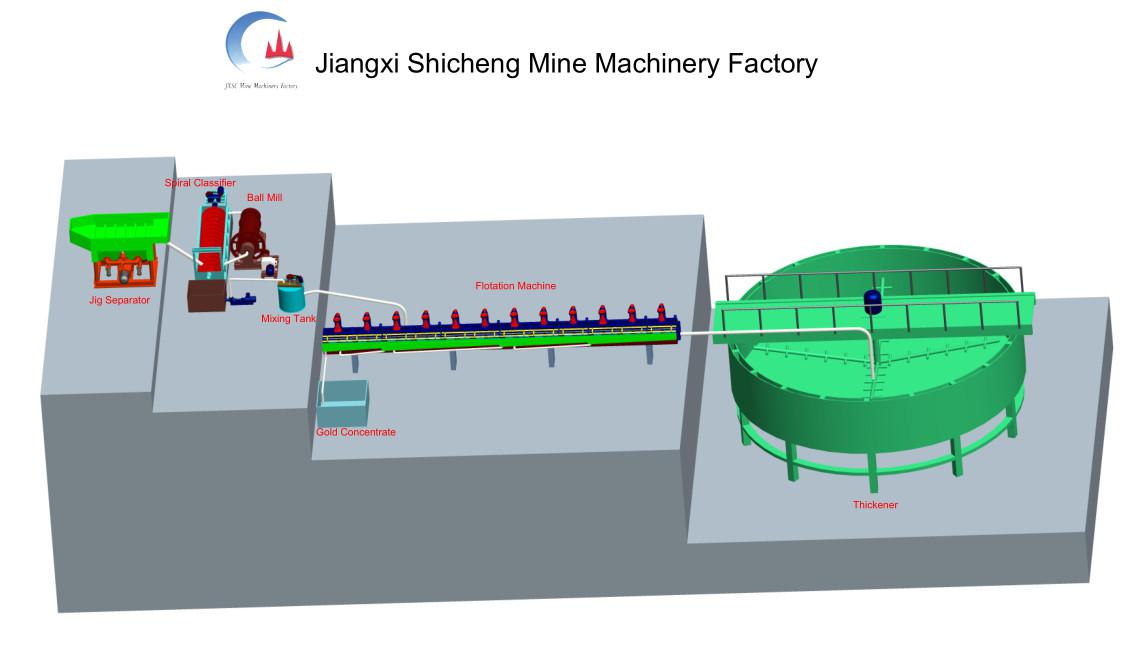
The classified ore gets into a tanque de mezcla for full mixing. At this stage, the chemical agent for foam can be added. After full mixing, the slurry will enter a flotation machine.
When the flotation machine works, the motor drives the impeller to revolve, so the centrifugal effect and negative pressure are produced. On one hand, ample air is absorbed and mixed with mineral slurry; on the other hand, the mixed mineral slurry is mingled with an additive. Meanwhile, the foams are thinned, the mineral is bound with foams, and floats up to the surface of the mineral slurry, and the mineralized foam is formed. The liquid surface can be adjusted with the height of the adjustment flashboard so that the useful foams are scraped with a squeegee. - Concentrador de espesamiento y secado
Then gold is separated from others. Since the separated ore is wet, it should be dewatered by thickening initially and dried by a secador.
Proceso de lixiviación del oro
Lixiviación y adsorción para la extracción de oro de roca dura
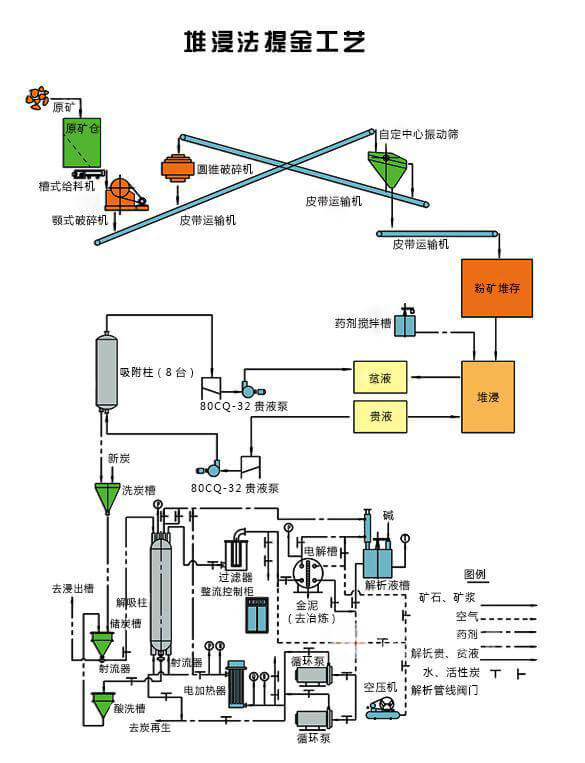
El lodo de mineral molido y cal pasa a una serie de seis tanques de lixiviación donde se añade una solución de cianuro sódico. Los tanques ofrecen un tiempo de retención suficiente para que la solución de cianuro disuelva el oro y la plata. Se añade oxígeno para facilitar el proceso.
The slurry then moves through a series of carbon adsorption tanks. While the leaching process continues in these tanks, the primary objective is to remove the gold and silver from the solution. To achieve this, carbon is fed through the tanks and the gold and silver adsorb (attach) to the carbon granules. Carbon is heated to 600 degrees C and fed into the circuit in the opposite direction to the slurry flow, moving from the last adsorption tank to the first. This is because the gold and silver move towards the carbon via a diffusive process. It is necessary to have fresh carbon at the end of the chain to scalp the gold and silver that has not been removed in the previous tanks.
By the time the slurry reaches the final adsorption tank, most of the precious metals have been removed. The barren slurry, now known as tailings, is pumped to the tailings storage facility. In contrast, by the time the carbon reaches the first adsorption tank, it has recovered most of the gold and silver from solution. This “loaded” carbon is then pumped to the elution circuit where the gold and silver are washed off with superheated water. The washed solution, called pregnant eluate, is passed to the electrowinning circuit. The remaining barren carbon is reactivated by acid washing and kilning and returned to the adsorption tanks.
Casos de extracción de oro de roca
JXSCmine Machinery Company in China has more than 40 years of professional experience in the rock gold process, designs a full set of rock gold ore process flowcharts, provides a complete set of máquinas de separación de mineral de oro de roca, and can send an engineer to the mine site for equipment installation and commissioning guidance. Have already built many gold ore processing plants in African countries. Including Mali, Sudan, Mozambique, Suriname, Ghana, Congo, Zimbabwe, Zambia, Tanzania, Ethiopia, Peru, Chile, Bolivia, Australia, etc.
The following are the gold processing solution cases:
30TPH Rock Gold Processing Plant In Australia
5TPH Alluvial Gold and 1TPH Rock Gold Processing Plant in Niger
50 TPH Rock Gold Processing Plant in Malaysia
30 TPH Rock Gold Processing in Congo
20TPH Planta de procesamiento de oro de roca en Mozambique
Planta de procesamiento CIP de oro de roca de 300TPD(12TPH) en Kenia
100TPH Alluvial Gold & Rock Gold Processing Plant in Congo
Conclusion and Key Takeaways
Resource Significance: Hard rock deposits represent the primary source of global gold supply
Technological Advances: Modern methods achieve >90% recovery rates
Operational Flexibility: Multiple processing options accommodate varying ore types
Global Industry: Production spans all inhabited continents
Economic Impact: Major contributor to many national economies
For mining operations, proper method selection depends on comprehensive ore testing and economic evaluation. The future of hard rock gold mining lies in sustainable practices, efficiency improvements, and technological innovation to profitably access deeper deposits and lower-grade ores.
ÚLTIMOS PRODUCTOS
-

Inclined Vibrating Screen
The inclined vibrating screen is a simple and eff…
-
High Temperature & Pressure Gold Desorption Electrolysis System
High-Temperature & Pressure Gold Desorption Elect…
-
Normal Temperature & Pressure Gold Desorption Electrolysis System
The normal temperature & pressure gold desorption…


ÚLTIMAS NOTICIAS
- Shaking Table, 3-Disc Dry Magnetic & Electrostatic Separator for W-Sn-Ta-Nb
- Mineral Analysis: The Foundation for Successful Mineral Processing Projects
- What Is Over-Grinding and How Can It Be Prevented?
- Fluorspar vs Graphite vs Quartz: Non-Metal Minerals Beneficiation Differences
- Tailings Dam Safety: 5 Critical Parameters to Monitor
 English
  French
  Spanish
  Portuguese
  Indonesian