



Gold ore processing methods vary depending on the composition, gold particle size, and associated minerals (such as sulfides or carbonates). Below, we explore six key gold processing techniques, from roasting to gravity separation, and their ideal applications.
1. Original Ore Roasting
(Best for fine-grained gold locked in sulfides like pirite & arsenopyrite)
Key Characteristics of Suitable Ore
- Gold embedded in fine sulfide minerals (pyrite, arsenopyrite) – difficult to liberate by grinding alone.
- “Roast-recoverable” gold (requires thermal breakdown of sulfides to expose gold).
- Presence of organic carbon & harmful elements (can interfere with cyanide leaching).
How Does It Work?
- Ore is heated (500–700°C) to oxidize sulfides.
- Carbon and sulfur burn off, freeing gold for later cyanidation.
- Produces porous calcine for efficient leaching.
Best For: Ores where mechanical grinding alone cannot liberate gold.
2. Gold Concentrate Roasting
(Ideal for flotation-enriched sulfide gold concentrates)
Why Use This Method?
- Flotation recovers ~90% of gold but leaves it locked in sulfide concentrates.
- Direct cyanide leaching has low gold recovery if sulfides remain.
Processo
- Flotação enriches gold-bearing sulfides.
- Assar breaks down sulfides, freeing gold for leaching.
- Cyanidation extracts gold from the roasted product.
Best For: High-grade sulfide concentrates with complex compositions.
3. Hot Pressing Oxidation Process
(For ultra-refractory ores resistant to roasting or leaching)
Two Types of HPO
| Acidic HPO | Alkaline HPO |
|---|---|
| Best for high-sulfur, arsenic-rich ores. | Best for carbonate-rich ores. |
| Utilizações oxygen + sulfuric acid under high heat & pressure. | Utilizações NaOH/Na2CO3 to prevent acid consumption. |
| More widely adopted in industry. | Less common but useful for specific ores. |
Best For: Extremely stubborn ores where roasting isn’t effective.
4. Joint Pretreatment Process
(For complex ores with multiple interfering elements)
When Is It Needed?
- Ore contains high arsenic, carbon, or cobre.
- Single methods (roasting/flotation) fail to optimize recovery.
Possible Combinations
- Roasting + Bioleaching (for carbon-rich ores).
- Flotation + Hot Press Oxidation (for ultra-refractory sulfides).
- Ultrafine grinding + Cyanide leach.
Best For: Mixed ores where no single method delivers full extraction.
5. Amalgamation Flotation
(For coarse native gold + sulfides)
How Does It Work?
- Grind ore and pass over mercury-coated plates (captures 30–45% free gold).
- Add NaOH/Na₂CO₃ to improve mercury-gold bonding (recovery jumps to ~70%).
- The remaining slurry undergoes flotação to recover sulfide-bound gold.
Nota: Mercury is toxic—modern alternatives like centrifuges are replacing this method.
Best For: Coarse gold embedded in sulfides (historical method; fading due to environmental concerns).
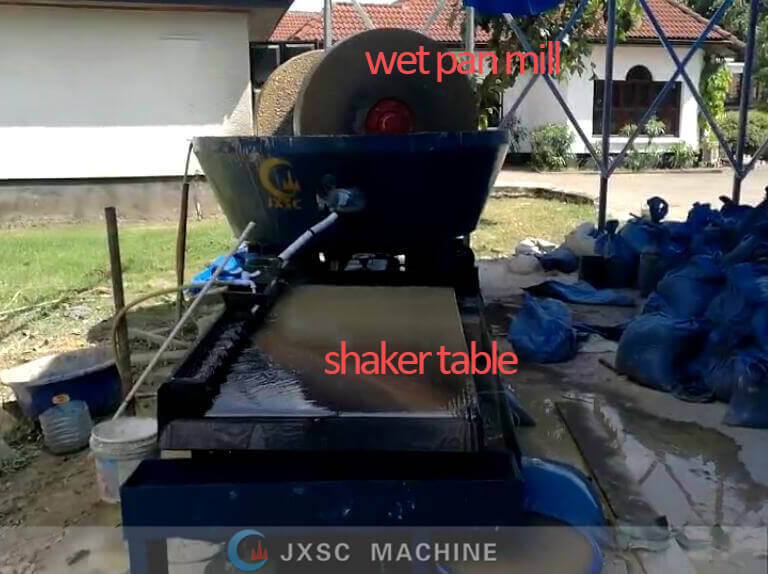
6. Gravity Beneficiation(Separador de jigueiras + Shaking Table)
(Best for free-milling gold with high density contrast)
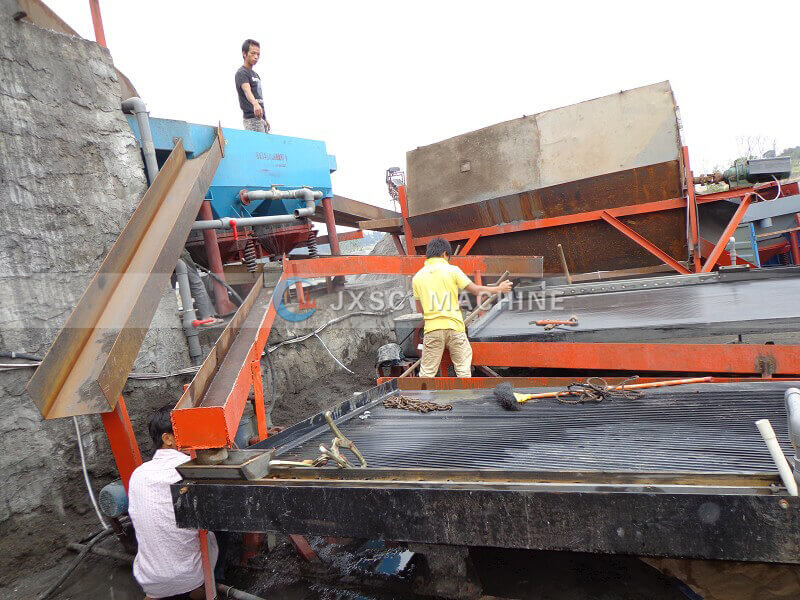
How Does It Work?
- Rastreio removes oversized waste rocks.
- Pesca à linha separates gold from lighter gangue via pulsating water flow.
- O mesa de agitação refines concentrates, recovering fine gold.
Best For: Placer gold or coarse liberated gold in vein deposits.
Summary Table: Best Gold Processing Methods
| Método | Best Ore Type | Taxa de recuperação |
|---|---|---|
| Original Ore Roasting | Fine sulfides | 85–95% |
| Concentrate Roasting | Flotation concentrates | 90–98% |
| Hot Press Oxidation (Acidic/Alkaline) | Ultra-refractory sulfides | 90–96% |
| Joint Pretreatment | Complex ores | Varies by combo |
| Amalgamation-Flotation | Coarse + sulfides | ~70%* (mercury) |
| Separação por gravidade | Free-milling gold | 60–85% |
Final Takeaway
- Fine sulfide-bound gold → Roast or HPO.
- Coarse free gold → Gravity separation.
- Mixed/complex ores → Hybrid approaches.
Would you like a cost-benefit comparison or case studies on specific gold processing plants? Please view our cases.
PRODUTOS MAIS RECENTES
-

SFM-8 Lab Grinder
【Max. Power Consumption】 150W 【Morta…
-
Cyclosizer
【Feeding Capacity】< 100g/time 【Feeding …
-
JKZ/2JKZ Mine Shaft Sinking Hoist
【Power Source】Electric Motor Drive 【Motor Spee…


 English
  French
  Spanish
  Portuguese
  Indonesian