



Mineral processing is critical in mining. Without the right techniques, valuable minerals get wasted. Screening, classification, and separation ensure efficiency. But what exactly are these processes? Let’s break them down.
Rastreio sorts ore by size using a mesh. Classificação separates particles based on their settling speed in water or air. Separação isolates valuable minerals from waste using differences in physical or chemical properties. These steps prevent over-grinding, improve equipment efficiency, and prepare ore for beneficiation.
Understanding these processes is key to optimizing mining operations. Let’s dive deeper into each one.
What Is Screening in Mineral Processing?
Ore sizes vary. Some chunks are too big for the next steps. Screening removes oversized material quickly and efficiently.
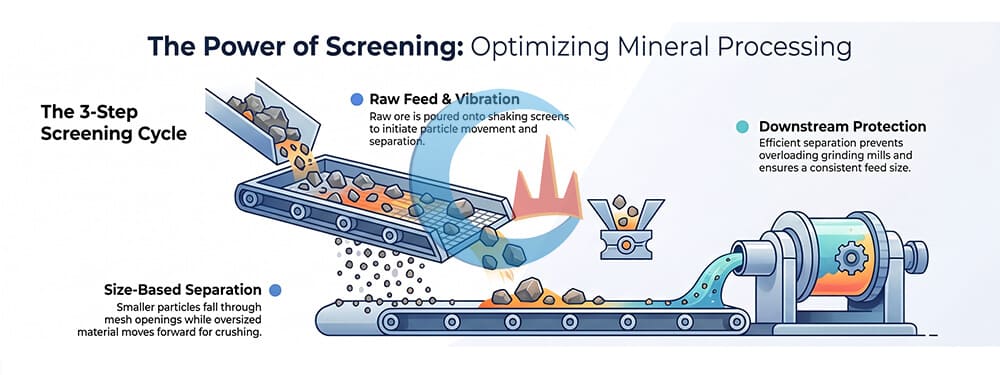
Screening uses peneiras vibratórias or sieves to divide ore into size groups. The material passes through mesh openings of specific sizes. Oversized particles stay on top, while smaller ones fall through. This prevents clogging in crushers and grinding mills, saving energy and improving efficiency.
How does screening work?
- Feed Material– Raw ore is poured onto the screen.
- Vibration– The screen shakes, helping particles move and separate.
- Separação– Smaller particles pass through; larger ones move forward for further crushing.
Types of Screens
| Tipo | Aplicação | Benefit |
| Peneira vibratória | Dry or wet material | Alta eficiência |
| Peneira Trommel | Large, sticky ores | Handles uneven sizes |
| Grizzly Screen | Pre-screening before crushing | Removes oversized rocks |
Why does it matter?
- Prevents overloading of grinding mills
- Reduces energy waste
- Ensures consistent feed size
What Is Classification in Mineral Processing?
Not all particles sink at the same rate. Classification sorts them based on how fast they settle—critical for efficient mineral recovery.
Classification divides particles by settling speed in water or air. Faster-sinking particles (heavier/larger) separate from slower ones. This ensures only the right-sized material moves to the next stage, improving grinding and separation efficiency.
Methods of Classification
- Uses water and centrifugal force.
- Fast, works for fine particles.
- Common in grinding circuits.
- Uses gravity and a rotating screw.
- Good for coarse sand separation.
- Air Classifiers
- Uses airflow for dry materials.
- No water needed.
Importance
- Avoids sending unnecessary fine particles back for grinding.
- Ensures stable operation of flotation and leaching.
What Is Separation in Mineral Processing?
Minerals and waste rock don’t behave the same. Separation isolates valuable minerals from the rest.
Separation leverages differences in density, magnetism, or surface properties to extract useful minerals. Techniques like flotation, gravity separation, and magnetic separation refine ore into valuable concentrate.
Types of Separation
| Método | Princípio | Used For |
| Froth Flotation | Bubbles attach to minerals | Minérios de sulfuretos |
| Separação por gravidade | Density differences | Gold, tungsten |
| Separação magnética | Magnetic properties | Iron ore |
Why is it essential?
- Increases mineral purity for smelting.
- Reduces waste transport costs.
What Are The Differences Between Screening, Classification, and Separation?
All three refine ore, but they work differently. Knowing when to use each is crucial.
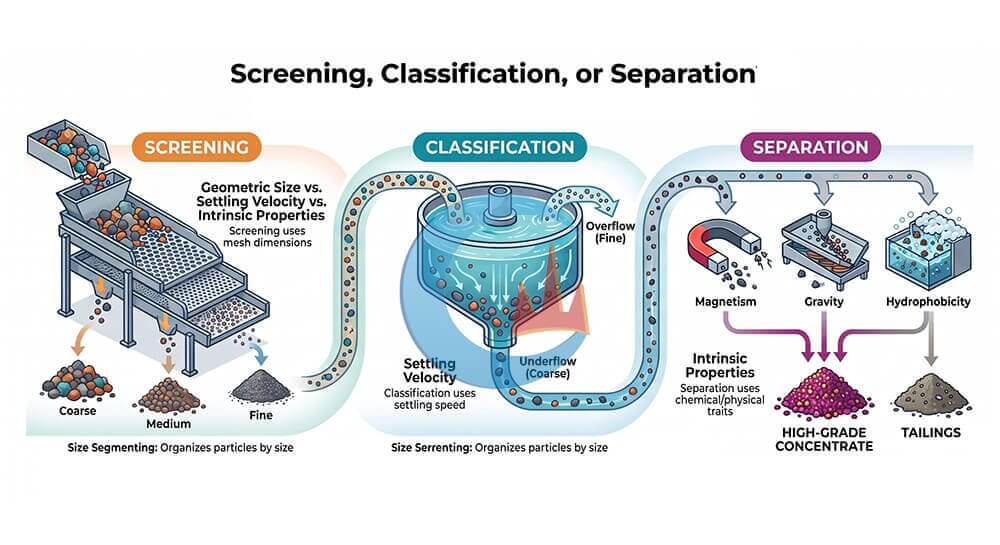
Screening sorts by size. Classification sorts by settling speed. Separation isolates minerals by physical/chemical traits. Together, they optimize mineral recovery and processing efficiency.
Key Differences
Different Objectives: Screening and classification aim to segment materials byparticle size range (e.g., controlling the particle size of crushed products or regulating fineness in closed-circuit grinding); beneficiation aims to enrich minerals after liberation, separating useful minerals from gangue.
Different Separation Criteria: Screening is strictly based on particle geometric dimensions (screen mesh size); classification is based on the particle’s settling velocity in a medium (influenced by particle size, density, and shape); separation is based on differences in the intrinsic properties of minerals (e.g., density differences for gravity separation, magnetic properties for magnetic separation, and surface hydrophobicity for flotation).
The nature of the products differs: the products of screening and classification are merely mixtures of ore of different particle sizes, with the grade typically remaining unchanged; the products of separation are concentrates, middlings, or tailings with significantly altered grades.
Their positions in the process differ: screening and classification are often located during the crushing and grinding stages (as auxiliary or control operations); separation occurs after grinding and is the core operation of the mineral processing plant.
Detailed Comparative Analysis
| Comparison Dimension | Rastreio | Classificação | Separation (Beneficiation) |
| Core Separation Basis | Screen aperture geometry | Difference in settling velocity in a medium | Differences in physical/physicochemical properties |
| Applicable Particle Size | Coarse particles (>2–3 mm) | Fine-particle slurry (<2 mm) | Fully liberated material (all size fractions) |
| Typical Associated Stages | Before/after crushing operations | Closed-circuit grinding | Core beneficiation process |
| Representative Equipment | Vibrating screens, trommel screens | Spiral classifiers, hydrocyclones | Máquinas de flotação, magnetic separators, shaking tables |
| Core Operational Objective | Strict sizing based on particle dimensions | Separation into narrow size fractions based on settling equivalence | Enrichment of valuable minerals to produce a concentrate |
Why do all three matter?
- Screening and classification prevent wasted grinding effort.
- Separation maximizes mineral recovery.
What Are The Applications of Screening, Classification, and Separation in Mineral Processing?
Mining operations rely on efficient mineral processing to extract value from ore. Screening, classification, and separation are essential steps—but where exactly are they applied? Let’s explore the specific applications of screening, classification, and sorting in mineral processing.
1. Specific Applications of Screening in Mineral Processing
-
- Pre-screening in the crushing plant: Positioned before the crusher to remove particles smaller than the discharge opening (undersize) from the raw feed; this reduces the crusher’s load and prevents energy waste caused by over-crushing.
- Check screening after crushing: Controls the final particle size of the crushed product; oversized material is returned to the crusher for secondary crushing, creating a closed-loop circuit that ensures uniform particle size.
- Dense medium separation (DMS) and medium recovery: Separates processed ore from the dense medium and recovers expensive magnetite powder for reuse, significantly lowering production costs.
- Concentrate/tailings dewatering: Dewaters products from flotation or magnetic separation; produces low-moisture concentrate for easier transport while generating thickened slurry that meets dry tailings disposal requirements.
2. Specific Applications of Classification in Mineral Processing
-
- Closed-circuit grinding: Forms a circulation system with the ball mill; promptly separates product of the required size while returning coarser material for regrinding, preventing over-grinding (sliming) and improving grinding efficiency.
- Pre-treatment for gravity separation: Classifies feed material before it enters shaking tables or sluices; allows different particle size fractions to be matched with specific operating parameters, optimizing separation performance.
- Desliming and thickening: Remove fine, clay-like impurities from the slurry to improve concentrate grade in subsequent flotation or magnetic separation, while increasing slurry density to reduce downstream processing costs.
- Particle size analysis: Utilizes settling rate differences in hydraulic classification to determine the particle size distribution of fine materials, providing data to support process parameter adjustments.
3. Specific Applications of Separation in Mineral Processing
-
- Gravity separation: Processes tungsten, tin, and gold ores as well as placer deposits; suitable for minerals in the 0.1–25 mm size range; serves as a pre-concentration method for rare earth ores and is often combined with flotation or magnetic separation in integrated flowsheets.
- Dry separation: Processes minerals such as magnetite and placer gold in water-scarce regions; achieves recovery rates exceeding 95%, saves 40% more energy than wet processing, and avoids water pollution issues.
- Shaking Table Separation: Used for processing ores of rare metals such as tungsten and tin; it is effective for a particle size range of 3–0.2 mm and can simultaneously yield concentrate, tailings, and intermediate products in a single operation.
- Combined Process Separation: In the beneficiation of copper sulfide and polymetallic ores, a combination of gravity separation, flotation, and magnetic separation is employed; this allows for the early recovery of concentrate from coarse particles, thereby minimizing metal loss and reducing costs.
Conclusão
Screening, classification, and separation are fundamental in mineral processing. They form a complete, progressive chain within the mineral processing workflow. Screening sorts by size, classification by settling speed, and separation by mineral properties. Together, they ensure efficient ore processing, reduce waste, enhance concentrate quality, and the efficient and stable operation of the entire production line.
PRODUTOS MAIS RECENTES
-

High Temperature & Pressure Gold Desorption Electrolysis System
High-Temperature & Pressure Gold Desorption Elect…
-
Normal Temperature & Pressure Gold Desorption Electrolysis System
The normal temperature & pressure gold desorption…
-
ABS Spiral Chutes
【Capacity】0.15-6 tph 【Feeding Size】0.02-…


NOTÍCIAS MAIS RECENTES
- Fluorspar vs Graphite vs Quartz: Non-Metal Minerals Beneficiation Differences
- Tailings Dam Safety: 5 Critical Parameters to Monitor
- What Is the Beneficiation Process for Ultra-pure Iron Concentrate?
- How to Comprehensively Recover Valuable Metals from Copper Slag?
- Chemical Phase Analysis of Manganese Ore: Optimizing Processing
 English
  French
  Spanish
  Portuguese
  Indonesian