



Outlines the composition, classification, recovery value, and typical recovery processes of slag generated during metal smelting. Slag is a by-product of high-temperature smelting, composed primarily of oxides such as silicon dioxide, aluminum oxide, calcium oxide, and magnesium oxide, while also containing valuable metals like iron, copper, chromium, and molybdenum. Depending on the smelting process, slag can be categorized into smelting slag, refining slag, enrichment slag, and synthetic slag; each type offers distinct potential for processing and resource recovery. The article also highlights the significant importance of recovering metal slag.
Slag Introduction
Slag is also called molten slag. The melt that floats on the surface of liquid substances such as metals during the pyrometallurgical process is composed mainly of oxides (silicon dioxide, aluminum oxide, calcium oxide, magnesium oxide) and often contains sulfides and a small amount of metal. The composition of the slag is adjusted by adding an appropriate amount of flux (lime, quartzite, fluorite, etc.). In the smelting process, by controlling the composition and properties of the slag, the products of gangue and oxidized impurities can be smoothly separated from the molten metal or sulfur; the harmful impurities in the metal are removed, and the non-metallic inclusions in the liquid metal are not directly affected. Furnace gas is polluted, and useful metal oxides are enriched; it is also a resistance heating element in electric furnace smelting. Slag plays a decisive role in ensuring the smooth progress of smelting operations, the quality of smelted products, and the metal recovery rate.
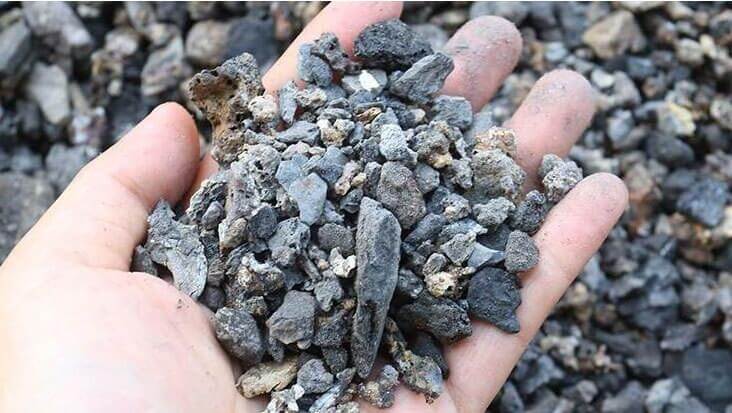
Classificação das escórias
According to different metallurgical processes, slag can be divided into smelting slag e refined slag.
- Using ore (including man-made rich ore or concentrate, etc.) as raw materials for reduction smelting or oxidation smelting, the slag formed while obtaining coarse metal or matte is called smelting slag.
- The slag produced by refining crude metal (smelting steel with pig iron, refining copper from blister copper, etc.) is called refined slag.
The main function of these two types of slag is to remove the useless or harmful substances in the raw materials from the metal products.
There is another type of slag whose main function is to enrich certain useful substances contained in the raw materials in order to facilitate recycling them in the next process. This is called enriched slags, such as high titanium slag obtained by reduction smelting of titanium concentrate, and converting Vanadium slag and niobium slag obtained from pig iron containing vanadium and niobium are used as raw materials for extracting titanium, vanadium, and niobium, respectively.
There is also a type of so-called “synthetic slag”, which is pre-prepared with various raw materials according to the metallurgical role of the slag, such as electroslag remelting slag, mold slag used for ingot casting or continuous steel casting, and molten steel. Slag washing with slag, etc.
Reciclagem de escórias metálicas
Valuable metals enter the slag due to mechanical loss, chemical loss, and physical loss. When it is economically uneconomical to recover these metals from the slag, the slag can be discarded for other purposes. For example, copper smelting waste slag contains Cu 0.2-0.4%, and ferrovanadium smelting waste slag contains V2O50.2-0.3%. A reasonable selection of the composition of the slag according to the physical and chemical properties plays an important role in reducing the content of valuable metals in the waste slag. The non-ferrous metal refining slag contains very high-value metals and is generally returned to the previous process. Among the raw materials for metal refining, in addition to the main metal, there are other metals with recycling value. Generally speaking, whether the metal has recycling value depends on the use value of the metal, the cost of recycling, and the price of the commodity. It is often recovered from the slag or smoke produced in the process of smelting the main metal. Among the smelting raw materials of non-ferrous heavy metals, most of the valuable metals are precious metals and rare metals, which have a high recovery value.
Instalação de reciclagem de escórias
Planta de processo de recuperação de escória de ferro molibdênio
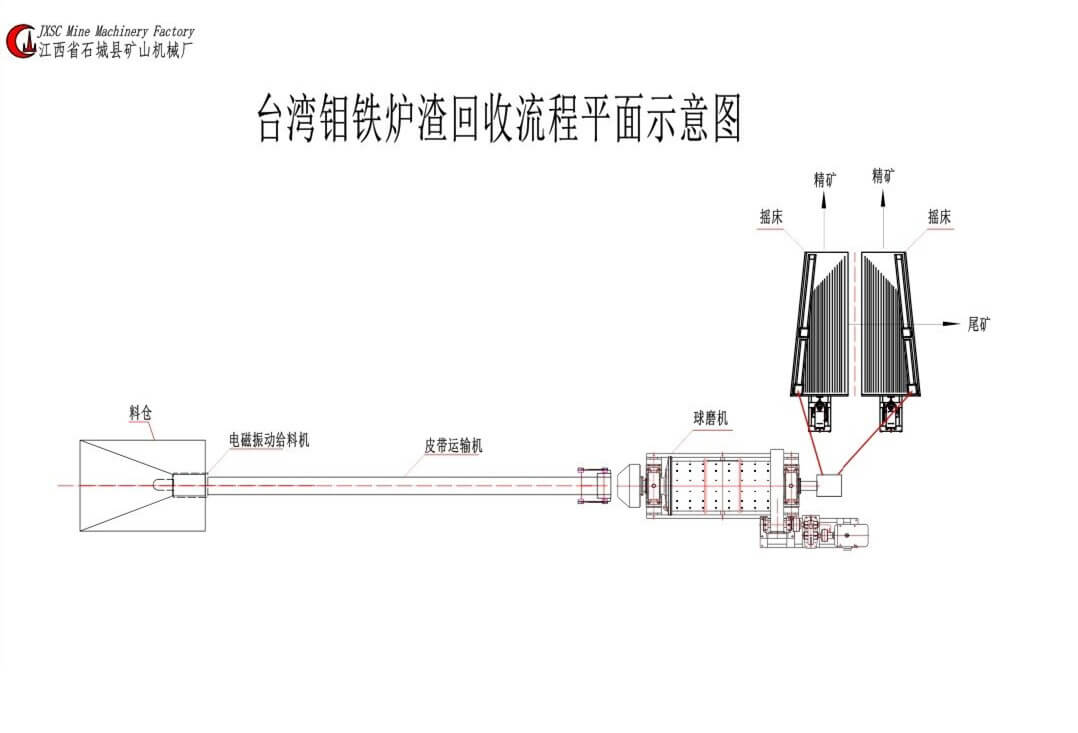
Este fluxograma foi concebido para o processamento de 1-2TPH de escória de ferro molibdénio para a recuperação de ferro e metais molibdénio da escória. Nós fornecemos um conjunto completo de máquinas de plantas para nossos clientes de Taiwan. Incluindo tremonha de alimentação, alimentador vibratório eletromagnético, correia transportadora, moinho de bolas, esferas de aço, mesa de agitação, etc..,
The vibration feeder is for feeding material smoothly and evenly to the ball mill, so that it can grind effectively. Ball mill is for grinding slag (0- 20 mm) to 0- 1 mm or smaller size depending on customer requirement. Then the output small fine powder goes to the shaking table for recovering the metals from slag. The shaking table has an extremely high recovery ratio for recovering heavy metals from slag. Then will get metal concentrate from the shaking table.
The slag is a very hard material and contains a lot of oil. So has a high requirement for the grinding machine and belt conveyor; the belt conveyor needs to be made of nylon material, oil, and solvent resistant. The ball mill needs more thick lining plates for wear resistance. Some customers will also use rod mills to grind slag.
The flowchart can be customized according to slag material condition, the requirement for the final product, and process capacity.
Planta de processo de recuperação de escória de ferrocromo
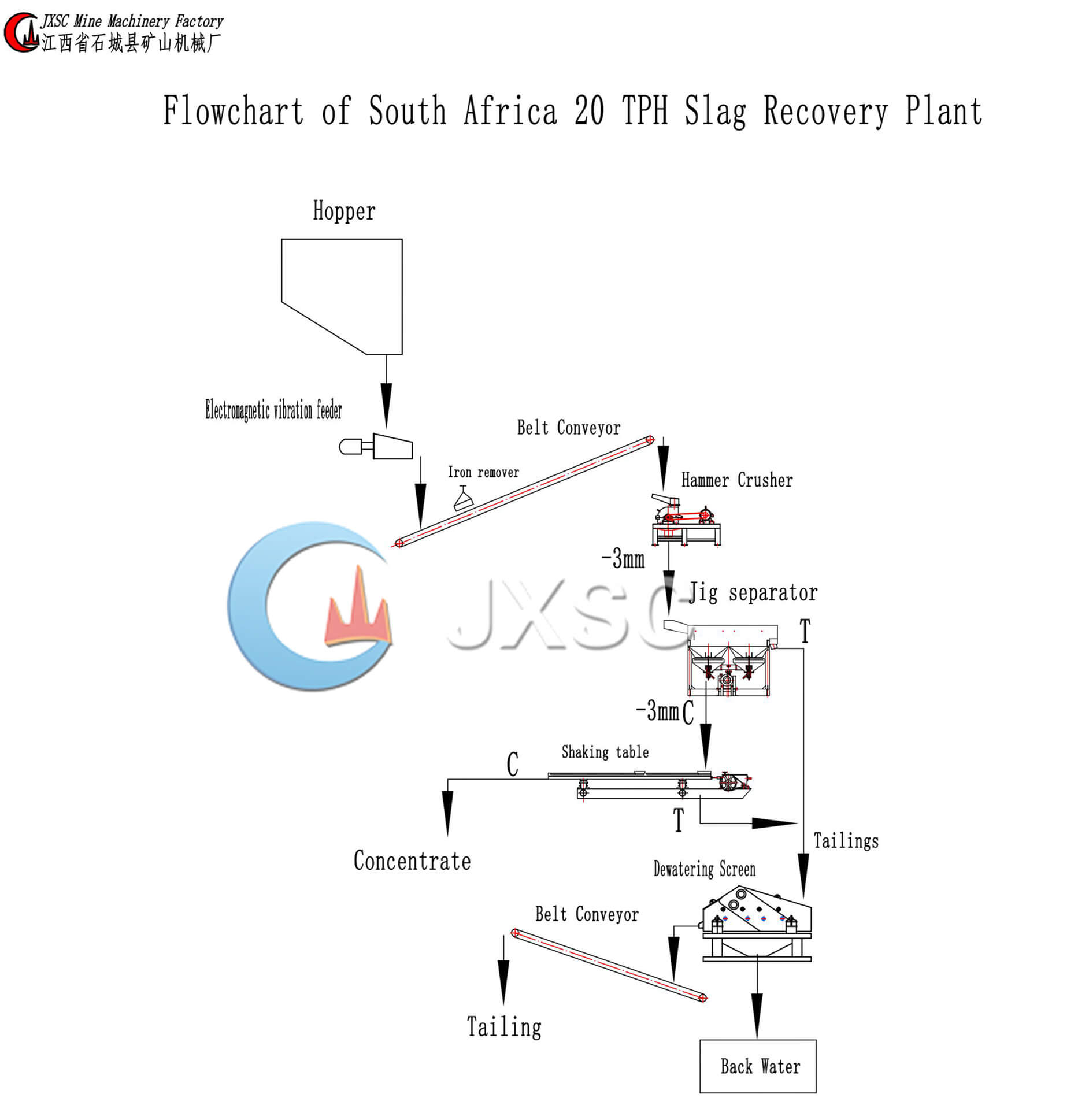
Esta planta de processamento é para a escória para a recuperação do ferro-cromo. O processo é o seguinte.
O carregadora de rodas ou alimentação de escavadoras a escória bruta para a tremonha. Existe um alimentador vibratório eletromagnético sob a tremonha, que pode alimentar o material para a correia transportadora more evenly. The client requires iron removal equipment to remove the big Fe slag first. The material will be fed into the triturador de martelos by the belt conveyor, using the hammer crusher for crushing the big slag into fine particles of 3 mm. The output size can be adjusted based on your requirements. The output from the hammer crusher goes to the separador de jigueiras para apanhar primeiro os concentrados. O filtro inferior do separador de jigues vai para o mesa de agitação para separação novamente, para melhorar o grau. Os rejeitos do separador de jigue e da mesa de agitação vão para o ecrã de desidratação for dewatering.
The required processing capacity for this flowsheet is 20 tons per hour of input feeding capacity. While any capacity is ok. With different mine situations and different requirements, the solution will be different.
Referindo-se a reciclagem das escórias, we can also design metal slag recycling plants, incluindo chumbo, ferro, aço, níquel, alumínio, cobre, and so on, according to your actual slag recycling goals. If you need to recycle the metal from the slag, please contactar-nos para obter o desenho de fluxo livre.
PRODUTOS MAIS RECENTES
-

SFM-8 Lab Grinder
【Max. Power Consumption】 150W 【Morta…
-
Cyclosizer
【Feeding Capacity】< 100g/time 【Feeding …
-
JKZ/2JKZ Mine Shaft Sinking Hoist
【Power Source】Electric Motor Drive 【Motor Spee…


 English
  French
  Spanish
  Portuguese
  Indonesian