



In the field of processamento de minerais, flotation, as the core technology for separating and enriching useful minerals, has process parameters that are closely related to the grade and recovery of the final product (concentrate). Normally, in the ideal flotation process, with the increase of mineral particle size, within a certain range, the concentrate grade will show a relatively stable state or regular change. However, in the actual production of some beneficiation plants, there will occasionally be an abnormal phenomenon – “coarse-grained and fine-grained concentrate grade inversion”, that is, the grade of coarse-grained concentrate is lower than the grade of fine-grained concentrate. This phenomenon not only violates conventional cognition but also directly affects the final economic benefits of the beneficiation plant. The purpose of this article is to analyze the deeper reasons behind the phenomenon of “inverted grade of Rough concentrate”, and to provide a diagnosis and problem-solving ideas for the beneficiation technicians.
What is Grade Inversion?
Before discussing abnormal phenomena, we first need to clarify the conventional relationship between particle size and grade. In flotation operations, the ore must be ground to a suitable particle size to achieve the monomer dissociation of useful minerals and gangue minerals.
Conventional expectations: It is generally believed that within the particle size range that achieves full dissociation, the concentrate grades of different particle sizes should not show a sharp contrast. Generally, the medium particle size (10-150μm) is considered to be the best floatable particle size with the best flotation effect. However, due to insufficient dissociation or the influence of gravity, the recovery rate of overly coarse particles may decrease, but the theoretical grade of the selected part should not be systematically lower than the fine particle size.
Coarse-grained concentrate: Composed of larger mineral particles.
Fine-grained concentrate: Composed of smaller mineral particles.
Grade inversion: Refers to the fact that when screening and analyzing the rough concentrate, the grade of particles of +150μm or coarser is significantly lower than that of finer particles, such as -74μm. This “inversion” directly indicates that a large amount of gangue minerals are mixed into the coarse-grained product, resulting in its poor purity.
What Causes Grade Inversion?
The phenomenon of “coarse and fine-grained concentrate grade inversion” is not caused by a single factor, but is the result of a combination of factors such as the nature of the ore, process flow, equipment performance, and pharmaceutical system.
1. Core internal factors: mineral embedding characteristics and insufficient dissociation
The characteristics of the ore itself are the most fundamental and core factors leading to grade inversion.
Complex Mineral Embedding Characteristic
For ores with very fine leaching grain sizes, such as microfine-grained leaching gold ores, useful minerals (e.g., pirite, poisonous sands) are dispersed in micron-sized particles in the veinlets. Extremely fine grinding grain sizes (e.g., -74 μm in more than 90% of cases) are often required to achieve adequate dissociation of such ores. Under conventional or coarse grinding conditions, the coarse-grained grades are almost exclusively concretions, and their grades are naturally not comparable to the fully dissociated fine-grained grades.
“Illusion” of Insufficient Dissociation
The most direct reason for the low grade of coarse grains is that the useful minerals and vein minerals fail to realize the effective monomer dissociation. Under coarse grinding conditions, many coarse particles are actually “conidia”, i.e., the useful minerals and chondritic minerals are still tightly bound together. When the surface area of the useful minerals exposed in these concretions is sufficient to interact with the trapping agent and float attached to the bubbles, they enter the concentrate product. However, the presence of significant amounts of veinlets themselves inevitably leads to low concentrate grades at this grain level.
2. Process and equipment factors: non-ideal flotation environment
The hydrodynamic environment of the máquina de flotação and the configuration of the grinding and classification circuits have a crucial impact on the sorting behavior of particles of different particle sizes.
The “misjudgment” of coarse particles by the flotation machine
Turbulence intensity and particle suspension: Conventional mechanical agitation flotation machines require strong turbulence to fully suspend the slurry. However, this strong turbulence is extremely unfavorable for the stable mineralization (i.e., attachment to bubbles) of coarse and heavy particles (>0.1mm). Due to the large gravity of coarse particles, the centrifugal force generated in the vortex can easily overcome their adhesion to the bubbles, causing them to fall off the bubbles.
Interference from floating gangue: When the ore contains gangue minerals with good natural floatability or easy to be “captured” (such as talc, pyrophyllite, carbonaceous minerals, etc.), under strong stirring and aeration conditions, these coarse gangue or gangue conjoined bodies containing a small amount of useful minerals may also be “accidentally captured” into the foam layer, thereby lowering the grade of the coarse concentrate.
Impact of grinding and classification efficiency
Lack of stage grinding and flash flotation: For ores with unevenly distributed particle sizes, the ideal process is to use stage grinding-stage separation. That is, after coarse grinding, the coarse useful minerals that have been dissociated are recovered in advance through technologies such as flash flotation to avoid over-grinding in subsequent grinding. If this link is missing, a one-stage grinding process is used. To ensure the dissociation of fine-grained minerals, the easily dissociated coarse minerals are often repeatedly ground, while the difficult-to-dissociate coarse conjoined bodies continue to circulate in the circuit, increasing the probability of them being “misselected”.
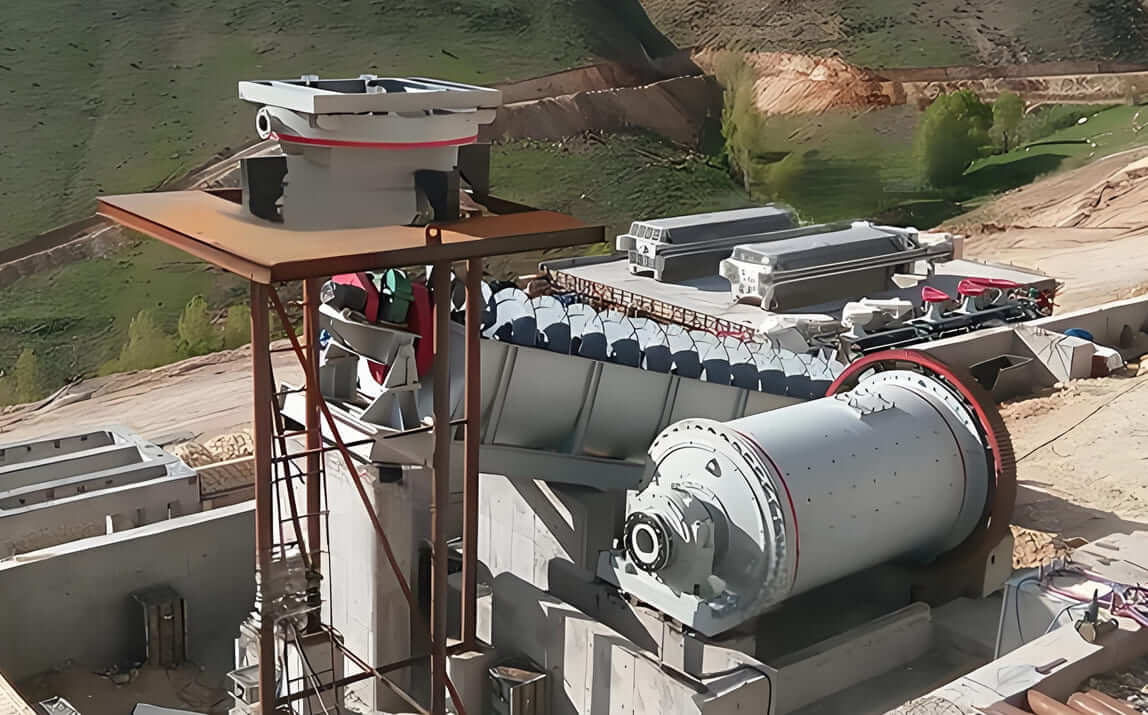
Low classification efficiency: The efficiency of the ciclone or classifier is not high, which will cause a large number of coarse conjoined bodies that should have been returned for re-grinding to “run away” and enter the flotation operation, becoming the “raw material” that causes the grade to be inverted.
3. Adaptability of the reagent system
The selectivity and action intensity of flotation reagents directly determine the difference in floatability of different minerals. An improper reagent system will aggravate the phenomenon of grade inversion.
Poor selectivity or improper dosage of the collector
Too strong collection ability: To enhance the collection of coarse-grained minerals, sometimes a collector with strong collection ability is selected, or the dosage is increased. However, this may be a “double-edged sword”. While improving the recovery rate of coarse particles, it may also activate some gangue minerals or make the intergrowth more easily float, thereby sacrificing the quality of the concentrate.
Negative effects of auxiliary collectors: Neutral oils such as diesel and kerosene added to enhance hydrophobicity can enhance the adhesion of coarse useful minerals and bubbles, but if used improperly, they may also be non-selectively attached to the surface of intergrowth or gangue, causing common floating.
Poor inhibitor effect: Failure to effectively inhibit gangue minerals, especially in a complex slurry chemical environment (such as the presence of various interfering ions), the inhibitor fails or its effect is weakened, which will cause a large amount of gangue minerals to enter the concentrate. This problem is particularly prominent in the coarse particle size.
How To Solve Grade Inversion?
To solve the problem of inverted Coarse concentrate grade, a systematic diagnostic approach must be adopted, and targeted process optimization must be carried out.
1. Strengthen process mineralogy research
This is the fundamental solution to the problem. The embedded particle size of useful minerals in the ore and the symbiotic relationship with the gangue must be accurately mastered. Through dissociation degree analysis, the theoretical grinding fineness required to achieve the target recovery rate and grade is clarified.
2. Optimize the grinding and classification process
Implement stage grinding: For ores with uneven embedded particle size, the “stage grinding-stage flotation” process is decisively adopted. Add a flash flotation machine or a coarse particle flotation column to the grinding circuit to recover the dissociated qualified coarse particle concentrate as soon as possible.
Regrinding of coarse concentrate: Regrinding the produced coarse concentrate to further dissociate it and then select it again is an effective means to improve the final concentrate grade.
Improve classification efficiency: optimize the operating parameters of the cyclone or replace more efficient equipamento de classificação to ensure that the coarse-grained conjoined bodies can be effectively returned to the mill to reduce their interference with flotation.
3. Innovate flotation equipment and processes
Use coarse-grained flotation technology: To address the problem of coarse-grained recovery, equipment specially designed for coarse-grained flotation can be used, such as fluidized bed flotation columns and boiling flotation machines. This equipment can provide a milder mineralization environment, reduce the shedding of coarse particles, and have a certain classification effect, which is beneficial to selective separation.
Split flotation: Divide the slurry into coarse and fine streams according to the particle size, and enter flotation machines of different types or different operating parameters for treatment, to achieve “teaching students by their aptitude” and optimize their respective sorting effects.
4. Fine-tuning the reagent system
Optimize the reagent formula: Through mineral processing experiments, find a collector combination with better selectivity for the target mineral and weaker capture of gangue.
Segmented dosing: Accurately add reagents at different positions in the flotation process to avoid excessive initial reagent concentrations that lead to indiscriminate capture of intergrowth and gangue.
Enhanced inhibition: Screen and use highly effective inhibitors for specific gangue components in the ore, and strictly control chemical conditions such as the pH value of the slurry to create the best environment for the inhibitors to work.
Conclusão
In conclusion, the phenomenon of coarse concentrate grade inversion is a complex issue arising from various factors, including mineralogy, flotation kinetics, and operational parameters. Understanding the underlying causes of this inversion is crucial for effective mineral processing and maximizing the economic benefits for beneficiation plants. By diagnosing the specific issues that lead to this abnormality and implementing appropriate solutions, such as optimizing flotation conditions, adjusting reagent use, and carefully managing particle size distributions, technicians can significantly enhance recovery and grade stability of the concentrates. Continuous monitoring and adaptation of processing strategies are essential to mitigate the impacts of grade inversion, ensuring that flotation remains a reliable method for mineral enrichment.
PRODUTOS MAIS RECENTES
-

SFM-8 Lab Grinder
【Max. Power Consumption】 150W 【Morta…
-
Cyclosizer
【Feeding Capacity】< 100g/time 【Feeding …
-
JKZ/2JKZ Mine Shaft Sinking Hoist
【Power Source】Electric Motor Drive 【Motor Spee…


 English
  French
  Spanish
  Portuguese
  Indonesian