



When people think of diamond-rich regions, South Africa often comes to mind. However, deep in the frozen Siberian wilderness lies Mina de diamantes Mirny—the world’s most valuable diamond deposit, producing 23% of global diamonds with an estimated worth of £13 billion.
The Colossal Scale of Mirny Mine
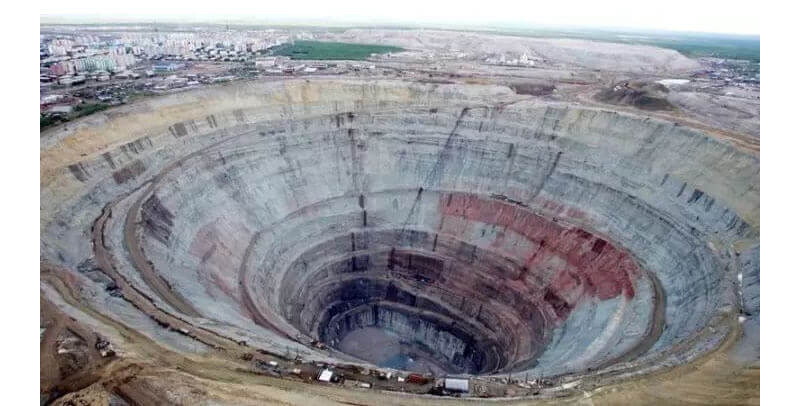
The Mirny Diamond Mine is a huge whirlpool cave. The cave is 1200 meters in diameter and 525 meters deep, which is equivalent to 161 stories. The depth of the spiral hole has created a strong airflow between the Earth’s internal magnetic field and the air above the surface. If a light-weight small aircraft flies over it, it can be sucked into the cave by this airflow.
O valor deste depósito é de cerca de 13 mil milhões de libras. Esta estimativa baseia-se na produção restante da mina mais o valor total dos diamantes produzidos. É atualmente a mina de diamantes mais cara do mundo.
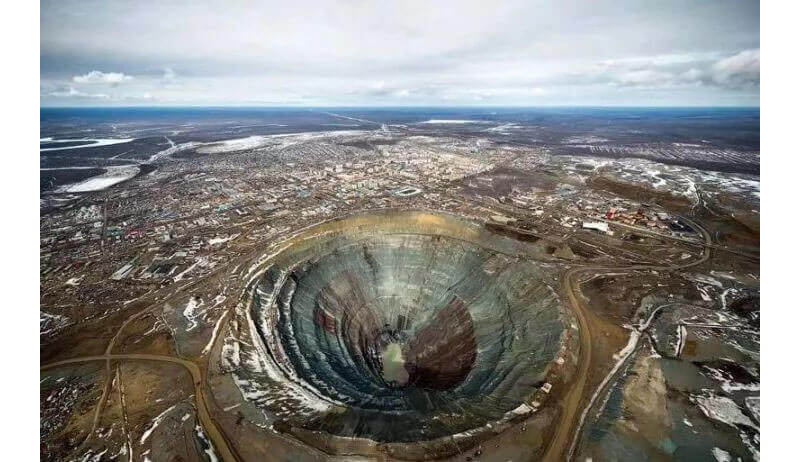
Overlooking the Mir diamond mine, huge whirlpool caves dig into the earth; how small the houses around the city are in front of the pit.
A Cold War Secret Turned Diamond Hub
Discovered in 1955 by a Soviet geologist, Mirny quickly became a state-level secret due to its diamond wealth. For decades, it:
- Funded Soviet military expenditures during the Cold War
- Contributed 23% of the world’s diamond supply at its peak
- Spawned the entire town of Mirny, where miners and their families endured:
- -40°C winters, dropping to -60°C
- Scarcity of supplies despite daily diamond production
The excavation of the Mir diamond mine started more than 50 years ago. In 1955, a young geographer came here to investigate and unexpectedly discovered that the area is rich in diamond resources. Subsequently, the geographer’s discovery became a state-level top-secret project in the former Soviet Union. Here and several nearby mines contribute 23% of the world’s total diamonds.
While mining diamonds, the government established an administrative district in the area and, in 1959, created the city of Mirny. For a long time, the city of Mirny has been a mystery in Russia, due to the confidentiality projects carried out by the state here. Mirny is located in the hinterland of Siberia, close to the Arctic Circle. It is long in winter and short in summer. The average temperature in winter is -40 °C, and the lowest temperature can reach -60 °C. Even in the short summer frost-free period, the climate here is not suitable for the growth of crops.
Most of the people living in the city of Mir are diamond miners and their families. For the past few decades, the most scarce thing for Mirny people who can see diamonds almost every day is daily necessities. It is out of the way. There is a hydropower station and reservoir near the town of Chernyshevsky, not far from the city. When the reservoir is discharged, the two places can be navigable. In addition, Milne is 1,193 km from the nearest railway station, the only road leading to Lensk, and is not connected to the main road. The connection between the Mirnes and the outside world is almost entirely by air traffic. There is a large airport here, which receives more than 200,000 passengers a year and has a cargo of 25,000 tons. Inconvenient transportation, plus no crops, fruits, and vegetables, have become the most demanding things in the local area.
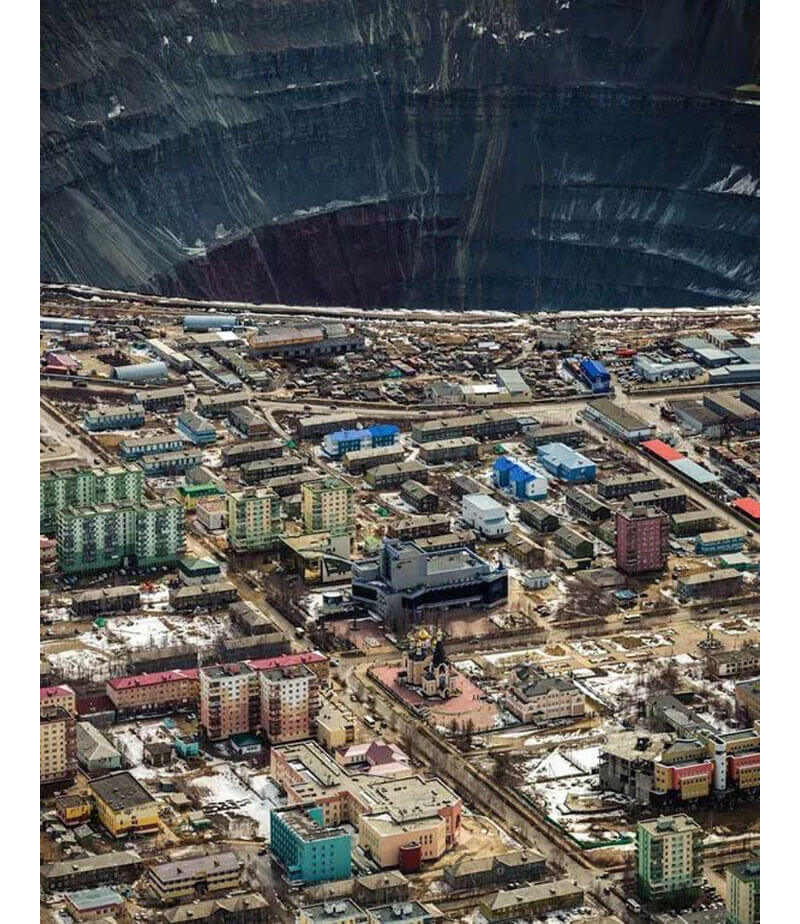
During the Soviet era, the Kremlin regarded its use as a top secret. In fact, it is one of the largest open-pit diamond pits in the world. Ironically, although its Russian name is “Mirny”, meaning “peace”, the main income of the mine at that time provided a large military expenditure for the Cold War in the former Soviet Union. It is hard to imagine the difficulty of mining diamonds on this rocky, hard, frozen layer. However, according to rough statistics, since the former Soviet leader Khrushchev ordered the mining of the first diamond mines in the 1950s, the “Muni” mine has so far excavated about 165 million cubic meters of rock. The residents, “holding the golden bowl to ask for food” for the future of the big pit.
A Mine So Valuable It Couldn’t Be Filled
In 2004, the government decided to close the diamond cave, and the world’s largest diamond pothole, which had been in operation for 46 years, was officially closed. The big pit has made the local government feel bad. Someone has proposed to fill it in, but the astronomical “burial fee” has allowed the government to completely abandon this proposal. It is important to know that since the mine was established, Mirne, which is rich in diamonds, has been one of the poorest places in the world.
From Open Pit to Underground: Mirny Mine’s New Era (2009 – Present)
When Russia’s colossal Mina de diamantes Mirny closed its open-pit operations in 2004, many wondered if its diamond riches had been exhausted. However, in 2009, a bold new chapter began—underground mining—extending the mine’s life and securing its place as one of the most productive diamond deposits in history.
Why Switch to Underground Mining?
The open pit had reached its physical and economic limits—digging deeper would have been dangerous and prohibitively expensive. Instead, the Russian mining giant Alrosa (which controls Mirny) invested over $1 billion in transitioning operations below ground. The goals:
- Access deeper diamond deposits untouched by the pit
- Continue production for another 30-50 years
- Reduce environmental impact compared to open-pit mining
The Engineering Feat: How Deep Can They Go?
The underground mine was designed to extract diamonds from four kimberlite pipes (volcanic rock formations rich in diamonds) at staggering depths:
- Planned depth: 1,200 meters (nearly double the original pit’s depth)
- Diamond-rich zones: Beyond the pit’s reach, ensuring decades of supply
- Mining method: Block caving (efficient for deep, large-scale operations)
Fun (but Dangerous) Fact:
- The mine’s underground shafts must be heated, as the surrounding rock stays frozen year-round.
- Workers face extreme cold (even underground) e high-pressure conditions.
Is Mirny Still a Major Diamond Producer?
Absolutely. Despite the shift from open pit to underground:
- Annual production exceeds 2 million carats
- Still one of Russia’s top diamond mines, operated by Alrosa (the world’s largest diamond miner by volume)
- Supplies high-quality gems—many end up in luxury jewelry markets
The Future of Mirny Mine
While underground mining prolongs Mirny’s life, new challenges emerge:
- Declining diamond grades – Lower concentrations mean higher extraction costs.
- Economic pressures – Synthetic diamonds and shifting demand affect profitability.
- Environmental concerns – Frozen permafrost makes rehabilitation difficult.
Could tourism still play a role?
- Some suggest repurposing the abandoned open pit as a UNESCO heritage site.
- However, logistics remain a nightmare—few tourists brave Siberia’s brutal winters for a giant hole in the ground.
Final Thoughts: From Soviet Secret to Modern Mining Marvel
Mirny Mine’s journey—from a top-secret Soviet project to an underground industrial giant—proves that even the harshest environments yield incredible riches. Its story is far from over—but will diamonds still be worth the cost?
PRODUTOS MAIS RECENTES
-

Inclined Vibrating Screen
The inclined vibrating screen is a simple and eff…
-
High Temperature & Pressure Gold Desorption Electrolysis System
High-Temperature & Pressure Gold Desorption Elect…
-
Normal Temperature & Pressure Gold Desorption Electrolysis System
The normal temperature & pressure gold desorption…


NOTÍCIAS MAIS RECENTES
- Modern Cyanide Residue Treatment Technologies for Gold Processing
- Traditional De-cyanidation Technologies for Gold Cyanide Residues
- Shaking Table, 3-Disc Dry Magnetic & Electrostatic Separator for W-Sn-Ta-Nb
- Mineral Analysis: The Foundation for Successful Mineral Processing Projects
- What Is Over-Grinding and How Can It Be Prevented?
 English
  French
  Spanish
  Portuguese
  Indonesian