



Introdução
Ball mill parameter selection is crucial for achieving optimal grinding efficiency and production capacity in mineral processing operations. This comprehensive guide explores key calculations for determining mill capacity, power consumption, rotational speed, and steel ball loading—all essential factors that influence operational performance. By understanding these parameters and their interdependencies, engineers can optimize grinding processes to enhance productivity while minimizing energy costs. The following sections provide detailed methodologies and reference tables for practical implementation.
1. Calculation of Ball Mill Capacity
The production capacity of the ball mill is determined by the amount of material required to be ground, and it must have a certain margin when designing and selecting. There are many factors affecting the production capacity of the moinho de bolas, in addition to the nature of the material (grain size, hardness, density, temperature and humidity), the degree of grinding (product size), the uniformity of the feeding material, the portion of loadede the mill structure (the mill barrel length, diameter ratio, the number of bins, the shape of the partition plate and the lining plate).
É difícil determinar teoricamente a produtividade do moinho. A capacidade de produção do moinho é geralmente calculada com base no minério em pó recém-gerado com menos de 0,074 mm (-200 mesh).
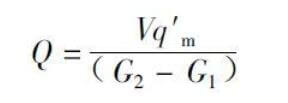
V - Volume efetivo do moinho de bolas, m3;
G2 - O material com menos de 0,074 mm de produto representa a percentagem do material total, %;
G1 - O material inferior a 0,074mm na alimentação do minério representa 0,074mm na percentagem do material total, %;
q'm - Produtividade unitária calculada de acordo com o grau de nova geração (0,074mm), t/(m3.h).
Os valores de q'm são determinados por experiências ou são calibrados na produção com propriedades físicas de minério semelhantes e o mesmo equipamento e condições de trabalho. Quando não existem dados de ensaio e valores de calibração da produção, estes podem ser calculados pela fórmula (1-3).

Di1- Diâmetro padrão do moinho, m;
K’4 — feed size and product size coefficient of the mill.

G3 G4 — The production capacity of existing or experimental mills with newly designed parameters (feed size or product size calculated according to the new generation 0.074mm level) is shown in Table 1-6.
The values of G1 and G2 above should be calculated according to actual data. If there is no actual data, they can be selected according to Tables 1-7 and 1-8.
Tabela 1-4 Coeficiente de dificuldade de moagem do minério (K'1)
| Dureza do minério | Dificuldade de trituração do minério Coeficiente (K'1) |
Dureza do minério | Dificuldade de trituração do minério Coeficiente (K'1) |
||
| Protodyakonov coeficiente |
Nível de dureza | Protodyakonov coeficiente |
Nível de dureza | ||
| <2 | muito suave | 1.4-2.0 | 8-10 | duro | 0.75-0.85 |
| 2-4 | suave | 1.25-1.5 | >10 | muito difícil | 0.5-0.7 |
| 4-8 | médio | 1.0 | |||
Quadro 1-5 Coeficiente de correção da fresagem (K'2)
| Tipo de moinho | Moinho de bolas de grelha | Moinho de bolas de transbordo | Moinho de barras |
| K'2 | 1.0 | 0.9 | 0.85 |
Quadro 1-6 Capacidade de produção relativa da dimensão dos alimentos para animais e da dimensão do produto (G3 ou G4)
| Tamanho da alimentação /mm |
Product Size/mm | |||||
| 0.4 | 0.3 | 0.2 | 0.15 | 0.10 | 0.074 | |
| Conteúdo de -0,074mm (%) | ||||||
| 40 | 48 | 60 | 72 | 85 | 95 | |
| 40-0 | 0.77 | 0.81 | 0.83 | 0.81 | 0.80 | 0.78 |
| Tamanho da alimentação /mm |
Product Size/mm | |||||
| 0.4 | 0.3 | 0.2 | 0.15 | 0.10 | 0.074 | |
| Conteúdo de -0,074mm (%) | ||||||
| 40 | 48 | 60 | 72 | 85 | 95 | |
| 0.77 | 0.81 | 0.83 | 0.81 | 0.80 | 0.78 | |
| 20-0 | 0.89 | 0.92 | 0.92 | 0.88 | 0.86 | 0.82 |
| 10-0 | 1.02 | 1.03 | 1.00 | 0.93 | 0.90 | 0.85 |
| 5-0 | 1.15 | 1.13 | 1.05 | 0.95 | 0.91 | 0.85 |
| 3-0 | 1.19 | 1.16 | 1.06 | 0.95 | 0.91 | 0.85 |
Quadro 1-7 Tamanho das partículas dos produtos triturados e valor G1 do teor de 0,074 mm
| Viscosidade do minério triturado | 40-0 | 20-0 | 10-0 | 5-0 | 3-0 | |
| Grau de 0,074 mm conteúdo G1 (%) |
Minério refratário | 2 | 5 | 8 | 10 | 15 |
| Médio Minério refratário | 3 | 6 | 10 | 15 | 23 | |
| trituração fácil de minério | 5 | 8 | 15 | 20 | 25 | |
2. Cálculo da potência, velocidade e carga do meio do moinho de bolas
2.1 Cálculo da potência

G' - a quantidade de meio de carga e de material, T;
Dm - diâmetro interior efetivo do tambor do moinho, m;
K’5 — grinding medium coefficient, check table 1-9.
Tabela 1-9 Coeficiente do meio de moagem K' 5
| Tipo de meio | Taxa de enchimento | 0.1 | 0.2 | 0.3 | 0.4 | 0.5 |
| Pedra siliciosa | 13.3 | 12.25 | 11.0 | 9.5 | 7.8 |
| Esfera de aço grande | 11.9 | 11.0 | 9.9 | 8.5 | 7.0 |
| pequena esfera de aço | 11.5 | 10.6 | 9.5 | 8.2 | 6.8 |
When the filling rate of the grinding medium is less than 35% in a dry grinding operation, the power can be calculated by formula (1-7).

n -- velocidade do moinho, r/min;
G" -- Total do meio de moagem, T;
η -- Eficiência mecânica, quando o acionamento é central, η = 0,92-0,94; quando o acionamento é lateral, η = 0,86-0,90.
2.2 Cálculo da velocidade de rotação do moinho de bolas
Velocidade crítica
Quando o cilindro do moinho de bolas é rodado, não há deslizamento relativo entre o meio de moagem e a parede do cilindro, e apenas começa a funcionar num estado de rotação com o cilindro do moinho. Esta velocidade instantânea do moinho é a seguinte:
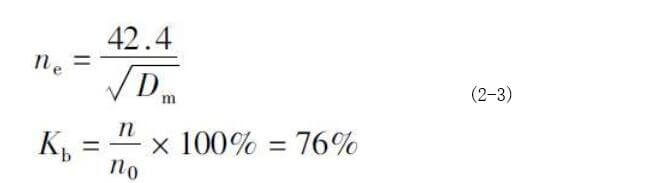
N0 -- velocidade de trabalho do moinho, r/min;
K'b - relação de velocidade, %.
There are many layers of grinding media in the mill barrel. It is assumed that the media will be concentrated in one layer, called the “polycondensation layer”, so that the grinding media of this layer will be at the maximum drop, i.e., the calculating speed of the mill when the total impact energy is the largest nj.
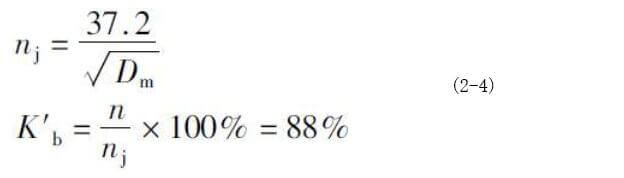
Por conseguinte, deduz-se teoricamente que a velocidade de trabalho razoável é

The working speeds of various mills are shown in Table 1-10.
Quadro 1-10 Velocidades de trabalho de vários moinhos
| Tipo de moinho | Moinho de bolas | Moinho de barras | Moinho de tubos |
| Velocidade de trabalho n0 | (0,76-0,88)nj | (0,65-0,70)nj | (0,68-0,76)nj |
In production practice, there are many factors affecting the motion state of grinding media. Therefore, the appropriate working speed should be selected according to the actual situation. In determining the actual working speed of the mill, the influences of the mill specifications, production methods, liner forms, grinding media types, filling rate, physical and chemical properties of the ground materials, particle size of the grinding materials, and grinding fineness of the products should be taken into account. The actual working speed of the mill should be determined by scientific experiments, which can reflect the influence of these factors more comprehensively.
2.3 Quantity of Loading Medium
Capacidade de carga das esferas
The volume of the grinding medium is the percentage of the effective volume of the mill, which is called the filling rate of the grinding medium. The size of the filling directly affects the number of shocks, the area of grinding, and the load of the grinding medium in the grinding process. At the same time, it also affects the height of the grinding medium itself, the impact on the material, and the power consumption.
A capacidade de carga de bolas do moinho pode ser calculada de acordo com a fórmula (1-14).

Gra - Quantidade de meio de moagem, T.
Rho
s — loose density of grinding medium, t/m3.
Forged steel balls; P=s=4.5-4.8t/m3
cast steel balls P=4.3-4.6t/m3;
rolling steel balls P=6.0-6.8t/m3;
steel segments P=4.3-4.6t/m3
Filling Ratio of The Grinding Medium
When wet grinding: lattice ball mill pi = 40% – 45%; overflow ball mill phi = 40%; rod mill phi = 35%.
Dry grinding: When material is mixed between grinding media, the grinding medium expands, and when dry grinding is adopted, the material fluidity is relatively poor, and the material flow is hindered by the abrasive medium, so the filling rate is low, and the filling rate is between 28% and 35%. The pipe mill is 25%-35%. The void fraction of grinding medium_k=0.38-0.42 and the quality of crushed material accounts for about 14% of the quality of grinding medium.
Tamanho e proporção do meio de moagem
In the ball mill, the size and proportion of steel balls have a great influence on the productivity and working efficiency of the mill. For coarse and hard materials, larger steel balls should be selected; for fine and brittle materials, with smaller diameter steel balls, the impact times of steel balls in the mill increase with the decrease of ball diameter, and the grinding between balls increases. The clearance is dense with a decrease in spherical diameter. Therefore, it is better to choose the ball with a larger mass and smaller diameter (lower density) as the grinding medium. The size of the ball mainly depends on the particle size of the material to be ground, and the diameter and speed of the mill can be considered appropriately. Formula (1-15) is an empirical formula for spherical diameter and feed size.

dmax — The maximum diameter of the steel ball, mm;
amax - o tamanho máximo do granulado de alimentação, mm.
After calculating the maximum steel ball diameter, the steel ball ratio in the mill can be calculated with reference to Fig. 2-1 (suitable for cement mill; other mills can refer to).
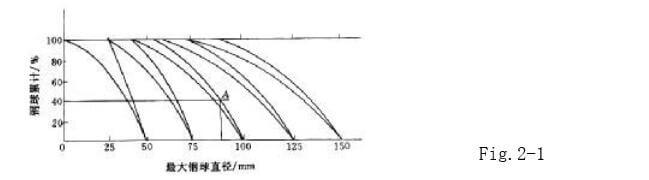
Depois de escolher o diâmetro máximo e o diâmetro mínimo das esferas de aço de acordo com os requisitos tecnológicos, as propriedades do material, as especificações do moinho e vários parâmetros e, em seguida, o grau de correspondência, usando curvas, a percentagem acumulada da massa de cada esfera de aço correspondente carregada no moinho pode ser encontrada, a percentagem real da massa pode ser calculada e a qualidade de carregamento das esferas de aço em todos os níveis pode ser obtida.
According to the production practice of production enterprises, the relationship between ball diameter and material size is shown in Table 1-11.
Steel balls are gradually worn out in the process of grinding materials. The wear of a drop steel ball is related to its impact force. The wear of grinding steel balls is related to the surface area of the steel balls. In general, the steel ball in the grinder has both impact and abrasion effects, so the wear is proportional to the n power of the diameter of the steel ball, and the value of n is between 2 and 3.
Tabela 1-11 Relação entre o diâmetro da esfera de aço e o tamanho do material
| Diâmetro da esfera de aço db/mm |
120 | 100 | 90 | 80 | 70 | 60 | 50 | 40 |
| Tamanho da alimentação /mm |
12-20 | 10-12 | 8-10 | 5-8 | 2.5-6 | 1.2-4 | 0.6-2 | 0.3-1 |
The quality and surface area of forged steel balls of various sizes are shown in Table 1-12.
Devido ao desgaste das esferas de aço no processo de produção do moinho, a fim de manter o moinho estável. As esferas de aço precisam de ser adicionadas regularmente.
O diâmetro máximo das esferas de aço adicionais continua a ser determinado pelo método acima referido. Para além da adição de esferas de aço adicionais, devem ser adicionadas várias esferas de aço de menor diâmetro, de acordo com a experiência de produção.
Table 1-12: Quality and Surface Area of Steel Balls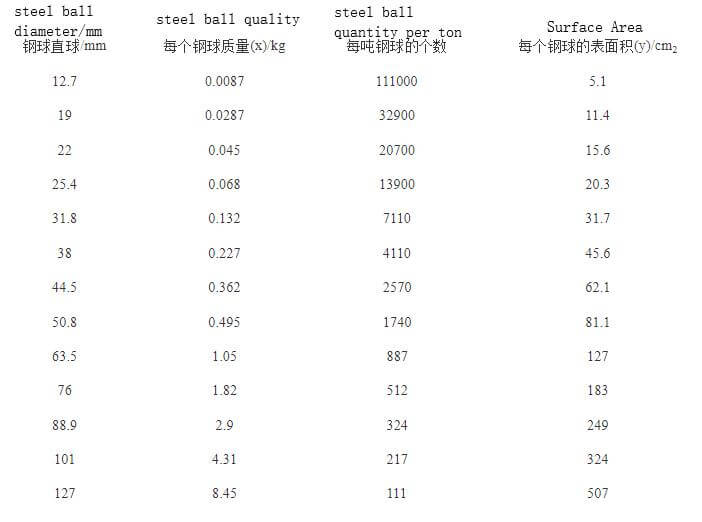
Conclusão
Proper selection of ball mill parameters requires balancing theoretical principles with practical adjustments based on material properties and operational conditions. Regular monitoring of steel ball wear, mill speed, and power draw ensures sustained efficiency. By leveraging the calculations and reference data provided in this guide, operators can tailor grinding processes to their specific needs, ultimately improving throughput and reducing operational costs. For further optimization, always validate theoretical models with real-world performance metrics and adjust parameters iteratively.
JXSC has supplied ball mill, rod mills for 40+ years. Contact us for a quotation.
Produtos quentes: triturador de mandíbulas, triturador de impacto, triturador de cone, moinho de bolas, mesa de agitador, separador centrífugo, jigue, separador magnético, flotação, trommel de ouro, esfregador trommel, planta de lavagem de ouro, e assim por diante.
PRODUTOS MAIS RECENTES
-

Inclined Vibrating Screen
The inclined vibrating screen is a simple and eff…
-
High Temperature & Pressure Gold Desorption Electrolysis System
High-Temperature & Pressure Gold Desorption Elect…
-
Normal Temperature & Pressure Gold Desorption Electrolysis System
The normal temperature & pressure gold desorption…


NOTÍCIAS MAIS RECENTES
- Modern Cyanide Residue Treatment Technologies for Gold Processing
- Traditional De-cyanidation Technologies for Gold Cyanide Residues
- Shaking Table, 3-Disc Dry Magnetic & Electrostatic Separator for W-Sn-Ta-Nb
- Mineral Analysis: The Foundation for Successful Mineral Processing Projects
- What Is Over-Grinding and How Can It Be Prevented?
 English
  French
  Spanish
  Portuguese
  Indonesian