casobg

1000TPD Lithium Ore Flotation Processing Plant in Nigeria

1000TPD Lithium Ore Flotation Processing Plant in Nigeria

Published Date:06 Novembro 2026

JXSC has supplied a complete set of mineral processing equipment and all necessary accessories for a 1,000-ton-per-day lithium ore flotation processing plant to our client in Nigéria. To ensure successful project execution, we provided process flow design, foundation construction drawings, all equipamento mineiro, and on-site guidance and installation.

Our main design advantages of this project include:

  • Efficient Crushing System: Three-stage crushing reduces the ore size from a maximum of 500 mm to less than 20 mm, improving grinding efficiency and reducing energy consumption.
  • Optimized Grinding System: A ball mill and spiral classifier form a closed-circuit grinding system to achieve the required grinding fineness without installing an additional ball mill.
  • Effective Desliming: Hydrocyclone groups remove fine mud before flotation, reducing reagent consumption and improving flotation performance.
  • Multi-Stage Flotation: Mica removal, roughing, scavenging, and cleaning stages work together to improve lithium recovery and concentrate grade.
  • Efficient Dewatering: The concentrate thickener and vacuum disc filter, together with the tailings thickeners and plate press filter, provide effective solid-liquid separation.
  • Water Recycling: Thickener overflow water is collected and reused, reducing fresh water consumption and improving the environmental performance of the plant.

With this integrated processing configuration, the plant is designed to provide continuous lithium ore beneficiation, efficient spodumene recovery, and reliable concentrate and tailings management for the Nigerian lithium mining project.

Situação da mina do cliente

1. The client required a processing capacity of 1000 tpd.
2. Maximum feeding size: 500 mm
3. Tipo de minério: Spodumene lithium

1000TPD Spodumene Lithium Ore Flotation Processing Plant in Nigeria Flowchart

1000TPD Lithium Flotation Plant in Nigeria Flowchart

Flowchart Detailed Explanation

1. Crushing Part: Capacity 100 TPH

The raw lithium ore, with a maximum feed size of 0-500 mm, will first be fed into the raw ore hopper. A alimentador de vibração DN38096 will evenly feed the ore into the triturador de maxilas for primary crushing. After primary crushing, most of the rocks will be reduced to approximately 100-150 mm.

The crushed material will then be transferred to the first cone crusher, DN1200, for secondary crushing, reducing the particle size to approximately 50 mm. After that, belt conveyors will transport the materials to a vibrating screen 2YK1860 equipped with 20 mm and 40 mm screen meshes for classification.

The oversized materials larger than 20 mm will be returned to another triturador de cone DN1310 for further crushing. After repeated crushing and screening, most of the materials will be reduced to less than 20 mm. The qualified materials will then be transferred to an underground transfer bin for temporary storage before entering the grinding section.

Reasons and Advantages for the Crushing Part Design

According to our crushing plant experience, the reduction ratio of equipamento de trituração is generally around 3-5. Therefore, reducing the raw lithium ore from a maximum size of 500 mm to less than 20 mm requires approximately three stages of crushing.

We recommend crushing the materials to less than 20 mm before the ball mill. This can significantly improve grinding efficiency and reduce the workload of the ball mill, eliminating the need to install two sets of ball mills.

For a large-capacity processing plant, the crushing section produces more material than the grinding section can process immediately. Therefore, an underground transfer bin is recommended to store the crushed ore temporarily and ensure a stable and continuous feeding supply to the grinding system.

By adding one more cone crusher instead of another ball mill, the plant can reduce equipment investment, electricity consumption, and overall operating costs.

1000TPD Lithium Ore Flotation Plant in Nigeria

2. Grinding and Desliming Part: Capacity 42 TPH

The crushed lithium ore smaller than 20 mm will be discharged from the underground transfer bin through a feeder and transported to the transfer hopper before the moinho de bolas.

An electromagnetic vibrating feeder installed beneath the hopper will evenly feed the materials into the ball mill MQZ2745 for grinding. The ball mill will grind the materials from less than 20 mm to approximately 0-1 mm, with 70%-80% passing 200 mesh (approximately 0.074 mm).

The ball mill will work together with a classificador em espiral FG-30 to form a closed-circuit grinding system. The ground slurry will enter the spiral classifier for particle size classification. The coarse particles larger than 0.074 mm will be returned to the ball mill for further grinding, while the qualified fine particles will be transferred to two sets of hydrocyclone groups for desliming.

The hydrocyclone groups will separate fine mud and slimes from the slurry before the materials enter the flotation section.

Reasons and Advantages for the Desliming Part Design:

After crushing and grinding, the lithium ore slurry contains a certain amount of fine mud and slimes. If these impurities are not removed before flotation, they can negatively affect the flotation process.

The hydrocyclone groups can effectively remove fine mud from the slurry, improving the separation conditions for the subsequent flotation process.

Without desliming, excessive fine mud may consume additional flotation reagents and interfere with the interaction between flotation chemicals and lithium-bearing minerals. This can reduce flotation efficiency, affect concentrate quality, and increase chemical consumption.

Therefore, installing hydrocyclone groups before flotation can improve the overall beneficiation performance and help reduce operating costs.

3. Flotation Processing Part: Capacity 42 TPH

After desliming, the qualified lithium ore slurry will be transferred to several sets of tanques de mistura. Appropriate flotation reagents will be added to the tanks to condition the slurry and prepare the minerals for flotation separation.

The conditioned slurry will first enter an 8-cell máquina de flotação system for mica removal. This stage is important because mica is a common associated mineral in spodumene lithium ore. If mica is not removed before lithium beneficiation, it may enter the final concentrate and negatively affect the Li2O grade.

After mica removal, the remaining slurry will enter the lithium flotation section to recover spodumene and upgrade the Li2O concentrate.

The lithium flotation process consists of three main stages:

  • Roughing Stage: The first flotation stage consists of 4 flotation cells. Its main purpose is to recover as much lithium-bearing mineral as possible from the feed slurry and produce rougher concentrate.
  • Scavenging Stage: The second flotation stage consists of 8 flotation cells, arranged in two groups of 4+4 cells. This stage further recovers the remaining lithium-bearing minerals from the rougher tailings to improve the overall lithium recovery rate.
  • Cleaning Stage: The final flotation stage consists of 7 flotation cells, arranged in three groups of 3+2+2 cells. The rougher concentrate will undergo multiple cleaning operations to remove associated gangue minerals and improve the final Li2O concentrate grade.

Reasons and Advantages for the Flotation Part Design:

The flotation process is designed to separate spodumene from associated gangue minerals through reagent conditioning and staged flotation.

The first mica removal stage helps reduce mica contamination before lithium recovery, which is beneficial for improving the quality of the final lithium concentrate.

The combination of roughing, scavenging, and cleaning stages provides a balance between lithium recovery and concentrate grade.

  • The roughing stage maximizes the initial recovery of lithium-bearing minerals.
  • The scavenging stage recovers valuable lithium minerals remaining in the tailings, reducing lithium losses.
  • The cleaning stage removes residual impurities and improves the final concentrate quality.

This multi-stage flotation configuration helps improve the overall beneficiation efficiency and provides a more stable lithium concentrate production process.

1000TPD Lithium Ore Flotation Plant in Nigeria

4. Concentrate and Tailings Treatment Part

After flotation, the lithium concentrate and flotation tailings will enter separate dewatering and treatment systems.

Lithium Concentrate Treatment

The lithium concentrate produced by the flotation machines will first be transferred to a concentrate thickener NT-18.

A flocculating agent will be added to the espessante to accelerate the sedimentation of fine concentrate particles and improve solid-liquid separation.

The settled concentrate will be pumped from the bottom of the thickener to a vacuum disc filter for further dewatering. After filtration, the final product will be lithium concentrate with a target Li2O grade of approximately 5%-6%.

Tratamento de rejeitos

The flotation tailings will be transferred to two sets of tailings thickeners NT-24 for sedimentation and concentration.

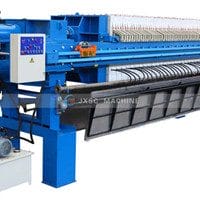
After thickening, the settled tailings will be pumped to a plate press filter for further dewatering, reducing the moisture content and facilitating tailings transportation and disposal.

Water Recycling System

The overflow water from all the thickeners will be collected in a water pool. After collection and appropriate management, the recovered water can be recycled and reused in the upstream processing sections.

Reasons and Advantages for the Concentrate and Tailings Treatment Design:

The concentrate thickener and vacuum disc filter work together to improve the solid-liquid separation efficiency and reduce the moisture content of the final lithium concentrate.

The two tailings thickeners and plate press filter provide an effective tailings dewatering solution, making tailings handling and disposal more convenient.

Meanwhile, collecting and recycling the thickener overflow water can significantly reduce fresh water consumption and improve water utilization efficiency.

This design helps reduce water discharge, lower operating costs, and promote more sustainable operation of the lithium ore processing plant.

Main Machines & Accessorie

 Não. Nome do produto Modelo QTY(set)
1 Alimentador vibratório DN380*96 1
2 Triturador de mandíbulas PE600*900 1
3 Triturador de cone DN1200, DN1310 Each for 1
4 Transportador de correia 800*22m, 800*13m,  800*35m, 650*10m Each for 1
5 Transportador de correia 800*26m, 650*15m Each for 2
6 Peneira vibratória 2YK1860 1
7 Iron Remover RCYB 1
8 Electromagnetic Vibratory Feeder GZ4 1
9 Moinho de bolas MQZ2745 1
10 Classificador em espiral FG-30 1
11 Hydrocyclone Group FX250*6, FX150*12 Each for 1
12 Máquina de flotação SF-8 12
13 Máquina de flotação SF-6 15
14 Slurry Mixing Tank XB2500 6
15 Reagent Mixing Tanks Ø1500*1500 6
16 Chemical Mixing Tank 1500 mm 2
17 Chemical Tank 1.5 meter 2
18 Espessante NZS-18 1
19 Espessante NZS-24 2
20 Bomba de polpa 6/4 AHR 6
21 Bomba submersível para polpas abrasivas 65QV-SPR 4
22 Chemical Dosing Pump   4
23 Feed Pump for Plate-and-Frame Filter Press 65ZJW 8
24 Plate-and-Frame Filter Press 250㎡ 8
25 Disc Vacuum Filter PGT-40-8 1

Production, Shipping & On-site

1000TPD Lithium Ore Flotation Plant in Nigeria

JXSC é um fabricante profissional de equipamentos de mineração e especialista em soluções de minério de mineração. Tem muitos casos de sucesso, como plantas de ouro, soluções de diamante, etc., Se você precisar de tal serviço, por favor contactar-nos.

Contacte-nos agora

Se você tiver alguma dúvida sobre nossos produtos, sinta-se à vontade para preencher o formulário abaixo, e entraremos em contato com você em até 24 horas. Fique tranquilo, pois não revelaremos suas informações a ninguém.

    Consulta gratuita com as nossas equipas de vendas e engenharia


    • As suas informações estão seguras. Consulte a nossa aviso de privacidade para mais pormenores.

    • Não oferecemos emprego, nem compramos ou vendemos minerais. Vendemos APENAS equipamento mineiro!

    • Não temos qualquer interesse na cooperação e no investimento!

    Visão geral da privacidade
    logótipo

    Este sítio Web utiliza cookies para que possamos proporcionar ao utilizador a melhor experiência possível. As informações dos cookies são armazenadas no seu browser e desempenham funções como reconhecê-lo quando regressa ao nosso sítio Web e ajudar a nossa equipa a compreender quais as secções do sítio Web que considera mais interessantes e úteis.

    Cookies estritamente necessários

    O cookie estritamente necessário deve estar sempre ativado para que possamos guardar as preferências do utilizador relativamente às definições de cookies.

    Analytics

    Este sítio Web utiliza o Google Analytics para recolher informações anónimas, como o número de visitantes do sítio e as páginas mais populares.

    Manter este cookie ativado ajuda-nos a melhorar o nosso sítio Web.