



Introdução
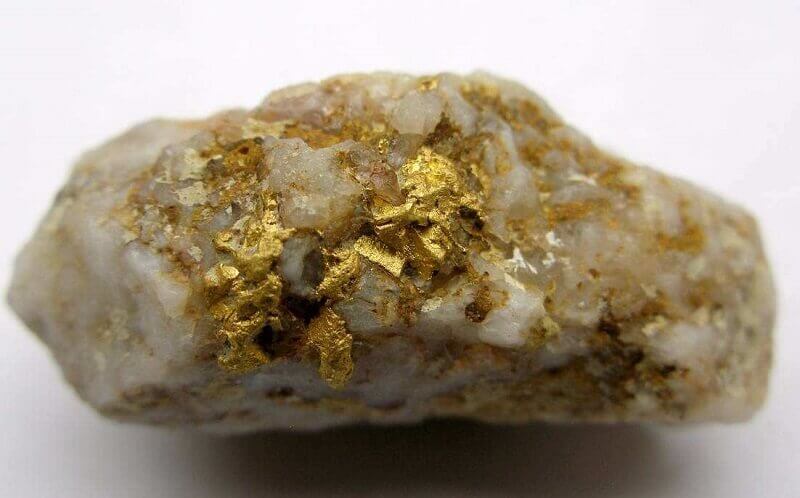
Vein gold, also known as lode gold, is found in various types of ore deposits. These can be broadly categorized into:
- Gold-bearing quartz veins or gold-bearing pyrite quartz veins;
- Gold-bearing pyrite granite-type deposits;
- Gold-bearing polymetallic sulfide quartz veins;
- Gold-containing oxidized quartz veins;
- Gold-bearing tungsten-arsenic quartz veins.
Given the diversity of vein gold ores, multiple beneficiation techniques are employed to maximize gold recovery. These methods include gravity separation, amalgamation, flotation, cyanidation, carbon-in-pulp (CIP), and resin adsorption. Each technique is selected based on ore characteristics, gold particle size, and economic viability.
1. Separação por gravidade
Best for: Coarse gold recovery (particle size >0.1mm)
Gravity separation is one of the oldest and most common gold extraction methods. In placer gold deposits, the density of gold is generally greater than 6 t/m3, which differs from that of the gangue. Therefore, the gravity separation method is the most important, effective, and economical method for gold mining.
However, it is rarely used alone in gold processing plants; more often, it is combined with a jigging machine, a shaker table, or a spiral chute to recover coarse gold. That is beneficial to improve the flotation and cyanide effect.
Principais separadores por gravidade: calha espiral, jigueiros minerais, mesas de agitadores, concentrador centrífugo, etc.
2. Amalgamation
The amalgamation method can be divided into internally mixed mercury e externally mixed mercury according to its production mode.
- In alluvial gold deposit mining, mercury is widely used to separate gold and heavy sand minerals.
- In the vein gold mine, amalgam is usually used as part of the combined process with flotation, gravity separation, cyanidation, etc., for the capture of coarse monomer gold.
The internal amalgamation is carried out in a mercury amalgamation tank ou um grinding machine, which can better control the pollution of mercury.
The main equipment for external amalgamation is a mercury-mixing plate, which consists of a bracket, a bed surface, and a mercury plate. The mercury plate material varies in copper plate, silver-plated copper plate, sterling silver plate, etc., and the silver-plated copper plate has the best mercury-mixing effect. In order to facilitate silver plating and easy replacement in production, the electrolytic copper plate is often cut into small pieces of 400-600 mm in width and 800-1200 mm in length, and after silver plating, the blocks are laid on the bed surface in the oblique direction of the bracket.
3. Gold Flotation
Optimal for: Sulfide-hosted gold ores (Au-Cu, Au-Pb, Au-Bi systems)
Flotation is one of the most widely used methods for processing lode gold ore. In most cases, the gold flotation method has the best effect on sulfide mineral ore containing gold. Flotation can not only maximize gold enrich into sulfide mineral concentrates, but also treat tailings.
The flotation process is also used to treat polymetallic gold-bearing ores such as gold-copper, gold-lead, gold-bismuth, and gold-copper-lead-zinc-sulfur ore. For this type of ore, the flotation process can effectively select various gold-bearing sulfide concentrates, which is conducive to the comprehensive recovery of mineral resources.
Além disso, os minérios refractários que não podem ser tratados diretamente por amalgamação ou cianetação devem também ser tratados por um processo combinado que inclua a flotação.
Of course, the flotation method also has limitations; for coarse-grained inlays, ores with a gold particle size greater than 0.2 mm, and for quartz-bearing gold-bearing ores without sulfides, it is difficult to obtain a stable flotation foam after slurrying, thus not suitable for using flotation.
In recent years, the flotation process of gold ore has made great progress, mainly in the innovation of the process, the development of new agents, and the improvement of design. The use of stage grinding and the stage selection process is the current development trend of gold flotation. Most foreign gold selection plants use two or even three sections, and the recovery rate of gold is increased by 2% to 6%.
Because the flotation method can only maximize the concentration of gold into various sulfide mineral concentrates, and can not finally obtain the finished gold, there are only a few gold selection plants using a single flotation process; generally, the flotation is used as a joint process. A process of the process is adopted. At present, China’s gold selection plants using a single flotation process include gold mines such as Suichang and Xiuyan, as well as small gold mines in some local groups.
4. Cyanidation
Desde que o processo de cianetação foi aplicado às minas de ouro e prata em 1887, tem uma história de quase cem anos. Devido à sua elevada taxa de recuperação e forte adaptabilidade, continua a ser um dos principais métodos de produção de ouro.
The cyanidation process can be divided into agitating cyanidation e diafiltration cyanidation.
- Stirring cyanidation for treatment of re-election, mercury-mixed tailings and flotation of gold-bearing concentrates, or for full mud cyanidation.
- Diafiltration cyanidation for treatment of flotation tailings and low-grade gold heap leaching of ore.
The conventional cyanidation process is a very mature process, which includes preparation of leaching raw materials, stirring cyanide leaching, counter-current washing and solid-liquid separation, leaching liquid purification and deoxidation, zinc powder replacement and pickling, smelting ingots, and so on.
5. Cyanide Carbon in Pulp (CIP)
O Processo CIP is a new technique for recovering gold and silver after developing based on conventional cyanide leaching and zinc powder replacement. It is mainly composed of leaching raw material preparation, stirring leaching & countercurrent carbon adsorption, gold-loaded carbon desorption, electrowinning or deoxidizing zinc powder replacement, smelting ingots, and regeneration of activated carbon.
6. Heap Leaching
Lixiviação em pilha is the transfer of the mined ore to a pre-prepared yard to pile up, or directly on the stored waste rock or low-grade ore, using cyanide leaching solution for spraying or diafiltration, so that the solution passes through the ore. The percolation leaching action is generated, the cyanide leaching solution is circulated several times, the ore heap is repeatedly sprayed, and then the leachate is collected and treated by the activated carbon adsorption method or the metal zinc replacement method. The gold grade of the ore treated by the heap leaching method in foreign countries is generally 1~3g/t, the recovery rate of gold is 50%-80%, and the recovery rate of silver is 30%-50%.
Conclusão
The beneficiation of vein gold requires a tailored approach based on ore composition and gold distribution. Gravity separation and amalgamation target coarse gold, while flotation optimizes sulfide-rich ores. Cyanidation, CIP, and heap leaching provide versatile solutions for fine or refractory gold. By integrating these methods—such as gravity-flotation-cyanidation circuits—modern plants achieve high recovery rates while minimizing environmental impact. Future advancements will likely focus on eco-friendly reagents, automation, and enhanced process synergies to further improve efficiency and sustainability.
PRODUTOS MAIS RECENTES
-

Inclined Vibrating Screen
The inclined vibrating screen is a simple and eff…
-
High Temperature & Pressure Gold Desorption Electrolysis System
High-Temperature & Pressure Gold Desorption Elect…
-
Normal Temperature & Pressure Gold Desorption Electrolysis System
The normal temperature & pressure gold desorption…


NOTÍCIAS MAIS RECENTES
- Modern Cyanide Residue Treatment Technologies for Gold Processing
- Traditional De-cyanidation Technologies for Gold Cyanide Residues
- Shaking Table, 3-Disc Dry Magnetic & Electrostatic Separator for W-Sn-Ta-Nb
- Mineral Analysis: The Foundation for Successful Mineral Processing Projects
- What Is Over-Grinding and How Can It Be Prevented?
 English
  French
  Spanish
  Portuguese
  Indonesian