



Introduction to Crushing Technology
Crushing is a fundamental process in aggregate production, mining operations, and construction material preparation. As the most widely used building material in road and bridge construction, gravel and sand can be directly applied in construction or processed into various aggregate sizes for asphalt and cement production. Understanding different crushing methods and equipment types is essential for selecting the right machinery for each application, ensuring efficiency and quality in material processing.
What Are The Crushing Types?
Espremer
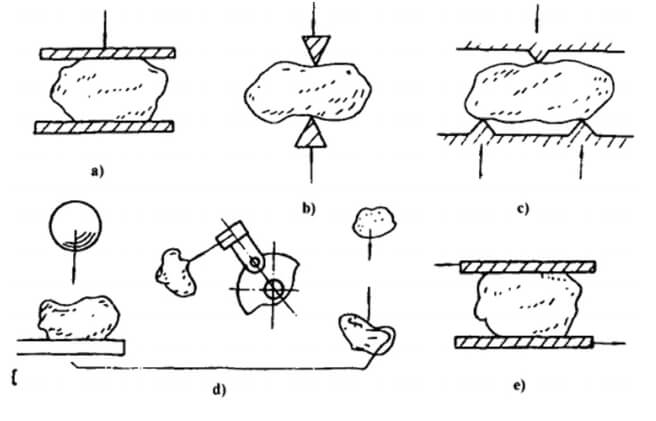
The rock is subjected to pressure between the two planes; the force that exceeds the compressive strength of the stone makes the stone break into smaller pieces.
Dividir
Under the action of the wedge, the tensile stress is generated in the stone. When the tensile stress exceeds the tensile strength of the stone, then be broken.
Fratura
Under the action of a multi-furculum staggered force, the stone is subjected to shear and bending stress. When these stresses exceed a certain limit, the stone will be sheared, bent, or broken.
What Are The Different Types of Crushers?
The crusher can be divided into three types according to the particle size of the feed and the final product.
- Primary crusher( from 1500-500mm to 350-100mm);
- Secondary crusher( from 350-100mm to 100-40mm);
- Tertiary crusher( from 100-40mm to 30-10mm).
This staged approach optimizes energy efficiency and product quality while minimizing wear on equipment.
The crushers can also be classified according to the working principle and mechanical structure.
Triturador de mandíbulas
Operating Principle: When the movable jaw plate closes to the fixed jaw plate, it creates a squeezing force act on the stone. In addition, there is jagged steel on the rock material contacting surface of the fixed plate and the fracture. When the movable plate is separated from the fixed plate, the crushed material is discharged under the gravity force.
The process of crushing is the process of breaking large particle material into smaller sizes under the action of external force. In industry applications, the size reduction task mainly depends on the mechanical force.
Key Characteristics
- Highest capacity of all primary crushers
- Simple, sturdy construction
- Produces somewhat flaky product with needle-shaped particles
- Best suited for hard, abrasive materials
Typical Applications
- Primary crushing in quarries
- Demolition debris recycling
- Mining operations
Technical Note: While efficient for primary crushing, jaw crushers’ product shape makes them less ideal for secondary crushing, where cubical aggregates are preferred for asphalt production.
Gyratory Crushers
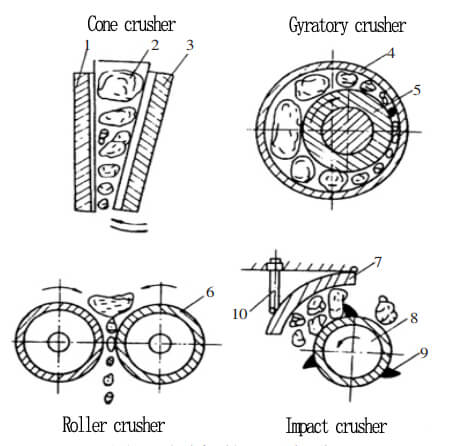
Operating Principle: Similar to jaw crushers but with a conical crushing head gyrating within a conical bowl. Continuous crushing action along the entire chamber circumference.
Advantages Over Jaw Crushers
- Higher capacity (can process up to 14,000 t/h)
- More continuous operation
- Better suited for extremely hard rock
- Lower maintenance requirements for large operations
Limitações
- More complex installation
- Higher initial cost
- Not suitable for portable applications
Cone Crushers
Key Differences from Gyratory Crushers:
- Orientation: Cone crushers are inverted compared to gyratory crushers
- Velocidade: Cone crushers operate at higher speeds
- Travel Path: Cone crusher mantle travels along an eccentric path rather than a circular path
- Aplicação: Primarily for secondary and tertiary crushing
Technical Benefits
- Better product shape than jaw crushers
- More efficient in smaller settings
- Better control of product gradation
- Lower headroom requirements
Impact Crushers
Working Principle: High-speed rotors with blow bars impact materials either against breaker plates or other blow bars. Available in horizontal shaft (HSI) and vertical shaft (VSI) configurations.
Aplicações
- Producing cubical aggregates for concrete and asphalt
- Limestone processing
- Recycling applications (concrete, asphalt)
Vantagens
- Excellent product shape
- High reduction ratios possible
- Adjustable gradation control
Roll Crushers
Operation: Materials are crushed between two counter-rotating rolls, with either smooth or toothed surfaces.
Best Uses
- Coal preparation
- Processamento de minerais
- Glass manufacturing
- Producing finer products with minimal fines
Hammer Mills
Características
- High-speed rotating hammers
- Multiple grinding stages
- Replaceable wear parts
Aplicações
- Powder production
- Waste processing
- Food processing industries
What Are The Key Factors to Consider When Selecting The Right Crusher?
When choosing crushing equipment, consider these critical factors:
Feed Material Characteristics
- Hardness/abrasiveness
- Teor de humidade
- Feed size distribution
- Flakiness index
Production Requirements
- Required capacity
- Finished product specifications
- Desired product shape
Site Constraints
- Available space
- Mobility requirements
- Power availability
Economic Factors
- Capital cost vs operating cost
- Maintenance requirements
- Expected service life
Emerging Trends in Crushing Technology
Modern crushers incorporate advanced features
- Automation systems for optimized performance
- Hybrid power options for energy efficiency
- Advanced wear materials extending component life
- Smart monitoring for predictive maintenance
Conclusion: Matching Crusher to Application
Understanding the various crusher types and their specific applications ensures optimal selection for any aggregate production or mineral processing operation. From primary jaw crushers to final shaping with impact crushers, each machine plays a vital role in the size reduction process. Proper crusher selection results in higher efficiency, better product quality, and lower operating costs throughout the production cycle.
PRODUTOS MAIS RECENTES
-

Inclined Vibrating Screen
The inclined vibrating screen is a simple and eff…
-
High Temperature & Pressure Gold Desorption Electrolysis System
High-Temperature & Pressure Gold Desorption Elect…
-
Normal Temperature & Pressure Gold Desorption Electrolysis System
The normal temperature & pressure gold desorption…


NOTÍCIAS MAIS RECENTES
- Modern Cyanide Residue Treatment Technologies for Gold Processing
- Traditional De-cyanidation Technologies for Gold Cyanide Residues
- Shaking Table, 3-Disc Dry Magnetic & Electrostatic Separator for W-Sn-Ta-Nb
- Mineral Analysis: The Foundation for Successful Mineral Processing Projects
- What Is Over-Grinding and How Can It Be Prevented?
 English
  French
  Spanish
  Portuguese
  Indonesian