



River sand es un non-metallic mineral formed from natural rocks through long-term erosion and friction by river water. Its particle size is typically less than 4.75 mm, with a smooth surface and complex composition. As an important building material, river sand is widely used in concrete preparation, construction, casting, and metallurgy.
River Sand Washing Process
Release time:13 marzo 2026Characteristics and Uses
River sand has smooth, rounded particles, high cleanliness, is widely available, and does not have a salty taste.
Its main uses include:
- As standard sand for cement, used in construction, concrete, cementitious materials, and road construction materials.
- Applied in sand removal, rust removal, and strengthening processes in casting, metallurgy, heat treatment, and steel structures.
- As an additive in heavy-duty concrete and high-temperature refractory materials to enhance wear resistance and high-temperature resistance.
Resource Status
River sand has a long formation cycle and is a non-renewable resource; its consumption rate far exceeds its natural recovery rate. Over-exploitation has led to resource depletion in many areas and has triggered problems such as illegal sand mining and ecological damage to river channels.
Faced with the scarcity of river sand resources, manufactured sand is gradually being used as a major alternative material.
River Sand Washing
The main purpose of river sand washing is to remove mud, stone powder, organic impurities, etc., from the surface of sand and gravel to meet the cleanliness and particle size requirements of construction sand. The river sand washing process is as follows:
Standard River Sand Washing Process
Raw Material Preparation: Mining or purchasing natural river sand with a high mud content, typically with high moisture content and impurities such as pebbles and organic matter.
Screening and Grading: Removing large-diameter pebbles (e.g., >5mm) and impurities using a criba vibratoria, and initially grading according to particle size.
Hydraulic Washing: Sending the screened river sand to a lavadora de arena (commonly a wheel bucket or spiral type) for deep washing.
Dewatering Treatment: The washed wet sand is dewatered using a criba de deshidratación or dewatering device to reduce moisture content and improve the quality of the finished product.
Fine Sand Recovery (Optional): The sand washing wastewater is treated in a sedimentation tank and a fine sand recovery machine (such as the LZ fine sand recovery system) to recover lost fine sand, reducing resource waste. Finished Product Output: The washed and dewatered river sand is transported to the stockpile by conveyor or directly loaded onto trucks for shipment.
Nota: If the river sand is used for special purposes (such as glass or casting), further advanced treatment steps such as scrubbing and desliming, acid washing, or magnetic separation may be required.
River Sand Cleaning and Washing Plant
This setup is a river sand wash plant, it is configured with a trommel screen, wheel sand washer, fine sand recycle machine, and conveyor belt. This flowsheet includes 7 parts: feeding, screening, oversized material handling, medium sand conveying, fine sand washing& recovery system, and wastewater recycling.
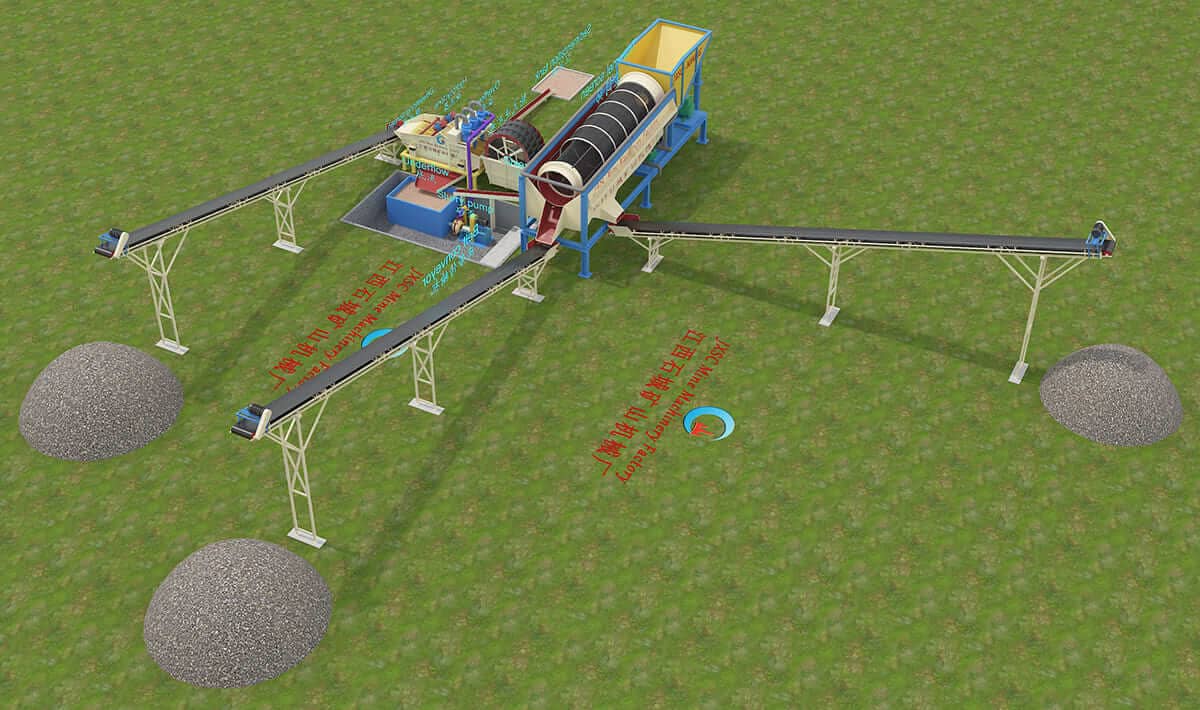
1. Raw Material Feeding Stage
The excavated river sand is loaded by an excavator into the feeding hopper of the trommel screen, initiating the washing process.
2. Primary Screening Process
The two-layer trommel screen (with 2mm and 5mm mesh sizes) separates the incoming sand into three grades:
- 0-2mm (fine sand)
- 2-5mm (medium sand)
- 5mm (oversized material)
3. Oversized Material Handling
Particles larger than 5mm are automatically discharged from the trommel screen and conveyed to a dedicated stockpile for collection.
4. Medium Sand Conveying
The 2-5mm sand fraction is transported via conveyor belt to a separate storage pile for medium-grade sand products.
5. Fine Sand Washing Stage
The 0-2mm fine sand flows directly into the wheel sand washer for thorough cleaning and impurity removal.
6. Fine Sand Recovery System
The washed fine sand then enters the fine sand recycle machine, where:
- The cyclone separator processes the material
- Undersized particles undergo hydrocyclone separation
- Clean fine sand is successfully recovered
7. Wastewater Recycling Loop
Tailings from the wheel sand washer and cyclone underflow are collected in a sedimentation pool, then:
- Pumped back to the cyclone separator
- Continuously recycled through the system
- Maximizing fine sand recovery while minimizing water waste
Productos relacionados



Póngase en contacto con nosotros
Si tiene alguna pregunta sobre nuestros productos, no dude en completar el formulario a continuación y nos comunicaremos con usted dentro de las 24 horas. Tenga la seguridad de que no revelaremos su información a nadie.
 English
  French
  Spanish
  Portuguese
  Indonesian