newbg

¿Cómo procesar la arena de sílice?

Tiempo de publicación:16 mayo 2018

What is Silica Sand?

Descripción

Silica sand, or quartz sand, primarily consists of silicon dioxide (SiO₂) and serves as a key raw material for glass production. It is categorized into three types based on purity:

  • Ordinary silica sand: 90–99% SiO₂, <0.02% iron oxide
  • Refined silica sand: 99–99.5% SiO₂, <0.015% iron oxide
  • High-purity silica sand: 99.5–99.9% SiO₂, <0.001% iron oxide (milky white appearance)

With a melting point of ~1750°C and corrosion resistance (except to hydrofluoric acid), silica sand is widely used across industries due to its durability, electrical insulation, and thermal stability.

Cómo procesar la arena de sílice1

Silica Sand Distribution

Silica sand ore is rich in Algeria, India, Bangladesh, Brazil, Egypt, Singapore, Indonesia, the Philippines, etc.

Silica Sand Classification

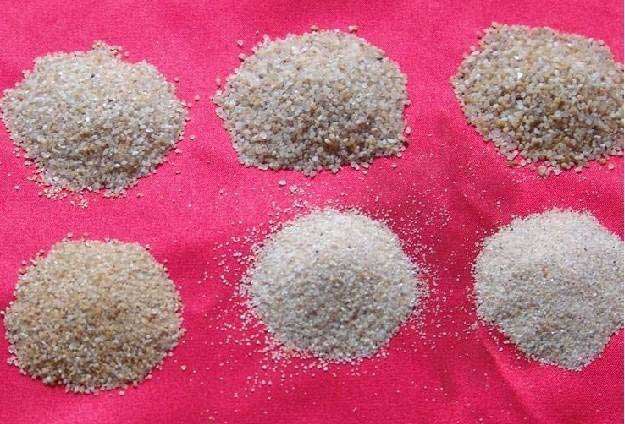
The regular specifications of silica sand are: 1-2mm, 2-4mm, 4-8mm, 8-16mm, 16-32mm, 10-20 mesh, 20-40 mesh, 40-80mesh, 100-120 mesh, 200 mesh, 325 mesh, SiO2 > 99-99.5%, Fe2O3 less than 0.02-0.015%.

The silica sand raw material usually will contain sticky clay, Kaolin clay, ilmenite, Hematite, Iron, and other magnetic minerals. The silica sand color in the raw material may be white, yellow, brown, etc.

Aplicación

Silicon sand is an important industrial mineral raw material, widely used in glass, casting, ceramics, refractory materials, metallurgy, construction, machinery, electronics, chemical, plastic, abrasive, rubber, aerospace, and other industries. Another important use of silica sand is as a filter used for water treatment.

1) Glass: Flat glass, float glass, glass products (glass jars, glass bottles, glass tubes, etc.), optical glass, glass fiber, glass instrument, conductive glass, glass cloth, and special glass for anti-ray.

2) Ceramics and refractories: Porcelain materials and glazes, high silica bricks, ordinary silica bricks, and silicon carbide raw materials.

3) Metallurgy: Raw materials or additives and fluxes of silicon metal, ferrosilicon alloy, and silicon-aluminum alloy.

4) Construction: Concrete, cementitious material, road building material, artificial marble, cement physical property test material (namely cement standard sand)

5) Chemical: Silicon compound, water glass, and other raw materials, sulphuric acid tower filling, and amorphous silica powder.

6) Machinery: The main raw materials for casting sand, abrasive materials (sandblasting, hard abrasive paper, sandpaper, abrasive cloth, etc.)

7) Electronics: High-purity metal silicon, optical fiber for communication, etc.

8) Rubber and plastics: Fillers (increase wear resistance)

9) Aeronautics and Astronautics: Its internal molecular chain structure, crystal shape, and lattice change law, with high-temperature resistance, low thermal expansion coefficient, corrosion resistance, high insulation, piezoelectric effect, resonance effect, and its unique optical properties.

Silica Sand Processing Methods

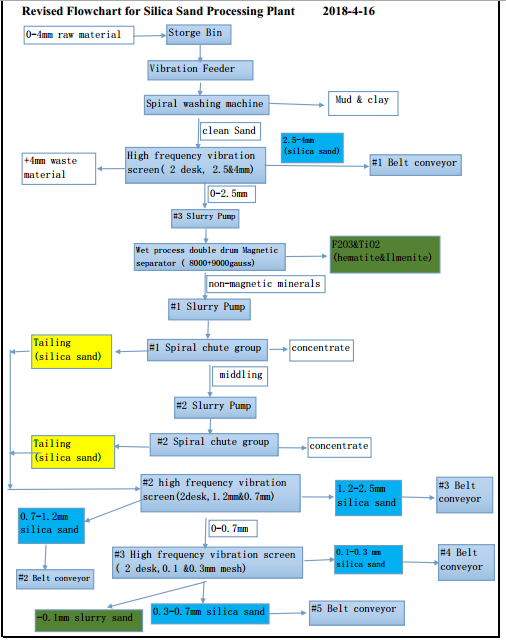
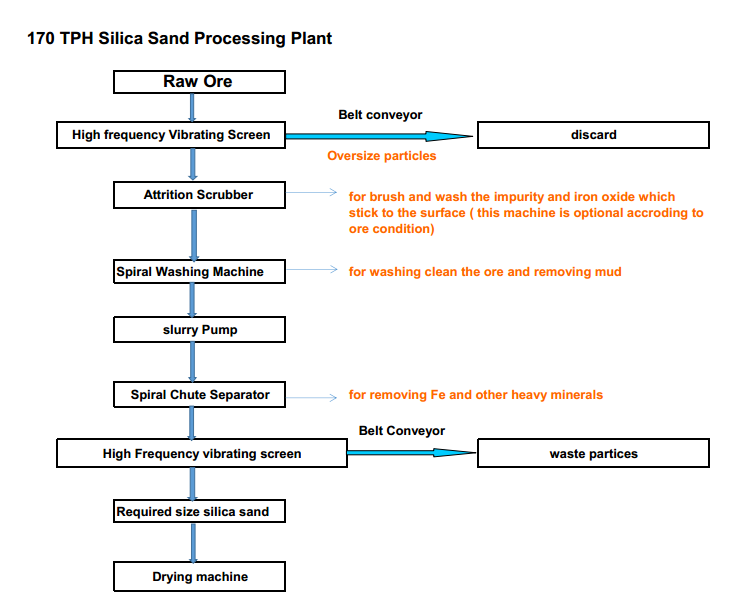
Generally speaking, the silica sand raw material is with sticky clay, kaolin clay, impurity minerals, magnetic minerals, such as ilmenite, hematite, iron, and others. So firstly, need to wash and clean the clay and kaolin clay, remove the waste sand and magnetic minerals, and finally sieve out the requested size silica sand, dry it, and pack it.

Key Processing Steps for Silica Sand

In Summary
Alimentación->lavado -> tamizado primario -> separación por gravedad para eliminar los minerales pesados -> proceso de refinado para eliminar los minerales magnéticos -> tamizado de la arena de sílice de tamaño solicitado -> secado -> envasado

1. Feeding Raw Material

Use a vibration feeding machine, feeding hopper, electromagnetic vibration feeder, belt feeder, wheel loader, or excavator to feed directly. It depends on process capacity and raw material conditions to choose which máquina de alimentación to use.

2. Washing & Clay Removal

To remove clay, kaolin, and slurry from raw materials, the most commonly used silica sand washers include drum sand washers, log-type sand washers, spiral sand washers, and grinding sand washers. Silica sand washers, grinding sand washers, and spiral classification sand washers are particularly effective for cleaning silica sand with a particle size of less than 3 millimeters. For larger particle sizes, drum sand washers and log-type sand washers are recommended for cleaning.

3. Primary Sieving to Remove Coarse Waste Sand
After washing and cleaning the clay, we need to sieve out some bigger waste sand, and the under-screen sand will go to the next máquina de separación por gravedad. This sieving process can use a normal vibration screen or a silica sand high-frequency vibration screen.

4. Gravity Separation to Remove Heavy Minerals
It is for primary silica sand gravity separation to remove heavy minerals, such as ilmenite, hematite, iron, etc. The most common uses of the silica sand separation machine are the mesa vibrante y el Separador de canal en espiral. It depends on the processing capacity to choose which gravity separation machine. High-capacity plants prefer spiral chutes; smaller setups use shaking tables.

6. Silica Sand Refining Process Removes Magnetic Minerals
After silica sand gravity separation, there will still be some percentage of magnetic minerals in silica sand, so we need to remove them using the separador magnético. Different magnetic minerals will use different Gauss magnetic separators. To remove the iron, you need 1000 gauss. And to remove ilmenite and hematite, a field strength of 8000- 9000 gauss is needed. Different usage of silica sand will require different percentages of magnetic minerals remaining in the final silica sand product.

7. Sieving Out The Requested Size Silica Sand
After removing magnetic minerals, we will need to sieve out the requested size silica sand, usually using the high-frequency vibration screen, with a PU screen; the screen mesh size can be customized.

8. Drying
After sieving out the final silica sand, then drying the sand by drying machine.

9. Packing
After drying the sand, use a packing machine to pack the final silica sand product, and then you can sell it. The silica sand packing machine is a ton bag packing machine, which can be 0.5T, 1T, 2T, or 3T per bag as requested.

Silica Sand Plant Flowchart

Cómo procesar la arena de sílice4
Cómo procesar la arena de sílice5

Silica Sand Processing Equipment Manufacturer

Fábrica de maquinaria minera JXSC in China has more than 40 years of professional experience in silica sand processing plants, designs a full set silica sand process flowchart, provides a complete set silica sand washing plant, and can send the engineer to the mine site for equipment installation and commissioning guidance. We have already built many silica sand separation plants in Algeria, India, Bangladesh, Brazil, Egypt, Singapore, Indonesia, the Philippines, etc.

Conclusión

Processing silica sand involves washing, sieving, gravity/magnetic separation, and drying to achieve industry-standard purity. With the right equipment—scrubbers, spiral chutes, and magnetic separators—producers can supply high-quality sand for diverse applications.

Need a Turnkey Silica Sand Plant? Expert engineers can design and install customized solutions for your mining site. Póngase en contacto con nosotros for a tailored processing flowchart!

    Póngase en contacto con nosotros

    Protección de datos
    logotipo

    Este sitio web utiliza cookies para que podamos ofrecerle la mejor experiencia de usuario posible. La información de las cookies se almacena en su navegador y realiza funciones como reconocerle cuando vuelve a nuestro sitio web y ayudar a nuestro equipo a comprender qué secciones del sitio web le resultan más interesantes y útiles.

    Cookies estrictamente necesarias

    Cookie estrictamente necesaria debe estar activada en todo momento para que podamos guardar sus preferencias de configuración de cookies.

    Analítica

    Este sitio web utiliza Google Analytics para recopilar información anónima como el número de visitantes del sitio y las páginas más populares.

    Mantener esta cookie activada nos ayuda a mejorar nuestro sitio web.