



Introduction: The Critical Role of Size Reduction
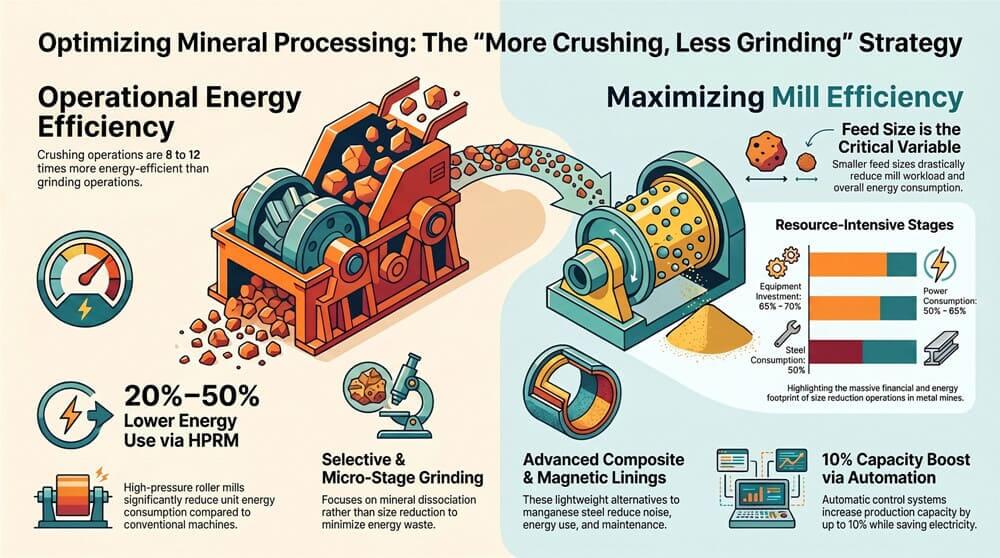
Trituración y molienda operations represent the most significant investment and energy-consuming stages in tratamiento de minerales. For metal mines, equipo de trituración alone accounts for 65-70% of total plant costs, while consuming 50-65% of power and generating up to 50% of steel consumption. These operational realities drive the industry’s relentless pursuit of more efficient, energy-saving solutions that deliver superior size reduction with minimized resource consumption.
This paper examines innovative approaches to grinding process optimization and equipment development that are transforming mineral processing operations worldwide.
1. Crushing and Grinding Process Optimization
The ore size reduction process consists of two key stages: trituración (primary size reduction) and molienda (final liberation). Grinding operations aim to achieve complete mineral dissociation while meeting required particle size specifications for downstream processes.
Operational Efficiency Considerations: Grinding represents a high-energy, low-efficiency operation, consuming 8-12 times more power than crushing. Process optimization can deliver significant efficiency gains with reduced energy consumption and improved economics.
Strategic Approach: More Crushing and Less Grinding
The crushing of materials is mainly achieved by the extrusion and impact of the equipment on the minerals, and the grinding is mainly achieved by the impact and grinding of the equipment.
La eficiencia energética de la trituración es mucho mayor que la de la molienda. Más trituración y menos molienda para lograr los mejores beneficios económicos.
Implementation Strategies
- Adopt a high-efficiency fine crusher: Such as the single-cylinder hydraulic cone crusher, the HP series cone crusher ( Nordberg ), and the domestic JC56, JC4060 jaw crusher, SX series double-roller jaw crusher, etc.
- Improve the crushing process: According to the plant scale, the ore nature, the ore size, the product size, etc., choose the appropriate crushing process.
- Integrated grinding-classification systems: The principle of mineral grinding-classification processing is to combine grinding and classification operations, cleans out the gangue minerals in time, reduces the grinding volume, and improves the beneficiation efficiency.
- Fine crusher replaces the conventional grinding machine: The crushing operation of the ore dressing plant is very inefficient, and the fine crusher replaces the conventional mill to produce fine products. For hard rock crushing, the water punching trituradora de cono can gradually replace the conventional drum mill.
Transform the Old Crushing Process
Some of the original mining plants have a large design scale, but for a variety of reasons, the production scale is only about half of its original design. With the gradual reduction of mineral resources, these old factories can be improved in energy conservation and efficiency, perfecting their crushing process, ensuring their crushing granularity while achieving energy saving and efficiency.
(1) Microwave-assisted grinding
In current mining production, the crushing method of mineral materials is mainly mechanical crushing. In order to reduce the steel consumption of crushing operations and improve the efficiency of energy utilization, mining workers have developed a new method of crushing, in which microwave pretreatment is a promising method of crushing.
The microwave is a high-frequency electromagnetic wave having a frequency of approximately 300 MHz to 300 GHz and a wavelength of 2500 px to 1 mm, penetrating the interior of a mineral to cause orientation polarization and deformation polarization of matter molecules. As the electrode changes, the direction of polarization also changes constantly, resulting in the self-heating effect of the mineral body, and the temperature rises. However, due to the different mineral properties of the ore, the absorbing properties are also different, resulting in differences in the ore. The temperature difference between each mineral in the mineral is different, and the thermal expansion coefficient of each mineral is also different. As a result, thermal cracking and the like occur, which cause microcracks in the mineral system and expand the original microcracks, thereby facilitating subsequent pulverization operations.
Although microwave heating treatment has the incomparable advantages of traditional heating methods, the current theoretical research on microwave grinding is not deep enough. In the near future, microwave heating will play a huge role in reducing the energy consumption and steel consumption of grinding operations.
(2)Selective grinding
The so-called selective grinding is the use of selective dissociation of minerals and selective grinding of the grinding; the purpose is to cause some selectivity in grinding operations.
El objetivo principal de la operación de molienda no es reducir el tamaño de las partículas de mineral, sino disociar los minerales útiles de los minerales de ganga. El objetivo último de la molienda es obtener la mayor disociación de monómeros con un aporte mínimo de energía.
Selective grinding is widely used in mining production, such as metal ore, non-metallic minerals, and coal mines, especially in the production practice of bauxite.
(3)Micro-stage grinding
Debido a que los materiales minerales de diferentes tamaños de partícula tienen diferentes requisitos en la forma de molienda, los materiales de grano grueso son adecuados para el método de molienda basado en la trituración por impacto, y los materiales finos deben ser molidos por trituración.
Micro-stage grinding involves installing barrel linings with different surface shapes along the axial direction of the barrel of the ball mill. The surface of the ball mill is installed with a non-smooth lining to form a high steel ball drop height, resulting in impact pulverization.
A smoother cylinder liner is installed at the discharge end of the ball mill to form a lower steel ball drop height, resulting in grinding and pulverization.
From the feeding end to the discharge end, the pulverized form gradually changes from impact pulverization to grinding pulverization and pulverization, so that the grinding form changes along the axis direction of the ball mill, and stage grinding is realized in a ball mill.
Esto puede satisfacer mejor las diferentes necesidades del material de mineral en diferentes etapas del proceso de molienda, la composición de tamaño de partícula diferente, y cumplir con la ley de trituración de mineral, mejorando así la eficiencia de molienda.
La aplicación de la tecnología de rectificado en microetapas sólo requiere la modificación de la superficie de la camisa parcial, lo que resulta sencillo y fácil.
(4)Ultrafine grinding
El coste de la tecnología de molienda convencional es bastante elevado. Incluso si el tamaño de las partículas de molienda puede hacer que los minerales útiles se disocien, se producirá el fenómeno de sobremolienda, y muchos minerales útiles se perderán en el lodo.
Tras varios años de continuo desarrollo, la tecnología de molienda ultrafina del molino se ha convertido en una de las importantes tecnologías de procesamiento profundo de minerales y materias primas industriales, de gran importancia para el desarrollo de las modernas industrias de alta tecnología.
Ultra-fine grinding technology is applied in the pretreatment of refractory gold ore. The gold is coated with pyrite. The gold ore, contained in microscopic gold, sub-microscopic gold, or solid solution, is a kind of gold that is extremely difficult to dissolve and extract from gold ore.
The key to gold extraction is to destroy the pyrite package and expose the gold to dissociation. The pyrite is very stable and difficult to decompose. With the development of ultra-fine grinding technology, it is possible to use ultra-fine grinding to open the sulfide package to dissociate the gold.
(5) Pressure grinding
There are many types of internal stress of the ball mill, such as impact, extrusion, shearing, grinding, etc. Some of the stress electric energy consumption is large, and the pulverizing efficiency is not high.
Los estudios han demostrado que cuando se selecciona como tensión principal la tensión de compresión con alta eficiencia de pulverización, ya que el proceso de pulverización a presión se ajusta a la ley de aplastamiento de la capa de material, cuando la presión es pequeña, el material suelto libre es primero suficientemente denso, y cuando la presión aumenta, las partículas que se aprietan son mutuamente La tensión se transmite, y cuando se supera el valor de resistencia de las partículas, las partículas minerales se rompen y se genera un gran número de microfisuras.
Ajustando y reforzando la entrada de energía para las diferentes características del material, y también restringiendo el área de acción de la tensión, para que el material pase a través de la zona de tensión regularmente, y la energía mecánica se convierta efectivamente en la energía de pulverización, para que la partícula se convierta en un producto en blanco con baja porosidad. Mediante el proceso subsiguiente, se obtiene un producto con un tamaño de partícula cualificado, con lo que se consigue el objetivo de alta producción y ahorro de energía.
En high-pressure roller mill developed based on this theory has been applied to large-scale industrial production and has achieved good economic benefits. It can significantly improve the processing capacity of equipment systems, reduce the power consumption per unit, and save infrastructure investment and simplify the process. , reduce the number of broken sections; general ore materials can be used, and the feed water content can reach 15%.
2. Application and Development of Rock Crusher
In the past 10 years, new grinding equipment has been continuously introduced to obtain a larger crushing ratio and obtain more fine-grained crushing products to reduce the particle size of the grinding material, save energy and reduce consumption, and at the same time carry out structural innovation, adopting new technologies and new materials to improve traditional equipment to improve reliability, durability, performance, and efficiency.
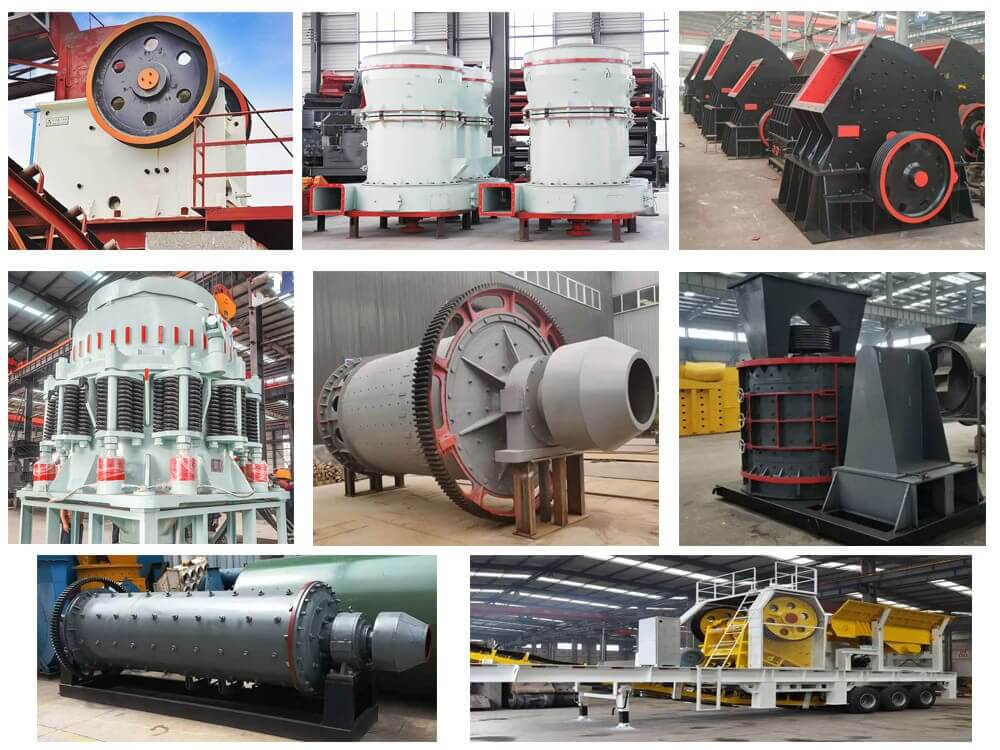
Rotary Crusher
The development of the gyratory crusher has a history of 100 years. Due to its large processing capacity, large ore size, and ability to handle hard ore, it is still important equipment for crushing various hard materials in large mines and other industrial sectors.
The rotary crusher has a large production capacity, low unit power consumption, and stable operation. It is suitable for processing sheet materials. The crushed product has a relatively uniform particle size and can be widely used for coarse crushing and medium crushing of various hardness ores. However, compared with the jaw crusher, the structure is complicated, the price is high, the maintenance is difficult, the repair cost is high, and the capital construction cost is high.
Trituradora de mandíbulas
With the adoption of large-scale carrying equipment, the crushing mill’s ore feeding size has reached 1.2 to 2 m, which has promoted the development of the trituradora de mandíbulas to large-scale.
The compound pendulum crusher has the advantages of high efficiency and low price, and occupies a large market share of the jaw crusher. With the promotion of conservation, energy-saving and efficient production methods, several new jaw crushers have also been successfully developed.
Trituradora de cono
The spring cone crusher has been in existence for a hundred years. It was invented by the American Symons brothers using the principle of a gyratory crusher. So far, its structure has not changed much; its performance is stable, and it has a certain market share.
In order to meet today’s high-throughput production, achieve high energy, achieve higher crushing ratio and finer product granularity, the new cone crusher has also been continuously developed and applied to production practice. For example, a hydraulic cone crusher that uses hydraulic instead of a spring and an inertia cone crusher that can replace the rough grinding operation have achieved good economic benefits in production and operation.
Roller Crusher
The high-pressure roller mill, also known as the trituradora de rodillos, works on the principle of material layer pulverization. It is a new type of high-efficiency energy-saving grinding equipment, which is gradually being applied and popularized at home and abroad.
When the high-pressure roller mill was originally designed and applied, it was mainly used for the crushing of limestone and brittle metal ore with less hardness, and it was used for the middle and fine crushing of crushing operations. After years of promotion and development, it has been used in fine crushing of medium hardness and above; especially in the case of iron ore crushing, its technology has become increasingly mature, and it has a large crushing ratio, fine product size, high efficiency, low energy consumption, etc. The utility model can also be applied to replace a rough grinding operation, and the ore can be crushed by a high-pressure roller mill to obtain a product of 3 to 10 mm in size, and the magnetite can be greatly improved after pre-magnetic separation. The grade of the mine has the characteristics of water saving, electricity saving, and production increase.
At present, the high-pressure roller mill is developing in the direction of large-scale; the diameter of the roller and the roll surface are further increased, the grain size range of the grinding is larger, and the throughput is also increased. The production practice shows that the single-machine production capacity of the high-pressure roller mill can reach 1,500 to 2 000 t / h, and the energy consumption of the crushed metal ore is 1.2 to 2. 8 kWh / t. Under the same conditions, the unit energy consumption is lower than the conventional one. The machine is 20% to 50% lower, the roll surface wear resistance is good, the service life of the inlaid hard alloy grain nail roll surface can reach 8 500 h, and the automation level is high. With the improvement of the performance of the high-pressure roll mill, it is necessary for the metal mine. There will be broad application prospects.
3. Grinding Mill Application and Development
The mill is further developed on a large scale. Changes in the mill diameter have a significant effect on the grinding process. The large mill usually has a high specific crushing rate and can handle coarser grade materials.
However, if the diameter of the mill is too large, the dead zone of the ball will increase. When the mill increases processing capacity, it will also reduce the residence time of the mineral material, hindering the transfer of energy from the ball medium to the ore particles and resulting in a lower unit volume yield. The decline in the unit energy consumption of grinding products has increased, so the development direction of the mill has been developed from large-scale to high-efficiency energy-saving.
Self-grinding, Semi-autogenous Grinding Machine
Since the use of self-grinding and semi-self-grinding technology in the 1950s, it has grown into a mature, reliable, and continuously applied technology.
In the self-grinding process, the ore larger than 100 mm in the mill acts as a grinding medium. The ore material with less than 80 mm and more than 20 mm has poor grinding ability, and it is not easily broken by large ore materials. Sometimes, when the material is crushed, a steel ball of about 4% to 8% of the volume of the mill is often added to the mill, which improves the grinding efficiency of the mill, and thus semi-self-grinding occurs.
En semi-autogenous mill belongs to a cylindrical mill with heavy load, low speed, and large starting torque. Nowadays, both the new expansion and the renovation of the old factory almost all use self-grinding, semi-self-grinding technology, and self-grinding.
La tecnología de semiautomolienda elimina la trituradora de dos etapas y el equipo de cribado, simplifica el proceso y mejora las condiciones de funcionamiento, lo que no sólo reduce el coste de capital de la construcción, sino que también reduce los costes de producción y funcionamiento, y además facilita la automatización.
Molino de bolas
En molino de bolas is a traditional material crushing device. It has a history of more than 100 years. It is still important equipment for fine powdering of solid materials. It is widely used in metallurgy, chemical industry, cement, ceramics, construction, electricity, and in industrial sectors such as national defense; dry and wet grinding of various ores and materials is possible.
In recent years, the development of ball mills has focused on energy saving and consumption reduction, continuously improving and perfecting the grinding machine transmission mode, researching and developing new lining plates and grinding media, striving to achieve automatic control of the grinding process, and improving the grinding process on the premise of ensuring grinding grain size. The processing capacity and grinding efficiency of the mill.
As we all know, the lining of the ball mill is a key part of the mill that can achieve high efficiency, energy saving, and consumption reduction. After research and development, it has made good progress.
- The angle spiral lining is also called energy-saving lining. After using this lining, the unit output power consumption is reduced by 10% to 25%, the mill output is increased by 15% to 20%, and the unit output ball consumption is reduced by 10% to 20%. It has the advantages of stable operation, less product pulverization, less noise, etc., and is especially suitable for crushing operations in cement production;
- The rubber lining is a corrosion-resistant and wear-resistant non-metallic material lining. Compared with the manganese steel lining, it has the advantages of being lightweight, having low energy consumption, high output, and low noise.
- Based on the rubber lining, a composite magnetic lining has been developed. This lining is magnetically adsorbed on the surface of the lining to adsorb a layer of magnetic particles and dielectric fragments to form a protective layer to extend the service life of the lining. It is almost half lighter than ordinary manganese steel lining, and can be directly adsorbed on the inner surface of the mill barrel without bolt fixing, which greatly reduces the workload of installation and maintenance, not only reducing energy consumption, but also increasing the processing capacity of the mill.
Molino de barras
En molino de barras is developed based on the ball mill. It has the advantages of reliable processing technology, low investment, less auxiliary equipment, and simple process flow. It can be combined with the ball mill to form a different grinding process.
The rod mill mainly grinds the ore through the pressure and the grinding force of the grinding rod. When the rod hits the ore, it first hits the coarser-grade ore, and then pulverizes the smaller-sized material between the rod and the wall. When the rod is in contact with the wall, the coarser-grained ore particles are mixed with it, which acts as a bar sieve. The finer-grained material can pass through the gap between the rods, which is beneficial to the clamp. The coarser-grained material also allows the coarser-grained ore particles to be concentrated in the place where the grinding media strikes.
Por lo tanto, el molino de barras tiene la función de molienda selectiva, y el producto tiene un tamaño de partícula uniforme y menos pulverización.
Vertical Spiral Mixing Mill
En vertical spiral mixing crusher is a new type of high-efficiency energy-saving grinding equipment successfully developed by Changsha Research Institute of Mining and Metallurgy. Its grinding effect is mainly grinding and stripping, as well as a small amount of impact and shearing, so that the original material can be kept. Lattice shape, making full use of energy to effectively grind the material, because in fine grinding and ultra-fine grinding, friction grinding is the most effective grinding method, and has been used in the regrind or fine grinding operation of metal mines.
High-speed Impact Pulverizer
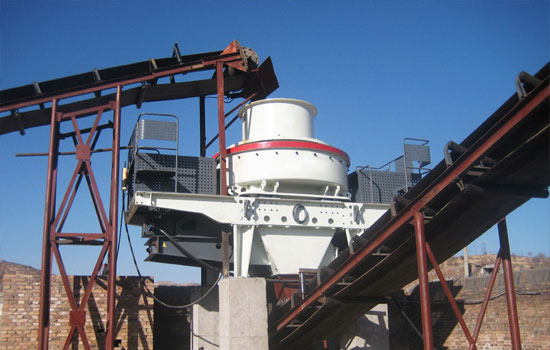
High-speed impact pulverizer refers to an impact pulverizing device that strongly impacts the material around a horizontal or vertical high-speed rotating body (rotor, hammer, blade), which can crush materials below 8 mm to – 10 μm at 70%. the above.
The device can be applied to ultra-fine pulverization of non-metal materials such as talc, clay, barite, calcium carbonate, mica, and graphite.
4. Ways to Improve Grinding Efficiency
Hay muchos factores que afectan a la eficacia de la molienda, como la naturaleza de la alimentación de la molienda, el tamaño del mineral, la tasa de llenado de la bola de acero, el tamaño de la bola de acero y la relación, el sistema de llenado de la bola, el sistema de molienda, el proceso de molienda, el funcionamiento del molino y la clasificación. Factores como la eficiencia y la cantidad de retorno de arena, pero estos factores no son independientes entre sí y tienen un cierto impacto entre sí.
Grinding Feed Properties
The mechanical properties of the ore, such as hardness, toughness, dissociation, and structural defects, determine the grindability of the ore, which determines the difficulty of grinding.
A small grinding degree indicates that the ore is easy to grind; the smaller the wear of the ore on the mill, the lining, and the grinding medium, the smaller the power consumption; on the contrary, if the grinding degree is large, the wear of the mill and power consumption are high.
The nature of the ore will directly affect productivity, and the impact on grinding operations is of paramount importance. In the modern grinding operation, a grinding aid process has been added to add some specific chemicals to the grinding process to improve the grindability of the ore and increase the productivity of the mill.
Tamaño del pienso
The grain size of the mill has a great influence on the grinding efficiency of the mill. Generally speaking, the smaller the grain size, the smaller the work done by the mill on the ore; on the contrary, the larger the grain size, the mill The work done by the ore is greater.
The crushing of ore by steel balls is a random crushing, and the crushing efficiency is very low. Some research has pointed out that the crushing efficiency of the ball mill is only 6% to 9%. It can be seen that the grinding grain size has a great influence on the mill. In order to achieve the final grinding fineness, it will inevitably increase the workload of the ball mill, and the energy consumption and power consumption of the ball mill will also increase.
Mill Rotation Rate and Filling Rate
There is a close relationship between the rotation rate and the filling rate of the mill. The two are related to each other. Generally speaking, once the mill is installed, its rotation rate is fixed; it will not change easily, and the operation of changing the rotation rate is cumbersome. It is cumbersome, so in actual production, the transfer rate is generally not analyzed as a factor affecting the grinding efficiency. It is only necessary to analyze the suitable ball filling rate at a certain speed.
When the transfer rate is constant, the filling rate is large, the steel ball hits the material more frequently, the grinding area is large, the grinding effect is strong, but the power consumption also increases, and the filling rate is too high, which also affects the steel. The movement state of the ball reduces the impact on the large material; on the contrary, if the filling rate is low, the grinding area is small, the grinding effect is relatively weak, but the power consumption and energy consumption are also small. Therefore, at the production site, whether the filling rate is appropriate has a great influence on the grinding efficiency of the plant.
Steel Ball Size and Ball Ratio
En el molino, la bola de acero y el molino están en contacto puntual. Cuando el diámetro de la bola es demasiado grande, la fuerza de trituración también es grande, de modo que el mineral se rompe a lo largo de la dirección de la fuerza de penetración, en lugar de romperse a lo largo del plano cristalino de diferentes minerales con una fuerza de enlace débil, lo que provoca que no haya fractura. Selectiva.
En el caso de la misma tasa de llenado de la bola de acero, el diámetro de la bola es demasiado grande, lo que resulta en muy pocas bolas de acero, baja probabilidad de rotura, trituración severa y tamaño desigual del producto; por el contrario, si la bola de acero es demasiado pequeña, su efecto de trituración sobre el mineral es pequeño. La eficiencia de la molienda es baja, por lo que el tamaño preciso de la bola de acero y la proporción de bolas tienen una gran influencia en la eficiencia de la molienda.
Liner
The main function of the ball mill liner is to protect the mill. When the mill is running, the steel balls and materials inside the mill are thrown or slid by the liner to a certain height, and the material is ground and pulverized. It will also be affected by the impact, sliding, and rolling of steel balls and materials, and will also be affected by temperature. Therefore, the main form of wear of the lining plate is abrasive wear under a small number of times of energy, so which material lining is selected, reducing its wear and tear is always an important issue for ball mills.
En la actualidad, hay tres tipos principales de materiales de revestimiento ampliamente utilizados: acero de alto manganeso; acero aleado resistente al desgaste; hierro fundido con alto contenido de cromo.
- High manganese steel has good wear resistance and good economic applicability, but low yield strength, suitable for medium and Use under high impact wear conditions.
- Alloy wear-resistant steel has a higher comprehensive performance than high-manganese steel and is suitable for medium impact wear conditions.
- High-chromium cast iron has a higher wear resistance than the former two and is more widely used.
Al seleccionar el material de revestimiento, deben tenerse en cuenta el uso del molino de bolas y los factores económicos para prolongar la vida útil del revestimiento del molino y conseguir el efecto más idóneo.
Grinding Concentration
Grinding concentration is also an important factor affecting the grinding efficiency. Its size will affect the specific gravity of the slurry, the adhesion of the ore around the steel ball, and the fluidity of the slurry.
Cuando la concentración de molienda es baja, la fluidez del lodo es rápida, y la adherencia del material alrededor de la bola de acero es baja, por lo que el impacto y el efecto de molienda de la bola de acero sobre el material se debilitan, y la eficiencia de molienda es baja.
Cuando la concentración de molienda es alta, la adherencia del material alrededor de la bola de acero es buena, el impacto y el efecto de molienda de la bola de acero sobre el material es mejor, pero la fluidez de la pulpa es pobre, la sobremolienda es más grave, y no es propicio para mejorar la capacidad de procesamiento del molino. Por lo tanto, la determinación de la concentración óptima de molienda tendrá un impacto importante en la eficacia de la molienda.
Grinding Classification Process
For a long time, people have tended to pay attention to the realization of grinding purposes, while ignoring the means and methods of grinding, patronizing the grinding grain size of the pursuit of requirements, and neglecting the monomer solution of various useful materials of ore containing various metals. The difference in the degree of separation will cause some minerals to be pulverized and some minerals to be insufficiently pulverized. In this case, if the conventional rough grinding process is still used, the grinding and sorting effects will not be good.
En classifier and the grinding machine work in a closed circuit, which can control the grain size of the grinding product and increase the productivity of the mill. Therefore, the classification efficiency has a certain influence on the grinding efficiency. When the classification efficiency is high, the qualified grain grade products can be eliminated in time. Avoid over-pulverization and reduce energy consumption; when the classification efficiency is low, the products that reach the qualified size can not be discharged in time and are returned to the mill for re-grinding, which can easily cause over-grinding and affect the later selection effect.
Return Sand Ratio
The return-sand ratio is the ratio of the amount of sand returned by the ball mill to the ore. The effect of graded anti-sand is not only to return the unqualified coarse particles, but also plays an important role in making the ball mill’s ore thickening, allowing the steel ball to crush efficiently over the entire axial length of the mill, increasing the productivity of the mill.
En circunstancias normales, la cantidad de arena de retorno no debe superar los 500%, y la segunda sección no debe superar los 690%.
Grinding Circuit Automatic Control
Hay muchas variables en el funcionamiento del clasificador de molienda, y el cambio de un factor puede causar cambios sucesivos de muchos factores. La operación manual no puede mantenerse al día con este cambio, no puede cumplir con los requisitos del proceso de producción, y adoptar el control automático para hacer El grado de molienda se mantiene en un estado estable y adecuado, aumentando así la productividad y reducir el consumo de energía.
The automatic control of the grinding and grading circuit can increase the production capacity by 2. 5% to 10%, and the treatment of 1 t ore can save electricity consumption of 0.4 kWh.
Chinese Crushing and Grinding Equipment
Los equipos de molienda de China han experimentado un desarrollo considerable a través de la introducción de tecnología, la cooperación técnica, la digestión y absorción, y el autodesarrollo. En la actualidad, China cuenta con una amplia variedad de equipos de molienda, variedades completas, mejora continua de la calidad de fabricación y aumento de la producción año tras año. Se ha convertido en uno de los países con los equipos de molienda más productivos del mundo.
JXSC has been supplying equipos de trituración y molienda de rocas since 1985. Contact us for model selection, installation guidance, crushing plant optimization, layout design, and so on service.
ÚLTIMOS PRODUCTOS
-

SFM-8 Lab Grinder
【Max. Power Consumption】 150W 【Morta…
-
Cyclosizer
【Feeding Capacity】< 100g/time 【Feeding …
-
JKZ/2JKZ Mine Shaft Sinking Hoist
【Power Source】Electric Motor Drive 【Motor Spee…


 English
  French
  Spanish
  Portuguese
  Indonesian