



En tratamiento de minerales, the shaking table (or Wilfley table) is a fundamental gravity separation device renowned for its efficiency in recovering fine-grained minerals like tungsten, tin, and gold. Mastering its core operational parameters is pivotal to maximizing concentrate grade and recovery rates. This article delves into seven critical aspects of shaking table optimization: feed control, deck zoning, slope adjustment, stroke settings, and beyond. Whether you’re a technician or an engineer, these actionable insights will refine your workflow and elevate separation performance.
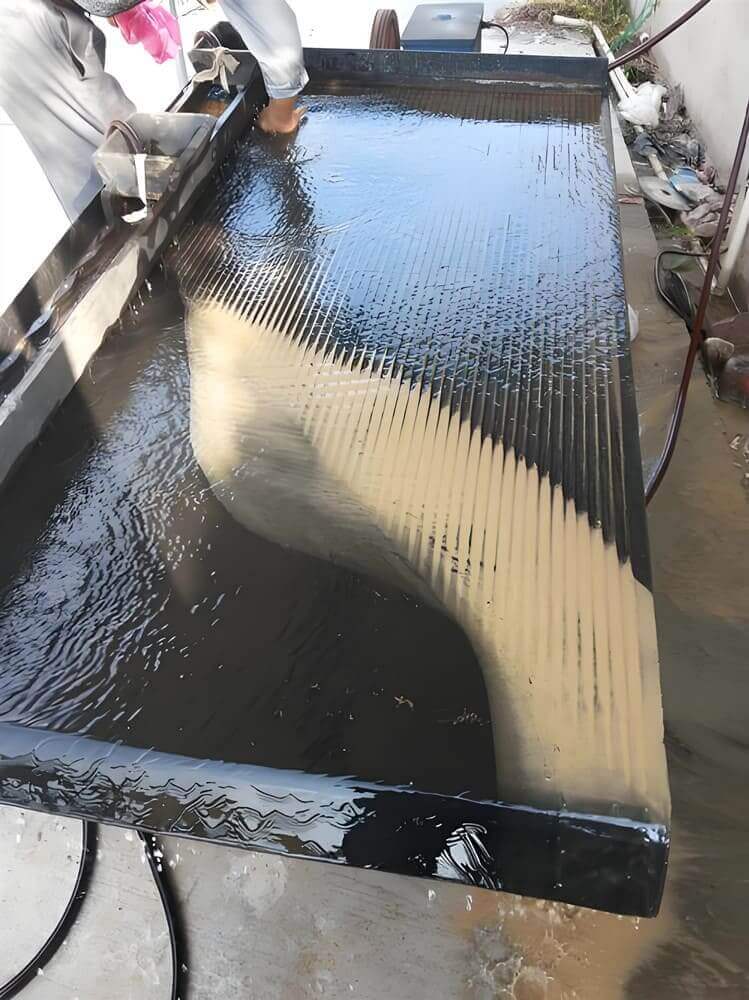
Core Operations of Mineral Processing Shaking Tables
The shaking table (or concentrating table) separates minerals based on gravity separation principles. Its key operations involve zonal management of the table surface, adjustment of longitudinal and lateral slopes, control of feed particle size and pulp density, regulation of wash water, and optimization of stroke and speed. Below is a detailed breakdown of these operations.
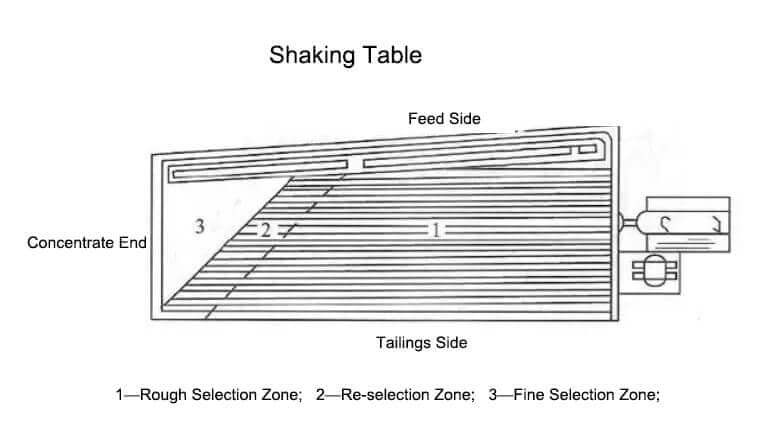
1. Zonal Control of the Shaking Table Surface
The shaking table surface is typically divided into four distinct zones: the concentrating area, middle mine area, tailings area, and sludge area, each requiring specific operational adjustments
| Zone | Ubicación | Función | Control Tips |
| Concentrating Area | Near the drive end (higher side) | Collects high-grade concentrate (e.g., tungsten, tin, gold) | Wash water flow should be minimized to prevent loss of valuable minerals; riffle height/spacing must match feed size |
| Middle Mine Area | Adjacent to concentrate zone | Contains semi-liberated particles and intermediate products | Requires careful wash water balance – excessive flow causes loss, insufficient flow reduces grade |
| Tailings Area | Lower side of the table | Discards low-density gangue minerals | Must maintain consistent flow to prevent buildup; adjust lateral slope for optimal rejection |
| Sludge Area | Outermost edge | Collects ultra-fine particles and slimes | Often requires separate processing; water flow should be sufficient to carry slimes without disrupting the main separation |
Optimization Guidelines:
- If the concentrate contains impurities, → Reduce wash water in the middle mine area
- If valuable minerals appear in tailings → Increase lateral slope or reduce feed rate
- If the sludge area contains recoverable fines → Consider regrinding or secondary processing
2. Adjustment of Longitudinal and Lateral Slopes
The slope of the bed surface must be matched to the particle size of the minerals being processed; this is a critical parameter influencing the separation efficiency.
(1) Longitudinal Slope (Drive End → Concentrate End)
Function: Influences the settling speed and lateral movement of particles.
Adjustment Guidelines
- Coarse particles (>0.2mm): Steeper slope (1°–3°) to enhance downward movement.
- Fine particles (<0.074mm): Gentler slope (0.5°–2°) to prevent loss with wash water.
- The sludge area has virtually no slope.
(2) Lateral Slope (Concentrate Side → Tailings Side)
Function: Controls the wash water’s ability to remove light gangue minerals.
Adjustment Guidelines
- High-density minerals (e.g., tungsten, tin): Steeper slope (3°–5°) for better gangue removal.
- Low-density minerals (e.g., coal, pyrite): Milder slope (2°–4°) to minimize concentrate loss.
The lateral slope generally ranges from 1.5° to 5°, tilting downward from the feed end toward the opposite side; for coarse-grained minerals, the lateral slope should be appropriately increased, while for fine-grained minerals, it should be decreased. The standard recommended ranges are 2.5°–4.5° for the coarse sand zone, 1.5°–3.5° for the fine sand zone, and 1°–2° for the slime zone.
Solución de problemas
- Tailings contain concentrate: Increase lateral slope or reduce wash water.
- Low concentrate grade: Reduce slope or increase wash water.
3. Control of Feed Particle Size
(1) Optimal Range
Best separation size: 0.074–2mm. Oversize (>2mm) or ultrafines (<0.037mm) reduce efficiency.
Impact of Size:
- Coarse particles: Deposit in the concentrate zone but may carry gangue.
- Fine particles: Easily lost with wash water, increasing metal loss in tailings.
(2) Adjustment Methods
Feed Pretreatment
- Coarse particles: Use screening or spiral classifiers for size control.
- Fine particles: Deslime with hydrocyclones or settling cones.
Table Adjustment
- Coarse particles: Longer stroke, gentler slope.
- Fine particles: Shorter stroke, higher speed.
4. Control of Feed Pulp Density
(1) Recommended Range
Coarse ore (>0.2mm): 20–30% solids.
Fine ore (<0.074mm): 15–25% solids.
If grooving appears on the bed surface, the feed concentration can be adjusted by increasing it appropriately. If sand heaps form on the bed surface, the feed concentration must be lowered immediately; this concentration can be precisely controlled by adjusting the feed water flow rate.
(2) Impact of Density
Too high (>35%): Poor stratification, lower concentrate grade.
Too low (<15%): Excessive wash water, fine mineral loss.
Adjustment Methods:
High density: Add dilution water or reduce dry feed rate.
Low density: Increase feed rate or reduce dilution water.
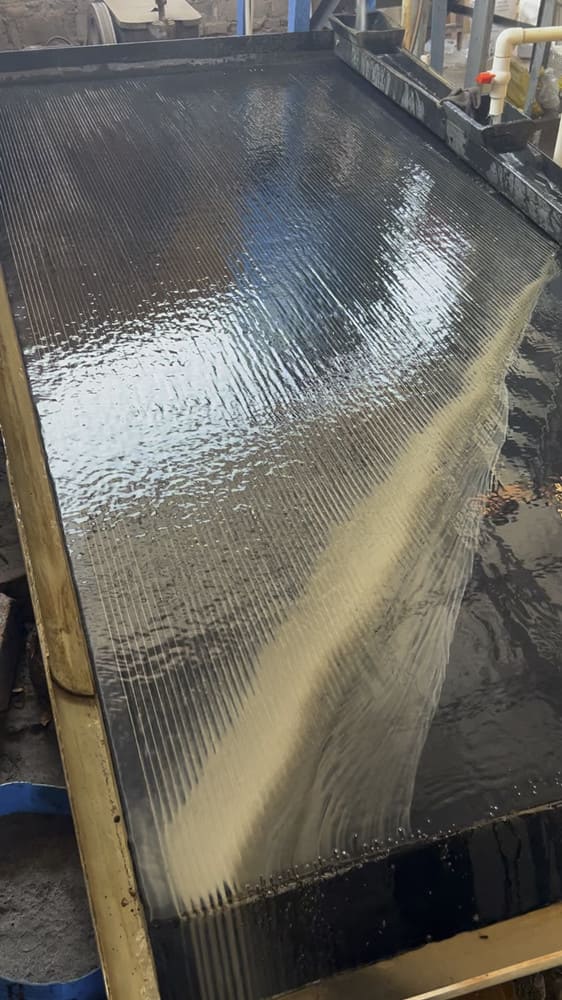
5. Control of Feed RateThe feed rate is directly proportional to the particle size of the incoming material; the coarser the ore particles, the higher the appropriate feed rate. Baseline Range: The processing capacity of a single shaking table typically ranges from 0.2 to 2 t/h (depending on equipment specifications). Indications of an Abnormal Feed Rate:
Adjustment Principles
Once the operating parameters have been established, the feed supply must be maintained continuously and uniformly to avoid significant fluctuations. |
 |
6. Wash Water Regulation
The flushing water consists of two components: feed water and wash water. Its primary function is to control the intensity of the lateral water flow, thereby influencing the discharge efficiency of light minerals. The flushing water must be adjusted in real-time, taking into account both the slurry flow velocity and the width of the concentrate belt.
Adjustment Methods
- Low concentrate grade (high gangue): Increase wash water.
- Low recovery (concentrate loss): Decrease wash water.
- Narrow middlings zone: Slightly increase the wash water to prevent mixing.
When the concentrate band narrows or concentrate migrates into the middlings, the wash water flow rate must be reduced. When the bed surface becomes exposed and lacks a covering water film, the wash water flow rate must be increased.
Water Quality Requirements: Use clean water or low-silt recycled water to avoid nozzle clogging.
7. Stroke and Speed Adjustment
Stroke (distance of table movement) and speed (reciprocations per minute) influence particle loosening and stratification.
General Guidelines
| Ore Type | Stroke (mm) | Speed (RPM) |
| Coarse, high-density (tungsten, tin) | 15–25 | 250–300 |
| Medium-fine (lead-zinc, pyrite) | 10–15 | 280–320 |
| Ultrafine (<0.074mm) | 8–12 | 300–350 |
Solución de problemas
- Fast settling (low recovery): Increase speed or reduce stroke.
- Poor loosening (impure concentrate): Increase stroke or reduce speed.
Resumen
Effective shaking table operation hinges on balancing interdependent variables—each adjustment directly impacts separation efficiency. By systematically addressing feed sizing, deck zoning, and hydraulic parameters, operators can significantly enhance recovery while reducing energy and resource waste. As technology evolves, the principles of precise control remain timeless. Keep experimenting, monitor outcomes, and let data drive your refinements.
ÚLTIMOS PRODUCTOS
-

Inclined Vibrating Screen
The inclined vibrating screen is a simple and eff…
-
High Temperature & Pressure Gold Desorption Electrolysis System
High-Temperature & Pressure Gold Desorption Elect…
-
Normal Temperature & Pressure Gold Desorption Electrolysis System
The normal temperature & pressure gold desorption…


ÚLTIMAS NOTICIAS
- Traditional De-cyanidation Technologies for Gold Cyanide Residues
- Shaking Table, 3-Disc Dry Magnetic & Electrostatic Separator for W-Sn-Ta-Nb
- Mineral Analysis: The Foundation for Successful Mineral Processing Projects
- What Is Over-Grinding and How Can It Be Prevented?
- Fluorspar vs Graphite vs Quartz: Non-Metal Minerals Beneficiation Differences
 English
  French
  Spanish
  Portuguese
  Indonesian