



Rare earth ore beneficiation employs various techniques based on the physical and chemical properties of rare earth minerals and associated gangue. Common methods include radiation beneficiation (using γ-rays to separate thorium-rich minerals), separação por gravidade (exploiting density differences via shakers or spirals for pre-enrichment), and separação magnética (leveraging weak/strong magnetism to isolate minerals like monazite). Flotação is widely used in vein-type deposits to exploit surface property differences, while electric separation targets conductivity variations in placer deposits. For ion-adsorbed clays or carbonate ores, chemical beneficiation (leaching, roasting, or solvent extraction) is applied. The choice of method depends on ore type (e.g., coastal placers vs. hydrothermal veins) and mineral composition. Below, we will introduce the most common methods for processing rare earth ores.
1. Método de Beneficiamento por Radiação
It mainly uses the difference in thorium content between rare earth minerals and gangue minerals in the ore. It uses a γ-ray radiation concentrator to separate rare earth minerals from gangue minerals. The radiation beneficiation method is mostly used for the pre-selection of rare earth ore. At present, this method is not widely adopted in the industry.
2. Método de beneficiamento por gravidade
The density difference between rare earth minerals and gangue minerals is used for sorting. Commonly used equipamento de separação por gravidade inclui cone concentrators, spiral concentrators, and shakers. Gravity separation is mainly used to separate rare earth minerals from low-density quartz, calcite, and other gangue minerals to achieve the purpose of pre-enrichment or to obtain rare earth concentrates. Gravity separation is widely used in the production of seashore placers; it is sometimes used as a means of pre-enrichment in the beneficiation of rare earth veins.
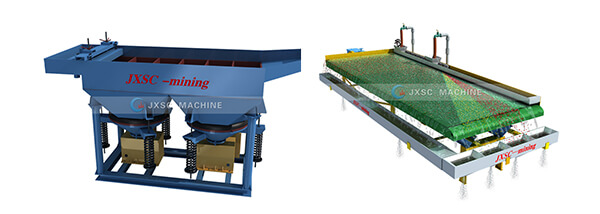
Equipamento de beneficiamento por gravidade
Agitador: It is also known as the gold shaking table, the gold separation table. It is a fine gold recovery equipment common in the gold shaker wash plant, alluvial gold mining plant, to separate concentrates, medium concentrates, and tailings according to material density and grain size.
Calha em espiral: It is the best equipment for mining and mineral processing, which combines the characteristics of the spiral concentrator, shaking table, and centrifugal concentrator. It is made of fiberglass lined with wear-resistant polyurethane and a corundum cover, light moisture-proof, and anti-rust.
Concentrador de jigueiras: It is an effective gravity separation machine based on the ore material density difference. The jigging machine is mainly used for processing placer gold, coltan, tungsten, tin, etc. The higher the density difference, the better the jigging separation effect.
Concentrador centrífugo de ouro: It is a brilliant gravity separation equipment widely used in the mining industry, especially for placer gold, fine-grained rock gold, and other precious minerals.
3. Método de separação magnética
Some rare earth minerals are weakly magnetic. The difference in specific magnetic susceptibility between them and associated gangue and other minerals can be used to separate rare earth minerals from other minerals by using magnetic separators with different magnetic field strengths. In the beneficiation of seaside placers, weak magnetic separation is often used to separate ilmenite from monazite; strong magnetic separation can also be used to separate monazite from zircon, quartz, and other minerals. In the beneficiation of rare earth veins, in order to simplify the flotation process and save flotation reagents, sometimes strong magnetic separation is used to pre-enrich rare earth minerals. With the continuous development of strong magnetic technology, strong magnetic separation will be more and more widely used in the beneficiation process of rare earth ore.
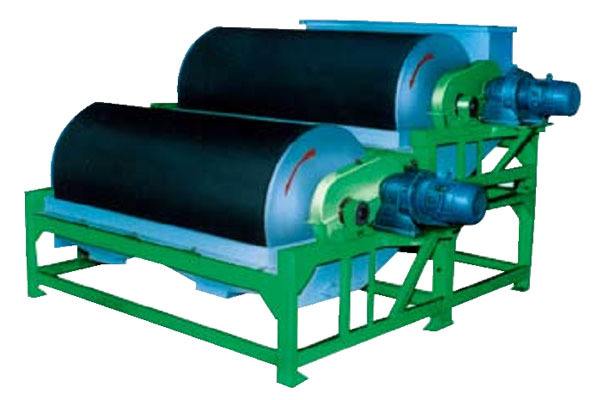
Equipamento de separação magnética
O separador magnético de tambor húmido is a commonly used iron ore processing equipment (iron ore magnetic separator) and manganese ore equipment (manganese ore magnetic separator), and is a mainstream strong magnetic separator ore dressing equipment.
Separador magnético seco de três discos aplicável à separação a seco de titânio, minério de terras raras, minério de tungsténio-estanho, cromite, minério de nióbio-tântalo, limonite, zircão, ouro vermelho, solitário, feldspato, quartzo e outras diferenças magnéticas numa variedade de minerais metálicos ou materiais não metálicos do removedor de ferro, mas também purificação de separação de minerais magnéticos e não magnéticos.
Separador magnético de tambor seco é uma das máquinas mais utilizadas e versáteis no processamento de minerais. Tecnologias minerais separadores electrostáticos adequados para minério de manganês, magnetite, pirrotite, minério de torrefação, ilmenite, hematite, e outros materiais abaixo de 50mm de granularidade, separador magnético seco, e separador magnético de tambor húmido.
Separadores magnéticos de alta intensidade are the upgraded products of dry separators developed on the basis of the original dry separators by improving the magnetic field strength and magnetic block arrangement. Its magnetic system is all made of high-performance rare-earth Nd-Fe-B material and high-quality ferrite material with high magnetic field strength (up to 12000 GAUSS). The high-intensity magnetic separator is suitable for wet magnetic separation of magnetite, pyrrhotite, roasted ore, and ilmenite with particle size less than 3mm, and also for removing iron from coal, non-metallic ore, building material, etc.
4. Método de flotação
Taking advantage of the difference in surface physical and chemical properties of rare earth minerals and associated minerals, flotation is used to separate them from associated gangue and other minerals to obtain concentrates, which is currently the main beneficiation method widely used in the production of rare earth veins. The rare earth mine of Mountain Pass in the United States uses flotation to produce rare earth concentrates. In the production of seashore placers, after the heavy sand is obtained by gravity separation, the flotation method is often used to obtain rare earth concentrates from the heavy sand.
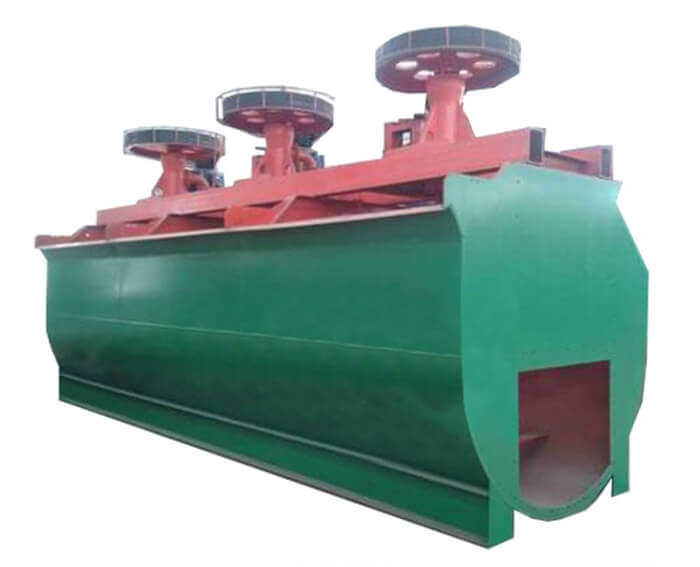
Equipamento de flotação
Máquina de flotação (planktonic concentrator) in the mineral processing plant, mainly used for separating copper, zinc, lead, nickel, gold, and other non-ferrous metals.
Tanque de mistura for flotation pulp operation before mixing, so that the pulp with a pharmaceutical is fully mixed as to create conditions for the flotation processing, and also suitable for blending various kinds of non-metal ores.
5. Electric Separation
Rare earth minerals are poor conductors, and their electrical conductivity can be used to be different from associated minerals, and they can be separated from minerals with good electrical conductivity by electric separation. Electric separation is often used in the selection of seashore placer heavy sand.
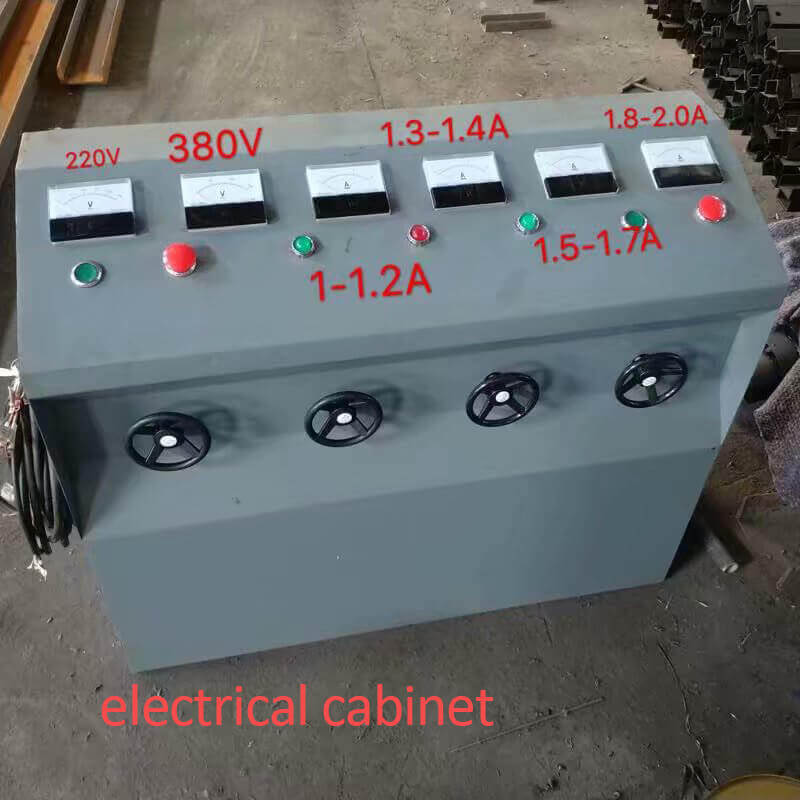
Equipamento de separação eléctrica
O Separação Eletrostática de Minerais is used for recycling various minerals, waste metals, and non-metal materials with conductivity differences, such as selected white tungsten, tinstone, zirconite, andalusite, rutile, and gold placer.
O Separador eletrostático tipo ARC is mainly used for separating a small number of metallic conductor minerals from non-metallic materials, especially for separating and purifying placer ores.
6. Método de Beneficiamento Químico
For rare earth deposits, adsorbed on kaolin or clay in the form of ions. It can make full use of the feature that rare-earth ions are easily soluble in sodium chloride or ammonium sulfate solution, and adopt a chemical beneficiation method of leaching first and then precipitation for recovery. For fluorocarbonate rare earth minerals that are easily soluble in acid or undergo phase change at high temperatures, they can be pre-enriched by flotation, and then purified by chemical beneficiation methods (acid leaching or high-temperature roasting).
Conclusão
The beneficiation of rare earth ores requires tailored approaches based on mineralogical composition and deposit type. Below is a comparative summary of the six primary methods:
Table: Comparison of Rare Earth Ore Beneficiation Methods
| Método | Princípio | Applicable Ore Types | Vantagens | Limitações |
|---|---|---|---|---|
| Radiation Beneficiation | Thorium content differences (γ-ray detection) | Thorium-rich ores | Non-contact; pre-concentration | Limited adoption; low throughput |
| Separação por gravidade | Density differences (shakers/spirals) | Placers (e.g., coastal sands) | Low cost; pre-enrichment | Limited to coarse/heavy minerals |
| Separação magnética | Magnetic susceptibility (weak/strong fields) | Monazite, ilmenite, hydrothermal veins | High efficiency for magnetic minerals | Requires precise field strength control |
| Flotação | Surface property differences (chemical reagents) | Vein-type deposits (e.g., bastnäsite) | High-purity concentrates | Complex reagent management |
| Separação eléctrica | Conductivity differences (electrostatic force) | Placers (heavy sands) | Effective for conductor minerals | Sensitive to moisture and particle size |
| Chemical Beneficiation | Leaching/roasting (acid/solvent extraction) | Ion-adsorbed clays, carbonates | Solves ultra-fine or complex ores | High cost; environmental concerns |
The optimal method or combination depends on ore characteristics (e.g., composition, grain size) and economic viability. Modern operations often integrate multiple techniques (e.g., gravity→flotation→magnetic) to maximize recovery and purity while minimizing environmental impact. Advances in equipment (e.g., high-intensity magnetic separators) and hybrid technologies continue to enhance rare earth beneficiation efficiency.
PRODUTOS MAIS RECENTES
-

SFM-8 Lab Grinder
【Max. Power Consumption】 150W 【Morta…
-
Cyclosizer
【Feeding Capacity】< 100g/time 【Feeding …
-
JKZ/2JKZ Mine Shaft Sinking Hoist
【Power Source】Electric Motor Drive 【Motor Spee…


 English
  French
  Spanish
  Portuguese
  Indonesian