



Separação magnética is a fundamental mineral processing technique that separates materials based on their magnetic properties. The magnetic separator machine can effectively select a large number of magnetic minerals, such as magnetite, hematite, limonite, manganese siderite, wolframite, ilmenite, manganese ore, manganese carbonate, metallurgical manganese ore, iron ore, kaolin, manganese oxide ore, and rare earth ore. In this guide, we break down the various classification methods for equipamento de separação magnética.
Hora de publicação:09 agosto 2019
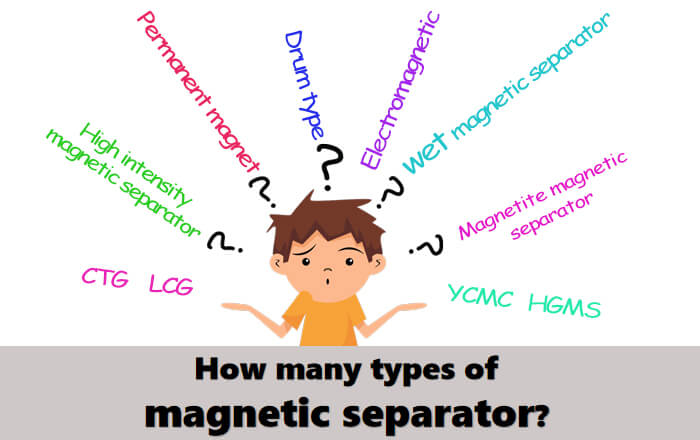
1. Types of Magnetic Separators: By Material State
Dry-type Magnetic Separators and Wet-type Magnetic Separators
According to the state of the material, the magnetic separators are divided into dry-type magnetic separators e wet-type magnetic separators. The dry magnetic separator refers to the material keep dry, don’t need to be mixed with water in the magnetic separation process. The material for a wet magnetic separator must be mixed with water or other media.
Estrutura
The dry magnetic separator generally does not need a tank for accommodating the slurry, and the material is conveyed by a vibrating feeding device; a dustproof device is often provided. The wet magnetic separator has a tank to accommodate the slurry to maintain the fluidity of the material, and the slurry is usually transported by a bomba de polpa.
Mineral Size
Dry magnetic separation functions for bulk, coarse particle separation, but also fine mineral separation, while wet magnetic separator can not sort large bulk minerals; most are effective for fine or even fine particles, except for a few models that can select coarse particles. HGMS (high gradient wet magnetic separator) can sort micron-sized materials using a suitable magnetically permeable medium.
Water Requirements
Dry magnetic separation requires low water content, dry materials, good liquidity, do not adhesion agglomeration.
A operação de separação magnética húmida tem certos requisitos sobre a concentração da lama. Não existe um limite óbvio para a concentração da separação magnética grosseira, mas a concentração do material não deve ser demasiado baixa para controlar eficazmente a força negativa do fluido durante a operação de processamento mineral. Ao selecionar magneticamente as partículas finas, a concentração deve ser elevada para garantir a recuperação dos minerais magnéticos.
Advantages and Application
Dry weak magnetic separators have features like a simple process, low investment, and low water consumption. However, the bottleneck of the dry cylinder magnetic separator is that the dust is difficult to control; as environmental protection requirements become stricter, the dry type magnetic separation is gradually replaced by the wet weak magnetic separator. At present, the fine-grained dry magnetic separation machine is only used in water-shortage areas and severe cold areas.
2. Types of Magnetic Separators: By Magnetic Field Strength
Weak, Medium, Strong Magnetic Separators
According to the magnetic field strength, the magnetic separators are divided into three types: weak magnetic separator (low-intensity magnetic separator), medium magnetic separator, and strong magnetic separator (high-intensity magnetic separator).
O separador magnético fraco é de várias centenas a 3000 Gs; o separador magnético forte refere-se geralmente a 3000Gs a 6000 Gs, e o separador magnético de campo magnético médio entre os dois.
A razão pela qual é classificada de acordo com a força do campo magnético está relacionada com as propriedades magnéticas de vários minerais comuns (outro post - Classificação de minerais magnéticos). No entanto, é necessário saber que não existe uma norma absoluta para as diferentes forças magnéticas e para o equipamento correspondente.
Magnetic Field Strength
In the actual magnetic separation machine, the magnetic field strength ranges from hundreds of Gauss to 20,000 Gauss; some even exceed 20,000 Gauss, but it is rarely used in general beneficiation production. Excessive magnetic field strength will lead to weak magnetic minerals to agglomerate that is not conducive to beneficiation. So the upper limit of the magnetic field strength of the strong magnetic separator is 20000Gs.
On the working surface of various magnetic separators, the magnetic field strength varies at different points and in different ranges, and the working magnetic field is a non-uniform magnetic field. Generally, the value of the magnetic field strength expressed refers to the maximum. magnetic strength; some factories may list the average value.
3. Types of Magnetic Separators: By Magnetic Source
Permanent Magnet and Electromagnetic Magnetic Separators
According to the type of magnetic field, the magnetic separators are divided into permanent magnet magnetic separators e electromagnetic magnetic separators.
O separador magnético de ímanes permanentes utiliza um material magnético permanente, como ferrite ou boro de ferro neodímio, para gerar um campo magnético de trabalho, e o separador magnético eletromagnético utiliza um íman com uma forquilha, um solenoide e um íman para gerar um campo magnético.
Magnetic Field Strength
A intensidade do campo magnético do separador magnético de ímanes permanentes é fixa, mas as diferentes áreas de ação na superfície de trabalho de separação magnética podem ser concebidas para ter diferentes intensidades de campo magnético. O separador magnético eletromagnético pode ajustar todo o campo magnético, mas os valores de intensidade do campo magnético na superfície de trabalho são um campo magnético equilibrado e uniforme.
Consumo de energia
A energia magnética do separador magnético de ímanes permanentes é baixa, enquanto a separação electromagnética requer um elevado consumo de energia para gerar a corrente de excitação. O consumo de energia por unidade do separador magnético permanente é muito inferior ao do separador magnético eletromagnético.
4. Types of Magnetic Separators: By Structural Design
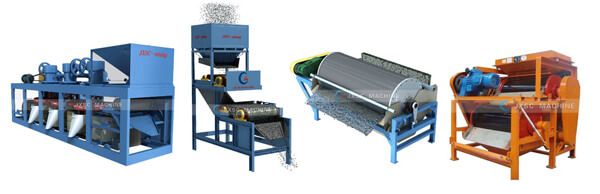
Cylindrical/Drum, Roller, Disc, Ring Magnetic Separators
According to the structure of the main working part of the magnetic separator, it is divided into cylindrical (drum) magnetic separator, roller magnetic separator, disc magnetic separator, ring magnetic separator, in addition, have rotor magnetic separator, belt magnetic separation, conical magnetic separator, but these types of magnetic separators have been used less.
Cylindrical/Drum magnetic separator: Most common for both dry/wet separation
Roller magnetic separator: High-precision sorting for fine materials
Disc magnetic separator: Multi-stage separation capability
Ring magnetic separator: Continuous processing of slurry materials
5. Types of Magnetic Separators: By Field Dynamics
Constant, Alternating, Pulsating, Rotating Magnetic Field Magnetic Separators
According to the way the magnetic field strength changes, the magnetic separators are divided into:
1) Constant magnetic field magnetic separator: Using a permanent magnet material and a direct current electromagnet, a solenoid, or the like as a magnetic source, the magnitude and direction of the magnetic field strength do not change with time.
2) Alternating magnetic field magnetic separator: An electromagnet that is connected to an alternating current is used as a magnetic source. The magnitude and direction of the magnetic field strength change over time.
3) Pulsating magnetic field magnetic separator: An electromagnet that simultaneously transmits direct current and alternating current is used as a magnetic source. The magnitude of the magnetic field varies with time, but the direction does not change. And pulse
Semelhante ao separador magnético dinâmico, a utilização de um fluxo de água pulsante faz com que a lama pulse, afectando a força de classificação do mineral magneticamente selecionado.
4) Rotating magnetic field magnetic separator: A magnet is used as the magnetic source, and the magnetic pole rotates around the axis. The magnitude and direction of the magnetic field strength change over time.
6. Types of Magnetic Separators: By Mineral Reversal
Reversal Magnetic Separators and Non Reversal Magnetic Separators
De acordo com whether the magnetic mineral is reversed in the magnetic field of the magnetic separator, it is divided into a mineral reversal magnetic separator e um non-reversal magnetic separator.
O separador magnético de reversão de minerais pode melhorar eficazmente o grau de concentrado, e o separador magnético de não-reversão pode selecionar os minerais magnéticos fracos refractários.
7. Types of Magnetic Separators: By Target Minerals
Various Magnetic Minerals Magnetic Separators(eg. ilmenite separators, rare earth separators)
According to the minerals, it also can divide into such as magnetite magnetic separator, hematite magnetic separator, manganese ore magnetic separator, quartz sand magnetic separator, NdFeB magnet, nickel, etc.
Para além dos tipos acima referidos, existem muitas formas de classificar os separadores magnéticos. Embora cada fabricante tenha um método de auto-classificação, carece de normas. Na fase de seleção do modelo de separador magnético, a maioria prefere usar um nome misto, como o "separador magnético hematite húmido", na verdade indica que o mineral de triagem é hematite, e o método de tratamento de minério é do tipo húmido, mas não nos mostra se o separador magnético é um tipo de íman permanente ou um tipo eletromagnético, e nem indica qual é a estrutura de separação magnética do equipamento.
JXSC offers custom magnetic separation solutions—from lab-scale testing to full-scale production—ensuring optimal recovery rates for minerals like iron ore, manganese, tungsten, and rare earths. Contact our team for expert guidance, equipment selection, and global logistics.
PRODUTOS MAIS RECENTES
-

SFM-8 Lab Grinder
【Max. Power Consumption】 150W 【Morta…
-
Cyclosizer
【Feeding Capacity】< 100g/time 【Feeding …
-
JKZ/2JKZ Mine Shaft Sinking Hoist
【Power Source】Electric Motor Drive 【Motor Spee…


 English
  French
  Spanish
  Portuguese
  Indonesian