



When it comes to mineral grinding equipment, both ball mills and rod mills play crucial roles in processing various ores and materials. Both the ball mill and the rod mill are designed for grinding materials, but with the same role of grinding materials and cylinder shape, what’s the difference between ball mills and rod mills? Next, we will introduce the intrinsic properties and construction of the ball mill and the rod mill.
1. Key Structural Differences Between Ball and Rod Mills
Grinding Media: Balls vs Rods
The most fundamental difference lies in their grinding mechanisms
- Moinhos de bolas utilize steel balls as grinding media
- Rod mills employ long steel rods for the grinding process
This distinction in grinding media leads to different contact patterns during operation
- Ball mills create point contact between particles and grinding media
- Rod mills produce line contact, resulting in more uniform particle size reduction
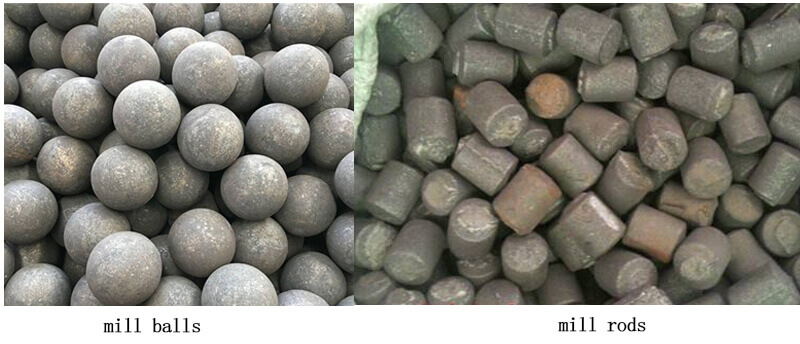
Cylinder Design Variations
Rod mills feature a unique cylinder design with:
- A larger diameter at the discharge end compared to moinhos de bolas of equivalent size
- Typically longer cylinder proportions than ball mills
- Different internal lining configurations to accommodate rod grinding action
2. Application Comparison
Compared with the ball mill, the rod mill adopts advanced controllable feeding and discharging technology, and can use the appropriate grinding body according to the grinding material. The point contact of the traditional ball mill can be changed into line contact, which can make the discharge granularity more uniform, and the output is higher.
O moinho de barras é utilizado principalmente para separação por gravidade ou separação magnética de minério de tungsténio-estanho e outros minérios de metais raros, porque a utilização de um moinho de barras pode evitar a ocorrência de poluição por poeiras causada por pulverização excessiva e melhorar a taxa de recuperação da operação de triagem.
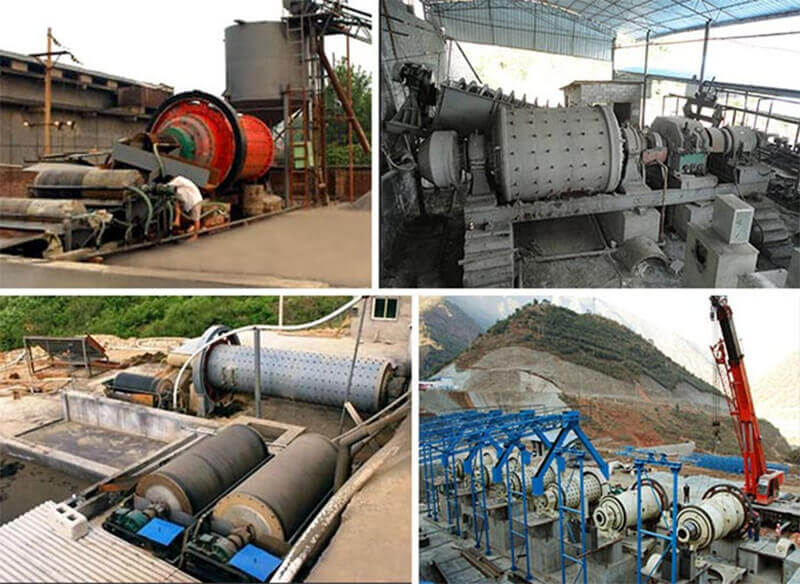
The ball mill is suitable for grinding various ores and other materials, including mineral processing, building materials, and chemical industries. The feed can be dry or wet.
3. Performance Characteristics Comparison
Fineness and Grinding Capability
The finesse of the material milled by the ball mill is 0.074mm-0.4mm, except for the two small ball mills that have a wider range of 0.075-0.89mm. However, the rod mill fine grinding fineness is about 0.833-0.147mm. In terms of the fineness of the ground material, the ball mill has a finer handling ability.
Por outro lado, a área de superfície do meio da haste de aço no moinho de barras é menor do que a do meio da esfera de aço no moinho de bolas, de modo que o fator de utilização é menor do que o do moinho de bolas com a mesma capacidade de processamento. Os moinhos de barras são frequentemente utilizados em trituração grosseira operations and are not suitable for fine crushing. But in some cases, the rod mill can replace the fine crusher and solve the problem that the discharge port of the fine crusher is easy to block.
Throughput and Capacity Considerations
Rod mills demonstrate
- Higher capacity for coarser materials
- Better prevention of overgrinding
- More uniform particle size distribution
Ball mills offer
- Greater flexibility in feed conditions (dry or wet)
- Higher energy efficiency for fine grinding applications
- Better adaptability to closed-circuit grinding systems
4. Operational Differences
Método de descarga
The rod mill adopts overflow type and open type discharge, and does not use grate type discharge. The diameter of the rod mill discharge end is larger than that of the same size ball mill. When the rod mill speed is lower than the working speed of the same size ball mill, the medium in the rod mill is in a sloping working state.
Para o moinho de bolas, dependendo dos requisitos específicos, pode escolher o método de descarga do tipo transbordamento e do tipo grelha.
Speed and Power Requirements
| Characteristic | Moinho de bolas | Moinho de barras |
|---|---|---|
| Operating Speed | Higher (70-80% critical speed) | Lower (60-70% critical speed) |
| Consumo de energia | Higher for fine grinding | Lower for equivalent coarse grinding |
| Medium Motion Pattern | Cascading action | Sloping working state |
5. Maintenance and Noise Considerations
Both mills require regular maintenance, but differ in
- Media wear patterns (balls wear more uniformly than rods)
- Noise levels (ball mills typically require more noise control measures)
- Maintenance frequency (rod mills often need more attention to rod integrity)
For noise control in ball mills, consider
- Sound insulation enclosures
- Anti-vibration mounts
- Acoustic dampening materials
- Proper lubrication to reduce mechanical noise
- Regular maintenance to prevent abnormal noises
6. Selection Guidelines
When deciding between ball mills and rod mills, evaluate
- Material characteristics (hardness, moisture content, stickiness)
- Required product fineness
- Production capacity needs
- Energy efficiency considerations
- Downstream processing requirements
- Total cost of ownership (including media consumption)
As a general rule
- Choose ball mills when fine grinding (below 0.4mm) is paramount
- Opt for rod mills when you need to prevent overgrinding or require coarser products
For operations requiring both coarse and fine grinding, consider using rod mills for primary grinding and ball mills for secondary grinding in a two-stage process.
Conclusão
Understanding the differences between ball mills and rod mills enables mineral processing professionals to make informed equipment selection decisions. While ball mills offer superior fine grinding capabilities and versatility, rod mills provide distinct advantages in coarse grinding applications and situations where overgrinding must be avoided.
The choice ultimately depends on your specific production requirements, material characteristics, and desired product specifications. Many modern processing plants benefit from incorporating both types of mills in different stages of their grinding circuits to optimize efficiency and product quality.
Further Reading
- How much is the Gold Ore Ball Mill?
- Ball Mill Parameter Selection – Power, Rotation Speed, Steel Ball
- Pode o Moinho de Bolas Moer o Material até 325 Mesh?
- 5 maneiras de controlar o ruído do moinho de bolas
PRODUTOS MAIS RECENTES
-

SFM-8 Lab Grinder
【Max. Power Consumption】 150W 【Morta…
-
Cyclosizer
【Feeding Capacity】< 100g/time 【Feeding …
-
JKZ/2JKZ Mine Shaft Sinking Hoist
【Power Source】Electric Motor Drive 【Motor Spee…


 English
  French
  Spanish
  Portuguese
  Indonesian