



O Kanyika Niobium–Tantalum Project in Malawi is an important niobium-focused polymetallic mineral development in northern Malawi. In addition to niobium, the project is associated with tantalum, zirconium, and other mineral components, making ore characterization and beneficiation testing particularly important before finalizing a processing plant design.
For mining companies, investors, and mineral processing equipment suppliers, the key challenge is not simply identifying the presence of niobium and tantalum. The more important question is how these valuable minerals occur in the ore and how effectively they can be recovered into a saleable concentrate.
Kanyika Project Development and Processing Considerations
The development status of the Kanyika Niobium–Tantalum Project in Malawi should be considered separately from the country’s overall niobium and tantalum resource potential.
Project development depends on multiple factors, including mining permits, financing, infrastructure, metallurgical testing, environmental requirements, and local processing conditions. Therefore, the existence of a mineral resource should not automatically be interpreted as established commercial concentrate production.
For equipment buyers, this distinction matters because they should select processing equipment based on verified ore characteristics and metallurgical test results, not resource estimates alone.
| Malawi Kanyika Project | |
| Project Location | Mzimba District |
| Mineral Type | Niobium (primary), Tantalum (associated) |
| Development Status | Verified against licenses and contracts |
| Equipment Assessment | Ore samples first, process flow second |
Ore Characterization Comes First
The processing route for Kanyika should not be determined simply by classifying the material as niobium-tantalum ore.
Before selecting a niobium processing plant ou tantalum processing plant, the following characteristics should be established:
- Niobium-bearing mineral species
- Tantalum mineral occurrence
- Mineral liberation characteristics
- Association with gangue minerals
- Weathering degree
- Clay and slime content
- Feed moisture
- Particle-size distribution
- Nb and Ta distribution by particle size
- Iron-bearing minerals
- Phosphorus and other impurities
- Zirconium distribution
- Uranium and thorium levels where applicable
If valuable niobium or tantalum minerals have sufficiently high density compared with the major gangue minerals, gravity separation may be a suitable beneficiation option.
However, this needs to be confirmed through laboratory and pilot-scale testing.
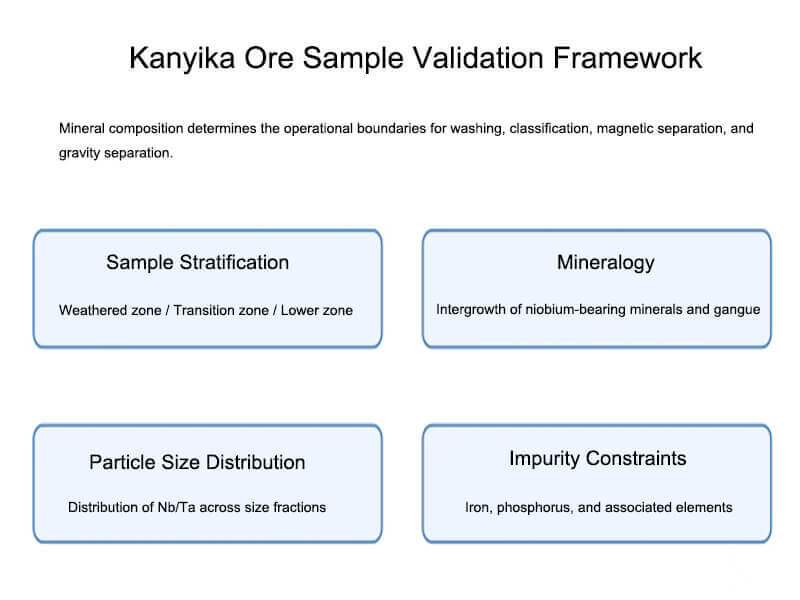
Layered Sampling for Different Ore Types
One of the most important steps in Kanyika ore beneficiation is representative sampling.
Rather than combining all material into one sample, the ore should preferably be divided according to geological and weathering characteristics, such as:
- Surface weathered ore
- Transitional ore
- Fresh or less-weathered ore
Each sample should be tested for moisture, clay content, particle-size distribution, and mineralogical characteristics.
This is especially important because weathered ore may contain significantly more clay and slimes than fresh rock.
High clay content can affect screening efficiency, gravity separation, water consumption, and the recovery of fine valuable minerals.
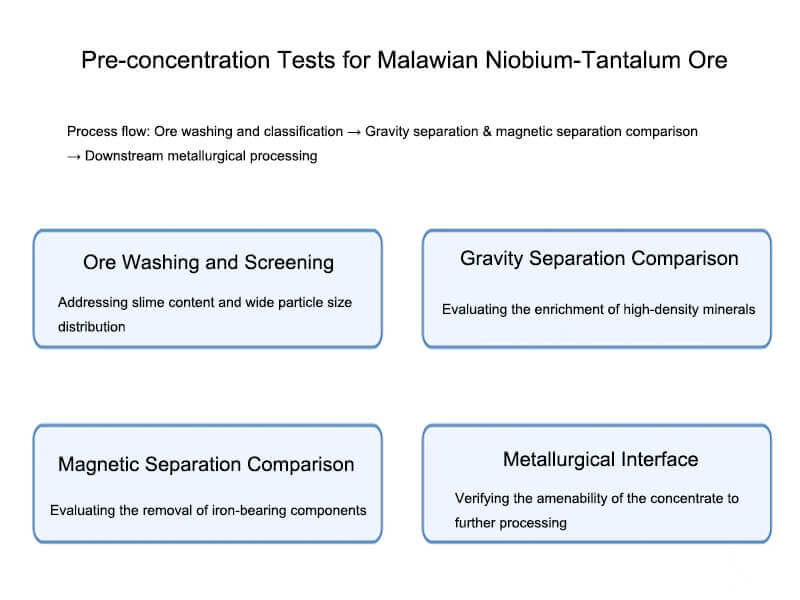
Washing and Classification Should Be Tested First
For ores containing significant clay or weathered material, washing and classification can be critical front-end operations.
Potential testwork may compare:
- Scrubbing
- Trommel washing
- Vibrating screening
- Desliming
- Hydrocyclone classification
- Different classification cut sizes
The objective is not simply to produce a clean feed.
The critical question is:
Where do Nb and Ta report after washing and classification?
If most valuable minerals report to a particular size fraction, downstream beneficiation equipment can be designed around that fraction instead of processing the entire feed in the same way.
This can potentially reduce equipment size, water consumption, and processing costs.
Gravity Separation for Niobium and Tantalum Recovery
Gravity separation should be considered where mineralogical testing confirms a useful density difference between valuable minerals and gangue.
Potential gravity concentration equipment may include:
- Mesas de agitação
- Concentradores em espiral
- Concentradores centrífugos
- Other fine or coarse equipamento de separação por gravidade
The appropriate equipment depends strongly on feed size and mineral liberation.
Gravity testwork should evaluate not only concentrate grade but also:
- Nb recovery
- Ta recovery
- Mass yield
- Tailings loss
- Middlings production
- Concentrate quality
- Consumo de água
A high-grade concentrate with poor recovery may not provide the best overall process.
Magnetic Separation as a Cleaning or Pre-Concentration Stage
Magnetic separation can also be evaluated for the Kanyika ore, particularly where iron-bearing or other magnetic minerals interfere with concentrate quality.
Depending on the magnetic susceptibility of the minerals, magnetic separation may be used for:
- Removing magnetic impurities
- Cleaning a gravity concentrate
- Pre-concentrating certain mineral fractions
- Reducing the processing load on downstream stages
The role of magnetic separation should therefore be determined by comparative testwork rather than included automatically in the flowsheet.
Evaluate Nb and Ta Distribution, Not Only Head Grade
A common mistake in preliminary niobium ore beneficiation studies is to focus on the head grade.
For plant design, distribution data are often more valuable.
The test program should establish how Nb and Ta are distributed between:
- Coarse fractions
- Intermediate fractions
- Fine fractions
- Slimes
- Concentrado
- Middlings
- Final tailings
This information allows engineers to identify potential recovery losses and determine whether separate treatment of different size fractions is justified.
For example, if a significant amount of tantalum reports to fine particles while niobium is concentrated in a coarser fraction, a single separation method may not provide optimum recovery for both metals.
Concentrate Quality Must Go Beyond Nb and Ta
The final concentrate should not be evaluated only by Nb or Ta grade.
Depending on the mineralogy and downstream requirements, the concentrate may also need to be analyzed for:
- Zr
- Fe
- P
- Si
- Ti
- U
- Th
- Other deleterious elements
This is particularly relevant when uranium or thorium occurs as an associated component.
Such elements can affect concentrate handling, environmental management, tailings design and downstream metallurgical processing.
Therefore, concentrate specifications should be established together with potential downstream customers or metallurgical processors whenever possible.
Data Required Before Equipment Quotation
Before requesting quotations for a niobium processing plant ou tantalum processing plant, project owners should provide equipment suppliers with as much of the following information as possible:
Ore Sample Data
- Representative samples
- Sample mass
- Geological zone
- Weathering condition
- Teor de humidade
Feed Data
- Maximum feed size
- Particle-size distribution
- Clay content
- Slime content
- Bulk density
- Feed moisture
Chemical and Mineralogical Data
- Nb grade and distribution
- Ta grade and distribution
- Zr
- Fe
- P
- Other major impurities
- U and Th where relevant
- Mineralogical identification
Processing Requirements
- Target throughput
- Target concentrate grade
- Target recovery
- Product size
- Expected mass yield
- Tailings requirements
Site Conditions
- Available water
- Water recycling requirements
- Power supply
- Infrastructure
- Climate
- Tailings disposal conditions
Without these data, equipment suppliers generally have to rely on assumptions or generic flowsheets, which can result in oversized, undersized, or technically unsuitable equipment.
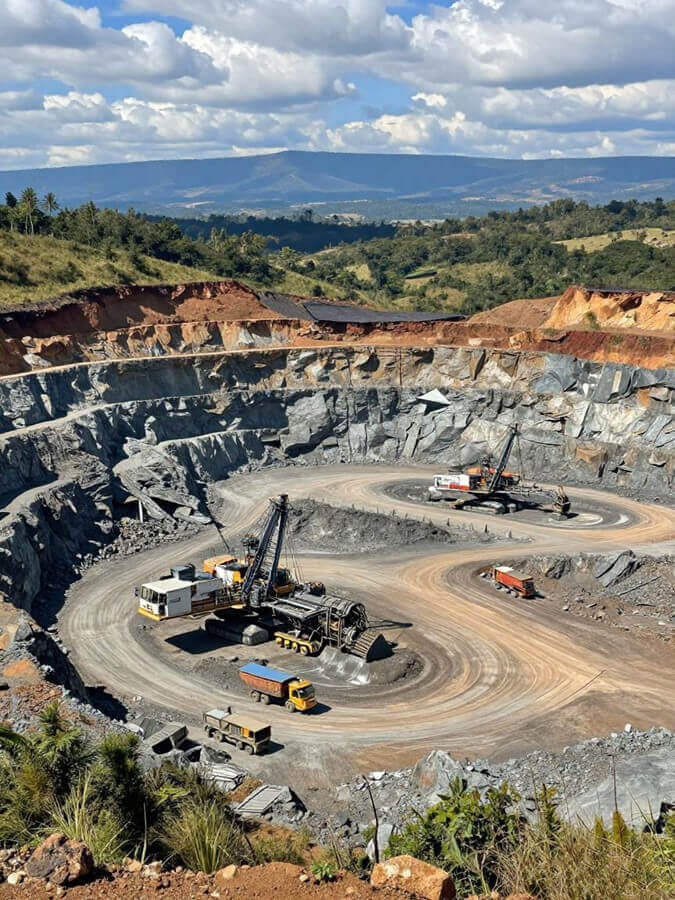
Recommended Beneficiation Approach
For the Kanyika Niobium & Tantalum Project in Malawi, a practical validation sequence can be summarized as:
Representative sampling → Ore characterization → Washing → Screening and classification → Desliming → Gravity testing → Magnetic testing → Combined flowsheet testing → Mass balance → Concentrate evaluation → Downstream metallurgical validation
The purpose is to establish a reliable material balance for each major ore type.
The final test program should demonstrate where the Nb and Ta report and quantify losses at every major separation stage.
This provides the technical foundation for selecting equipment and designing a commercial processing plant.
Conclusão
O Kanyika Niobium & Tantalum Project in Malawi has significant potential as a niobium-focused polymetallic development with associated tantalum and zirconium. However, the technical feasibility of a processing plant depends on verified ore characteristics rather than resource estimates alone.
The most important priorities are therefore:
- Separate different ore and weathering types.
- Determine Nb and Ta mineralogy and liberation.
- Evaluate washing and classification performance.
- Analyze metal distribution by particle size.
- Compare gravity and magnetic separation.
- Quantify concentrate and tailings losses.
- Check potential impurities such as Fe, P, U, and Th.
- Complete mass-balance and downstream metallurgical testing before final equipment selection.
For equipment suppliers and project developers, the guiding principle is simple:
Characterize the ore first, validate the beneficiation process second, and select the equipment third.
This approach provides a more reliable basis for developing a technically and economically viable processing flowsheet for the Kanyika project.
PRODUTOS MAIS RECENTES
-

Inclined Vibrating Screen
The inclined vibrating screen is a simple and eff…
-
High Temperature & Pressure Gold Desorption Electrolysis System
High-Temperature & Pressure Gold Desorption Elect…
-
Normal Temperature & Pressure Gold Desorption Electrolysis System
The normal temperature & pressure gold desorption…


NOTÍCIAS MAIS RECENTES
- Kanyika Niobium-Tantalum Project in Malawi: Processing Priorities
- Modern Cyanide Residue Treatment Technologies for Gold Processing
- Traditional De-cyanidation Technologies for Gold Cyanide Residues
- Shaking Table, 3-Disc Dry Magnetic & Electrostatic Separator for W-Sn-Ta-Nb
- Mineral Analysis: The Foundation for Successful Mineral Processing Projects
 English
  French
  Spanish
  Portuguese
  Indonesian