



Cyanidation remains one of the most widely used methods for recovering gold from suitable ores and concentrates. However, the process generates cyanide-containing residues that require effective treatment before disposal, storage, backfilling, or further utilization.
Traditional de-cyanidation methods include natural degradation, chemical oxidation, cyanide recovery, and solid-liquid separation and washing. These technologies provide established approaches for reducing cyanide concentrations, but modern gold-processing operations increasingly require treatment systems that do more than simply destroy cyanide.
Modern cyanide residue treatment technologies are increasingly focused on integrated de-cyanidation, water recycling, waste reduction, energy efficiency, and recovery of valuable components from cyanide residues.
This development reflects a broader shift from single-purpose cyanide destruction toward integrated residue management. Recent technical literature describes cyanide tailings treatment in terms of physical, chemical, biological, and resource-utilization approaches, while China’s HJ 943-2018 technical specification lists technologies such as solid-liquid separation and washing, INCO, peroxide oxidation, pressure-washing processes, three-waste synergistic purification, and other methods for different cyanide-residue applications.
For an overview of conventional methods, see our related article: Traditional De-cyanidation Technologies for Gold Cyanide Residues.
Modern Cyanide Residue Treatment Technologies
Modern cyanide residue treatment is not limited to one process. Depending on the type of residue, cyanide species, moisture content, mineral composition, water balance, and resource-recovery objectives, a gold-processing plant may combine several treatment technologies.
Three approaches that have attracted particular attention are:
- Three-waste synergistic purification technology
- Pressure filtration and washing technology
- Medium-temperature treatment and comprehensive utilization technology
The common characteristic of these approaches is that cyanide removal is considered together with other process objectives, including wastewater recycling, waste-gas utilization or treatment, dewatering, and recovery of valuable elements.
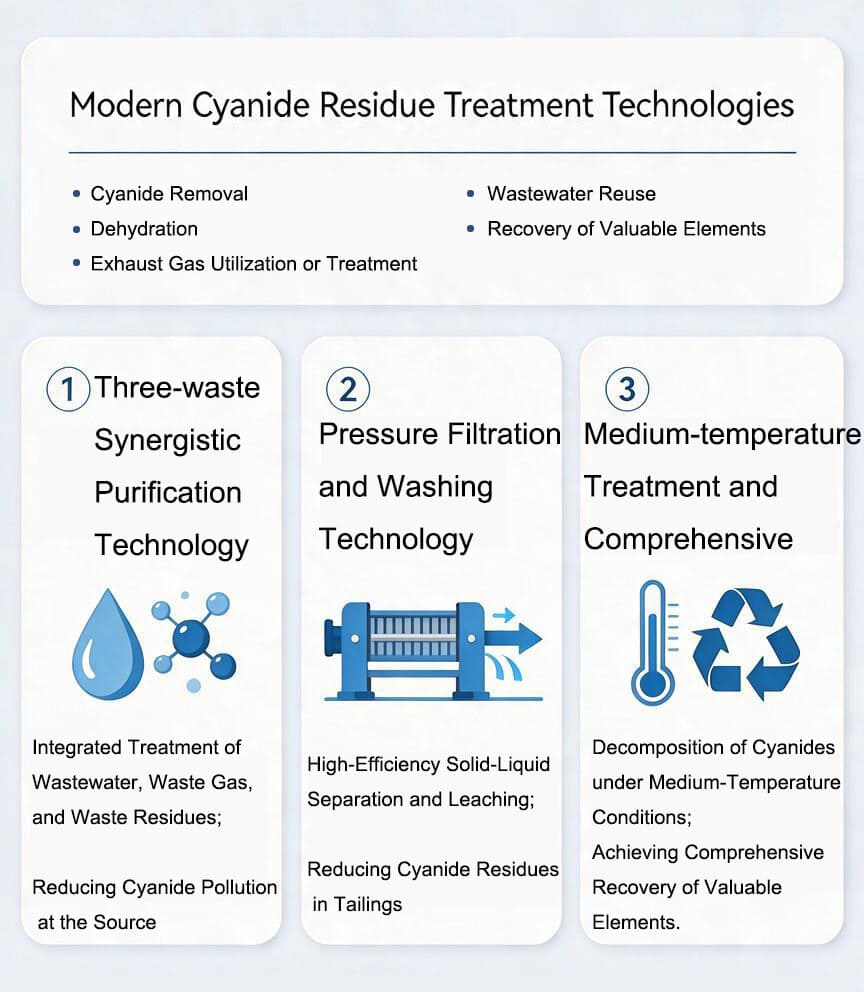
1. “Three-Waste” Synergistic Purification Technology
The “Three-Waste” synergistic purification technology, also known as the WAST technology, is mainly designed for cyanide tailings generated from gold concentrate cyanidation. It adopts the concept of “using waste to treat waste” and utilizes flue gas or oxidation liquor generated during the pretreatment of sulfur-bearing gold ores or gold concentrates to treat cyanide-containing tailings slurry. The objective is to achieve simultaneous treatment of cyanide residues, wastewater, and waste gas.
The basic concept is to make full use of waste streams generated during normal production as treatment media or reagents, thereby reducing the need for additional chemicals. Gold-processing plants employing roasting, bio-oxidation, or pressure oxidation pretreatment processes can potentially integrate the flue gas or oxidation liquor generated by these processes into the cyanide-residue treatment system.
The “Three-Waste” synergistic purification technology combines cyanide-residue de-cyanidation, wastewater recycling, and waste-gas treatment. It can reduce the consumption of additional treatment chemicals and the operating costs associated with separate pollution-control systems. After treatment, the solid cyanide residues can meet the relevant requirements, while part of the treated liquid can be returned to the production system for recycling, thereby promoting integrated waste management.
The technology has the advantages of convenient process integration, stable operation, and relatively low capital and operating costs. It is consistent with the principles of “using waste to treat waste” and coordinated pollution control. Therefore, it can be considered particularly suitable for gold-processing plants equipped with roasting, bio-oxidation, or pressure-oxidation pretreatment processes.
2. Pressure Filtration and Washing Technology for Cyanide Residues
Pressure filtration and washing technology has been developed from conventional solid-liquid separation and washing processes. It integrates pressing, washing, and air stripping/drying into a combined operation, allowing the equipment to perform pressure filtration, washing, and drying functions simultaneously. The technology is used to remove residual cyanide from cyanide residues through pressure filtration and washing.
In this process, cyanide tailings are first subjected to solid-liquid separation using a high-efficiency filter press. The solid phase is then washed to further remove soluble residual cyanide. Pressing and air stripping can further reduce the moisture content and the amount of residual liquid in the filter cake. After treatment in a high-efficiency filter press, the moisture content of the cyanide residue can be reduced to below 20%. Depending on the process conditions, the washing liquid can be returned to the mineral-processing circuit for recycling or used in a closed-loop washing system, thereby reducing fresh-water consumption.
Pressure filtration and washing can not only achieve cyanide-residue purification but also facilitate the recovery of valuable substances contained in the residues. The technology has the advantages of convenient process integration and stable operation and has been increasingly applied in gold-processing plants in recent years.
However, the technology places relatively high requirements on the treatment and recycling of washing water. If the washing-water treatment process is not properly selected, contaminants such as cyanide may accumulate in the circulating water, reducing the washing driving force and overall de-cyanidation efficiency. As a result, the treated cyanide residue may fail to meet the relevant requirements. Therefore, solid-liquid separation, washing-water treatment, and water-recycling systems should be designed and optimized as an integrated system.
3. Medium-Temperature Utilization Technology for Cyanide Residues
Medium-temperature utilization technology is a process in which cyanide residues are treated at approximately 200–300 °C using specialized equipment to remove cyanide while simultaneously promoting comprehensive utilization of the treated residue.
The process is relatively simple and can operate stably under appropriate conditions. Through controlled temperature and equipment parameters, cyanide can be removed from the residues, with cyanide removal rates reportedly reaching more than 98%. The treated solid phase can meet the relevant requirements for cyanide residues.
Compared with treatment technologies designed solely for cyanide removal, medium-temperature utilization technology places greater emphasis on the subsequent comprehensive utilization of the treated residue. While cyanide is removed, the grades of certain valuable elements, such as copper and zinc, can be increased, potentially enabling the resulting material to meet corresponding product specifications and providing favorable conditions for subsequent resource recovery.
The main operating cost of this technology is electricity consumption. Compared with conventional incineration, its operating cost is relatively low. Therefore, it may be particularly applicable to cyanide residues or sludges with relatively high potential for comprehensive resource utilization.
However, this technology is not necessarily suitable for all types of cyanide residues. For residues with low resource-recovery value, medium-temperature treatment may not provide sufficient economic benefits. Therefore, practical application should consider the composition of the residue, cyanide concentration, moisture content, resource-recovery potential, and energy costs.
De-cyanidation Technologies for Gold Cyanide Residues: Development Trends
The development of cyanide-residue treatment technologies in the gold industry is gradually shifting from single-purpose de-cyanidation toward integrated, low-cost, and resource-oriented treatment. Future technologies will place greater emphasis on the coordinated treatment of solid residues, wastewater, and waste gas, as demonstrated by the “Three-Waste” synergistic purification technology. At the same time, pressure filtration and washing can reduce water consumption through process-water recycling, while medium-temperature utilization can achieve cyanide removal while facilitating the recovery and upgrading of valuable elements such as copper and zinc. These approaches can reduce the consumption of additional chemicals and energy while improving the overall environmental and economic performance of cyanide-residue treatment.
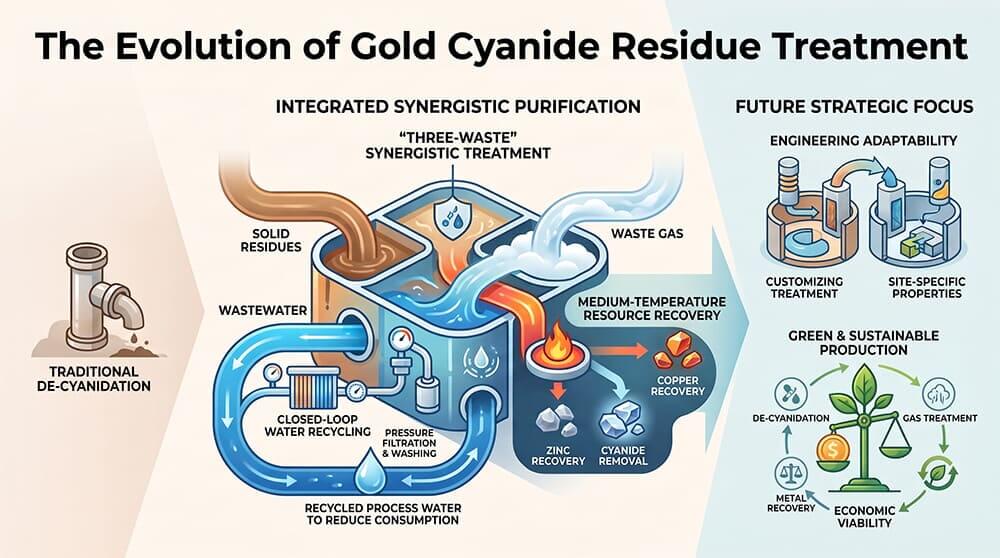
In addition, future research should focus on process integration, resource recovery, and engineering adaptability. Since the composition and properties of cyanide residues vary among different gold-processing plants, treatment processes should be selected and optimized according to specific production conditions and residue characteristics. The integration of de-cyanidation with wastewater recycling, waste-gas treatment, and valuable-metal recovery is expected to become an important direction for the development of green and sustainable gold production.
Conclusions
Modern cyanide-residue treatment in gold processing is evolving from conventional cyanide destruction toward integrated, resource-oriented, and process-efficient residue management. In addition to reducing cyanide concentrations to environmentally acceptable levels, modern treatment systems increasingly aim to improve water recycling, reduce reagent and energy consumption, control multiple waste streams, and recover valuable components from cyanide residues.
The three approaches discussed in this review illustrate this development. Three-waste synergistic purification integrates the treatment of cyanide residues, wastewater, and waste gas and can reduce the demand for additional treatment reagents. Pressure filtration and washing combine efficient solid-liquid separation, cyanide removal, dewatering, and process-water recycling, while medium-temperature treatment provides an alternative pathway for cyanide removal with potential for subsequent recovery and utilization of valuable elements. However, these technologies have different technical and economic requirements and should be selected according to the specific characteristics of each gold-processing operation.
In practical applications, the selection and optimization of cyanide-residue treatment technologies should consider cyanide speciation and concentration, moisture content, mineralogical composition, water balance, energy requirements, residue characteristics, and resource-recovery potential. De-cyanidation is therefore best considered as part of an integrated residue-management system that combines solid-liquid separation, wastewater recycling, waste-gas treatment, dewatering, and valuable-metal recovery.
For gold-processing plants seeking to improve cyanide-residue management, the appropriate equipment and process configuration are equally important. A JXSC fornece equipamento de processamento de minerais e customized solutions for gold ore processing, including crushing, grinding, gravity separation, flotation, and related mineral-processing systems. By combining suitable process equipment with site-specific process design, JXSC can support gold-processing operations in developing more efficient and integrated solutions for residue treatment and resource recovery.
Future development of cyanide-residue treatment is expected to focus increasingly on process integration, closed-loop water management, resource recovery, and energy-efficient treatment. By matching treatment technologies with site-specific residue characteristics and integrating environmental control with resource utilization, gold-processing operations can reduce waste generation, improve resource efficiency, and enhance the overall environmental and economic performance of cyanide-residue management. JXSC’s mineral processing expertise and equipment solutions can provide practical support for gold-processing projects seeking to move toward more integrated and sustainable processing systems.
PRODUTOS MAIS RECENTES
-

Inclined Vibrating Screen
The inclined vibrating screen is a simple and eff…
-
High Temperature & Pressure Gold Desorption Electrolysis System
High-Temperature & Pressure Gold Desorption Elect…
-
Normal Temperature & Pressure Gold Desorption Electrolysis System
The normal temperature & pressure gold desorption…


NOTÍCIAS MAIS RECENTES
- Modern Cyanide Residue Treatment Technologies for Gold Processing
- Traditional De-cyanidation Technologies for Gold Cyanide Residues
- Shaking Table, 3-Disc Dry Magnetic & Electrostatic Separator for W-Sn-Ta-Nb
- Mineral Analysis: The Foundation for Successful Mineral Processing Projects
- What Is Over-Grinding and How Can It Be Prevented?
 English
  French
  Spanish
  Portuguese
  Indonesian