



Introdução
Lixiviação de cianetos is one of the most widely used methods for recovering gold and silver from ores. Its high extraction efficiency and adaptability to different types of gold ores have made cyanidation an important process in the gold mining and mineral processing industry. However, the process also generates large quantities of cyanide-containing residues and tailings that require appropriate treatment before long-term storage, discharge, or further utilization.
Gold cyanide residues may contain residual free cyanide, weak-acid-dissociable cyanide, relatively stable metal-cyanide complexes, and other potentially mobile contaminants. The composition and treatment characteristics of these residues depend on factors such as ore mineralogy, cyanide concentration, grinding size, leaching conditions, and solid-liquid separation efficiency.
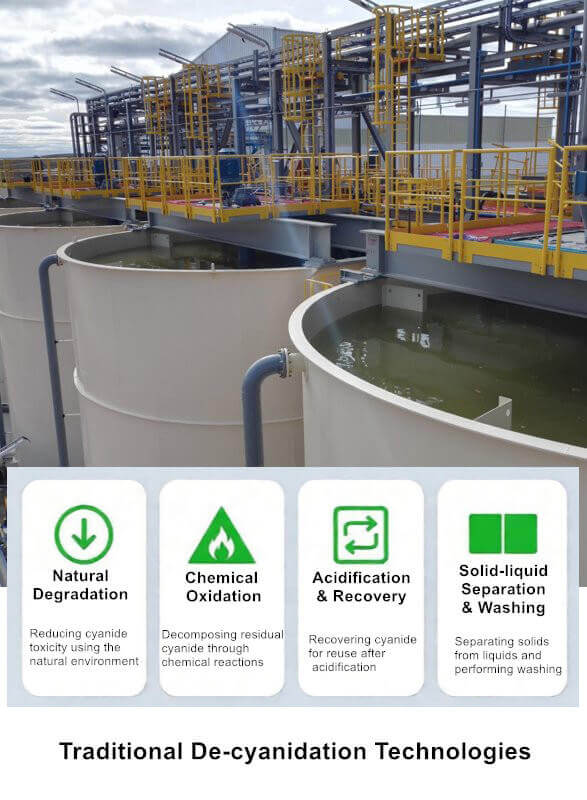
De-cyanidation refers to the reduction, destruction, removal, or recovery of cyanide from cyanide-containing residues and process streams. Over the years, several conventional technologies have been developed and applied in the gold industry. These include natural degradation, chemical oxidation, acidification and cyanide recovery, and solid-liquid separation and washing.
This article reviews these traditional de-cyanidation technologies for gold cyanide residues, focusing on their basic principles, key operating considerations, advantages, and limitations. Understanding these conventional approaches also provides a useful basis for evaluating newer treatment technologies.
For a detailed discussion of emerging and advanced treatment approaches, see our related article, [Modern Cyanide Residue Treatment Technologies].
Cyanide Residues Generated in Gold Processing
1. Sources of Cyanide Residues
Cyanide residues in the gold industry are primarily generated during cyanide leaching and subsequent solid-liquid separation.
After trituração e moagem, gold ore is contacted with a cyanide-containing leaching solution under controlled conditions. Gold and silver dissolve from the ore and form soluble cyanide complexes. Following leaching, the solid minerals are separated from the process solution, and the remaining solid material becomes cyanide-containing tailings or residues.
The characteristics of cyanide residues can vary considerably between different gold-processing operations. Important factors include ore type, mineralogical composition, particle size, cyanide concentration, leaching time, and solid-liquid separation efficiency.
As a result, residues from different processing plants may differ significantly in cyanide concentration, metal composition, particle-size distribution, and mineralogical properties. Cyanide residue treatment should therefore be selected according to the specific characteristics of the material being treated.
2. Main Components of Cyanide Residues
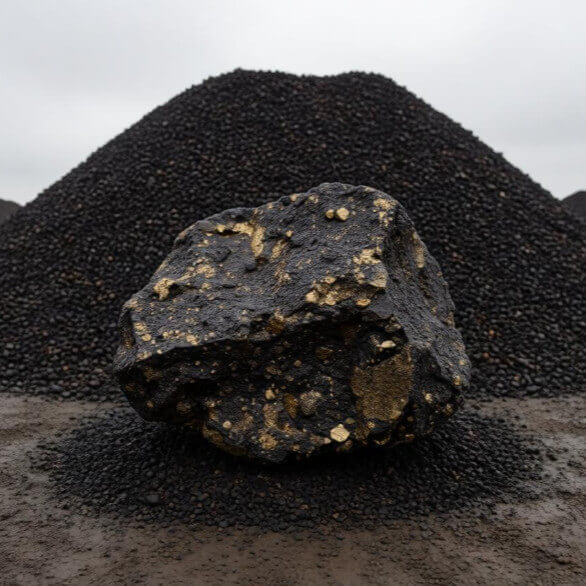
Gold cyanide residues generally consist of unreacted or partially reacted mineral particles, gangue minerals, iron-bearing minerals, and other metal-bearing minerals. Depending on the ore and processing conditions, they may also contain residual valuable metals such as ouro e prata.
During cyanidation, cyanide can react with metals such as copper, iron, zinc, and nickel to form metal-cyanide complexes with different degrees of stability.
From a treatment perspective, this is particularly important because cyanide does not occur in a single chemical form. Residues may contain free cyanide, weak-acid-dissociable cyanide, and more stable metal-cyanide complexes. These species can exhibit different chemical behaviors and responses to treatment.
Consequently, a treatment method that is effective for one form of cyanide may not provide the same removal efficiency for other cyanide species.
3. Cyanide Speciation and Environmental Risks
Cyanide species can be classified according to their chemical form and stability. Free cyanide is generally more readily available for reaction and is associated with higher acute toxicity, while some metal-cyanide complexes are more stable and less likely to release cyanide under certain short-term environmental conditions.
However, relatively stable complexes may still undergo transformation or dissociation under specific environmental conditions.
The migration and transformation of cyanide in the environment can be affected by factors such as pH, temperature, sunlight, microbial activity, oxygen availability, and mineral composition. Some cyanide species may undergo natural degradation under favorable conditions, whereas more stable metal-cyanide complexes may persist for longer periods.
In addition to cyanide, gold-processing residues may contain metals that can potentially migrate through leaching. Therefore, effective cyanide residue management should consider not only cyanide reduction but also the potential mobility of associated metals and other contaminants.
Traditional De-cyanidation Technologies
Traditional de-cyanidation technologies are generally based on several established mechanisms, including natural degradation, chemical oxidation, cyanide recovery, and physical removal through solid-liquid separation and washing.
These technologies have been used in various forms in the mining and mineral-processing industry and benefit from established operating experience. However, their effectiveness varies depending on cyanide speciation, residue characteristics, treatment objectives, and process conditions.
The main conventional approaches are discussed below.
1. Natural Degradation
Natural degradation is one of the simplest approaches to reducing residual cyanide.
When cyanide residues are exposed to suitable environmental conditions for a sufficient period, cyanide concentrations may gradually decrease through processes such as volatilization, photochemical reactions, oxidation, and microbial activity.
Natural degradation requires relatively little equipment and can have low operating costs. It may therefore be used as an auxiliary treatment mechanism in certain tailings-storage and residue-management systems.
However, its effectiveness depends strongly on environmental conditions, including temperature, sunlight, pH, moisture, air movement, and cyanide speciation.
The process can also require a relatively long treatment period, while stable metal-cyanide complexes may degrade much more slowly than readily available cyanide species.
Therefore, natural degradation is generally more suitable as a supporting measure than as a stand-alone technology when a specific and reliable de-cyanidation target must be achieved within a defined timeframe.
2. Chemical Oxidation
Chemical oxidation is one of the most widely used approaches for cyanide destruction.
The basic principle is to oxidize cyanide-containing species and convert them into less toxic or more readily manageable compounds. The choice of oxidant depends on cyanide concentration, cyanide speciation, residue composition, required treatment performance, and operating conditions.
Common oxidizing agents include hypochlorites, hydrogen peroxide, ozone, and permanganates. The SO₂/air process is another established oxidation-based cyanide treatment approach used in the mining industry.
Hypochlorite Oxidation
Hypochlorite oxidation is relatively simple to operate and can provide rapid reactions with readily oxidizable cyanide species.
However, oxidant dosage and reaction conditions must be carefully controlled. Excessive reagent addition can increase chemical consumption and may promote unwanted side reactions or the formation of secondary contaminants.
Hydrogen Peroxide Oxidation
Hydrogen peroxide is a strong oxidizing agent that can promote cyanide oxidation under appropriate conditions.
One potential advantage is that hydrogen peroxide decomposes into water and oxygen. However, treatment performance depends on factors such as cyanide concentration, pH, reaction time, catalyst availability, and the composition of the residue.
Ozone Oxidation
Ozone has strong oxidation capacity and can provide relatively rapid reactions with certain cyanide species.
Because ozone decomposes after use, it can offer certain environmental advantages. However, ozone must generally be generated on site, requiring electrical energy and specialized equipment.
Capital investment, energy consumption, and operating costs should therefore be considered when evaluating ozone oxidation for large-scale applications.
SO₂/Air Process
The SO₂/air process is another established cyanide destruction technology used in the mining industry.
It uses sulfur dioxide, air, and controlled reaction conditions to promote the oxidation of cyanide. Depending on residue characteristics and treatment requirements, the process can be incorporated into gold-processing and cyanide detoxification circuits.
3. Acidification and Cyanide Recovery
Acidification and cyanide recovery are based on the chemical equilibrium of cyanide species under different pH conditions.
Under carefully controlled conditions, cyanide can be converted into hydrogen cyanide and separated from the process stream. The hydrogen cyanide-containing gas can then be captured through an appropriate absorption or recovery system.
Unlike destruction-based technologies, cyanide recovery provides the potential to recover cyanide for subsequent reuse.
However, the formation of hydrogen cyanide presents a significant safety concern. Hydrogen cyanide is highly toxic, so acidification and recovery systems require strict containment and process controls.
Important considerations include:
- Accurate pH control
- Closed or contained process systems
- Hydrogen cyanide monitoring
- Effective gas absorption
- Temperature control
- Equipment integrity
- Appropriate emergency and safety systems
For these reasons, acidification and cyanide recovery require careful engineering design and rigorous operational management.
4. Solid-Liquid Separation and Washing
Solid-liquid separation and washing are important physical approaches for reducing soluble cyanide in gold cyanide residues.
Following cyanide leaching, a portion of the residual cyanide may remain in the liquid associated with the solid tailings. Improving solid-liquid separation and washing the residue with fresh or recycled water can transfer soluble cyanide and other dissolved species from the solid phase into the liquid phase.
The liquid can then be returned to the process circuit or subjected to further treatment.
Factors Affecting Washing Efficiency
The effectiveness of washing depends on several factors, including:
- Number of washing stages
- Liquid-to-solid ratio
- Washing-water quality
- Tamanho das partículas
- Contact time
- Solid-liquid separation efficiency
- Water-recycling strategy
Multiple washing stages can improve the removal of soluble cyanide. However, if recycled washing water contains high cyanide concentrations, cyanide may accumulate within the process circuit and reduce the overall washing efficiency.
Therefore, water balance and cyanide loading should be considered when designing an integrated washing and cyanide residue treatment system.
Conclusão
Traditional de-cyanidation technologies provide several established approaches for reducing, removing, destroying, or recovering cyanide from gold-processing residues. Natural degradation, chemical oxidation, acidification and cyanide recovery, and solid-liquid separation and washing each operate through different mechanisms and have distinct advantages and limitations.
The effectiveness of a treatment process depends not only on the selected technology but also on cyanide speciation, cyanide concentration, residue mineralogy, associated metals, particle size, moisture content, and operating conditions. Therefore, cyanide residue treatment should be based on detailed residue characterization and clearly defined treatment objectives.
In practical gold-processing operations, individual technologies may be applied separately or combined into multi-stage treatment systems. Effective solid-liquid separation, process-water management, and cyanide monitoring can further contribute to overall treatment performance.
For a detailed discussion of newer approaches to cyanide residue treatment, including advanced methods for improving treatment efficiency and resource utilization, see [Modern Cyanide Residue Treatment Technologies].
PRODUTOS MAIS RECENTES
-

Inclined Vibrating Screen
The inclined vibrating screen is a simple and eff…
-
High Temperature & Pressure Gold Desorption Electrolysis System
High-Temperature & Pressure Gold Desorption Elect…
-
Normal Temperature & Pressure Gold Desorption Electrolysis System
The normal temperature & pressure gold desorption…


NOTÍCIAS MAIS RECENTES
- Traditional De-cyanidation Technologies for Gold Cyanide Residues
- Shaking Table, 3-Disc Dry Magnetic & Electrostatic Separator for W-Sn-Ta-Nb
- Mineral Analysis: The Foundation for Successful Mineral Processing Projects
- What Is Over-Grinding and How Can It Be Prevented?
- Fluorspar vs Graphite vs Quartz: Non-Metal Minerals Beneficiation Differences
 English
  French
  Spanish
  Portuguese
  Indonesian