



Powder Grinding Mill Introduction
Powder grinding mills are essential industrial equipment designed to transform raw materials into fine powders for various applications across multiple sectors. These versatile machines play a crucial role in processing materials such as ores, minerals, and other bulk substances by reducing them to smaller, more manageable particle sizes suitable for industrial use.
Key Industries Relying on Powder Grinding:
- Metalurgia
- Building materials manufacturing
- Chemical processing
- Mining operations
- Pharmaceutical production
- Food processing
How Powder Grinding Mills Work: The Science Behind the Process
After the material is crushed to the required particle size, the material is sent to the storage hopper by elevator, and the material is uniformly and continuously fed into the main grinding chamber of the Moinho Raymond by the vibrating feeder. The grinding roller swings outward due to the centrifugal force during rotation; it is pressed tightly on the grinding ring, the shovel blade scoops up the material to be sent between the grinding roller and the grinding ring, and the grinding roller is rolled to achieve the purpose of crushing. The fine powder after material grinding is brought into the analyzer with the circulating air of the blower for sorting. The coarse material falls back to regrind, and the qualified fine powder enters the finished cyclone powder collector with the airflow and is discharged through the powder outlet pipe. That is the finished product. In the Raymond mill room, there is a certain amount of moisture in the material to be ground, which generates heat during grinding; vapor evaporates, and the pipeline connections of the whole machine are not tight, and external air is sucked in, which increases the circulating air pressure to ensure that the mill is under negative pressure. Working in this state, the increased airflow is discharged into the dust collector through the residual air pipe and then discharged into the atmosphere after being purified.
Composição do moinho de pó
The powder grinding mill is composed of a host, a classifier, a blower, a finished cyclone separator, a pipeline device, and a motor. The main host machine is composed of a frame, an air inlet volute, a blade, a grinding roller, a grinding ring, a cover, and a motor.
Core Components
- Main Assembly: Housing frame, grinding elements, and structural supports
- Power Transmission: Sealed gearbox and pulley systems for reliable operation
- Material Processing Elements: Precision grinding rollers and rings
- Control Systems: Centralized electrical controls and automation features
Auxiliary Equipment
- Pre-processing units: Britadeiras de maxilas for initial size reduction
- Material handling: Bucket elevators and alimentadores vibratórios
- Dust collection: Cyclone separators and bag filters
- Control systems: Integrated electrical control panels
Características do moinho de pó
- Estrutura tridimensional, área pequena, conjunto completo forte, sistema de produção independente desde o material em bloco até ao pó acabado.
- A finura do pó acabado é uniforme, e a taxa de peneiração é 99%, o que é difícil para outros equipamentos de moagem.
- O dispositivo de transmissão da máquina adopta uma caixa de velocidades fechada e uma polia, que é estável na transmissão e fiável no funcionamento.
- The important parts are made of high-quality steel, and the wear parts are made of high-performance wear-resistant materials, and the whole machine has high wear resistance and is operationally reliable.
- The electrical system adopts centralized control; the grinding workshop can basically realize unmanned operation, and the maintenance is convenient.
Tipos de moinhos de pó
De acordo com a finura do material a ser moído e a finura do material descarregado, os moinhos de pó podem ser divididos em seis tipos: moinho de rolos pendulares, moinhos de suspensão de alta pressão, moinhos de micro-pó de alta pressão, moinhos centrífugos de passagem direta, moinhos trapezoidais de sobrepressão e moinhos de micro-pó. Aqui centramo-nos nos primeiros 3 tipos de moinhos de pó.
Moinho de rolos pendulares
O moinho de rolos pendulares POITTEMILL é um moinho vertical que funciona através da compressão do leito do material. Os pêndulos montados numa roda em estrela são accionados por um eixo vertical. Cada pêndulo está equipado com um rolo de moagem que gira sobre o seu eixo. A rotação da roda em estrela combina-se com a articulação do pêndulo para gerar uma força centrífuga ao nível do rolo de moagem.
It is mainly used to make powder (80-400 mesh), which includes an elevator, hopper, feeder, mill, classifier, reducer, blower, cyclone collector, pipes, etc. This kind of roller mill is mainly used to grind non-metallic minerals with Mohs hardness less than 7, such as calcium carbonate, talc, calcite, dolomite, marble, gypsum, barite, clay, kaolin, quick lime, and so on.
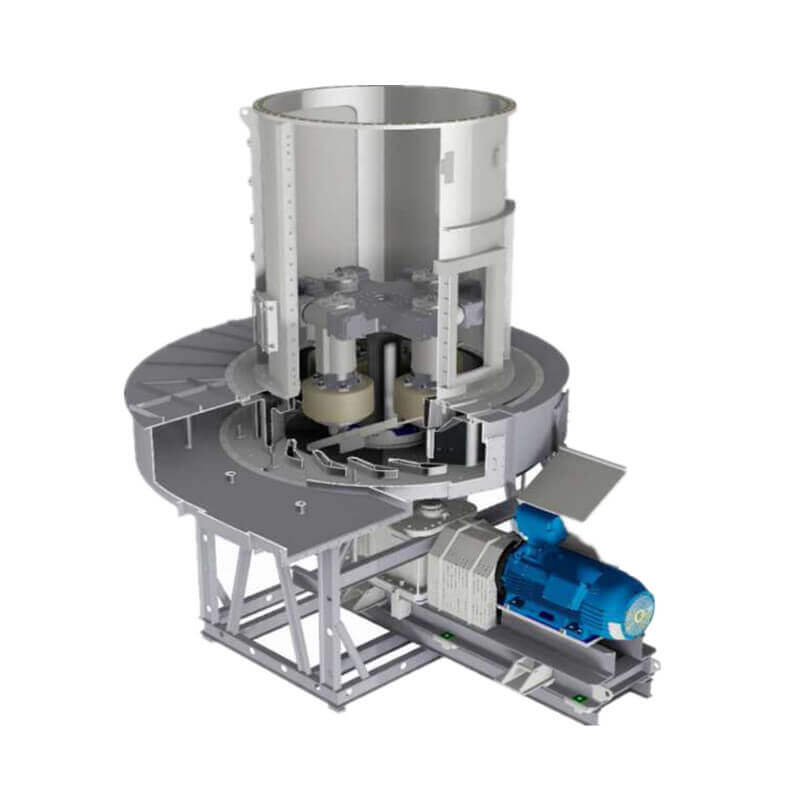
Wtrabalho Pprincípio
The material is conveyed to the hopper by the elevator, and the feeder moves the material into the mill house continuously. The material is ground between the roller and ring. The qualified powder goes into the cyclone collector through the classifier with the help of a fan. The air current of the whole system is a closed loop, and flow circulation occurs under positive and negative pressure conditions.
Advantagens
- Low vibration with the help of high-quality and reliable casting.
- Higher grindability with the bigger roller and ring
- Desempenho fiável e suave
- Classificador de turbina para um controlo preciso da finura
- Maior potência e menor consumo de energia
Moinhos de Suspensão de Alta Pressão
The high-pressure suspension grinding mill is suitable for processing various non-flammable and non-explosive mineral materials with Moh’s hardness less than 6 and humidity less than 6%. It is widely used in the fields of metallurgy, construction, the chemical industry, mining, and highway construction. The granularity of the finished powder size can be adjusted between 50 and 325 meshes (315-45 micron). Examples of processing materials include quartz, feldspar, barite, calcite carbonate, limestone, talc, ceramic, iron ore, carborundum, bauxite, rock phosphate, coal, and other materials, a total of about 400 kinds of materials.
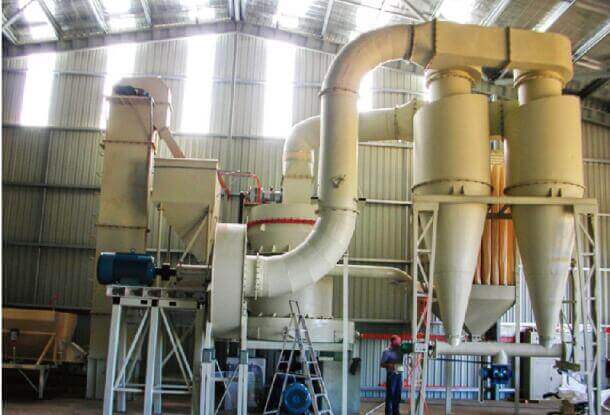
Moinho de Micro Pó de Alta Pressão
Micro Powder Mill is also called a high-pressure micro powder mill, which is a highly efficient powder grinding machine manufactured based on a high-pressure grinding mill and improving the classification technology of the fineness of the final products. This machine technically solves the difficult problem of the classification of superfine powders, thus greatly improving the classification efficiency while ensuring the grinding quality and output. The finished product granularity of the grinding machine has a wide range; the largest diameter of particles can reach 30 mesh, and the general diameter of particles is up to 0.033 millimeters (425 mesh). The finest small amount of material can reach 0.013 millimeters (1000 mu).
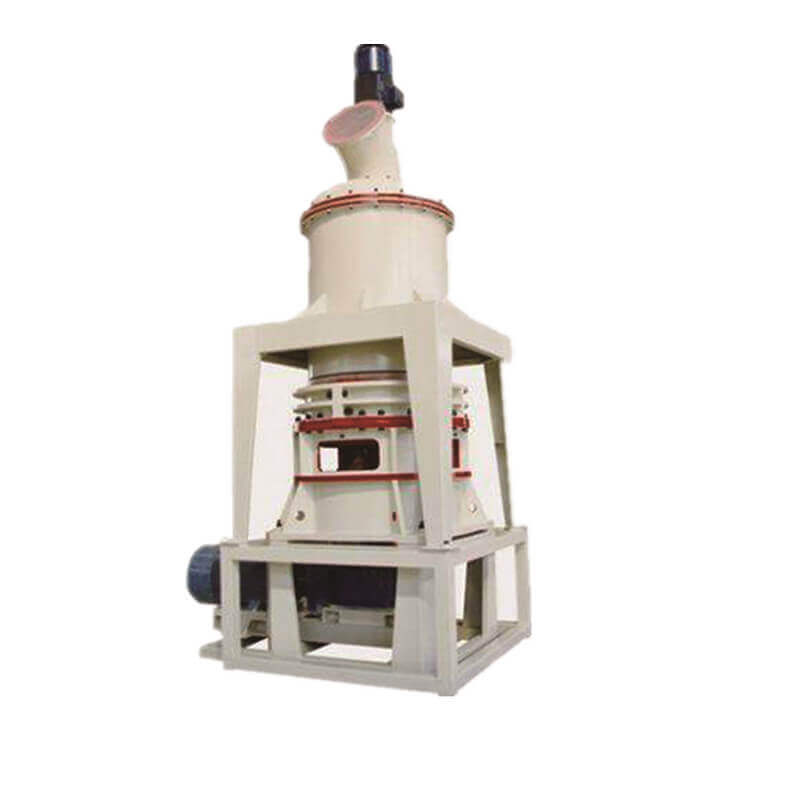
Princípio
When entering the grinding chamber, the raw materials are shoveled up by the shovels and ground between the rollers and ring; the materials after grinding are brought into the separator along with the air from the blower, and the qualified fine powder becomes final products and comes into the cyclone powder collector; the other unqualified powder falls to be re-ground. The circular air returns to the blower so that the above process will be repeated, and the remaining air enters the bag filter to protect the environment.
Característica
- Compared with other mills, its capacity increases by 10%-20% under the same power condition, and the compression force of rollers to material improves 800-1200kgf under the force of a high-pressure spring.
- O tamanho do produto final pode ser de 0,613mm (30mesh) -0,033mm (425mesh). Alguns podem atingir a finura de 0,013mm (1000 mesh).
- The machine for Limestone Powder mill/High-pressure grinder mill meets the requirements of the national dust-dump standard.
- O separador pode ser ajustado muito facilmente.
- Os selos de várias classes são adoptados para manter o equipamento de moagem bem fechado.
This guide provides a comprehensive overview of powder grinding mill technology, from basic operational principles to advanced features of different mill types. Whether you’re processing minerals for industrial applications or creating fine powders for specialized uses, understanding these grinding systems will help you select the optimal equipment for your specific requirements.
PRODUTOS MAIS RECENTES
-

Inclined Vibrating Screen
The inclined vibrating screen is a simple and eff…
-
High Temperature & Pressure Gold Desorption Electrolysis System
High-Temperature & Pressure Gold Desorption Elect…
-
Normal Temperature & Pressure Gold Desorption Electrolysis System
The normal temperature & pressure gold desorption…


NOTÍCIAS MAIS RECENTES
- Modern Cyanide Residue Treatment Technologies for Gold Processing
- Traditional De-cyanidation Technologies for Gold Cyanide Residues
- Shaking Table, 3-Disc Dry Magnetic & Electrostatic Separator for W-Sn-Ta-Nb
- Mineral Analysis: The Foundation for Successful Mineral Processing Projects
- What Is Over-Grinding and How Can It Be Prevented?
 English
  French
  Spanish
  Portuguese
  Indonesian