



Amalgamación de oro is a traditional method of extracting gold by binding it with mercury to form an amalgam, which is then heated to isolate pure gold. While historically significant, this process presents concerns due to mercury’s toxicity and environmental risks. The recovery rate—the efficiency of gold extraction via amalgamation—is influenced by multiple factors, including gold particle size, mercury quality, slurry concentration, pH levels, and temperature. Modern mining increasingly favors safer alternatives like cyanide leaching, but understanding amalgamation’s mechanics remains relevant for legacy operations and regulatory contexts.
¿Qué es la amalgamación del oro?
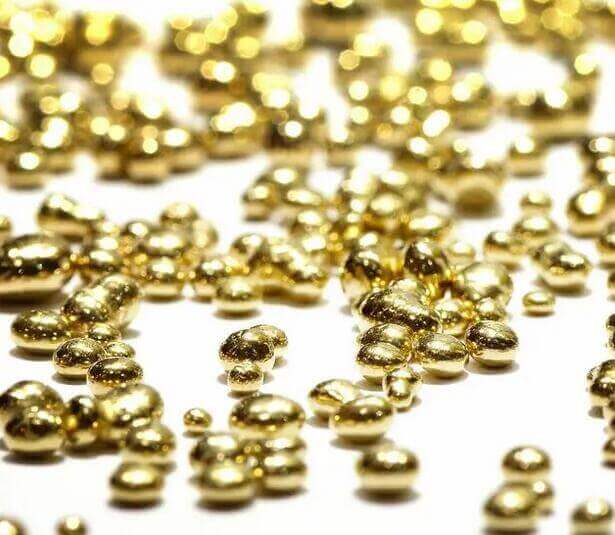
Amalgamación de oro is a method of extracting gold from its ores by mixing it with mercury. It is an ancient gold separation method. This process forms a amalgama de oro y mercurioLas partículas de oro se unen químicamente al mercurio. A continuación, la amalgama se calienta para vaporizar el mercurio y dejar el oro. Esta técnica se ha utilizado históricamente en la minería del oro, sobre todo en zonas donde el oro está finamente diseminado en el mineral y puede no ser fácilmente recuperable por otros métodos.
Tasa de recuperación de amalgama de oro
En tasa de recuperación de oro por amalgamación se refiere al porcentaje de oro que puede recuperarse con éxito mediante el proceso de amalgamación. Mide la eficacia del método de extracción de oro que consiste en utilizar mercurio para formar una amalgama de oro y mercurio.
La tasa de recuperación se calcula comparando la cantidad de oro recuperado mediante amalgamación con la cantidad total de oro presente en la mena o el concentrado. Se expresa en porcentaje y permite conocer la eficacia del proceso de amalgamación para capturar y extraer el oro de la materia prima.
Un índice de recuperación más alto indica que una mayor proporción del oro del mineral se amalgama y se recupera con éxito. Una tasa de recuperación más baja indica que una cantidad significativa de oro no se recupera o se pierde durante el proceso. Las prácticas mineras modernas pretenden maximizar las tasas de recuperación al tiempo que minimizan los riesgos para el medio ambiente y la salud asociados al uso de mercurio en la amalgamación del oro.
Factores que afectan a la tasa de recuperación de la amalgama de oro
La tasa de recuperación de oro durante la amalgamación con mercurio depende de the particle size and shape of natural gold, the color of gold particles, the quality of mercury, the mercury amalgamation temperature, the slurry concentration, the mercury amalgamation method, and equipment factors, etc.
1. Gold Particle Size and Shape
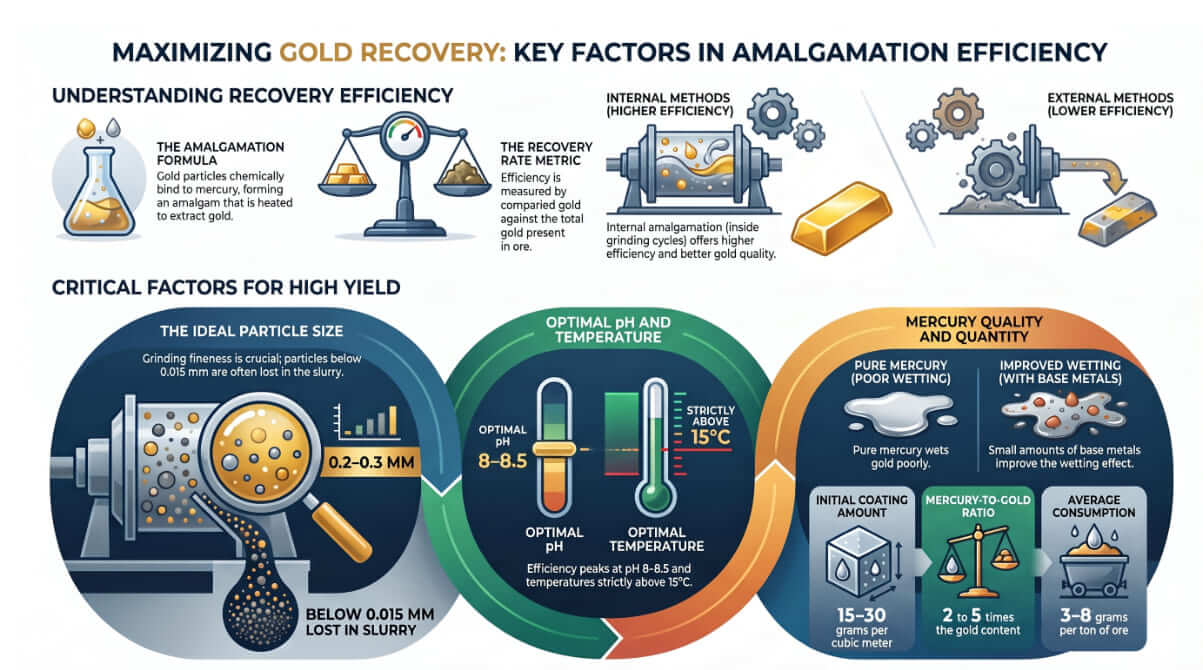
The particle size, shape, and monomer dissociation degree of gold are mainly related to the grinding operation. In particular, the degree of monomer dissociation has a more significant impact. Increasing the grinding fineness can improve the recovery rate of mercury amalgamation operations. Gold particles suitable for mercury amalgamation generally are 0.2-0.3 mm. The lower limit of the mercury amalgamation plate particle size in the grinding cycle is 0.015 mm, but the fine gold particles are lost with the slurry.
2. La finura de los granos de oro
El color del oro de aluvión es superior al del oro de veta, and the color of gold in the oxidation zone is higher than that of primary ore. Gold with a high color is prone to amalgamation with mercury. If the surface of gold particles is contaminated, their amalgamation ability will significantly reduce.
3. Método de amalgamación de mercurio
La amalgama de mercurio se divide en amalgamación interna de mercurio y amalgamación externa de mercurio. External mercury amalgamation is mixing mercury to extract gold outside the crushing chamber. External mercury amalgamation is commonly used in China with fixed and vibrating mercury amalgamation plates. Internal mercury amalgamation is performed outside the crushing chamber. During the grinding operation cycle, mercury amalgamation is used to extract gold. Gold mines in South Africa and the United States often use mercury amalgamation in ramming machines. Small and medium-sized gold mines in the Soviet Union often use disc rollers. In China, mercury amalgamation cylinders are often used. The efficiency of internal mercury amalgamation is higher than that of external mercury amalgamation, and the quality of mercury gold is good. The concentration of external amalgamated mercury slurry should not be too high to form a loose, thin slurry flow, and the flow rate should not be too high to allow gold particles to settle onto the mercury plate. The concentration of internal mercury slurry should be 30-50%, and the mercury should be suspended.
4. pH de los purines
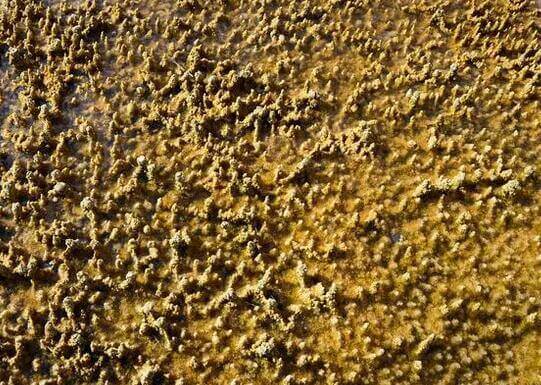
El pH del lodo influye mucho en el efecto de amalgamación del mercurio. El efecto de amalgamación del mercurio es bueno en medios ácidos y soluciones de cianuro, pero cuando hay mucho limo, el medio ácido no puede aglomerar el limo, y éste contamina la superficie de las partículas de oro, afectando al efecto de amalgamación del mercurio. Cuando el mercurio se mezcla en un medio alcalino, como el uso de cal como regulador para precipitar las sales solubles y eliminar los efectos adversos de la calidad del aceite, el impacto de la mezcla de mercurio es mejor cuando PH=8-8,5.
5. Masa de mercurio
La calidad del mercurio influye mucho en el efecto de la amalgamación con mercurio. El mercurio puro no es bueno para humedecer el oro. El mercurio que contiene una pequeña cantidad de oro, plata y metales comunes puede reducir la tensión superficial del mercurio y mejorar el efecto humectante. El aceite de motor, otras materias orgánicas y el lodo fino contaminarán la superficie de las partículas de oro. El mineral sulfurado, el talco, el grafito y el arseniuro del mineral se adhieren fácilmente a la superficie del mercurio, lo que también afecta a la capacidad de humectación del mercurio en el oro.
When mixing mercury, add an appropriate amount of mercury. Too much will reduce the elasticity and consistency of the mercury paste, causing the amalgam to be lost with the slurry. Insufficient addition of mercury makes the mercury paste hard and loses its elasticity, reducing its gold-capturing performance. After the mercury board is put into production, the initial mercury coating amount is 15-30 grams/cubic meter, and mercury is added after 6-12 hours. The amount of mercury added is 2-5 times the gold content of the ore, and the consumption of mercury is usually 3-8 g/ton of ore.
6. Temperatura de amalgamación
In addition, temperature also affects the effect of mercury amalgamation. If the temperature is too low, it will increase the viscosity of mercury and affect the mercury amalgamation effect. If the temperature is too high, it will increase the fluidity of mercury, causing some of it to be lost. Therefore, the mercury amalgamation index is prone to seasonal changes. The mercury amalgamation temperature should generally be greater than 15 degrees. Adding mercury and adjusting the slurry concentration are used to eliminate the influence of temperature.
Conclusion: Balancing Efficiency and Sustainability
While amalgamation can achieve high recovery rates under optimal conditions, its reliance on toxic mercury demands caution. Modern alternatives such as cyanide leaching and gravity separation now dominate the industry, prioritizing environmental and worker safety. For operations still employing amalgamation, meticulous control of the above factors—particle size, gold purity, method selection, slurry chemistry, mercury quality, and temperature—is essential to maximize yields and minimize harm.
ÚLTIMOS PRODUCTOS
-

SFM-8 Lab Grinder
【Max. Power Consumption】 150W 【Morta…
-
Cyclosizer
【Feeding Capacity】< 100g/time 【Feeding …
-
JKZ/2JKZ Mine Shaft Sinking Hoist
【Power Source】Electric Motor Drive 【Motor Spee…


 English
  French
  Spanish
  Portuguese
  Indonesian