



Introducción
Deposit genesis refers to the origins and processes by which mineral deposits are formed. Understanding how these deposits develop is crucial for geological exploration, resource extraction, and economic viability. Deposits are typically classified based on their formation processes and geological environments. This article explores four fundamental types of deposit genesis: Endogenic (formed deep within the Earth), Exogenic (shaped by surface processes), Metamorphic (resulting from rock alteration under heat and pressure), and Superimposed (modified by later geological events).
1. Endogenic Deposits (Internal Processes)
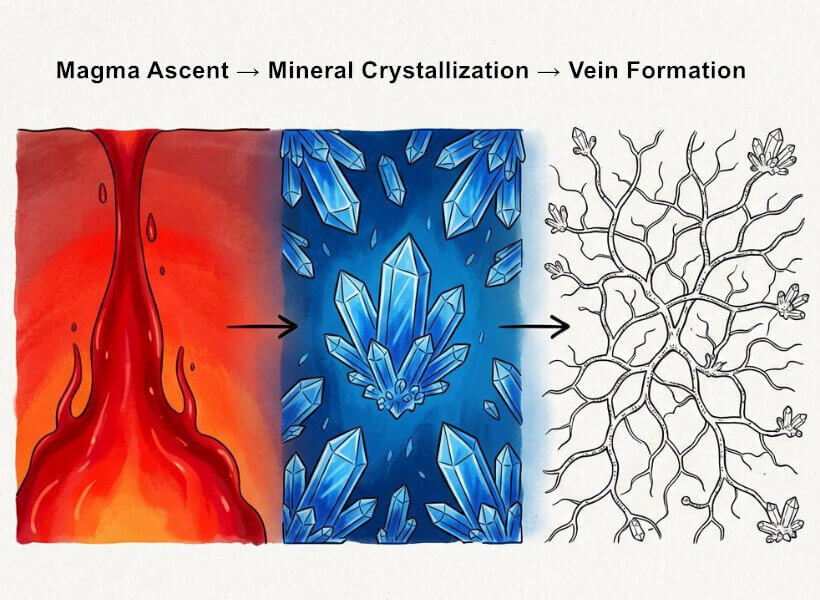
Endogenic deposits originate from internal geological processes, typically associated with magma and hydrothermal activity. These deposits form deep within the Earth’s crust or mantle and are often linked to igneous activity.
Formation Process: Magmatic segregation, hydrothermal fluids, or volcanic exhalation.
Types: Common varieties include magmatic, porphyry-associated, metasomatic, and volcanic-associated massive sulphide (VAMS).
Key Features: High-temperature conditions, association with intrusive rocks, and often valuable metals like gold, copper, and platinum.
Examples: Porphyry copper deposits, pegmatite-hosted lithium, and diamond-bearing kimberlite pipes.
Major Types of Endogenous Deposits
(1) Magmatic Deposits
A magmatic deposit refers to a deposit formed when, during the crystallization and fractionation of magma, changes in physicochemical conditions cause certain useful minerals to crystallize or concentrate prematurely.
Formation: Crystallization and segregation of minerals from magma.
Subtypes:
- Layered Mafic Intrusions (e.g., Bushveld Complex, South Africa—platinum, chromium).
- Podiform Chromite (e.g., Kazakhstan chromite deposits).
Key Feature: Directly derived from molten magma; often host Ni, Cu, PGEs.
(2)Volcanogenic Deposits
Formation: Associated with submarine or subaerial volcanic activity.
Subtypes:
- VMS (Volcanogenic Massive Sulfide): Kuroko-type deposits (Japan—Cu, Zn, Pb).
- Epithermal Au-Ag: Sleeper Deposit (USA)—formed from hot springs near volcanoes.
Key Feature: Stratabound sulfide lenses or vein systems.
(3) Intrusion-Related Hydrothermal Deposits
Formation: Metal-rich fluids expelled from cooling plutons.
Subtypes:
- Porphyry Deposits: Chuquicamata (Chile)—low-grade, large-scale Cu-Mo-Au.
- Skarn Deposits: Daye Iron Skarn (China)—Fe-Cu minerals at limestone-granite contacts.
Key Feature: Hydrothermal alteration halos (e.g., potassic, phyllic zones).
2. Exogenic Deposits (Surface Processes)
Exogenic deposits result from surface processes such as weathering, sedimentation, and precipitation. These deposits are concentrated near the Earth’s surface due to erosion and deposition.
- Formation Process: Physical or chemical weathering, mechanical concentration (e.g., placer deposits), or sedimentary precipitation (e.g., evaporites).
- Examples: Alluvial gold deposits, banded iron formations (BIFs), and salt flats.
- Key Features: Layer stratification, association with sedimentary rocks, and economically significant for iron, aluminum, and rare earth elements.
Major Types of Exogenic Deposits
(1) Weathering Deposits
Weathering deposits are ore deposits formed through the residual accumulation or enrichment of valuable minerals resulting from the weathering of rocks at the Earth’s surface.
| Tipo | Genesis | Typical Deposits |
| Lateritic nickel deposit | Leaching and enrichment of nickel following the weathering of ultrabasic rocks | Lateritic nickel deposits in Indonesia and the Philippines |
| Weathering crust rare earth deposit | Enrichment of ion-adsorption type rare earth elements in the weathering crust | South China |
Example of lateritic nickel deposits:
- The world’s largest type of nickel deposit; approximately 60% of nickel production comes from laterite ores.
- Indonesian nickel belt: Grade of 1%–2%; reserves exceed 1 billion tonnes.
- Mining method: Open-pit mining; acid leaching process.
(2) Sedimentary Deposits
Sedimentary deposits are ore deposits formed through sedimentation and enrichment within surface water bodies.
| Deposit Type | Características | Key Examples |
| Placer Deposit | Mechanical deposition of heavy minerals (Au, Sn, Ti, Zr). | Sukhoi Log (Russia), Alaska Gold Mines (USA) |
| Chemical Sedimentary | Bedded/stratiform, banded hematite-magnetite, 25%-35% grade. | Anshan-style metamorphic iron ore (China) |
| Marine Sedimentary | Carboniferous-Permian strata, Al/Si ratio 6-8, mainly diaspore. | Youjiang Bauxite, Guangxi (China) |
3. Metamorphic Deposits
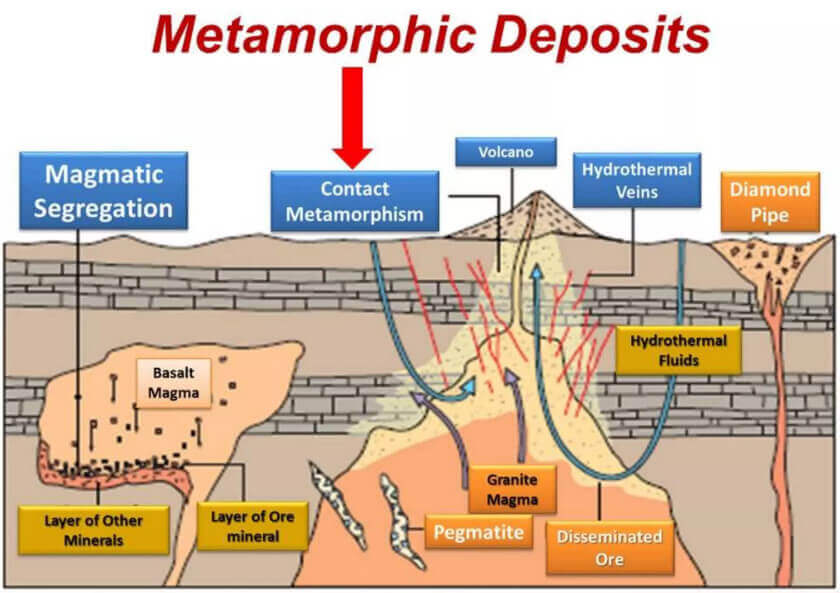
Metamorphic deposits form when pre-existing rocks undergo mineralogical and textural changes due to heat and pressure. These deposits are commonly found in orogenic belts (mountain-building regions).
- Formation Process: Recrystallization, metasomatism (chemical alteration), or remobilization of metals into new structures.
- Examples: Skarn deposits (formed at contact zones between igneous and carbonate rocks), graphite deposits in schist.
- Key Features: Variable mineralogy, often associated with hydrothermal activity, and host to gold, tungsten, and other critical minerals.

4. Superimposed Deposits
Superimposed deposits are older mineral accumulations that have been modified by later geological events, altering their original characteristics.
- Formation Process: Overprinting by metamorphism, secondary enrichment, or tectonic reworking.
- Examples: Lateritic nickel deposits (formed from ultramafic rocks via weathering) or oxidized copper deposits (secondary enrichment zones).
- Key Features: Complex geological history, economic potential influenced by multiple geological events, and often requiring advanced exploration techniques.
Comparison Summary
| Característica | Endogenic | Exogenic | Metamorphic | Superimposed |
| Primary Energy Source | Internal heat (radioactive decay) | External energy (Solar/Gravity) | Internal heat and tectonic pressure | Polygenetic: Combines endo-/exogenic or metamorphic processes |
| Location of Formation | Deep within the crust | On the Earth’s surface | Deep within the crust | Variable: Often shallow crust reworking deeper precursors |
| Typical Examples | Magmatic sulfides | Placer gold, Bauxite | Graphite, Garnet | Carlin-type Au (hydrothermal + sedimentary), IOCG (magmatic + metamorphic) |
| Key Drivers | Magma cooling, Hydrothermal fluids | Weathering, Erosion, Deposition | Heat, Pressure, Fluid activity | Overprinting: Later fluids/heat modify pre-existing mineralization |
Spatio-temporal Distribution Patterns of Mineral Deposits
Precambrian (>540 million years ago)
Major deposits
- Banded Iron Formations (BIF): e.g., Hamersley Basin, Australia (2.5 billion years ago)
- Paleogranite-type uranium-gold deposits: Witwatersrand Basin, South Africa (2.8 billion years ago)
- Greenstone belt gold deposits: Abitibi Belt, Canada (2.7 billion years ago)
Controlling factors
- Anoxic atmospheric conditions promote iron precipitation
- Intense volcanic activity supplies ore-forming minerals
- The absence of terrestrial vegetation leads to unique weathering patterns
Paleozoic Era (540–250 million years ago)
Major Deposits
- Mississippi Valley Type (MVT) lead-zinc deposits: Central North America (300–200 million years ago)
- Volcanogenic Massive Sulfides (VMS): Pyrite Belt of Spain and Portugal
- Orogenic gold deposits: Tianshan Mineralization Belt, Central Asia
Controlling Factors
- Mineralization triggered by continental convergence and collision
- The Phanerozoic biological explosion altered the mineralization environment
Mesozoic–Cenozoic Era (<250 million years ago)
Typical Deposits
- Porphyry copper deposits: Andes Mountains (Cenozoic)
- Karim-type gold deposits: Western United States (Mesozoic)
- Limonite-type nickel deposits: New Caledonia (Cenozoic)
Controlling Factors
- Pacific plate subduction drives circum-Pacific mineralization
- Uplift of the Tibetan Plateau forms collision-type deposits
Conclusion & Practical Applications with JXSC Machinery
Understanding the genesis of mineral deposits is crucial not only for geological exploration but also for optimizing mining operations and resource extraction. From deep-seated endogenic deposits to surface-driven exogenic accumulations, each deposit type influences the selection of mining methods, processing techniques, and equipment. Metamorphic and superimposed deposits further highlight how geological complexity requires tailored approaches in mineral recovery.
JXSC Machinery provides advanced mining and processing solutions tailored to different deposit types:
- For Endogenic Deposits (e.g., porphyry copper, magmatic nickel): Alta eficiencia crushing and grinding machines ensure fine liberation of deeply embedded minerals.
- For Exogenic Deposits (e.g., placer gold, bauxite): Modular trommel scrubbers and gold centrifugal concentrators maximize recovery from weathered and sedimentary ores.
- For Metamorphic Deposits (e.g., skarn-type tungsten): Density separation (jiggers, shaking tables) effectively processes altered and recrystallized ores.
- For Superimposed Deposits (e.g., oxidized copper): Lixiviación en pilas or flotation plants adapt to secondary enrichment zones.
By integrating deposit genesis knowledge with JXSC’s customizable mineral processing solutions, mining operations can enhance efficiency, reduce waste, and improve economic returns. As exploration technology evolves, combining geological expertise with innovative machinery ensures sustainable and profitable mining—bridging the Earth’s hidden wealth with modern industrial demands.
ÚLTIMOS PRODUCTOS
-

Inclined Vibrating Screen
The inclined vibrating screen is a simple and eff…
-
High Temperature & Pressure Gold Desorption Electrolysis System
High-Temperature & Pressure Gold Desorption Elect…
-
Normal Temperature & Pressure Gold Desorption Electrolysis System
The normal temperature & pressure gold desorption…


ÚLTIMAS NOTICIAS
- Modern Cyanide Residue Treatment Technologies for Gold Processing
- Traditional De-cyanidation Technologies for Gold Cyanide Residues
- Shaking Table, 3-Disc Dry Magnetic & Electrostatic Separator for W-Sn-Ta-Nb
- Mineral Analysis: The Foundation for Successful Mineral Processing Projects
- What Is Over-Grinding and How Can It Be Prevented?
 English
  French
  Spanish
  Portuguese
  Indonesian