



Introducción
Ball mill parameter selection is crucial for achieving optimal grinding efficiency and production capacity in mineral processing operations. This comprehensive guide explores key calculations for determining mill capacity, power consumption, rotational speed, and steel ball loading—all essential factors that influence operational performance. By understanding these parameters and their interdependencies, engineers can optimize grinding processes to enhance productivity while minimizing energy costs. The following sections provide detailed methodologies and reference tables for practical implementation.
1. Calculation of Ball Mill Capacity
The production capacity of the ball mill is determined by the amount of material required to be ground, and it must have a certain margin when designing and selecting. There are many factors affecting the production capacity of the molino de bolas, in addition to the nature of the material (grain size, hardness, density, temperature and humidity), the degree of grinding (product size), the uniformity of the feeding material, the portion of loadedy the mill structure (the mill barrel length, diameter ratio, the number of bins, the shape of the partition plate and the lining plate).
Es difícil determinar teóricamente la productividad del molino. Por lo general, la capacidad de producción del molino se calcula a partir del mineral en polvo recién generado de menos de 0,074 mm (-200 mallas).
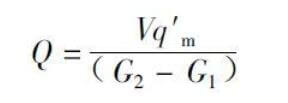
V - Volumen efectivo del molino de bolas, m3;
G2 - El material inferior a 0,074 mm en el producto representa el porcentaje del material total, %;
G1 - El material inferior a 0,074 mm en la alimentación de mineral representa 0,074 mm en el porcentaje del material total, %;
q'm - Productividad unitaria calculada según el grado de nueva generación (0,074mm), t/(m3.h).
Los valores de q'm se determinan mediante experimentos o se calibran en producción con propiedades físicas del mineral similares y los mismos equipos y condiciones de trabajo. Cuando no se dispone de datos de ensayo y valor de calibración en producción, puede calcularse mediante la fórmula (1-3).

Di1- Diámetro estándar del molino, m;
K’4 — feed size and product size coefficient of the mill.

G3 G4 — The production capacity of existing or experimental mills with newly designed parameters (feed size or product size calculated according to the new generation 0.074mm level) is shown in Table 1-6.
The values of G1 and G2 above should be calculated according to actual data. If there is no actual data, they can be selected according to Tables 1-7 and 1-8.
Tabla 1-4 Coeficiente de dificultad de molienda del mineral (K'1)
| Dureza del mineral | Dificultad de molienda del mineral Coeficiente (K'1) |
Dureza del mineral | Dificultad de molienda del mineral Coeficiente (K'1) |
||
| Protodyakonov coeficiente |
Nivel de dureza | Protodyakonov coeficiente |
Nivel de dureza | ||
| <2 | muy suave | 1.4-2.0 | 8-10 | duro | 0.75-0.85 |
| 2-4 | suave | 1.25-1.5 | >10 | muy duro | 0.5-0.7 |
| 4-8 | medio | 1.0 | |||
Tabla 1-5 Coeficiente de corrección del molino (K'2)
| Tipo de molino | Molino de bolas de parrilla | Molino de bolas de desbordamiento | Molino de barras |
| K'2 | 1.0 | 0.9 | 0.85 |
Cuadro 1-6 Capacidad de producción relativa del tamaño del pienso y del tamaño del producto (G3 o G4)
| Tamaño de la alimentación /mm |
Product Size/mm | |||||
| 0.4 | 0.3 | 0.2 | 0.15 | 0.10 | 0.074 | |
| Contenido de -0,074 mm (%) | ||||||
| 40 | 48 | 60 | 72 | 85 | 95 | |
| 40-0 | 0.77 | 0.81 | 0.83 | 0.81 | 0.80 | 0.78 |
| Tamaño de la alimentación /mm |
Product Size/mm | |||||
| 0.4 | 0.3 | 0.2 | 0.15 | 0.10 | 0.074 | |
| Contenido de -0,074 mm (%) | ||||||
| 40 | 48 | 60 | 72 | 85 | 95 | |
| 0.77 | 0.81 | 0.83 | 0.81 | 0.80 | 0.78 | |
| 20-0 | 0.89 | 0.92 | 0.92 | 0.88 | 0.86 | 0.82 |
| 10-0 | 1.02 | 1.03 | 1.00 | 0.93 | 0.90 | 0.85 |
| 5-0 | 1.15 | 1.13 | 1.05 | 0.95 | 0.91 | 0.85 |
| 3-0 | 1.19 | 1.16 | 1.06 | 0.95 | 0.91 | 0.85 |
Cuadro 1-7 Granulometría de los productos triturados y valor G1 del contenido de grado 0,074 mm
| Viscosidad del mineral triturado | 40-0 | 20-0 | 10-0 | 5-0 | 3-0 | |
| Grado 0,074 mm contenido G1 (%) |
Mineral refractario | 2 | 5 | 8 | 10 | 15 |
| Mineral refractario medio | 3 | 6 | 10 | 15 | 23 | |
| mineral de fácil trituración | 5 | 8 | 15 | 20 | 25 | |
2. Cálculo de la potencia, velocidad y carga media del molino de bolas
2.1 Cálculo de la potencia

G' - la cantidad de medio y material de carga, T;
Dm - diámetro interior efectivo del barril del molino, m;
K’5 — grinding medium coefficient, check table 1-9.
Tabla 1-9 Coeficiente del medio abrasivo K' 5
| Tipo de medio | Velocidad de llenado | 0.1 | 0.2 | 0.3 | 0.4 | 0.5 |
| Piedra silícea | 13.3 | 12.25 | 11.0 | 9.5 | 7.8 |
| Gran bola de acero | 11.9 | 11.0 | 9.9 | 8.5 | 7.0 |
| bola de acero pequeña | 11.5 | 10.6 | 9.5 | 8.2 | 6.8 |
When the filling rate of the grinding medium is less than 35% in a dry grinding operation, the power can be calculated by formula (1-7).

n -- velocidad del molino, r/min;
G" -- Medio de molienda total, T;
η -- Eficiencia mecánica, cuando el accionamiento central, η = 0,92-0,94; cuando el accionamiento de borde, η = 0,86-0,90.
2.2 Cálculo de la velocidad de rotación del molino de bolas
Velocidad crítica
Cuando el cilindro del molino de bolas gira, no hay deslizamiento relativo entre el medio de molienda y la pared del cilindro, y éste empieza a girar con el cilindro del molino. Esta velocidad instantánea del molino es la siguiente:
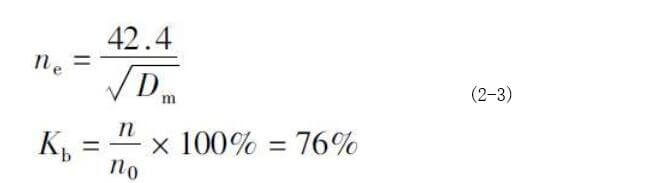
N0 -- velocidad de trabajo del molino, r/min;
K'b - relación de velocidad, %.
There are many layers of grinding media in the mill barrel. It is assumed that the media will be concentrated in one layer, called the “polycondensation layer”, so that the grinding media of this layer will be at the maximum drop, i.e., the calculating speed of the mill when the total impact energy is the largest nj.
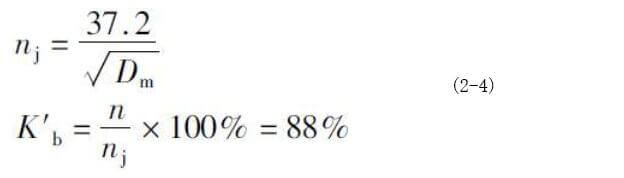
Por lo tanto, se deduce teóricamente que la velocidad de trabajo razonable es

The working speeds of various mills are shown in Table 1-10.
Tabla 1-10 Velocidades de trabajo de varios molinos
| Tipo de molino | Molino de bolas | Molino de barras | Molino tubular |
| Velocidad de trabajo n0 | (0,76-0,88)nj | (0,65-0,70)nj | (0,68-0,76)nj |
In production practice, there are many factors affecting the motion state of grinding media. Therefore, the appropriate working speed should be selected according to the actual situation. In determining the actual working speed of the mill, the influences of the mill specifications, production methods, liner forms, grinding media types, filling rate, physical and chemical properties of the ground materials, particle size of the grinding materials, and grinding fineness of the products should be taken into account. The actual working speed of the mill should be determined by scientific experiments, which can reflect the influence of these factors more comprehensively.
2.3 Quantity of Loading Medium
Capacidad de carga de bolas
The volume of the grinding medium is the percentage of the effective volume of the mill, which is called the filling rate of the grinding medium. The size of the filling directly affects the number of shocks, the area of grinding, and the load of the grinding medium in the grinding process. At the same time, it also affects the height of the grinding medium itself, the impact on the material, and the power consumption.
La capacidad de carga de bolas del molino puede calcularse según la fórmula (1-14).

Gra - Cantidad de medio de molienda, T.
Rho
s — loose density of grinding medium, t/m3.
Forged steel balls; P=s=4.5-4.8t/m3
cast steel balls P=4.3-4.6t/m3;
rolling steel balls P=6.0-6.8t/m3;
steel segments P=4.3-4.6t/m3
Filling Ratio of The Grinding Medium
When wet grinding: lattice ball mill pi = 40% – 45%; overflow ball mill phi = 40%; rod mill phi = 35%.
Dry grinding: When material is mixed between grinding media, the grinding medium expands, and when dry grinding is adopted, the material fluidity is relatively poor, and the material flow is hindered by the abrasive medium, so the filling rate is low, and the filling rate is between 28% and 35%. The pipe mill is 25%-35%. The void fraction of grinding medium_k=0.38-0.42 and the quality of crushed material accounts for about 14% of the quality of grinding medium.
Tamaño y proporción del medio de molienda
In the ball mill, the size and proportion of steel balls have a great influence on the productivity and working efficiency of the mill. For coarse and hard materials, larger steel balls should be selected; for fine and brittle materials, with smaller diameter steel balls, the impact times of steel balls in the mill increase with the decrease of ball diameter, and the grinding between balls increases. The clearance is dense with a decrease in spherical diameter. Therefore, it is better to choose the ball with a larger mass and smaller diameter (lower density) as the grinding medium. The size of the ball mainly depends on the particle size of the material to be ground, and the diameter and speed of the mill can be considered appropriately. Formula (1-15) is an empirical formula for spherical diameter and feed size.

dmax — The maximum diameter of the steel ball, mm;
amax - el tamaño máximo de la granularidad de alimentación, en mm.
After calculating the maximum steel ball diameter, the steel ball ratio in the mill can be calculated with reference to Fig. 2-1 (suitable for cement mill; other mills can refer to).
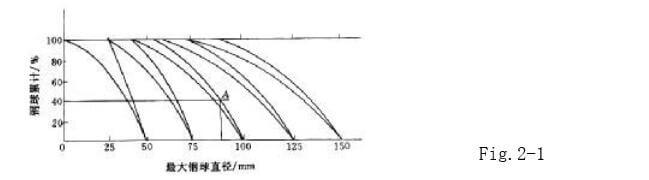
Después de elegir el diámetro máximo y el diámetro mínimo de las bolas de acero de acuerdo con los requisitos tecnológicos, las propiedades de los materiales, las especificaciones del molino y diversos parámetros, y luego hacer coincidir el grado, utilizando curvas, se puede encontrar el porcentaje acumulativo de la masa de cada una de las bolas de acero correspondientes cargadas en el molino, se puede calcular el porcentaje real de la masa, y se puede obtener la calidad de carga de las bolas de acero en todos los niveles.
According to the production practice of production enterprises, the relationship between ball diameter and material size is shown in Table 1-11.
Steel balls are gradually worn out in the process of grinding materials. The wear of a drop steel ball is related to its impact force. The wear of grinding steel balls is related to the surface area of the steel balls. In general, the steel ball in the grinder has both impact and abrasion effects, so the wear is proportional to the n power of the diameter of the steel ball, and the value of n is between 2 and 3.
Tabla 1-11 Relación entre el diámetro de la bola de acero y el tamaño del material
| Diámetro de la bola de acero db/mm |
120 | 100 | 90 | 80 | 70 | 60 | 50 | 40 |
| Tamaño de la alimentación /mm |
12-20 | 10-12 | 8-10 | 5-8 | 2.5-6 | 1.2-4 | 0.6-2 | 0.3-1 |
The quality and surface area of forged steel balls of various sizes are shown in Table 1-12.
Debido al desgaste de las bolas de acero en el proceso de producción del molino, para mantener la estabilidad del molino. Es necesario añadir bolas de acero con regularidad.
El diámetro máximo de las bolas de acero adicionales se sigue determinando por el método antes mencionado. Además de la adición de bolas de acero adicionales, deben añadirse varias bolas de acero de menor diámetro según la experiencia de producción.
Table 1-12: Quality and Surface Area of Steel Balls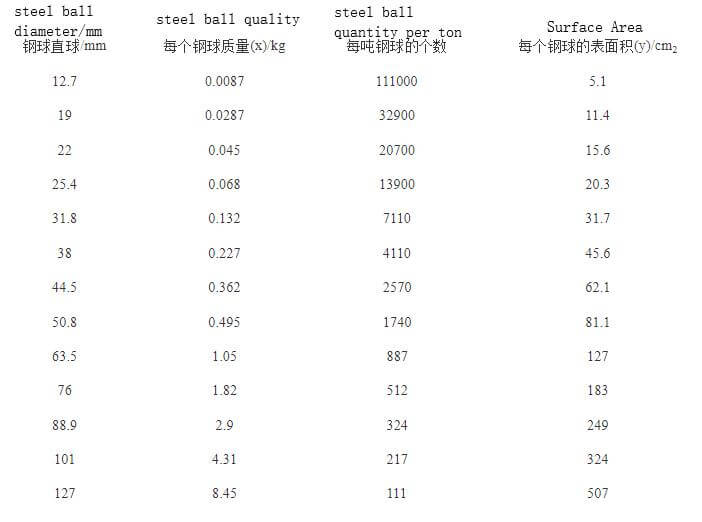
Conclusión
Proper selection of ball mill parameters requires balancing theoretical principles with practical adjustments based on material properties and operational conditions. Regular monitoring of steel ball wear, mill speed, and power draw ensures sustained efficiency. By leveraging the calculations and reference data provided in this guide, operators can tailor grinding processes to their specific needs, ultimately improving throughput and reducing operational costs. For further optimization, always validate theoretical models with real-world performance metrics and adjust parameters iteratively.
JXSC has supplied ball mill, rod mills for 40+ years. Contact us for a quotation.
Productos calientes: trituradora de mandíbulas, trituradora de impacto, trituradora de cono, molino de bolas, mesa vibratoria, separador centrífugo, jig, separador magnético, flotación, trommel de oro, depuradora trommel, planta de lavado de oro, etc.
ÚLTIMOS PRODUCTOS
-

Electric Rock Drills
【Power Source】 Electric 【Voltage】3…
-
Inclined Vibrating Screen
The inclined vibrating screen is a simple and eff…
-
High Temperature & Pressure Gold Desorption Electrolysis System
High-Temperature & Pressure Gold Desorption Elect…


ÚLTIMAS NOTICIAS
- Kanyika Niobium-Tantalum Project in Malawi: Processing Priorities
- Modern Cyanide Residue Treatment Technologies for Gold Processing
- Traditional De-cyanidation Technologies for Gold Cyanide Residues
- Shaking Table, 3-Disc Dry Magnetic & Electrostatic Separator for W-Sn-Ta-Nb
- Mineral Analysis: The Foundation for Successful Mineral Processing Projects
 English
  French
  Spanish
  Portuguese
  Indonesian