



Quartz sand is an important industrial mineral. According to different product qualities, it can be divided into ordinary, refined, high-purity, and fused quartz sand. High-purity quartz sand is currently the product with the highest demand in the quartz sand market. With its superior performance, it has become a key raw material in photovoltaics, semiconductors, and other fields. It is mainly used to produce quartz crucibles and quartz boats.
At present, there are three main production methods for quartz sand, which are deeply purified from quartz minerals (purification method), processed from natural crystals as raw materials (natural crystal processing method), y produced from silicon-containing compounds as raw materials (synthetic method). Among them, the purification method is currently the mainstream production method of quartz sand in China. To produce high-purity quartz sand through this method, high-purity quartz sand raw ore is required as raw material. The synthesis method is an emerging method for preparing high-purity quartz sand in China. It refers to the quartz sand products produced from silicon-containing compounds such as sodium silicate and aluminum silicate as raw materials through mixing, heating, crystallization, crushing, washing, drying, etc, collectively called arena de cuarzo sintético o arena de cuarzo artificial. Synthetic quartz sand has the ventajas of high strength, high purity, strong corrosion resistance, and good chemical stability, and it can be used in industry, electronics, optics, semiconductors, machinery, aviation, and other fields.
This guide explores how artificial quartz sand is made, its unique properties, and where it’s used in industries from construction to semiconductors.
Artificial Synthetic Quartz Sand Overview
La arena de cuarzo sintética artificial es un material artificial. Es un material inorgánico no metálico fabricado a partir de arena de cuarzo, caolínpolvo de aluminio y otras materias primas mediante procesos de trituración, cribado, mezcla, moldeo, secado, sinterización, etc.
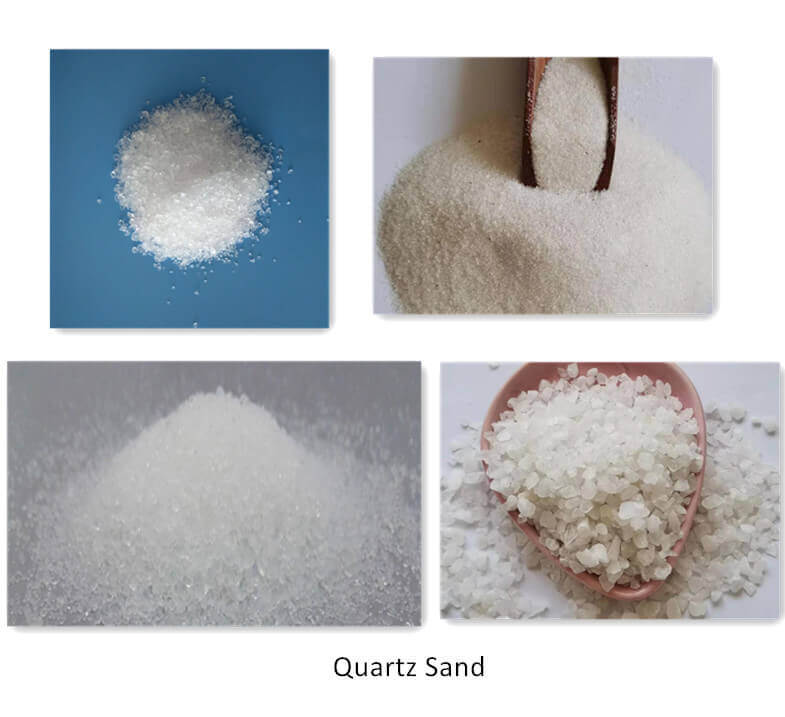
Arena de cuarzo sintético artificial Propiedades físicas
Las propiedades físicas de la arena de cuarzo sintético artificial son similares a las de la arena de cuarzo natural, y tiene las ventajas de buena resistencia a altas temperaturas, resistencia al desgaste, resistencia a la corrosión, alta resistencia a la compresión y buenas propiedades aislantes. Sin embargo, debido a su elevada dureza, dificultad de procesamiento y fácil fragilidad, el campo de aplicación de la arena de cuarzo sintético artificial es relativamente estrecho.
Key Differences from Natural Quartz:
| Característica | Natural Quartz Sand | Artificial Quartz Sand |
|---|---|---|
| Purity | 90-99% SiO₂ | 99-99.99% SiO₂ |
| Impurities | Contains iron, alumina, etc. | Chemically refined for minimal contamination |
| Grain Shape | Irregular, angular | Controlled (spherical, uniform) |
| Color | Often yellowish due to iron | Pure white or custom-tinted |
Artificial Synthetic Quartz Sand Application
Las principales áreas de aplicación de la arena artificial de cuarzo sintético son materiales resistentes al desgaste, materiales para equipos de alta temperatura, la industria química, la metalurgia y la fabricación de otros equipos industriales, materiales de alta resistencia, materiales aislantes, etc,
- En cuanto a materiales resistentes al desgaste, la arena de cuarzo sintético artificial puede utilizarse para fabricar muelas abrasivas, abrasivos, papel de lija, etc.
- En términos de materiales para equipos de alta temperatura, la arena de cuarzo sintético artificial puede utilizarse para fabricar termopares, tubos de termopar, manguitos de termopar, etc.
- In terms of manufacturing equipment in the chemical industry, metallurgy, and other industries, artificial synthetic quartz sand can be used to make acid- and alkali-resistant pipes, acid and alkali-resistant containers, acid and alkali-resistant pumps, etc.
- En cuanto a los materiales de alta resistencia, la arena de cuarzo sintético artificial puede utilizarse para fabricar hormigón de alta resistencia, vidrio de alta resistencia, cerámica de alta resistencia, etc.
- En cuanto a materiales aislantes, la arena de cuarzo sintético artificial puede utilizarse para fabricar cerámica aislante, placas aislantes, tubos aislantes, etc.
Artificial Synthetic Quartz Sand Manufacturing Process
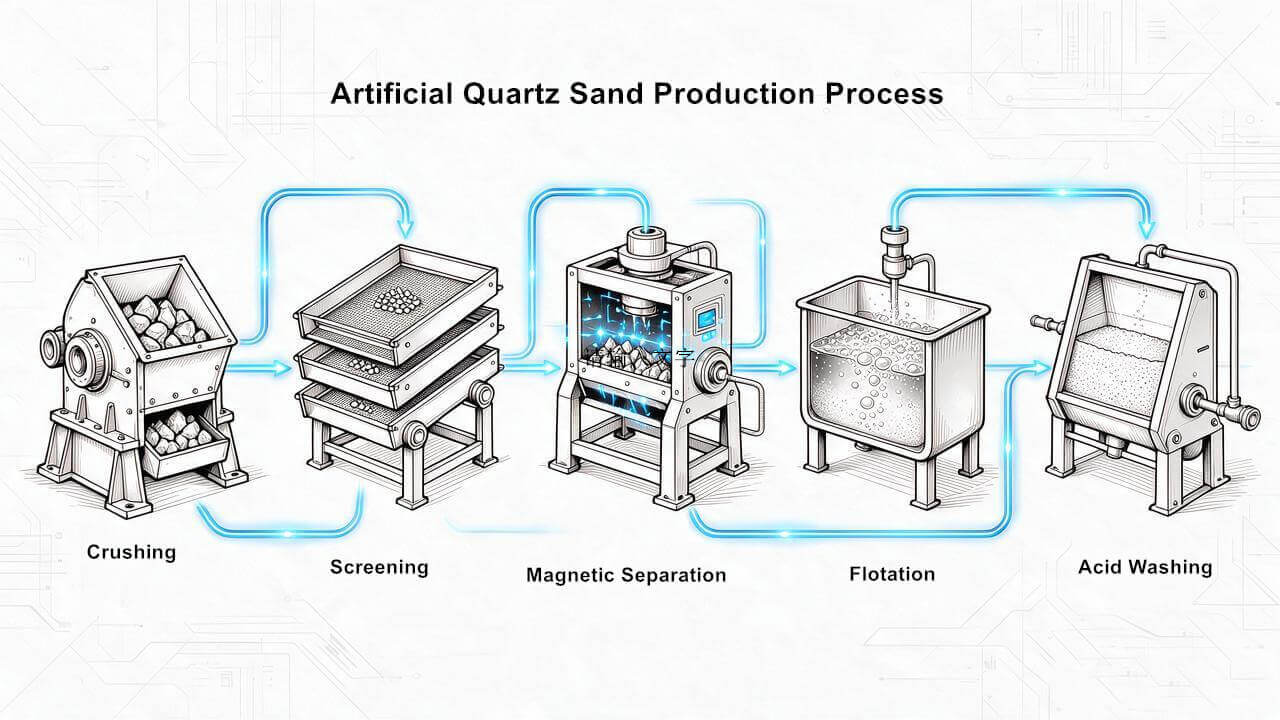
El proceso de fabricación de la arena artificial de cuarzo sintético incluye principalmente trituración, cribado, mezcla, moldeo, secado, sinterizacióny otros procesos.
- Aplastante: En primer lugar, el mineral de cuarzo natural o la arena de cuarzo se tritura hasta obtener partículas de tamaño adecuado para su posterior procesamiento.
- Proyección: Las partículas de cuarzo trituradas se tamizan para eliminar las impurezas y las partículas que no cumplen las especificaciones, lo que garantiza la calidad del producto.
- Mezclando: Las partículas de cuarzo tamizadas se mezclan con resinas, pigmentos y otros aditivos. El proceso de mezcla requiere un control estricto de las proporciones de los ingredientes para garantizar el rendimiento y el aspecto del producto final.
- Moldeado: Los materiales mezclados se introducen en moldes y, a continuación, se compactan para llenarlos y conseguir las formas y tamaños deseados mediante métodos como la vibración o la compresión.
- Secado: Los moldes rellenos suelen someterse a un proceso de secado para eliminar la humedad y favorecer el curado del material. El secado puede realizarse mediante secado natural al aire o utilizando equipos de secado.
- Sinterización: Los moldes rellenos y secos se someten a un proceso de sinterización, en el que se someten a altas temperaturas para curar la resina, unir fuertemente las partículas de cuarzo y formar arena sólida de cuarzo sintético artificial.
Artificial Synthetic Quartz Sand: Current Challenges & Future Potential
Artificial synthetic quartz sand presents a promising alternative to natural quartz sand, boasting superior properties such as high-temperature resistance, wear resistance, corrosion resistance, high compressive strength, and excellent insulation performance. While its physical properties closely resemble natural quartz sand, synthetic quartz offers greater purity and consistency, making it a preferred choice for high-tech industries like semiconductors and advanced materials.
However, despite its advantages, widespread adoption remains in the pilot stage, with key challenges impeding full-scale industry integration.
Key Challenges in Artificial Quartz Sand Adoption
Limited Industrial Maturity
- Synthetic quartz sand is still in the early phases of testing and application, with uncertainties around its performance in downstream processes (e.g., crucible inner layers).
- Su brittleness and processing difficulties must be improved to broaden usability.
Balancing Purity & Performance
- While synthetic sand offers higher purity, excessive purity can reduce temperature resistance, creating trade-offs in industrial applications.
- Not all industries require ultra-high purity, meaning natural sand remains preferable for cost-sensitive uses.
High Production Costs
- Current synthetic sand costs are several times higher than natural quartz, making it economically viable only in high-value applications like semiconductor crucibles.
- Expanding production efficiency is crucial to making it viable for broader industries like photovoltaics.
Future Outlook & Industry Evolution
Despite current limitations, synthetic quartz sand is on an inevitable path toward replacing natural sand in critical sectors, driven by:
- Sustainability & Resource Security – Reducing reliance on finite natural quartz deposits.
- Technological Advancements – Enhancing processing methods to improve hardness and reduce brittleness.
- Cost Optimization – Scaling production to make synthetic sand competitive across more industries.
As R & D progresses, synthetic quartz is expected to unlock new applications in quantum computing, advanced electronics, and high-performance construction materials. However, achieving full-scale commercialization will require overcoming technical and economic barriers.
Conclusion: A Gradual but Inevitable Shift
While synthetic quartz sand cannot yet fully replace natural sand, its superior properties and long-term potential position it as the future standard for high-precision industries. The technology must evolve to enhance durability, reduce costs, and improve manufacturability before achieving widespread adoption.
Looking for tailored synthetic quartz solutions? Contact our experts for advanced material specifications.
ÚLTIMOS PRODUCTOS
-

Inclined Vibrating Screen
The inclined vibrating screen is a simple and eff…
-
High Temperature & Pressure Gold Desorption Electrolysis System
High-Temperature & Pressure Gold Desorption Elect…
-
Normal Temperature & Pressure Gold Desorption Electrolysis System
The normal temperature & pressure gold desorption…


ÚLTIMAS NOTICIAS
- Modern Cyanide Residue Treatment Technologies for Gold Processing
- Traditional De-cyanidation Technologies for Gold Cyanide Residues
- Shaking Table, 3-Disc Dry Magnetic & Electrostatic Separator for W-Sn-Ta-Nb
- Mineral Analysis: The Foundation for Successful Mineral Processing Projects
- What Is Over-Grinding and How Can It Be Prevented?
 English
  French
  Spanish
  Portuguese
  Indonesian