



Introduction to Feldspar: The Essential Industrial Mineral
Feldespato, a group of rock-forming silicate minerals containing potassium (K), sodium (Na), and calcium (Ca), is one of the most abundant minerals in Earth’s crust. Its unique chemical composition makes it indispensable for numerous industrial applications:
Key Components:
- SiO₂
- Al₂O₃
- K₂O
- Na₂O
- CaO
- MgO
This versatile mineral serves as a crucial raw material for:
- Chemical industry
- Abrasives manufacturing
- Glass fiber production
- Electrode fabrication
- Enamel coatings
- Filler applications
Industry Insight: The growing demand for premium glass and ceramic products requires feldspar with exceptionally low iron content (>99% purity). This has driven significant advancements in feldspar beneficiation technologies.
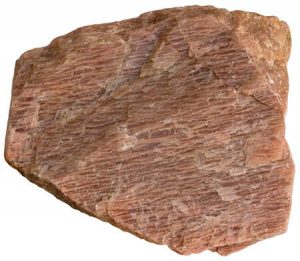
Fuente de la foto: sandatlas.org
Comprehensive Feldspar Processing Workflow
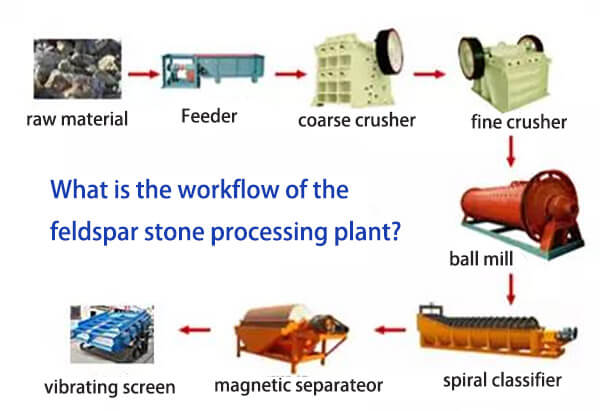
Generally speaking, the feldspar concentrate rich in potassium and sodium is recovered by the combined mineral separation methods of gravity separation, electric separation, magnetic separation, and flotation to remove associated minerals such as cuarzo y mica.
1. Crushing and Grinding
The crushing and grinding of feldspar are not only to meet the grain size requirement of the final product, but also to meet the need of the impurity removal process. The coarse crushing of feldspar mostly adopts a trituradora de mandíbulasy el tamaño de las partículas es de unos 10 mm. Hay muchas opciones de máquinas de trituración y molienda fina de la planta de procesamiento de feldespato, principalmente. roller crusher, impact crusher, máquina para fabricar arena, hammer crusher, stone grinding, column mill, tower mill, Raymond mill, stirring mill, vibration mill, sanding mill, and airflow mill, etc.
At present, feldspar grinding can be divided into molienda en seco y molienda en húmedo; wet type grinding is more efficient than dry type.
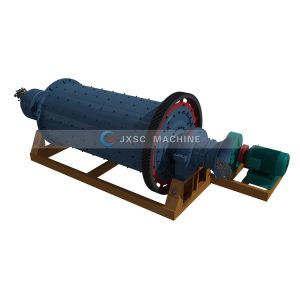
Desde el punto de vista de la industria de aplicación, el procesamiento de materias primas de feldespato en la industria del vidrio adopta principalmente una máquina de molienda de medio de varilla de acero, que tiene una alta eficiencia de molienda y tamaño de partícula uniforme, pero la introducción de la contaminación de hierro conduce a la baja calidad de los productos de feldespato. La industria cerámica tiene mayores requisitos para las materias primas de feldespato, por lo que a menudo se utiliza la molienda de rodillos de piedra o la molienda de bolas de cerámica, que tiene una baja eficiencia de molienda y un alto consumo de energía, y no puede realizar una alta eficiencia y un proceso continuo.
On the basis of ensuring the high quality of feldspar products, how to realize a high efficiency grinding process and continuous production is an important subject in the research of feldspar beneficiation and purification.
2. Ore Washing and Desliming
En ore washing process is suitable for feldspar from weathered granite or sandy feldspar deposits, and is primarily used to remove impurities such as clay, fine silt, and mica. On the one hand, this process reduces the Fe₂O₃ content in the feldspar ore; on the other hand, it increases the potassium and sodium content in the ore.
Common mineral washing equipment includes: Denver washers, cribas vibratorias, trommel washers, agitation tanks, and grinding mills.
The desliming process is primarily used to remove primary slime from the raw ore, as well as secondary slime generated during the grinding process, with the aim of preventing large amounts of fine slime from adversely affecting the separation efficiency of subsequent mineral processing operations such as flotation and magnetic separation.
Common desliming equipment includes: desliming hoppers, centrifugal separators, and hidrociclones.
3. Magnetic Separation
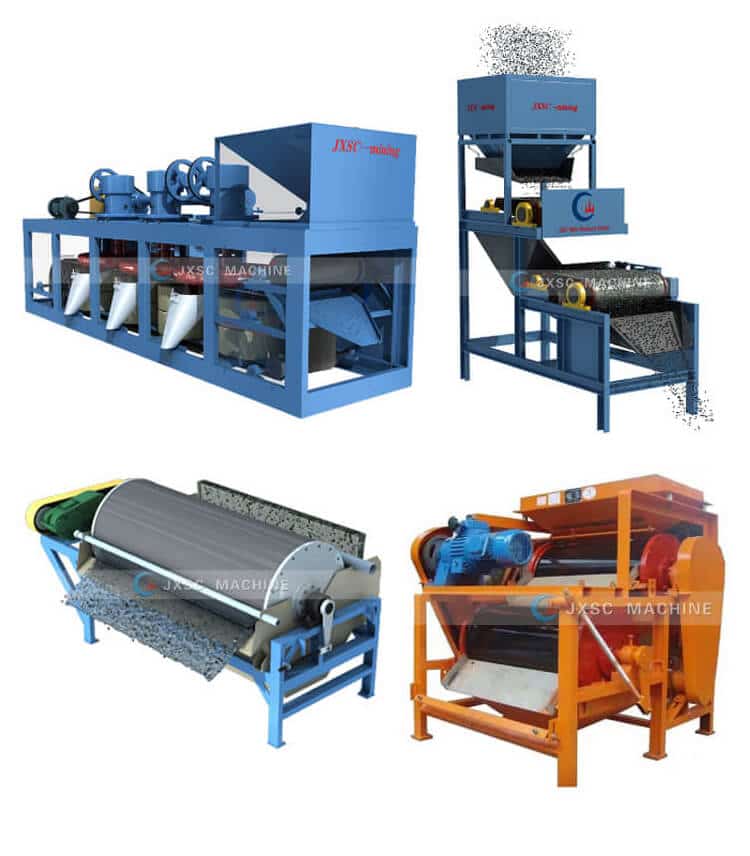
Due to the magnetic properties of iron minerals, mica, and garnet in feldspar ore, it can be separated from feldspar minerals by the external magnetic field. In general, the magnetic properties of iron minerals and mica in feldspar are weak; only by using a high-intensity magnetic separator can a good result be obtained. The main magnetic separator equipment has a permanent magnetic roller type strong magnetic separator, a permanent magnetic drum type medium strong magnetic separator, a wet flat type strong magnetic separator, and a high gradient strong magnetic separator.
-
- Separadores magnéticos de alta intensidad de rodillos magnéticos permanentes
Permanent magnetic roller high-intensity magnetic separators use the rare earth permanent magnetic repulsion magnetic pole principle, with magnetic roller surface magnetic induction up to 2.0 T. It is suitable for dry separation of weakly magnetic minerals, and has become the main magnetic separation equipment for dry iron removal from feldspar in recent years. Particle size lower limit of 0.12mm, good separation effect, low operation cost, and convenient operation. - Permanent magnetic drum-type high-intensity magnetic separator
The magnetic induction of a separate field is between 0.3 t and 0.8 t, and has the dry-type and wet-type processing methods. Due to the weak magnetic field, it is difficult to get high-grade feldspar products. - Wet-type horizontal ring high-intensity magnetic separator
It is the common used strong electromagnetic separator both at home and abroad, its magnetic induction of 1.2 ~1.7 T, great advantages of a wide particle size and high capacity. - Separador magnético de alta intensidad y alto gradiente
The high gradient high-intensity magnetic separator is the most effective equipment for the purification of fine minerals; its magnetic induction can reach 2.0 t, even 5.0 t, and it can purify 74 m of feldspar. It is definitely an effective machine for dressing high-grade feldspar products, but the equipment cost and operation cost are higher than those of other magnetic separators.
- Separadores magnéticos de alta intensidad de rodillos magnéticos permanentes
4. Flotación
Flotación is an effective way to remove impurities in feldspar. On the one hand, the impurity elements such as iron and titanium can be removed from feldspar; the combination of chemical agents depends on the existing impurity components. On the other hand, the feldspar can be separated from the quartz, thus increasing the content of K and Na.
En la actualidad, existen numerosos estudios sobre la separación del feldespato y el cuarzo, así como sobre la separación selectiva del feldespato potásico y la albita.
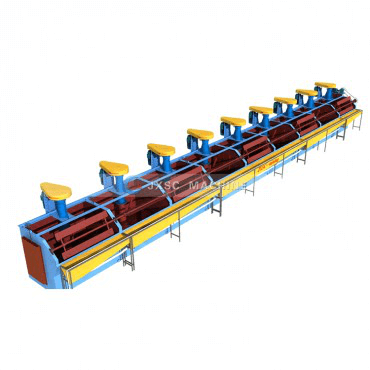
- Flotación de minerales con Ti
The results show that titanium mainly exists in rutile (or Anatase) and a small amount of sphene. Using fatty acids as collectors, rutile (or Anatase) can be floated out in the pH4-6, but its floatability decreases in the following order: oleic, linoleic acid, linolenic acid.
Using Petroleum sulfonate or aliphatic primary amine acetate, rutile (or anatase) can also be floated at pH 2.5. At present, only a few pieces of literature have described the floatation performance of sphene. - Flotación de ganga ferruginosa
In general, iron in feldspar minerals occurs mainly in mica, pyrite, a small amount of hematite, and iron-bearing alkali silicates (such as garnet, tourmaline, and amphibole). In general, mica can be floated by amine cation collector at PH 2.5 ~ 3.5; sulfide minerals such as pyrite can be floated by xanthate collector at PH 5 ~ 6; Iron-bearing silicates can be obtained by flotation with sulphonate collectors at pH 3 ~ 4. - Separación por flotación de cuarzo-feldespato
El método de separación por flotación comercial del cuarzo-feldespato es el método del ácido HF. Teniendo en cuenta la protección del medio ambiente, la mayoría de los trabajadores de minerales prefieren el método del ácido libre de flúor. - Separación por flotación de feldespato potásico y albita
The separation of potash feldspar (orthoclase and microcline) and albite is a challenging issue because they are mostly mixed in feldspar deposits, and these minerals have similar chemical structures and similar physical chemistry properties.
Future Trends in Feldspar Processing
En la actualidad, es fácil obtener concentrado de alto grado en el proceso combinado, y resulta económico y eficaz pretratar el mineral de feldespato con alto contenido en hierro mediante lixiviación ácida y decapado.
1. Acid/Bio Leaching
Es difícil eliminar los minerales ferruginosos de las partículas ultrafinas de feldespato por métodos tradicionales, pero la lixiviación puede lograr mejores resultados. El reactivo de lixiviación de feldespato no solo es beneficioso para la descomposición del feldespato, sino que también puede eliminar eficazmente los minerales de hierro intercalados en la superficie del feldespato.
La lixiviación biológica presenta las ventajas de un funcionamiento sencillo y una baja contaminación ambiental.
2. Combined Processes
For certain feldspar ores that are extremely difficult to process and have high iron content (where some iron-bearing minerals have already infiltrated the cleavage planes of the feldspar), a single processing method is often insufficient to meet the quality requirements for the concentrate. Therefore, it is necessary to introduce a multi-stage combined processing method as appropriate.
(1) Magnetic Separation-Flotation Combined Process Flow
In this process, magnetic separation is first used to remove most of the iron-bearing minerals, followed by flotation to remove residual fine-grained iron-bearing minerals and potassium feldspar stained by iron. Although the “dry magnetic separation followed by flotation” combination yields the best separation results, the subsequent dewatering and drying required after dry magnetic separation result in higher costs; therefore, the “wet magnetic separation followed by flotation” process is more widely used in practice.
(2) Combination Process of Abrasion and High-Intensity Magnetic Separation
If the feldspar ore is relatively soft and easily crushed, it can be fed into a grinding mill to remove the iron-bearing substances entrained in the mica minerals. Beneficiation results indicate that the combined abrasion and high-intensity magnetic separation process can significantly improve separation efficiency; furthermore, its processing costs are lower than those of the magnetic separation-flotation combination process.
Conclusion: Maximizing Feldspar Value Through Advanced Processing
Modern feldspar beneficiation combines mechanical, magnetic, and chemical processes to meet increasingly stringent industry requirements. Successful operations must balance:
- Process efficiency
- Product quality
- Environmental compliance
- Economic viability
Our mineral processing experts specialize in developing customized feldspar solutions featuring:
Tailored equipment selection
Process flow optimization
Quality control systems
Cost-effective operations
Get Expert Consultation: Póngase en contacto con nosotros today for a deposit-specific technical evaluation and processing recommendation.
ÚLTIMOS PRODUCTOS
-

Inclined Vibrating Screen
The inclined vibrating screen is a simple and eff…
-
High Temperature & Pressure Gold Desorption Electrolysis System
High-Temperature & Pressure Gold Desorption Elect…
-
Normal Temperature & Pressure Gold Desorption Electrolysis System
The normal temperature & pressure gold desorption…


ÚLTIMAS NOTICIAS
- Modern Cyanide Residue Treatment Technologies for Gold Processing
- Traditional De-cyanidation Technologies for Gold Cyanide Residues
- Shaking Table, 3-Disc Dry Magnetic & Electrostatic Separator for W-Sn-Ta-Nb
- Mineral Analysis: The Foundation for Successful Mineral Processing Projects
- What Is Over-Grinding and How Can It Be Prevented?
 English
  French
  Spanish
  Portuguese
  Indonesian