



Titanium dioxide (TiO2), commonly known as titanium white, is one of the most widely used white pigments in industries ranging from paints and coatings to plastics, paper, and cosmetics. As global demand continues to rise, manufacturers are increasingly focused on optimizing production processes to improve efficiency, reduce environmental impact, and enhance product quality. This article explores both conventional and emerging technologies in titanium dioxide manufacturing, highlighting key advancements shaping the future of this essential industrial material.
Titanium Dioxide Production Process Technology
1. Overview of Existing Processes
In titanium dioxide production, the primary titanium ore raw materials used include rock ores and sand ores. These materials undergo a series of mineral processing steps—such as gravity separation, magnetic separation, and electrostatic separation—to refine them into high-titanium slag. Subsequently, through advanced processing steps like iron reduction and chemical treatment, the final product is synthetic rutile, a key intermediate in titanium dioxide manufacturing.
◆ Sulfuric Acid Process
The history of titanium dioxide production via the sulfuric acid process dates back to 1918. Today, sulfuric acid-based titanium dioxide rivals chloride-process titanium dioxide in product quality and is favored for its ability to cost-effectively produce anatase titanium dioxide. In Europe, up to 70% of titanium dioxide production employs the sulfuric acid process. The following is a process flow diagram for sulfuric acid-based titanium dioxide production:
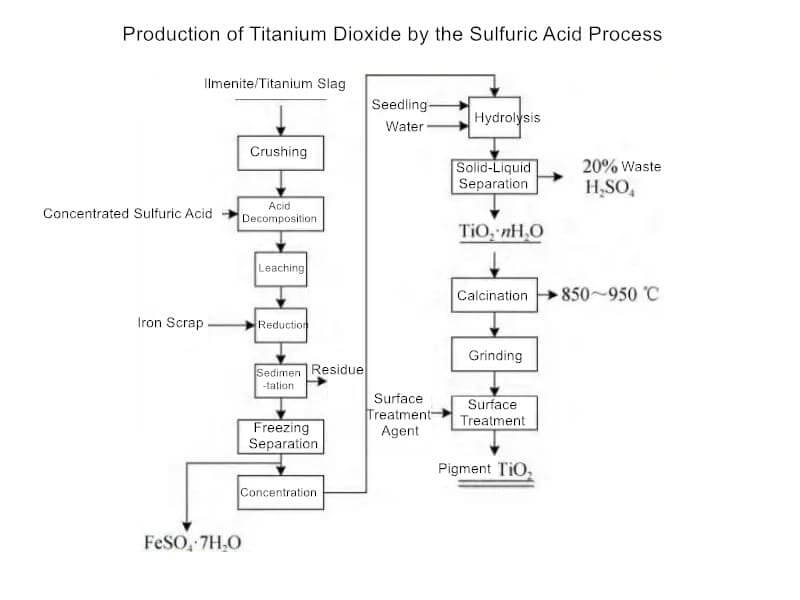
The modern advanced sulfuric acid processes have achieved effective treatment and recycling of waste acid, waste gas, and wastewater.
◆ Chlorination Process
Advanced chlorination processes have comprehensively optimized chlorine recycling and waste treatment. When producing titanium dioxide from rutile ore, recovery rates typically reach 93% to 95%. while using a mixed ore of titanium concentrate and ilmenite yields a recovery rate of approximately 90%. Notably, the recovery rate of titanium dioxide from titanium slag exceeds that from rutile, primarily because both slag and natural rutile possess larger particle sizes, resulting in less fine powder being carried away during chlorination. To address this issue, researchers have developed a novel circulating fluidized bed chlorination reactor.
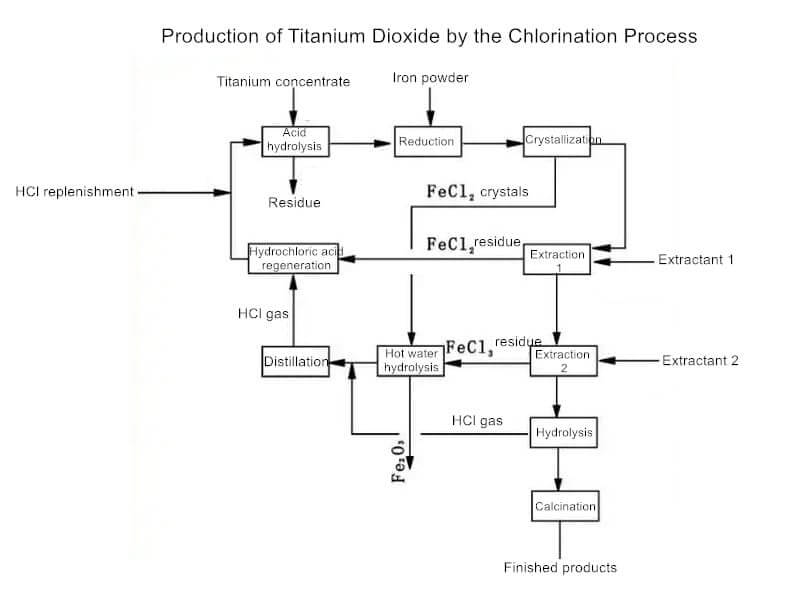
The chlorination process comprises three primary stages: chlorination, oxidation, and post-treatment. This method is regarded as the future direction for titanium dioxide production technology. The entire titanium dioxide production process using this method can be divided into three key segments: the chlorination stage, the oxidation stage, and the post-treatment section.
During the chlorination stage, high-purity coke is mixed with ore and reacts chemically with chlorine gas at high temperatures to produce titanium chloride containing significant impurities—namely, crude TiCl₄. Subsequently, chemical treatment agents or distillation methods are employed to refine the crude TiCl₄, removing various ions such as chromium, manganese, iron, and vanadium. The refined titanium tetrachloride requires further oxidation to convert into titanium dioxide. Finally, the reaction product is quenched with low-temperature circulating chlorine gas to extract titanium dioxide from the gas. This is followed by dechlorination to obtain pure titanium dioxide.
2. New Production Process
◆ REPTILE Process
The REPTILE process is an innovative titanium dioxide production method that incorporates chlorination. It partially chlorinates iron in titanium concentrate to form ferric chloride, which then undergoes oxidation to yield iron oxide and chlorine gas. The generated chlorine gas is recycled back into the chlorination system for reuse. This process simultaneously yields rutile and iron oxide products during raw material processing.
◆ ERMSSR Process
The ERMSSR process, meticulously developed and successfully demonstrated in industrial trials by Australia’s AUSTPAC, represents an innovative acid-cycle, zero-waste method for producing synthetic rutile. The rutile produced by this process exhibits exceptional particle fineness, comparable to natural rutile. The entire process comprises two key components: first, the roasting and magnetic separation of ilmenite, abbreviated as ERMS; second, the waste acid recovery system, known as EARS.
◆ Altair Hydrochloric Acid Process
The Altair hydrochloric acid process for titanium dioxide production offers multiple advantages, enabling the manufacture of both rutile and anatase titanium dioxide, as well as the further preparation of nano-sized titanium dioxide. During production, ferrous chloride separated after cooling and crystallization undergoes pyrolysis to convert into solid iron oxide. The generated hydrogen chloride gas and water vapor are recovered and reintroduced into the initial decomposition process, achieving a closed-loop circulation of hydrochloric acid. The only byproduct of this process is iron oxide slag, which requires no deep-well disposal and can be directly used as raw material for steel or other iron-based products, thereby reducing production costs. Additionally, this process features low titanium raw material costs, reduced energy consumption, simplified process conditions, and flexible production capabilities.
◆ Alkali Leaching Process
The alkali leaching process involves roasting ilmenite with alkali at high temperatures between 850 and 875°C, followed by extraction using organic acids to effectively remove impurities. After this series of steps, synthetic rutile is obtained. In the chlorination process for producing titanium dioxide, this material consumes only one-twentieth of the chlorine required by traditional methods. Notably, several Chinese research institutions have conducted in-depth studies on the alkali fusion process.
- Titanium ore reacts with NaOH molten salt at high temperatures to form Na₂TiO₃ and water:
2Ti₃O₅ + 12NaOH + O₂ → 6Na₂TiO₃ + 6H₂O - After leaching and washing the reaction product, excess Na⁺ in Na₂TiO₃ undergoes ion exchange with H⁺ in water. Part of the Na⁺ enters the liquid phase, forming an alkaline solution of a certain concentration.
- The washed solid phase (x Na₂O·TiO₂·y H₂O) reacts with sulfuric acid to form a titanium oxosulfate solution, as follows:
x Na₂O·TiO₂·y H₂O + (x+1) H₂SO₄ → TiOSO₄ + x Na₂SO₄ + (x+y+1) H₂O - The titanium oxosulfate solution obtained from the above reaction undergoes further hydrolysis via the sulfuric acid process to produce metatitanate. Subsequently, following the downstream sulfuric acid process flow, the metatitanate is processed into rutile or anatase titanium dioxide products according to the reaction: TiOSO₄ + 2H₂O = H₂TiO₃↓ + H₂SO₄.
However, this process faces two major challenges: first, effectively removing impurities from titanium-containing feedstock; second, reducing energy consumption. Currently, the alkali raw material used primarily originates from electrolytic caustic soda, but this method has several drawbacks.
- Energy consumption is particularly prominent during product manufacturing.
- Concentrating a dilute alkali solution also requires substantial energy.
- The process generates a dilute sodium sulfate solution, whose treatment and utilization pose significant challenges.
- The production of concentrated waste acid (approximately 20%–25% concentration) remains unresolved, further exacerbating environmental burdens.
These unfavorable factors collectively constrain the broader adoption and application of the alkali fusion method.
Conclusión
The titanium dioxide industry is undergoing a significant transformation as it balances growing market demand with environmental sustainability. While traditional methods like the sulfate and chloride processes remain dominant, innovative techniques such as REPTILE, ERMS-SR, and Altair’s hydrochloric acid process demonstrate promising potential for reduced energy consumption and waste generation. As research progresses, the adoption of these new technologies may redefine industry standards, offering more sustainable production pathways without compromising product quality. The evolution of titanium dioxide manufacturing continues to be an exciting field where chemistry, engineering, and environmental responsibility converge.
ÚLTIMOS PRODUCTOS
-

Inclined Vibrating Screen
The inclined vibrating screen is a simple and eff…
-
High Temperature & Pressure Gold Desorption Electrolysis System
High-Temperature & Pressure Gold Desorption Elect…
-
Normal Temperature & Pressure Gold Desorption Electrolysis System
The normal temperature & pressure gold desorption…


ÚLTIMAS NOTICIAS
- Modern Cyanide Residue Treatment Technologies for Gold Processing
- Traditional De-cyanidation Technologies for Gold Cyanide Residues
- Shaking Table, 3-Disc Dry Magnetic & Electrostatic Separator for W-Sn-Ta-Nb
- Mineral Analysis: The Foundation for Successful Mineral Processing Projects
- What Is Over-Grinding and How Can It Be Prevented?
 English
  French
  Spanish
  Portuguese
  Indonesian