



Fluorite, a vital industrial mineral, is categorized into four ore types based on gangue mineral composition. Each type requires tailored beneficiation methods to maximize fluorite recovery and purity.
Fluorite Ore Type
Los diferentes minerales de ganga pueden dividir el mineral de fluorita en cuatro tipos:
- Mineral de fluorita de tipo cuarzo
- Mineral de fluorita de tipo carbonatado
- Mineral de fluorita tipo barita
- Mineral de fluorita sulfurada
(1) Mineral de fluorita de tipo cuarzo: Los principales minerales son la fluorita y cuarzoy el contenido de fluorita puede alcanzar de 80% a 90%. Contiene una pequeña cantidad de calcita, barita y sulfuro.
(2) Carbonate-type fluorite ore: The main minerals are fluorite and calcite. The content of calcite can reach more than 30%, and there is a small amount of quartz, sometimes composed of quartz, calcite, and fluorite-type ore.
(3) Mineral de fluorita de tipo barita: The main minerals are barite and fluorite, and the barite content reaches 10% to 40%. It often accompanies this type of ore with pyrite, galena, sphalerite, and other sulfides, and sometimes the range of quartz increases, forming a quartz-barite-fluorite type ore.
(4) Mineral de fluorita de tipo sulfuro: Su composición mineral es la misma que la de la cuarzo-fluorita, pero contiene más sulfuros metálicos, y a veces el contenido de plomo y zinc puede alcanzar grados industriales.
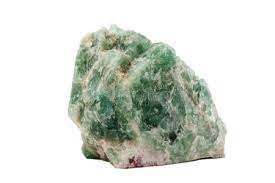
¿Cómo beneficiar el mineral de fluorita?
En la actualidad, utiliza principalmente el método de flotación para el beneficio y la purificación de fluorita en el país y en el extranjero.
1. Cuarzo-Fluorita
Quartz-type fluorite ore is mainly composed of fluorite (about 85%) y quartz, with only a small amount of calcite, barite, and sulfide.
La clave de la selección es principalmente reducir el silicio en los concentrados.
To separate quartz from fluorite, it is necessary to dissociate the quartz and fluorite monomers through grinding, so grinding is an essential factor affecting the flotation of quartz-type fluorite. If the grinding particle size is too coarse, the conjoined body of quartz and fluorite exists in the product, making the rough concentrate after flotation too high. If the grinding particle size is too fine, although it dissociates the quartz and fluorite individually, it will lead to excessive fluorite crushing in the grinding product and reduce the recovery rate of fluorite.
The most reasonable method is to use a stage grinding process, which can reduce the silicon content in the fluorite concentrate after flotation and increase the fluorite concentrate’s recovery rate.
This type of fluorite ore can be divided into two kinds, coarse-grained and fine-grained, according to the inlaid characteristics of valuable minerals.
- La fluorita incrustada de grano grueso es fácil de seleccionar. Se utiliza el colector de tipo ácido graso, el ajustador de lodos es carbonato sódico y el inhibidor de cuarzo es vidrio al agua. Puede obtener concentrado de fluorita de alta calidad mediante un proceso grueso y multifino.
- The flotation reagents of the fine-grained embedded quartz-type fluorite ore are the same as those of the coarse-grained embedded quartz-type fluorite ore. Still, due to the small embedded particle size of the target minerals, it is necessary to strengthen the grinding and use a stage grinding stage for the separation process flow.
Quartz-type Fluorite Beneficiation
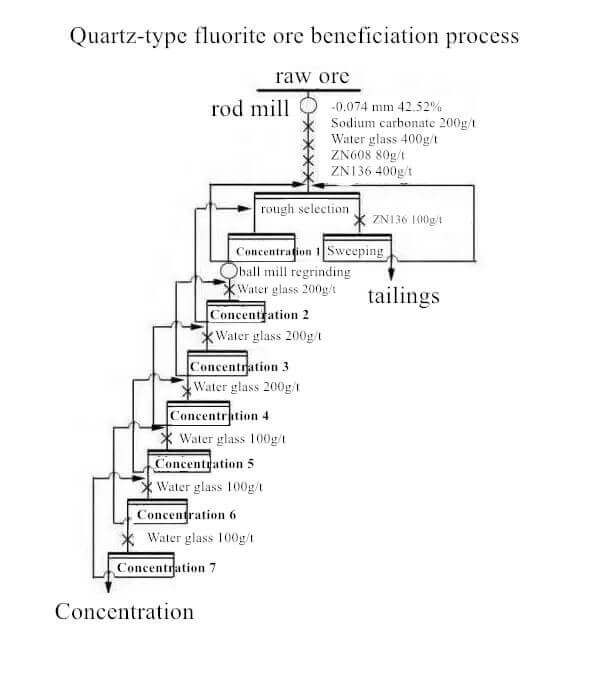
Quartz-type low-grade fluorite ore: the main recoverable mineral is fluorite with a grade of 30%, and the main gangue mineral is quartz, followed by calcite, feldspar, mica, etc.
Parámetros del proceso: rough dressing and grinding fineness is -200 mesh(accounting for 42.52%). It uses water glass + ZN608 as an inhibitor and fluorite low-temperature collector ZN136 as a collector. It uses one coarse, one sweep, and seven fine. One-stage concentrate regrinding and middling return to a closed-circuit process that can obtain fluorite concentrate with a CaF2 grade of 97.45% and a recovery rate of 92.71%.
Fine-grained Embedded Quartz-type Fluorite Ore Beneficiation
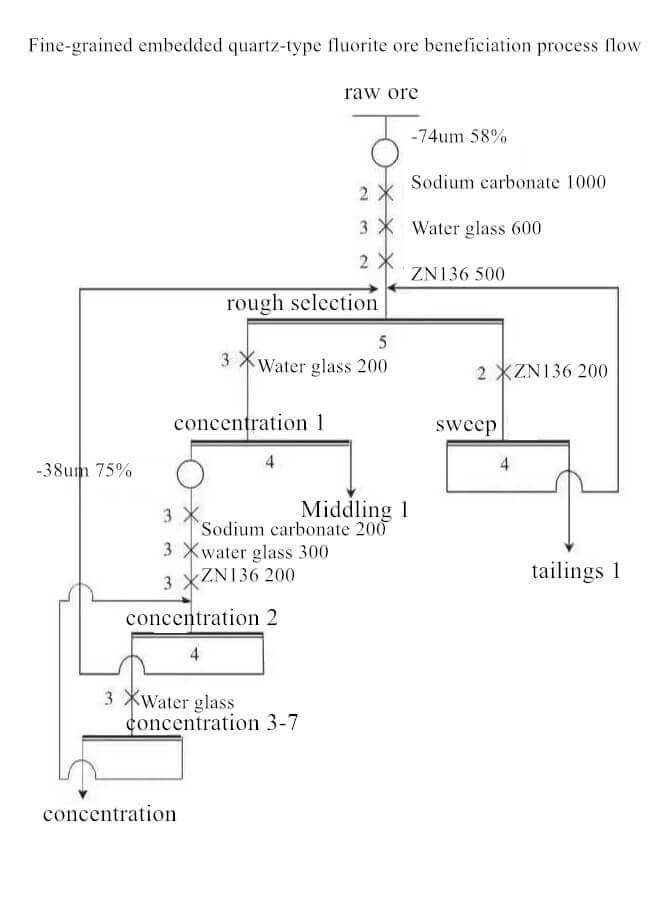
El mineral de fluorita de tipo cuarzo con incrustaciones de grano fino tiene un contenido de fluorita de 32,75%. La relación de incrustación entre la fluorita y el cuarzo en el mineral es compleja, y la granularidad de la incrustación es pequeña. Se requiere una molienda fina para disociar los monómeros de fluorita y cuarzo.
Parámetros del proceso
La investigación experimental adopta el proceso de un desbaste, un barrido y siete beneficiamientos.
One-stage middling cast tails directly; flotation concentrate of one-stage concentrate regrind and refloat. It uses the self-developed ZN136 as the fluorite low-temperature flotation collector. Under the condition that the slurry temperature is 5~10℃, the beneficiation index obtained by the laboratory is the fluorite feed CaF2 32.52%, the concentrate CaF2 97.55%, and SiO2 1.36%; the fluorite recovery rate is 76.67%. Under the slurry temperature of 5℃, the industrial production index is fluorite feeding CaF2 30.14%, concentrate CaF2 97.37%, SiO2 0.81%, fluorite recovery rate 89.67 %.
2. Calcita-fluorita
Calcite-type fluorite ore is mainly composed of fluorite and calcite (content up to 30% or more), with a small amount of quartz, which can form quartz-calcite-fluorite-type ore.
La principal razón por la que los minerales de fluorita de tipo calcita son difíciles de separar es que tanto la calcita como la fluorita son minerales que contienen calcio con propiedades físicas y químicas superficiales similares.
Both fluorite and calcite are calcium-containing minerals, and their solubility is similar. Therefore, the flotation separation of such ores is difficult. The selection of suitable collectors and inhibitors is the key to achieving the separation of fluorite from calcite. At the same time, proper process flow and process conditions are also essential factors in improving the flotation index. Combined and new agents are widely used in sorting this type of fluorite ore.
To achieve the separation of calcite and fluorite, the pH value of the slurry and use a collector to achieve a good separation effect. Water glass, salted water glass, acidified water glass, sodium hexametaphosphate, lignosulfonate, dextrin, tannin, and calcium carbonate special inhibitor ZN608 can be used. They can use them alone or in combination to inhibit calcite for separation purposes.
3. Barita-fluorita
The main minerals of barite-type fluorite ore are barite and fluorite, and the barite content is 10% to 40%. It often accompanies this ore with pyrite, galena, sphalerite, and other sulfide minerals.
The difficulty in beneficiation of barite-type fluorite ore is that the floatability of barite and fluorite is similar, which makes it difficult to separate the two.
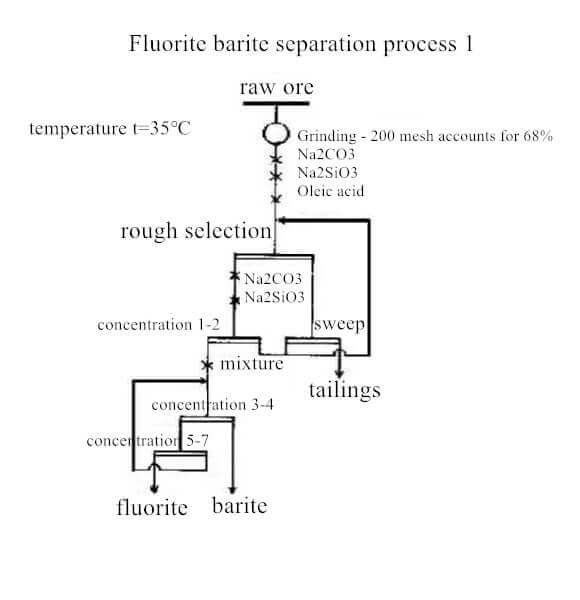
Mixing flotation and Na2CO3 adjusts the slurry’s pH value in the flotation of barite-type fluorite ore. It uses oleic acid and water glass as collectors and inhibitors to obtain fluorite and barite. The concentrate is mixed and uses flotation to separate barite and fluorite.
The flotation separation process of barite-type fluorite ore is divided into two types: inhibiting barite from floating out of fluorite and inhibiting fluorite from floating out of barite. The key to flotation separation of barite and fluorite lies in the choice of inhibitor.
Uso de inhibidores combinados 1
Utilizando ácido oleico como colector, dextrina + cloruro férrico como inhibidor combinado de barita, mediante un proceso de flotación de 1 barrido grueso y siete finos, se puede obtener el concentrado de fluorita con un grado de CaF2 de 97,87% y una tasa de recuperación de 79,26%, concentrado de barita con un grado de BaSO4 de 94,62% y una tasa de recuperación de 72,53%.
Uso de inhibidores combinados 2
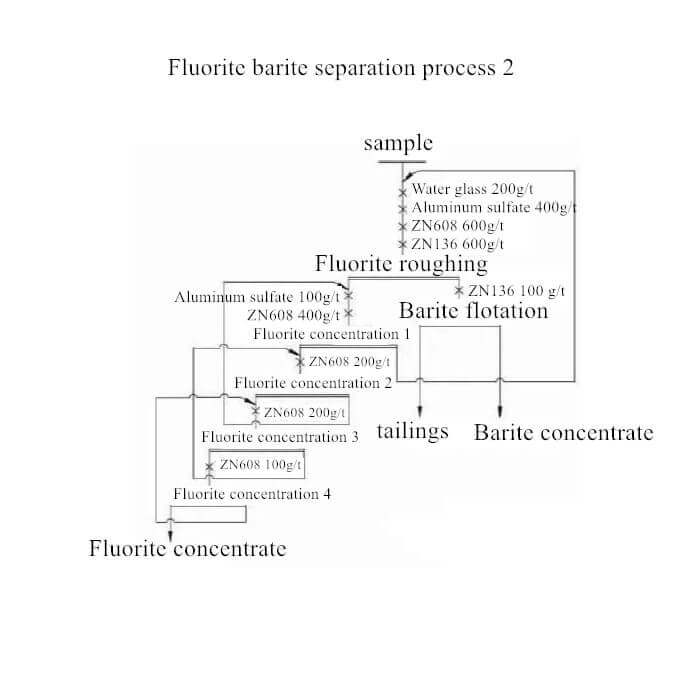
El ZN608 puede inhibir selectivamente la barita, y el vidrio al agua puede inhibir selectivamente el cuarzo y mejorar la dispersidad de la pulpa. El sulfato de aluminio no sólo puede ayudar a inhibir la barita, sino también debilitar el efecto inhibidor del vidrio al agua sobre la fluorita. Para lograr el propósito de inhibir la barita y el cuarzo al mismo tiempo.
Parámetros del proceso: The mixed concentrate was treated with one coarse, four refined, one sweep, and selected medium ore returning to the process. It can obtain the fluorite concentrate with a CaF2 grade of 97.21%, a recovery rate of 85.44%, and a BaSO4 grade of 94.36%, and the barite concentrate with a rate of 86.75% and a density of 4.25 g/cm3 has achieved high-efficiency separation of fluorite and barite.
4. Beneficio de mineral de fluorita sulfurada
La composición del mineral de fluorita de tipo sulfuro es similar a la del mineral de fluorita de tipo cuarzo. Sin embargo, el contenido de sulfuro metálico es mayor, y a veces el contenido de plomo y zinc puede alcanzar el grado industrial. Por lo tanto, a la hora de desarrollar y utilizar la fluorita, también debemos tener en cuenta la recuperación del mineral metálico.
Las minas de fluorita de tipo mineral de sulfuro utilizan generalmente colectores de mineral de sulfuro para seleccionar preferentemente los minerales de sulfuro metálico y, a continuación, utilizan colectores de ácidos grasos para recuperar la fluorita de los relaves de flotación. Además, también se pueden utilizar procesos como la tostación y la lixiviación para extraer metales valiosos y descomponer la fluorita. El flujo del proceso es relativamente sencillo, y se pueden preparar productos de fluorita de alta calidad a la vez que se reciclan exhaustivamente los metales valiosos.
Resumen
Fluorite ore is classified into four types based on gangue mineral composition: quartz-type, carbonate-type, barite-type, and sulfide-type, each requiring tailored beneficiation approaches. Quartz-type fluorite focuses on silicon reduction through staged grinding and selective inhibitors, while carbonate-type demands precise pH control and specialized reagents to separate calcite. Barite-type fluorite relies on combined inhibitors like dextrin-ferric chloride or ZN608 for efficient separation from barite. Sulfide-type fluorite prioritizes sequential flotation to recover metals before fluorite extraction. Across all types, optimizing grinding, reagent selection, and process flow ensures high-purity fluorite concentrates with maximal recovery, highlighting the importance of ore-specific strategies in industrial mineral processing.
ÚLTIMOS PRODUCTOS
-

Inclined Vibrating Screen
The inclined vibrating screen is a simple and eff…
-
High Temperature & Pressure Gold Desorption Electrolysis System
High-Temperature & Pressure Gold Desorption Elect…
-
Normal Temperature & Pressure Gold Desorption Electrolysis System
The normal temperature & pressure gold desorption…


ÚLTIMAS NOTICIAS
- Modern Cyanide Residue Treatment Technologies for Gold Processing
- Traditional De-cyanidation Technologies for Gold Cyanide Residues
- Shaking Table, 3-Disc Dry Magnetic & Electrostatic Separator for W-Sn-Ta-Nb
- Mineral Analysis: The Foundation for Successful Mineral Processing Projects
- What Is Over-Grinding and How Can It Be Prevented?
 English
  French
  Spanish
  Portuguese
  Indonesian